Nuck fan from 1970 no matter score, humanist, hope I do right things, understand/respect/accept all, sacrifice now for better future.🇨🇦 Follow ≠ endorsement.
🧵1/3 My fellow Canadians, in Netflix podcast "We're Back with Brian Williams", is a great episode interview with @neiltyson. From it we can see a great parallel to the inflexion point for Canada that is Davos & what he says should resonate for what/why @MarkJCarney is doing.
Elon Musk said on X on 16th November that Tesla "may start trials next month" for owners sending their own cars out as robotaxis.
On 21st October, a Tesla executive put the first customer cars in its Robotaxi fleet at about the second quarter of 2027.
Elon’s full reply read: "Coming soon. If things well, may start trials next month. Much better to manage a fleet of cars than have to drive just one car by yourself!" It named no city, no owner terms and no fare split.
Tesla has described the mechanics before.
Its Master Plan, Part Deux of July 2016 said owners would add a car to "the Tesla shared fleet just by tapping a button on the Tesla phone app" once regulators approve true self-driving. At Autonomy Day on 22nd April 2019, Elon said Tesla would keep 25 to 30 percent of the revenue, per TechCrunch. The owner keeps the rest.
Ashok Elluswamy, Tesla's artificial intelligence software chief, gave the catch on the 21st October earnings call. Customer cars must sit inside "the geofences and the fleet management that Tesla has" before they drive themselves. Tesla dispatches, the owner supplies the car.
The idle car is the prize. Elon said at the We, Robot event on 10th October 2024 that the average car "is only used about 10 hours a week out of 168 hours."
Elon pitched fleets at that same event. A ride-hail driver today could "manage, I don't know, 10, 20 cars" and look after them "like a shepherd" with a flock. On 3rd September 2026 Tesla opened an interest form listing Cybercab fleet purchasing, per TechCrunch. No fleet sale terms are public.
Measured today, the network is still Tesla's own. Tesla's safety report counts 3.1 million miles with no safety monitor aboard through 18th October, in Texas and Florida. In California, the Department of Motor Vehicles lists Tesla only as a holder of a testing permit with a safety driver.
Costs sit with the owner. The first personal Cybercabs list at $29,990 plus a $299 monthly Autonomy Subscription. Tesla's terms bar Robotaxi, ride-hail, delivery and rental use without its written authorization, and leave insurance, registration, charging, parking and cleaning to the owner.
Charging still takes a human. A Tesla employee was filmed plugging in driverless robotaxis at an Austin Supercharger. Permit drawings for a Tesla Robotaxi hub in Austin show 48 V4 Supercharger stalls, with equipment to support 80 wireless chargers in a second phase.
The model is the contrast. Waymo, owned by Alphabet, buys its own cars and runs about 4,000 of them in 15 American cities for about 500,000 paid rides a week, per TechCrunch. Alphabet's Other Bets unit, which holds Waymo, lost $2.047 billion in the third quarter. Uber owns no cars and expects about 700 driverless vehicles on its app by year end.
Uber Chief Executive Dara Khosrowshahi said in April that once camera-only Teslas are proven safe, "we'd love to have those Teslas on our platform." No Tesla and Uber deal has been announced so far. Owner-supplied cars would let Tesla grow a fleet without paying for every car.
The scale target is in Elon's pay package. One of its 12 operational milestones is 1 million Robotaxis in commercial operation, next to 10 million active Full Self-Driving subscriptions and 1 million bots, per Tesla's third-quarter filing.
The record cuts both ways. In April 2019 Elon said "next year for sure, we'll have over a million robotaxis on the road." Paid rides began in Austin on 22nd June 2025 with a safety monitor aboard, and Tesla counts rides with none from 22nd January 2026. Cybercab production began in April 2026.
My call, about 70 percent, is that no car owned by anyone other than Tesla carries a paying Robotaxi rider by 31st December 2026. I am wrong if Tesla says one did.
BREAKING: The US Departments of Commerce and Justice said on 16th November that Commerce opened an export control probe into Megaspeed back in 2024. Nvidia put the Singapore firm on its "no sell" list in June 2025. Justice now leads a criminal investigation. No charges were announced.
In Singapore, The New York Times reported on 9th October 2025 that just 2 employees were present in Megaspeed's office on a weekday, beside clusters of empty desks.
The Straits Times found the same Megaspeed office locked, with no sign of activity, the next day.
The address on shipping records for its Malaysian unit, Speedmatrix, led the Times to a run-down storefront outside Kuala Lumpur under a construction company's sign. The storefront was empty when a Times reporter went there in late September 2025.
Trade records the Times cited put Speedmatrix's purchases from June 2024 to February 2026 at $4.8 billion or more of advanced artificial intelligence (AI) hardware, Nvidia systems among it.
The statement adds dates.
Commerce investigators asked Nvidia in May 2025 for records of its direct and indirect sales to Megaspeed. Agents of the Bureau of Industry and Security (BIS) and Singapore law enforcement then ran an on-site check in June 2025 at Megaspeed, questioning Alice Huang, its chief executive at the time.
In the same month, on 21st May 2025, Nvidia's then chief executive Jensen Huang said of the Biden-era chip curbs, "All in all, the export control was a failure."
The statement leaves 3 things out.
Bloomberg reported that Megaspeed brought in 17,544 or more Nvidia GB300 processors in November 2025, worth about $787 million, citing Malaysian trade records.
That is 5 months after the no-sell date. The statement does not say how they arrived.
The Times reported on 9th November that the case moved to the Justice Department after Nvidia's general counsel emailed Commerce investigators in August 2025, citing permission from a senior Commerce official. The Times said the move was meant to avoid any compromise of the case. The statement places the handoff after the June check and does not mention the email. Commerce told the Times it acted "strictly by the book."
Treasury Secretary Scott Bessent said on 13th November that Treasury, War, State and the US Trade Representative favoured listing Megaspeed "for months, but Commerce has the pen." The statement never mentions the Entity List. BIS has published no Entity List additions in more than 13 months, since 9th October 2025, per the Federal Register. On 16th November it filed a different tool, a licence rule for advanced chips shipped to Singapore, Malaysia, Indonesia, Thailand and Brazil.
Singapore says that June 2025 check was the first time it learned of US interest in Megaspeed. Its repeated requests to the Justice Department and the Federal Bureau of Investigation for help with a US server supplier have drawn "limited information or assistance." It found insufficient evidence that Alice Huang committed offences over the import declarations it was probing. Megaspeed says it "conducts legitimate and lawful business."
The statement credits Commerce Secretary Howard Lutnick and Attorney General Todd Blanche, and says 17 defendants across 6 investigations have been charged under President Trump over alleged chip smuggling. It names none of them. Lutnick has agreed to testify to the Senate Banking Committee on 10th December, per CBS News, citing a US official.
My call, about 75 percent, is that Megaspeed is not added to the Entity List by 31st December 2026. I am wrong if a Federal Register rule adds Megaspeed to the Entity List on or before that date.
JUST IN: Nvidia held 161,082,488 Intel shares on 30th September, a quarter fewer than in June, per the holdings report it filed on 16th November. SpaceX is now its biggest listed holding.
That report, a Form 13F, is the quarterly list of US listed stocks a large investor sends to the Securities and Exchange Commission. Nvidia's lists 8 holdings worth $48.33 billion, down from $63.44 billion in June. SpaceX, at $19.68 billion, and Intel, at $19.37 billion, make up 80.8 percent of it.
The trims hit stakes Nvidia first reported less than a year ago. It cut Nokia by 56 percent and Synopsys by 10 percent, and added 6 percent to SpaceX. Its other 4 holdings, Nebius, CoreWeave, Generate Biomedicines and Coherent, held steady.
Intel fell after the quarter closed. Its stock went from $120.23 on 30th September to $55.47 on Monday. The 161,082,488 shares Nvidia kept are now worth about $8.9 billion. SpaceX closed at $137.36, which puts Nvidia's 130,472,925 shares near $17.9 billion.
My call, about 60 percent, is that Nvidia's next 13F, for 31st December and due by 16th February 2027, still lists at least 161,082,488 Intel shares. I am wrong if it lists fewer.
JUST IN: Jensen Huang's family trusts moved 58,962,602 Nvidia shares, worth $10.7 billion, into the Huang Irrevocable Remainder Trust on 18th March, per his filing with the Securities and Exchange Commission (SEC). The date was fixed in 2016, per Barron's.
Jensen and Lori Huang funded the 2 trusts on 16th March 2016 with 1,539,410 shares, about $51 million at that day's price, per that year's filing. Each was a grantor retained annuity trust, set to run 10 years, per Barron's. It pays its creator a fixed annual amount for the term and passes what is left to the next trust in line.
Nvidia's stock rose about 220 times over the decade, counting its stock splits. Estate planners told Barron's the structure can pass that growth to heirs free of federal estate tax.
The handover landed 238 days before Nvidia's board accepted his resignation on 11th November. Its timing followed the 10 year term set in 2016.
The shares never left his Form 4 either. Huang is a trustee of the receiving trust, and his filings still count its 109,040,602 shares among the 811,521,160 he reports.
His filings show no sale in 2026.
Jensen filed 50 notices of planned share sales, called Form 144s, with the SEC in 2024 and 83 in 2025. He has filed none this year. His 2026 Form 4s show shares withheld for tax, gifts to the family foundation and a donor fund, and moves between family trusts and companies.
At Monday's close of $156.14, the 58,962,602 shares are worth $9.2 billion, $1.5 billion less than in March.
My call, about 80 percent, is that no Form 144 naming Jensen Huang as a seller of Nvidia shares is filed by 31st December 2026. I am wrong if the SEC's public filing database shows one filed on or before that date.
JUST IN: Crypto stealing code ran inside Optimizely script files on 178 organisations' websites, including CNN and Zoom, on 16th November, per security researcher Scott Helme. Archived copies of both files still show it.
The code rode inside Optimizely, a website testing service whose script runs on every page of a customer's site. Helme found it in 188 Optimizely files, per his Report URI write-up. His list includes CNN, Zoom, the BBC, Fox News, Salesforce, GitLab, American Eagle and Hootsuite.
The added code was 1 line. It pulled a script from https://t.co/cufUgmjfU9, a domain registered at 5:23 Coordinated Universal Time (UTC) that morning, per Helme. CNN's archived file carries the line twice, once hidden in base64 encoding. The archived Zoom file was last changed at 11:20 UTC, matching Helme's timeline.
That script swapped copied crypto wallet addresses for the attacker's, watched for card numbers typed into a site's own forms, stole cookies and screenshots, and pushed exploit kits at unpatched iPhones and iPads, per Helme.
The money trail is public.
The attacker's bitcoin wallet took 5 deposits worth 0.0853 bitcoin between 11:13 and 19:57 UTC on 16th November, about $5,500 at today's price, the blockchain shows. Nothing has arrived since, and none of it has moved. Helme counted about $7,040 across bitcoin, litecoin, Tron and Ethereum by 19:25 UTC.
The clean-up was fast. Helme saw 169 infected files at 20:56 UTC and 1 at 21:52 UTC. By 11:42am Melbourne time on 17th November, the live Optimizely files behind CNN, Zoom and the BBC were clean. Salesforce's homepage had Optimizely switched on last week. Today that setting reads off.
How the attacker got write access to so many customer projects is unknown, Helme wrote. Optimizely has published no statement, and its status page listed no security incident at 11:49am Melbourne time.
My call, about 80 percent, is that Optimizely publicly acknowledges the malicious code by 1st December. I am wrong if no Optimizely statement, on its own site or on the record to a named outlet, acknowledges it by 1st December 2026.
JUST IN: Anthropic lists on 19th November but cannot join the Nasdaq-100 before 21st December, a week behind SpaceX, per Bloomberg. Russell is slower too.
My call, about 85 percent, is that MSCI adds it on 30th November, faster than SpaceX. I am wrong if MSCI misses that date.
JUST IN: Leopold Aschenbrenner's hedge fund Situational Awareness reported $1.58 billion of US stocks and options at the end of September, down from $20.24 billion in June, per its quarterly holdings report to the Securities and Exchange Commission (SEC) on 16th November.
That is a 92 percent drop in reported holdings. It is not a 92 percent loss. That report, a Form 13F, covers US-listed stocks and options only. Cash, short bets and private stakes stay off it.
The common stock behind the June total, $20.17 billion of it, is down to $532.7 million. Micron, Taiwan Semiconductor and CoreWeave are gone entirely.
Most of it left in late July. The fund sold the bulk of its stock book to Citadel after the artificial intelligence (AI) rout, per Reuters. A letter to investors put the portfolio's July fall at 67 percent, Reuters reported.
What is left is mostly options. Calls on Bloom Energy, Nebius, Sandisk and a memory chip fund make up $1.04 billion, or 66 percent of the total, valued at the shares behind them. The biggest stock line is SharonAI at $440.7 million, a 21.1 percent stake per the fund's 13D.
Then October hit. SharonAI closed at $20.13 on 16th November, 63 percent below its $54.60 quarter end. Nebius went from $235.88 to $107.13.
The money kept coming. The fund's Form D shows $4.35 billion of partnership interests sold to 135 investors by 11th September, up from $1.76 billion in March.
My call, about 75 percent, is that the 4th quarter 13F stays under $5 billion. I am wrong if the filing due 16th February 2027 reports $5 billion or more.
JUST IN: Fed Chair Kevin Warsh said on 16th November that Fed staff are modeling 3 artificial intelligence scenarios. In one scenario stocks fall and unemployment rises.
My call, about 85 percent, is that the Fed hikes on 9th December anyway. I am wrong if it holds at 3.75 to 4 percent.
JUST IN: President Donald Trump said on Truth Social on 16th November that only 2 Iranian drones and 1 ballistic missile have caused US fatalities since 28th February.
He wrote that Iran has fired 8,000 to 9,000 one-way attack drones and about 2,000 ballistic missiles from the start of Operation Epic Fury. He said the 2 drones got through on the first day, in Kuwait and Saudi Arabia, and the 1 missile got through in Jordan. He put the share "shot down or, in any event, not caused U.S. deaths" at 99.99 percent.
His own figures are about 99.97 percent.
US Central Command (CENTCOM) Commander Admiral Charles Bradford Cooper II told the House Armed Services Committee on 19th May that the integrated air defense network "intercepted over 6,000 one-way attack drones and more than 1,500 ballistic missiles" aimed at US forces, Israel, and Arab partners during the operation.
The Defense Casualty Analysis System, as of 13th November, lists 7 hostile deaths under Operation Epic Fury and 4 hostile deaths under Overseas Operations. Pentagon circumstances put 6 of those on a 1st March drone attack in Kuwait, 1 on a 1st March attack in Saudi Arabia, 3 on a 17th and 18th July enemy attack in Jordan, and 1 on a 19th July controlled detonation of a downed drone in Iraq.
My call, about 70 percent, is that no new US hostile death from an Iranian one-way attack drone or ballistic missile is recorded through 31st December. I am wrong if the Defense Casualty Analysis System or a numbered US Central Command or Pentagon release logs one.
LATEST: NVIDIA options price an 8.6% move either way after its 17th November results, per TipRanks, and its last 9 reports moved it that far once.
My call, about 65 percent, is that its 18th November close lands within 8.6% of 17th November's. I am wrong if it moves more.
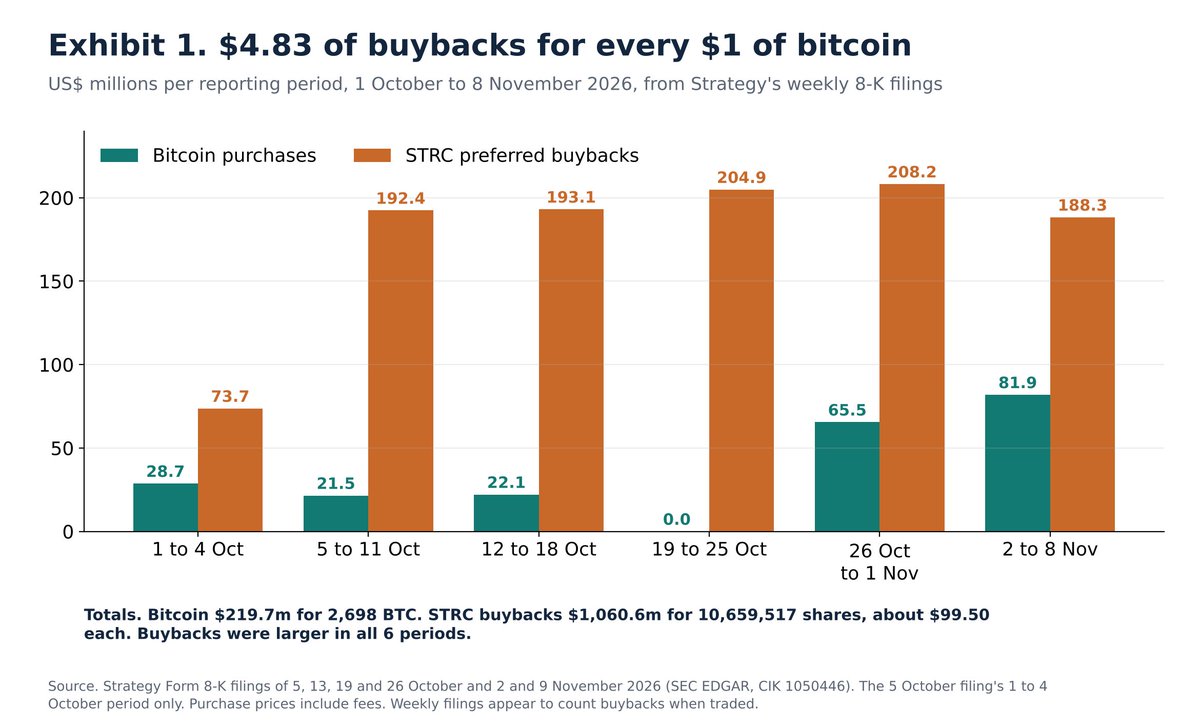
Strategy spent $4.83 buying back its own preferred stock for every $1 it spent on bitcoin from 1st October to 8th November, per its weekly Securities and Exchange Commission filings.
The largest corporate holder of bitcoin now buys back more of its own paper than coins.
Chain of Custody PRO Issue 02, Who Will Buy Bitcoin Next?, is live now.
It follows that money to the next bid through the US spot bitcoin funds that sold for 7 straight sessions, Strategy's shrinking cash pool and the MSCI index sale due at the 30th November close.
My call, about 85 percent, is that buybacks stay ahead of bitcoin buying through 31st December. I am wrong if bitcoin buying catches up by 8th January 2027.
INSIGHT: Ondo Finance reported 48.57% of its OUSG token's assets sitting in a State Street and Galaxy fund with a 7-day yield of 2.84%, per its holdings table for 13th November.
The same page lists BlackRock's BUIDL fund as OUSG's primary asset.
BUIDL held 32.69%.
The State Street fund, called SWEEP, charges a total expense ratio of 0.50% a year, per Galaxy. OUSG adds its own fund expenses of up to 0.15%. Ondo's 0.15% management fee sits on top, waived only until 1st January 2027.
OUSG's own 7-day yield was 3.44% on 13th November. The US Treasury put the 4-week bill at 4.02% that day. Franklin Templeton's onchain government money fund showed a 7-day yield of 3.79% after its 0.20% expense ratio. At those rates the gap between OUSG and the bill is about $5,800 a year on $1 million.
OUSG is a limited partnership interest in a private fund. Its manager's brochure at the Securities and Exchange Commission (SEC) sets standard withdrawals at 7 days' notice. It also lets the general partner 'compel the withdrawal' of any holder 'for any reason or no reason at all.'
Ondo has moved the fee waiver before. Its June 2024 page ran it to 1st January 2025, and its 2026 SEC brochure ran it to 1st July 2026.
My call, about 70 percent, is that Ondo moves the waiver past 1st January 2027. I am wrong if its OUSG page shows no later waiver date by 15th January 2027.
$5.915 a gallon before tax for heating oil delivered to American homes on 9th November 2026, 22.1 cents below a week earlier in EIA's survey.
A home on the day's price sees what its dealer passes on.
A fixed price normally stays put, and a pre-buy usually does too
Heating oil fell 22.1 cents a gallon in EIA's survey of 9th November, and whether a home sees that fall depends on what it signed.
The first issue of The World & Your Wallet follows the same question through the gas tariff, the grocery pack and 186,000 mortgages that ICE estimates are due for a first reset in 2027.
It prices the winter for three hypothetical households against EIA's own forecast from before the war, sets out what Maine and Connecticut make a dealer hold behind a prepayment, and is free in full.
Morgan Stanley's strategists moved global stocks to 'maximum overweight' in a 15th November note, 9 days after the bank's own prime brokerage said hedge funds had made their biggest cut to gross positions in at least 10 years.
Those hedge funds are the bank's clients.
Its 6th November note put US hedge fund net leverage in its bottom decile since 2010. It added that this level 'has historically been indicative of more positive forward-returns on the S&P.'
The strategists, including Serena Tang, set an end-2027 target of 8,700 for the S&P 500, about 15% above its 7,561.67 close on 13th November. They see 13% earnings growth for global stocks in 2027, with those stocks at about 15 times expected earnings, the lowest since 2023.
Since 1950 the S&P 500 has risen 15% or more in 31 of 76 calendar years. The Federal Reserve raised rates in September, and Morgan Stanley's economists expect 2 more hikes.
My call, about 60 percent, is that the S&P 500 ends 2027 below 8,700. I am wrong if its last close of 2027, on 31st December, is 8,700 or higher.