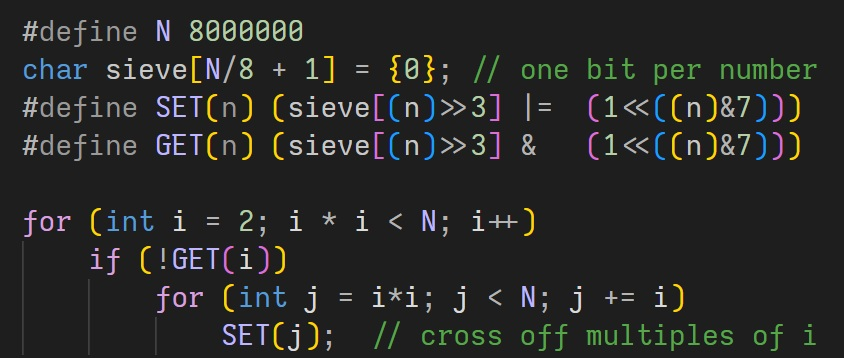
the sieve of Eratosthenes can find every prime up to about 8 million using just 1MB of memory
one bit represents one number and composite numbers are marked using simple bit operations
the same technique is still used in prime generators and for choosing efficient hash table sizes
Seru juga yaa film The Odyssey. Suka banget kata-katanya yang,
“The most we want is what the most we can’t have, and what the most we can’t have is what we already had and lost”.
temenku isi acara kan di UI tentang karir kan
terus ada mahasiswa yang nanya:
“kak, program magang yang bisa bantu keluarga apa ya?”
NGILUUUUUU HATI GW DENGERNYA
Anakku, 18 tahun, meninggal mendadak tiga tahun lalu. Minggu lalu, orang asing kirim pesan, "Anak ibu nyelametin hidup saya. Saya harus ketemu ibu." Aku kira soal donor organ, tapi dia dateng ke kedai kopi tempat kita janjian.
Begitu liat mukanya, aku pucat. Perempuan ini temen sekelas anakku waktu SMA, yang hampir setahun jarang masuk sekolah. Aku inget wajahnya dari buku tahunan yang anakku simpen di kamarnya.
Dia duduk di depanku, tangan gemeteran, cerita semuanya.
Katanya, tahun itu dia berjuang sendirian, gak ada temen, sampai hampir nyerah total.
Anakku sadar. Dia mulai nitipin catetan kecil di lokernya, kayak "Kamu penting." "Besok butuh kamu ada." Dia anterin perempuan itu ke kelas pas gak ada yang mau noleh. Dia gak pernah cerita ke siapa-siapa. Perempuan itu bilang anakku chat dia tiap malam selama lima bulan, cuma mastiin dia baik-baik aja.
Dia keluarin hapenya, nunjukin ratusan chat. Yang terakhir, dikirim pagi sebelum anakku meninggal, bunyinya, "Hei. Cuma mau cek kabar. Kamu lebih kuat dari yang kamu kira."
Dia natap aku, bilang, "Saya masih hidup karena anak ibu berani baik walau gak ada untungnya buat dia sendiri." Aku genggam tangannya lintas meja, sadar kebaikan diam-diam anakku ternyata kekuatan terbesarnya.
cc : rgjan03
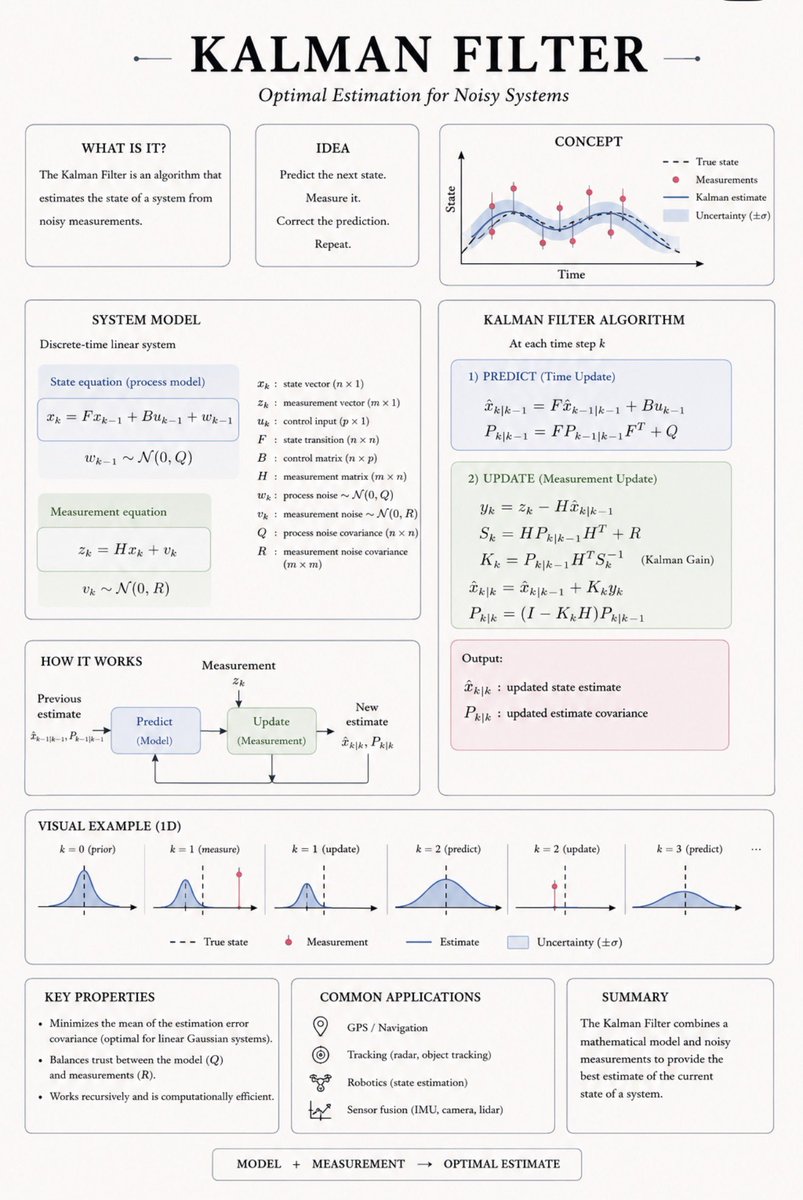
the kalman filter solves a problem that every robot eventually runs into: sensors are noisy, and models are imperfect. if you trust only your sensors, your estimate jumps around. if you trust only your model, errors accumulate over time. the kalman filter does neither. it continuously balances prediction with measurement, producing the best estimate of the system’s current state from both sources of information.
every iteration follows the same loop. first, predict where the system should be using the mathematical model. then take a measurement from the real world. compare the prediction with the measurement, calculate how much to trust each one, and update the estimate. then repeat. prediction → measurement → correction. this simple recursive idea is why a kalman filter can track a moving car, estimate a drone’s position, stabilize a rocket, or fuse data from a camera, imu, gps, and lidar into a single coherent estimate.
what i find beautiful is that the kalman filter isn’t trying to eliminate uncertainty. it embraces it. every estimate comes with a measure of confidence, and every new observation changes that confidence. that’s a much deeper engineering principle. reality is noisy, models are incomplete, and measurements are never perfect. the goal isn’t certainty. it’s making the best possible decision with the information you have right now.
a markov chain is one of the simplest ideas in probability, yet it explains an astonishing number of real systems. the central assumption is called the markov property: the future depends only on the present state, not on the path taken to get there. if you know where the system is now, its entire history no longer matters. that’s why it’s called a memoryless process. every step is just a probability of moving from one state to another, and those probabilities define how the system evolves over time.
once you represent those probabilities as a transition matrix, the mathematics becomes remarkably elegant. every multiplication by the matrix moves the system one step into the future. repeat the process enough times, and many markov chains converge to a stable probability distribution, where the long term behavior becomes predictable even though every individual transition is random. this simple framework powers everything from google’s original pagerank algorithm and weather forecasting to speech recognition, genetics, finance, robotics, and reinforcement learning.
the deeper lesson is that uncertainty doesn’t always mean unpredictability. individual events may be random, but the system as a whole often follows a clear mathematical structure. that’s a recurring theme across mathematics and engineering: stop trying to predict every single outcome, and instead model the process that generates those outcomes. once you understand the transition rules, seemingly chaotic behavior starts revealing stable patterns.
Gw masi ga paham (meski kalopun gw paham gw kudu bacot 4 jam) kalo pake jersi persib di jakarta itu jauh jauh jauh lebih aman ketembang pake jersi persija di bandung