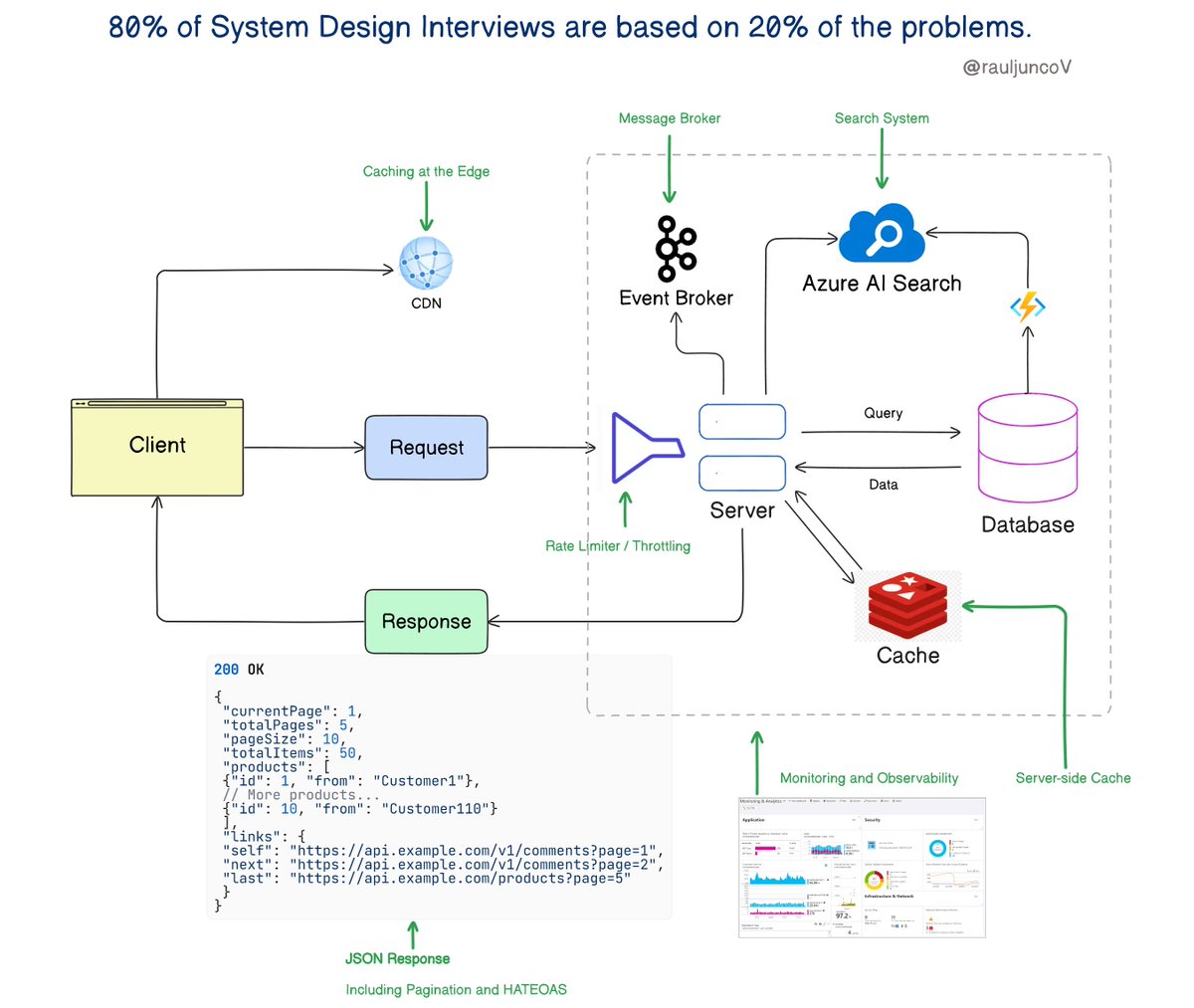
80% of System Design Interviews are based on 20% of the problems.
Here is what you need to master.
1. Scalable Data Storage
• Relational vs. NoSQL: Know when to use SQL vs. NoSQL databases.
• Partitioning: Vertical and horizontal partitioning (sharding). Understand trade-offs.
• Indexing: Covering indexes, primary vs. secondary indexes.
• Consistency Models: Strong, eventual, causal.
2. Caching
• Client-side vs. Server-side Cache: Understand where caching should happen.
• Caching Strategies: Write-through, write-back, write-around.
• Distributed Cache: Redis, Memcached.
• Cache Eviction Policies: LRU, LFU, etc.
3. Load Balancing
• Horizontal Scaling: Why and how to horizontally scale services.
• Load Balancing Techniques: Round-robin, consistent hashing.
• Reverse Proxy: Understand how to use Nginx, HAProxy.
4. Asynchronous Processing
• Message Brokers: Kafka, RabbitMQ. When to use queues vs. streams.
• Event-Driven Architecture: Benefits of decoupling and event sourcing.
• Task Queues: For delayed jobs or retries.
5. Database Read and Write Scaling
• Read Scaling: Master replication, read replicas.
• Write Scaling: Challenges with partitioning for writes, leader-election.
• CAP Theorem: Consistency, Availability, or Partition tolerance may be compromised.
6. Distributed Systems Concepts
• Consensus Algorithms: Paxos, Raft.
• Conflict Resolution: Last Write Wins, CRDTs, vector clocks for data reconciliation.
7. Reliability and Failover
• Redundancy: Active-passive vs. active-active configurations.
• Health Checks.
• Retries and Circuit Breakers: How to protect systems from cascading failures.
8. CDNs (Content Delivery Networks)
• Static Content Delivery: Why use a CDN, how does it work?
• Caching at the Edge: How CDNs improve latency for end users.
9. API Design and Rate Management
• REST vs. GraphQL: Difference and practical use-cases for each.
• Pagination and Filtering: Strategies for efficiently fetching data.
• API Versioning: Best practices for evolving APIs.
• Throttle Requests: Why rate limiting is essential, algorithms like token bucket, leaky bucket.
10. Search Systems
• Indexing: Building and maintaining indexes for fast search.
• Full-Text Search Engines: ElasticSearch, Azure AI Search.
• Ranking and Relevance: Basic understanding of how scoring works.
11. Monitoring, Observability and Security
• Metrics Collection: Prometheus, Grafana.
• Distributed Tracing: OpenTelemetry, Sentry.
• Centralized Logging.
• Authentication and Authorization: OAuth, JWT.
• Encryption: Data in transit vs. data at rest.
If you master these 13 areas, you'll be ready for most system design interviews thrown at you.
Add more if you can 👇
¿Sabías que la falta de información clara y unificada puede generar ineficiencia y dependencia en tu equipo? Descubre cómo centralizar la información y mejorar la comunicación a través de un Handbook.
https://t.co/TpgyMkEeYW
Si no conocéis el «The Startup CTO's Handbook» de @advancetheworld, os recomiendo que le echéis un vistazo. Lo tiene publicado con licencia Creative Commons en GirHub y se pueden sacar muchas lecciones del mismo https://t.co/v70tT4HeUz
El libro "Software Engineering at Google" ya está disponible GRATIS!
El libro habla las prácticas que tenemos en Google, design docs, como trabajamos los features, y más
Super recomendado ❤️
https://t.co/MInGFLmMWv
Remate total. Fin de temporada con otro miembro muy estimado de la comunidad PEUM.
Episodio 84 - Empezamos con VUE pero no sabemos cómo acabaremos con el huracán Gonzalo Nandez @Infogon
Directo en YouTube: https://t.co/MMk9gv9Qqx
Lunes, 21 de junio a las 22:00 CEST
¿¡Te gusta lo que hacemos en Codely!? 🤔
Tenemos una propuesta para ti:
Buscamos 2 personas que se quieran unir al equipo para los nuevos retos que tenemos 😬🎉
Aquí te lo contamos 👉 https://t.co/qdi2XSKh8I
🙊 ¡SORTEO! 1 año de CodelyTV Pro totalmente GRATIS 🤯
+45 cursos ya disponibles… ¡y lo que se viene!
🔁 Cómo: RT
⏱️ Hasta cuándo: Mañana ~18h CET
💸 Qué: 1 cuenta anual gratis entre todos los RTs (con Black Friday son 199€, normalmente 348€)
https://t.co/RimWNm6CmU
Commands and Events are Messages. Make your life easier by designing them with messageId (unique id) for identification, correlationId (the id of the first message that originated the whole process) to track the flow and replyingToId (the previous message id).
Pocas cosas son tan satisfactorias como ver volar alto a esa gente que un día tuviste en el equipo, les enseñaste lo que supiste y confiaron en ti como jefe #proud