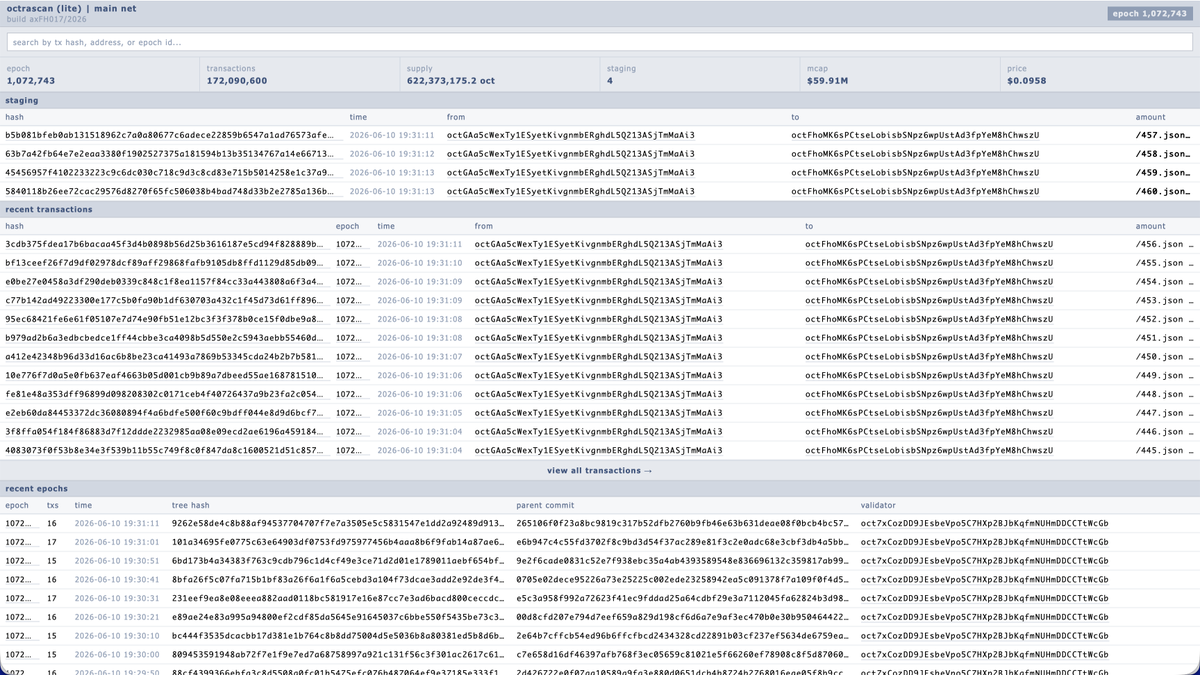
in 3 months, we are preparing to release a scanner update, there are many updates, but one of the most interesting is a program authority map
on each program's page, you can build a graph of info about which key owns what, which programs are called by each other and how, this helps determine which functions are under which owner, unchangeable fields are marked separately (immutability), it also helps clearly understand where authority is unlimited and helps create unlimited execution conditions, potential backdoors and logic errors, so new feature helps understand which program (transparent at first glance) and how it can rug you
part of the state is encrypted, but it still helps understand what permissions are defined where and how
this and much more will be available in the next few days with a full scanner update
Everyone's calling @octra a privacy coin. Some call it an FHE experiment. Both frames miss what was actually built.
Octra is a full-stack encrypted backend. BFT blockchain. Isolated execution environments (Circles). Encrypted native state. A local client managing keys, ciphertexts, and proofs. Not a coin. Not a coprocessor. A network where ciphertexts are state. The difference matters. A privacy coin hides transactions. An FHE coprocessor adds encryption on top of an existing chain. Octra makes encrypted state a first-class network primitive: clients encrypt, nodes compute without decrypting, and consensus agrees on the result.
The clearest first product fit: an onchain dark pool. Encrypted order submission. Homomorphic matching, no decryption required. Publicly enforceable settlement. The assets, users, and privacy problem already exist on-chain. Octra's architecture already has the pieces. That's not just Octra's thesis. Tiger Research published an independent case that decentralized dark pools are structurally inevitable as crypto goes institutional. Stellar's dev team compared MPC, FHE, and TEEs for dark pool construction. FHE is the only approach where the matching node has zero key access.
The competitive picture: Fhenix and Inco both license Zama's TFHE. They're layers on top of existing chains.
Octra built the cryptography and the chain together. No licensing. That's either a serious moat or a serious risk, and the public record has something to say about which. Here's what the public record shows. Octra runs a bounty program on their open-source PVAC-HFHE PoC. Three vulnerabilities were found and paid out:
* Nonce correlation enabling plaintext recovery without a secret key.
* Homomorphic addition leaking the plaintext sum.
* Ciphertext structure failing basic semantic security (IND-CPA).
Octra's defense is in the repo README: the PoC intentionally excludes production noise refresh and the transfer mechanism. The bounty tested whether the operations were self-consistent, not whether the PoC was production-secure. That's a reasonable defense. It also can't be verified without an independent audit.
What's verifiably real:
* Mainnet alpha live since December 2025
* 100M+ testnet transactions from 1.5M accounts at 17K TPS peak
* $20M raised at $200M valuation via Uniswap CCA
* EVM compatibility and live Ethereum bridge since Q1 2026
My impartial take: Octra has built the right architecture for a problem that is real and growing. The cryptographic foundation is promising and unaudited. Those two things are both true. What would change the picture? An independent review of the production scheme, not the PoC. That's the next thing to watch.
Deploying more capital - steady lads.
$ETH - no explanation needed
$OCT - accumulating below $0.05. One of the fairest token distributions I've seen, community favorite atm
$JTO - probably the cleanest $SOL beta. Nearly all supply is already in circulation, best solana infra, LST dominance, and a serious shot at building one of the leading perps (JTX)
$XMR - OG privacy coin is back on the menu after $ZEC scam. Major hacks are becoming a daily occurrence, and privacy remains one of the strongest narratives in the market
announcing octra starter pack
our trusted partner will configure a full octra node on raspberry pi or mac mini and ship it worldwide or run it for you
payments in OCT, ETH, BTC, XMR and stablecoins, with 100% of proceeds converted to OCT
pre-sales opening this summer, notis on
octra is not slap-on privacy, and OCT is not a governance token
it is an asset that allows users and devs to build and pay for encrypted compute today: programs, webapps, defi, inference, and soon staking, running nodes and mining encrypted balance
no TEEs or plaintext involved
Octra Bridge (Alpha) with Ethereum mainnet is now added to the web client.
Users should export their keys and install the latest version by following these instructions: https://t.co/SwmZ3euZIS
Next up: stealth withdraw for Ethereum, bridge support for Monero and Bitcoin.