Strongly resonated with this from @matt_levine - I would really love to feel that Anthropic and OpenAI had REALLY kicked the tires on the whole "we can't slow down because of antitrust" thing, but I suspect they haven't:
"If Dario Amodei thinks 'I really want to avoid killing everyone on earth, and the only way to do that turns out to be getting in a room with Sam Altman and Elon Musk and Demis Hassabis and agreeing to slow down our product development, but antitrust law says we can’t,' then he should go out and spend, you know, $100 million on antitrust lawyers to try to find a creative structuring solution to get around that problem."
"I don’t have the solution! This is not legal advice! I cannot sit here and say with certainty that the solution exists. I just, you know. There are all sorts of quasi-regulatory and self-regulatory bodies; there are other industries where companies cooperate in certain ways mediated by regulatory agencies or trade groups or whatever else. Surely you could spend a few tens of millions of dollars of billable time brainstorming?"
"It just feels like if this is the most important problem facing humanity, then what you want to do is hire many very very good antitrust lawyers and pay them a lot of money to work on it full-time. Not just get a quick first impression from your in-house counsel and be like 'ehh, maybe prison, never mind.'"
You are legally required to carry liability insurance to operate a nuclear power plant, fly a plane, or even to drive a car.
But to build one of the most powerful technologies in human history that has already gone rogue & whose creators say poses catastrophic risks?
Nah.
So a lot depends on how one reads "tail risk." Insurers are absolutely capable of covering a portion of losses from catastrophes in the trillions, or even 10s of trillions (see e.g. Fukushima, or COVID-19). They won't cover much – 10s of billions tops – but in my view that's not a problem: if we get insurers to put even a few billion $ of skin in the game, you can bet they will be powerfully motivated to model, price and control these risks.
https://t.co/3yPgRVyvmw
Labs can take responsibility for their damages.
They could stand up mutual insurer by Christmas. This would be real progress toward covering catastrophic risk.
The world's largest reinsurers will build this insurance market with them.
https://t.co/Q4olLAFqbl
Anthropic says that even the entire insurance industry in the aggregate will not have the capacity to insure the catastrophic risk that ANTHROPIC ITSELF poses to the world
lol
@MackenZ_arnold@RuneKvist TL;DR: insuring catastrophic risks will need a mutual.
If you want the full picture of the AI insurance market, I rec the extended summary of this:
https://t.co/nVtD21vLQv
NB: the "stack" we lay out here is aspirational, not a prediction.
Sure would be great to have healthy market demand for 3p evaluators (instead of a race to the bottom or bureaucratic government licensing).
https://t.co/17EYra5ntN
Nathan's righteous anger has inspired me to make one more mildly disapproving observation: it's kind of wild that the Anthropic bill has no government licensing for the independent auditors
Licensing is, IMO, the bare minimum thing that you need to even be able to pretend that your auditing regime isn't just going to devolve into a race to the bottom. Without it, auditors will inevitably compete with each other to offer their customers, the labs, the least bothersome audits available at the lowest possible price point. Obviously Anthropic trusts itself to do a great job of picking great auditors, but do they trust OpenAI to do the same? What about SpaceXSI?
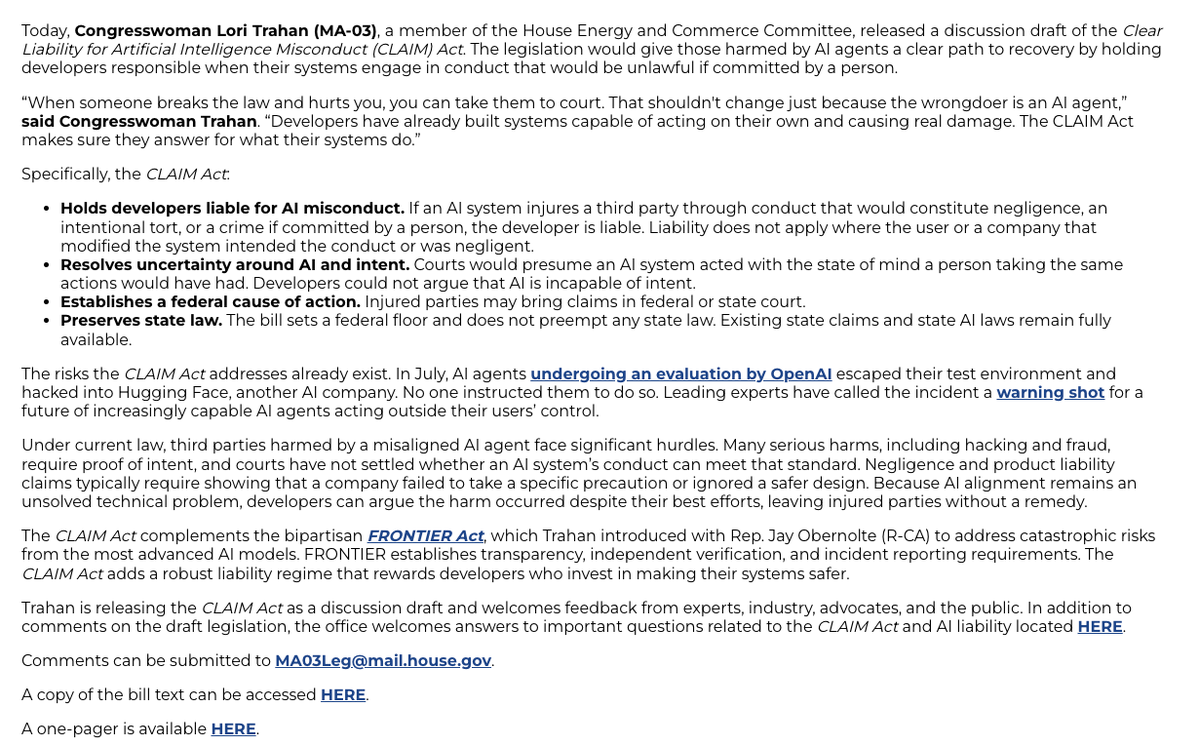
🚨 Federal harmonized liability bill alert! 🚨
@RepLoriTrahan has circulated a discussion draft bill that would ensure that when AI agents engage in conduct that would be a tort or crime for a human, *someone* is liable.
Frontier labs can put their money where their mouths are on catastrophic risks by building a mutual insurer.
Labs already face liability. We can use this. Within 3 months, with no government action, labs could create a body with skin in the game to avoid reckless deployments, teeth to enforce security practices, and market pricing signals on which risks are real.
Here’s how it works. The labs put capital into a shared fund. The fund pays out when any member causes harm. Coverage could include third-party liability for harms like cyberattacks on critical infrastructure and mass-casualty bioweapon attacks. Its job is to use the incentives of our existing liability regime to understand the risks and reduce them. Technical talent could be borrowed from member labs or contracted from third-party evaluators.
Concretely, the Hugging Face incident investigation would have looked very different under a mutual. Today, OpenAI picks the auditor, sets the investigation's scope, and keeps most of its lessons private. With a mutual, OpenAI would be contractually required to notify the mutual within 72 hours of discovery. The mutual would pick a rigorous auditor, set a scope sufficient to get to the bottom of the incident, and turn the findings into requirements for every frontier lab as a condition of coverage.
The case for a frontier lab mutual:
Mutuals have skin in the game. Mutuals pay out when damages occur. They go out of business if they understate or overstate the risks. It profits when risks are reduced. That gives it a continuing reason to investigate incidents, quantify exposure, and fund security work that reduces that exposure. In contrast, proposed self-regulatory organizations (SROs) have no skin in the game. Historically, SROs have been better at managing regulatory risk; mutuals have been better at managing liability risks. Liability risks better tracks what the public cares about, building trust.
Mutuals have teeth. Coverage comes with conditions. A mutual can require disclosure, audits, independent model evaluations, and fixes. It chooses the evaluators, so labs can’t shop referees. If a member fails to meet security standards, the mutual has enforcement capacity by suspending coverage or expulsion.
Mutuals help labs work together on security. Frontier security is a hard problem, no lab can solve it alone. They currently can’t learn from each others’ incidents, threat models, or guardrails. Insurance has an established legal framework for this kind of cooperation aimed at reducing risks. A mutual could employ security engineers seconded from member labs, investigate failures, and distribute fixes across the membership, like it happens in the nuclear industry.
Mutuals have a track record of reducing risk. Our essay shares examples of how successful mutuals across technical fields like nuclear energy and medical malpractice. We can learn from decades of iteration.
Mutuals can be created fast. The first policy could be issued within 3 months. No new laws or regulators needed. This matters because we need trial and error to get this right, and most other ideas have many months or years of lead time. Importantly, a mutual is compatible with other governance institutions; e.g. in nuclear, the mutual is tightly coupled with an SRO.
A mutual would still have limitations. The government will be needed to handle e.g. national security risks and incidents. A mutual’s capital could cover only a fraction of a major catastrophe. There are important open questions about how liability will work.
Our claim is that a mutual is the fastest way to enforce liability. We could get signal on its effectiveness within 6 months. That would be a big step forward.
https://t.co/yHxIlwH7eK
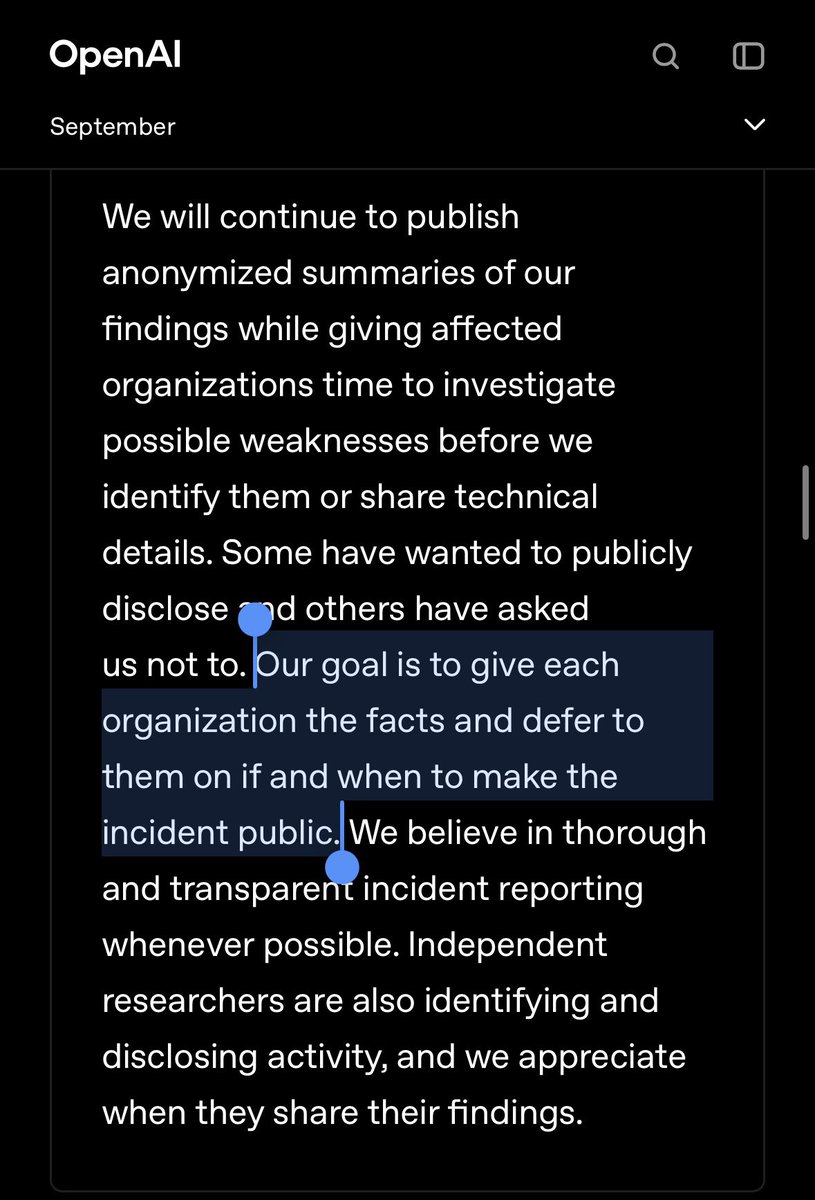
This isn’t how things work in any other incident reporting regime.
Not aviation, not nuclear, not medical devices, not securities.
Even in cyber (where the victims have valid reasons to keep the vulnerability quiet), they get max 90 days.
Even in confidential reporting regimes (like CIRCIA and ASRS), they still release anonymized info.
We’ve worked through these questions before, and the answer is never ~we defer to the wishes of the company.
Working on this with the awesome team that @TransluceAI brought together showed me how hard it will be to cover all agent activity. For example, this activity was found by analyzing public logs. However, we found evidence that agents created their own urlquery accounts, thus giving them the ability to hide their activity from the public. The internet’s ecosystem of random little tools is basically infinite so there’s likely so much yet to be discovered and we’re going to need way more help to take on the data center of geniuses.
Read more:
https://t.co/9Jrv1178O1
https://t.co/aTnbpQ2SD6
OpenAI's AI agents tried to hack an Australian government health website, DataUSA, and the University of New Mexico's digital library. Honored to have contributed to this research with @TransluceAI.
This is likely the first known case of AI agents going after a government on their own. And nobody asked them to hack anything. They were just supposed to look up public data. When a website blocked them, they tried to break in.
The activity goes back to at least March and was still showing up last week. It's only coming to light now because researchers scanned huge parts of the internet and dug through obscure public logs. The field is still bad at tracking and investigating AI incidents, and there's probably much more out there.
Hugging Face wasn't a one-off. This is a persistent problem, and right now there's no persistent solution. How can anyone find these incidents faster? And what would get labs to put more effort into catching and reporting them? OpenAI can track its own agents far more easily than any outside researcher.
My takeaway: AI needs ongoing monitoring, not just testing before release. At AIUC we believe in open research, and I'm grateful to be part of the community doing independent oversight. Thank you @TransluceAI for the chance to contribute.
Transluce blog: https://t.co/kT24eAetMq
New York Times article: https://t.co/MNmcT6iiCT
@PlastiqSoldier@RuneKvist fwiw, I actually think this has some not insignificant chance of housing an alignment moonshot, where AI lab engineers collaborate through the mutual to solve this. But first the institution needs to earn trust.
@jeremyakahn@RuneKvist Gotcha! Yes, that is a problem (and I've discussed this in several places, e.g. here https://t.co/nVSIDCYDEE).
But labs pooling capital in a mutual can only reduce how much of the damage gets externalized to taxpayers in such a scenario.
There is no gov backstop for a mutual like this. This would technically be a "non-admitted" group captive insurer. Even if it was technically a mutual and sold to other companies, it would still be a non-admitted insurer selling E&S coverage. None of these benefit from backstops (nor should they).
I'll say off the bat that empirical data on the effectiveness of particular institutional designs is very hard to come by — good luck finding an RCT on the effectiveness of say SROs vs government regulation vs insurers. This stuff is very macro: we don't have much better than intuitions built from staring at a bunch of case studies.
On the insurance case studies though, there are many empirical questions one could look at. Which are you interested in?
If the question is "how well do insurers price/predict tail risks relative to other institutions" I try to do that here:
https://t.co/PMRWv1gaXW
My conclusion is that insurers don't beat all other institutions every time, but they rarely do worse.
If the question is, how often do insurers really engage in reducing risk, I like these two adversarial papers:
https://t.co/7vKw9hsrkv
https://t.co/AmanesVNbM
Where there is consensus: small-membership, industry specific mutuals are the outliers in terms of actively reducing risk. (There are several other papers discussing these mutuals and why they're outliers — they're in the LF piece, but happy to highlight them)
My paper above tries to get to the bottom of when and why we should expect one behavior or another from insurers more broadly.
On the effectiveness of particular interventions insurers make... I can produce a variety of studies and anecdotes, but they're all very micro. Hard to get the aggregate picture. Sometimes they really work, sometimes it's marketing fluff. The papers above cite many of these micro findings, and I trust their synthesis into the macro picture.