The beauty of Reader Revenue is that it rewards value, not volume. Local book reviews were never going to be a big source of ad revenue for the @PressHerald. But the 275 new subscribers who rallied to save the reviews likely generated ~$60K. My analysis: https://t.co/MInacxisze
Shipments of AI-imbued speakers grew 95 percent from 22.6 million units in Q3 to 38.5 million units in Q4 — more than the entire 2017 total.
https://t.co/9pu9mPzdsM
In a survey of 200 digital leaders over three-quarters (78%) think it is important to invest more in Artificial Intelligence (AI) to help secure the future of journalism. Most see increased personalisation as a critical pathway to the future (73%).
👉
https://t.co/e0CSrmAHs3
Publishers are getting serious about podcast revenue. It is a format that now offers in some cases a more viable ad model than video.
😀👉
https://t.co/hC5nWJaweZ
"Our goal is to bring users back to our properties, fully immersing them in the journalism, with the goal of developing a relationship and a daily habit with our readers."
https://t.co/sbR6rP7PNc
How Le Monde site tweaks helped increase subscriptions by 20 percent in 2018:
👏
https://t.co/EaopBNN2xG
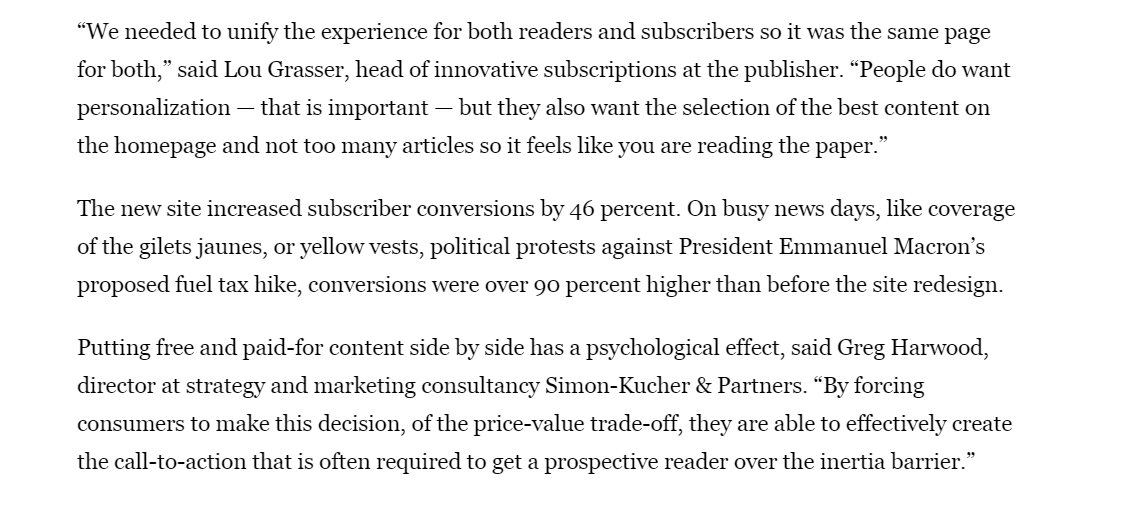
“The focus for 2019 is to make sure the most valuable subscribers know they are valuable, they have more advantages and benefits.” - Lou Grasser 👀
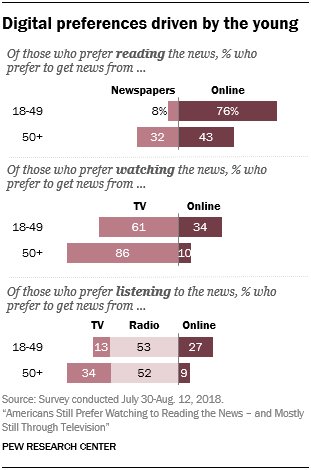
Nearly three quarters (76%) of adults ages 18-49 who prefer to read the news also prefer to get their news online, compared with 43% of those 50+. https://t.co/GVfFYrQsUp
"The company plans bring its personalization technology to podcasts in order to make better recommendations, update its app’s interface so people can access podcasts more easily and broker more exclusives with podcast creators."
👏👉
https://t.co/PzIvCFUpjx
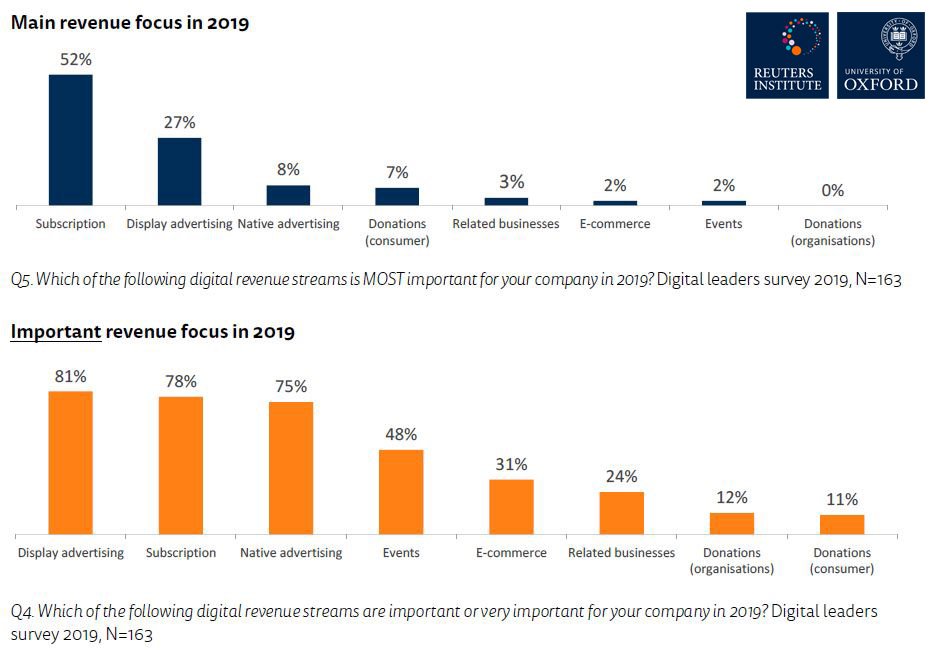
Over half (52%) of publishers expect subscription & membership to be main revenue focus in 2019, compared to 27% for display advertising - but are enough people willing to pay for news?
NEW REPORT: Journalism, Media & Technology Trends & Predictions 2019
https://t.co/OPppVeEG2u
[2/2] Pro Intelligence mines the internet for sources relevant to businesses that track the EU and political developments. The tool then presents the information in a feed within a single dashboard alongside Politico's editorial stories.
[1/2] That subscriptions growth has been as much thanks to the data and resource tools developed for subscribers as it has to pure editorial packages.
https://t.co/sXEgiUw2PW
Behavioural science 🤔 represents a modified way of thinking about audiences, and is especially relevant when deciding who is and isn’t targeted, or who is targeted with different messages:
https://t.co/Y4qG1eFZgj
Interesting perspective by @StephEdgerly - "In addition to asking “why do people consume news?” we need to ask (without judgment) “why don’t people consume news?”"- We should be asking this question more in all newsrooms, communities https://t.co/e9XjfATtQ9
"Here’s what I do know. I know that we’re in this together as an industry. We have to share our knowledge. That means open-sourcing technology, sharing anonymized analytics when possible, and talking about what works and what doesn’t in the open."
https://t.co/JSrGJnajah
In the blog 📣
The Correspondent reaches its US crowdfunding target 👍
Digital-born news sites continue to expand their newsrooms
They are tapping into non-traditional audiences and focus on quality content
👉
https://t.co/t2seqhWq5v
The reader revenue revolution is real 👌👌👌
Number of journalists employed by the New York Times
2014: 1,100.
2016: 1,300.
2018: 1,500.
Number of journalists employed by the Washington Post
2013: 500.
2016: 600.
2018: 825.
https://t.co/VxuI0ru4Qk
"Without a doubt, the content manager will be the person to hire, to train and to give authority in the newsroom for 2019 and beyond." @DrMarioRGarcia#Predix2019 https://t.co/mZkh63XvL4