@bigkozar@CatiaKyen The ounce of truth is more significant than the lies. The question is, did the giveaway happen? Were they people begging from terrorists?? Brain dead dumdass.
Some of you are just struggling to belong in “it” conversations, so you latch onto whatever opinion is trending instead of thinking for yourselves. You were probably neutral about the song until someone you’re trying to align with condemned it, and suddenly you manufactured hate
If there’s one thing Justin had that Michael never truly got, safe love. Someone truly obsessed with his totality and ready to fight his pains with him. Two child stars,but different endings.
It painful Mike never got this, i’m just grateful Hailey Bieber became that for Justin.
🗣️ Pep Guardiola says he’s been “f**king fun” and smiles as he points to the final year of his contract when asked on the possibility that the FA Cup Final could be his last Wembley visit.
🎙️ Great questions by @JamieJackson___
It’s funny how something can look so simple on the surface, then you try it for a bit and start noticing things about yourself you didn’t expect.
How you react.
When you hesitate.
When you get too confident.
Been getting that kind of vibe from @cfldotfun lately.
Not even about winning or losing at this point, just understanding my own decisions better. 😁
Lowkey enjoying it 👀
Let’s play 👉 https://t.co/L1r9huPYlc
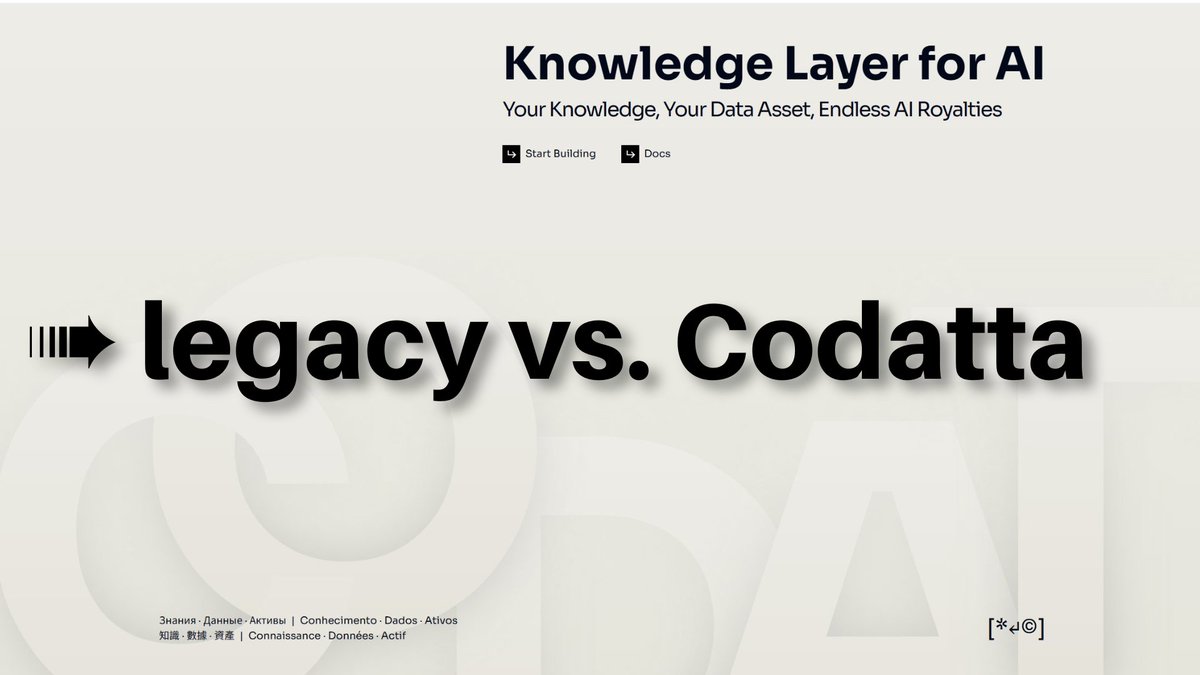
Old data economy pays you once.
The new one -@codatta_io pays you every time your data is used.
Legacy: one-off payments
Codatta: recurring royalties
Legacy: opaque
Codatta: on-chain
Legacy: upfront cost
Codatta: pay from outcomes
Contribute once → get used → get paid again
Something I've seen that is a very big flaw in today’s on-chain systems is 𝐟𝐫𝐚𝐠𝐦𝐞𝐧𝐭𝐚𝐭𝐢𝐨𝐧.
For example, Prediction markets generate high-quality signals but fail to retain value.
DeFi protocols capture liquidity but rely on continuous inflows to sustain it.
These systems operate in silos. And as a result, both remain structurally inefficient.
Lately, I came across what I will proudly refer to as a solution. It's 𝐏𝐎𝐓𝐒. What I notice is that it introduces a different model: 𝐚 𝐜𝐥𝐨𝐬𝐞𝐝-𝐥𝐨𝐨𝐩 𝐞𝐜𝐨𝐧𝐨𝐦𝐲.
At the top layer, 𝐏𝐨𝐭𝐬 𝐌𝐚𝐫𝐤𝐞𝐭 transforms real-world uncertainty into capital-backed probabilities, tradable, on-chain intelligence derived from market consensus.
At the base layer, 𝐏𝐨𝐭𝐬 𝐌𝐨𝐧𝐞𝐲 captures that activity and converts it into structured financial primitives bonds, staking, and treasury mechanisms designed for long-term capital formation.
The result is a self-reinforcing system:
✔Market activity generates revenue.
✔Revenue strengthens the treasury.
✔A stronger treasury improves liquidity and efficiency.
✔Improved efficiency attracts more informed participation.
This feedback loop is the core innovation.
Rather than relying on speculative inflows, the system compounds based on 𝐈𝐧𝐭𝐞𝐫𝐧𝐚𝐥 𝐩𝐫𝐨𝐝𝐮𝐜𝐭𝐢𝐯𝐢𝐭𝐲.
Equally important is access design.
Through the Pool Bidding Mechanism (PBM), POTS removes the asymmetric advantage typically reserved for early or insider participants.
Capital enters through shared pools, governed by transparent rules, not privileged timing.
On the monetary side, $IBS functions as a control instrument, not a speculative asset.
Issuance is constrained via Minting Ceiling Limits, while treasury-backed metrics anchor system stability.
This introduces something rare in DeFi:
𝐩𝐫𝐨𝐠𝐫𝐚𝐦𝐦𝐚𝐛𝐥𝐞 𝐫𝐞𝐬𝐭𝐫𝐚𝐢𝐧𝐭.
𝐏𝐎𝐓𝐒 is not optimized for short-term attention.
It is engineered for structural durability.
In a market dominated by extraction and narrative cycles, that distinction matters.
For more information:
Follow: @pots_money and @pots_market
Visit: https://t.co/afyb7UgOz3 and https://t.co/DkVxv6jBcH
Trust the Rules. Create the Future.