my wallet just got an inbox 📥
@evmdotchat — messaging for every EVM wallet.
one address. every chain. one inbox.
code: EVM-Y2PK → https://t.co/MMgA9V6cqH
https://t.co/8XYdkraOmU
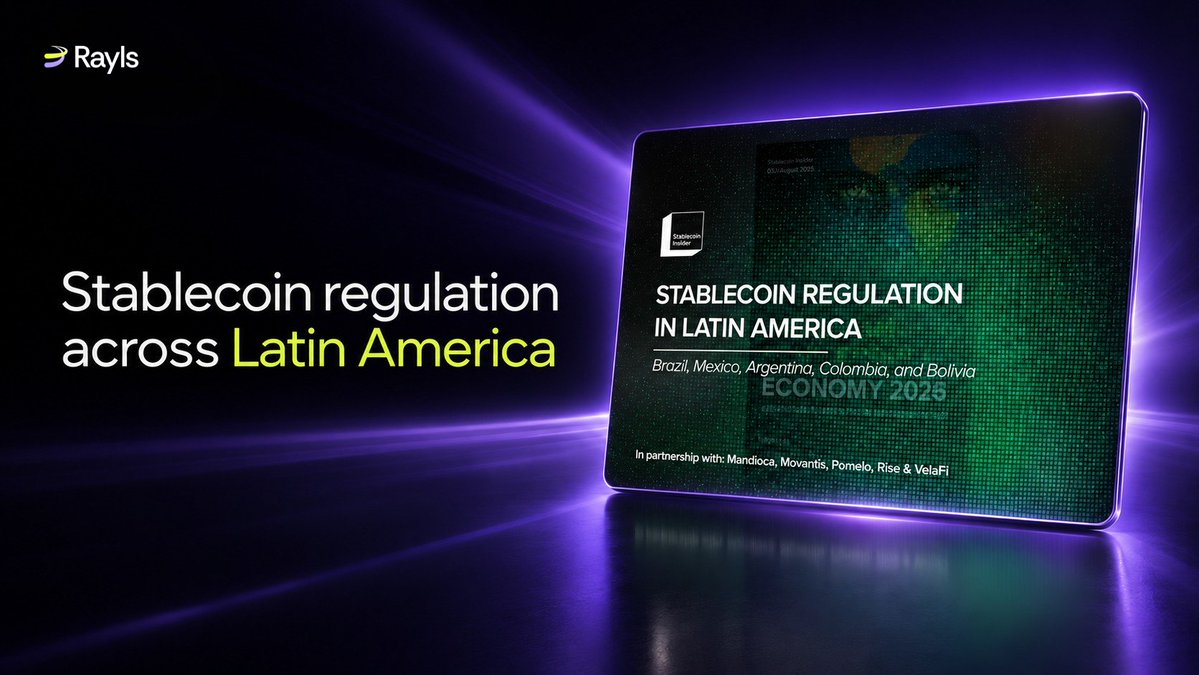
$324B moved through stablecoins across Latin America in 2025.
That’s an 89% increase year over year.
As Stablecoin Insider’s latest analysis points out, regulators across the region are no longer treating stablecoins as a crypto niche.
They’re being absorbed into existing financial frameworks through FX rules, licensing, AML requirements, and reporting.
That changes the infrastructure question.
The next phase is about giving regulated financial institutions the privacy, compliance, and connectivity needed to actually operate onchain.
That’s where Rayls is focused.
We’re already working with institutions across Brazil’s financial ecosystem, including Núclea, Amfi, NimoFast, and XP, bringing established financial infrastructure closer to onchain rails.
As regulation catches up with adoption, the infrastructure underneath these assets will matter just as much as the assets themselves.
Read the full analysis from Stablecoin Insider 👇
Privacy on blockchain comes with a cryptographic cost.
The important question is how that cost is managed without compromising the properties institutions need most: confidentiality, auditability, and performance.
In our latest deep dive, we break down the performance trade-offs behind Enygma and look at:
→ Where the overhead of confidential transactions comes from
→ Why proof generation is the dominant cost
→ How batching, aggregation, and hardware acceleration help optimise performance
→ Why different institutional workflows require different performance considerations
Read our latest blog to learn more 👇
The $RLS flywheel starts with real institutional activity on Rayls.
→ Institutions use Rayls
→ Network activity generates fees
→ Fees are used to buy $RLS from the open market
→ 50% of purchased $RLS is permanently burned
→ The remaining 50% flows into the Network Security Pool
→ The pool supports validators and ecosystem growth
As institutional usage grows, more fees flow through the mechanism, increasing $RLS burns while strengthening network security.
Track network activity, fee flows, and $RLS burns through the Rayls Transparency Portal: https://t.co/67rSo0etna
Something big is coming to Rayls.
On 15th October, Rayls Vaults go live.
We’re starting with AmFi-powered receivables, following the extended agreement reached during Febraban Tech.
More details on the Vaults, the assets, and what’s next will be revealed over the coming days.
Stay tuned.
DLT is moving from experimentation to infrastructure.
The latest DLT in the Real World 2026 report makes the shift pretty clear:
→ 56% of financial institutions expect to tokenise securities in 2027
→ Tokenised collateral is becoming a major institutional use case
→ 77% of DLT users are already seeing meaningful improvements in their workflows
However, 92% still cite client and counterparty adoption as a major obstacle.
The opportunity is no longer proving that assets can move onchain. It’s building infrastructure that lets institutions move them privately, compliantly, and at scale, while still accessing onchain liquidity.
That’s the problem Rayls is built to solve.
With Rayls, institutions can issue and manage tokenised assets within their own sovereign environment, transact privately with counterparties, and connect those assets to public onchain markets when they’re ready.
Private where they need control. Public where they need liquidity. EVM-native throughout.
The next phase of institutional tokenisation is all about making onchain finance work for the institutions that already move the world’s capital.
55% boosted staking is officially closed.
When we launched a 55% APY staking opportunity, the goal was simple: get $RLS into the hands of the people who wanted to help build and secure Rayls from the very beginning.
The response was stronger than we could have hoped for.
We thank everyone who participated in this campaign.
You took a chance on Rayls early. You locked your $RLS, supported the network, and helped turn the first phase of staking into a reality.
Starting tomorrow, your boosted staking position will transfer to the ~18% APY staking.
By continuing to delegate your $RLS, you can:
→ Help secure the Rayls Public Chain
→ Support the network’s validator set
→ Continue earning staking rewards
We look forward to seeing more of the community put their $RLS to work securing the network.
Powered by Rayls Enygma, Rayls makes private transactions verifiable without exposing the underlying data.
- Transaction details remain private.
- The network verifies that transactions are valid.
- The resulting proofs can still be publicly audited.
Enygma provides the cryptographic layer behind the Rayls Sovereign Ledger, handling zero-knowledge proofs, encryption, and key management.
Private by design. Publicly verifiable. Built for institutional finance.