We're building a FREE AI asset library.
In the coming days, anyone will be able to access our AI tools.
Exclusive prompt packs, Claude workflows, Skills, agents & much more.
A small way to give back to the AI Edge community and help you guys level up with AI.
Stay tuned!
Hermes Agent. Zero to full autonomous operation. One complete course.
Installation. Skills. Memory. MCP. Scheduler. Multi-agent.
Works while you sleep.
The people who build this system will never manually operate a content, research, or business workflow again.
The compounding starts from the first automated skill that runs.
Read this and bookmark it now.
The AI supercycle will last 15 years. We're in year 3.
Most investors are still buying Phase 1 names while the real money is already rotating into Phase 3.
I mapped the entire cycle into 4 phases with the tickers that matter at each stage:
The AI supercycle is the biggest investment theme of our generation. Bigger than mobile. Bigger than cloud. A 15 year structural shift that will reshape every sector of the global economy. Hyperscalers just committed $725 billion in capex for 2026, nearly doubling last year. Microsoft, Google, Amazon, and Meta each spending over $100 billion individually.
This is not speculation. I've mapped the entire supercycle into four phases so you know exactly where we are and where the asymmetric opportunities sit.
🔴 Phase 1: Already Ran (2023 to 2025)
The foundation layer is complete. $AMD ran 78% in 2025, $NVDA 39%, and $INTC just posted a blowout Q1 that sent the Philadelphia Semiconductor Index above 10,000 for the first time. Chips still power every phase but the generational entries are gone and risk/reward has compressed.
- $NVDA, $AMD, $ARM, $INTC, $AVGO, $MU, $GLW
- Semiconductors, Memory & Storage,Photonics/Optics
- Foundation complete. Still growing but priced for it.
🟠 Phase 2: Peak Buildout (2025 to 2027)
The phase most investors just woke up to. $CEG acquired Calpine to become the largest U.S. private power producer at 55 GW. $GEV up over 200% in a year. $VRT co engineering cooling for NVIDIA's Rubin architecture. $GLW up 74% YTD on optical fiber demand. Nuclear SMRs are the breakout with $OKLO, $SMR, and $BWXT positioning to power data centers directly. Still upside but the obvious names have moved.
- $CEG, $GEV, $VRT, $VST, $TLN, $ANET, $GLW, $MOD, $EQIX $OKLO, $SMR, $BWXT, $NNE
- Power/Grid, Cooling, Networking, Nuclear/SMR Peak buildout.
- Nuclear SMRs are the sleeper.
🟡 Phase 3: The Positioning Window (2026 to 2028)
Where AI escapes the data center and enters the physical world. Most will be late. Tesla converting Fremont to Optimus production, $25B capex, mass production targeted H2 2026. Rocket Lab posted record $602M revenue with $1.85B backlog. $LUNR up 47% YTD with $943M in contracts. $KTOS Valkyrie drone selected for the Marine Corps. The window to position is open right now.
- $TSLA, $RKLB, $LUNR, $KTOS, $AVAV, $PATH, $ISRG $MP, $FCX, $ALB, $ASTS
- Robotics/Autonomy, Space/Defense/Drones, Rare Earths
- This is where the asymmetric risk/reward lives.
🟢 Phase 4: Final Frontier (2028+)
The endgame. Microsoft capex $190B. Alphabet $190B. Amazon $200B. Meta $145B. Google Cloud backlog past $460B. They're building the rails for AI software dominance and AGI. Quantum still early but $IONQ and D Wave are laying groundwork. The platforms that control the software layer win the entire supercycle.
- $MSFT, $GOOGL, $AMZN, $META, $ORCL, $IONQ
- AI Software Dominance, AGI Infrastructure Decade long thesis.
- Accumulate on weakness.
💊 Key Takeaway
- Phase 2 is confirmed ($725B hyperscaler capex)
- Phase 3 is where the smart money positions nowRobotics, space, defense, nuclear
- SMR are the 2026 to 2028 trades
- Most will rotate into these names 12 months too late
15 year supercycle. Not a trade. Phase 1 ran. Phase 2 is priced. Phase 3 is where you want to be.
MCPs are the single biggest upgrade you can make to Claude right now.
If you're not using them, you're only tapping into 10% of Claude's full power.
This is hands-down the #1 way to level up your Claude productivity right now.
Everything you need to level up is right here:
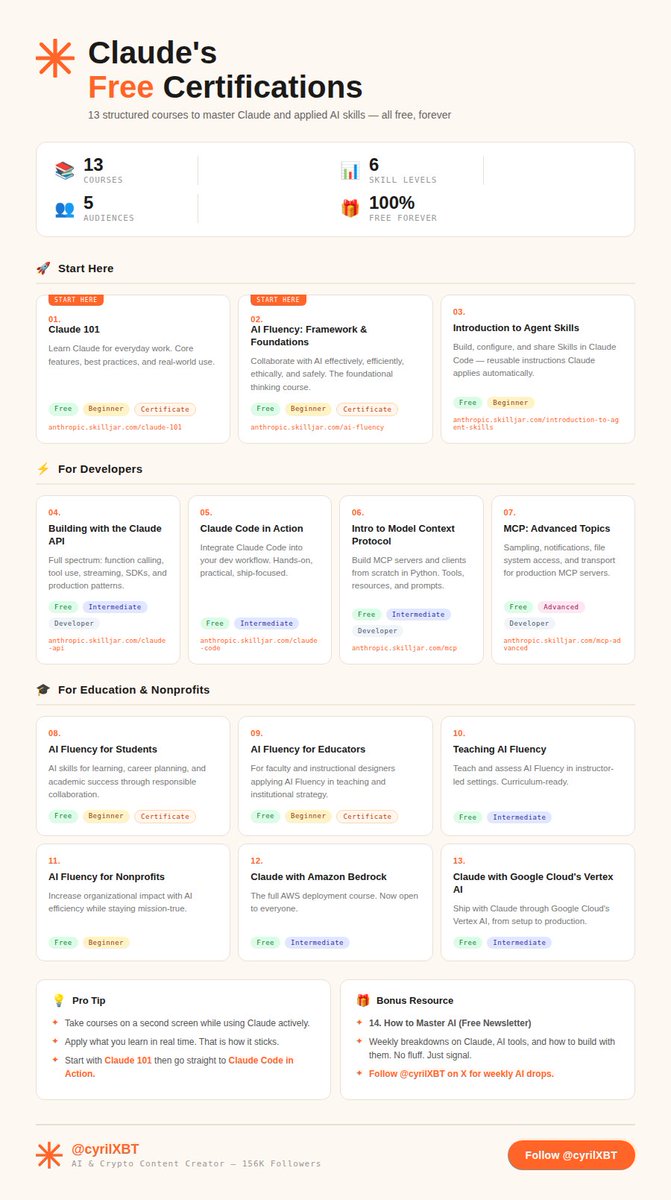
ANTHROPIC JUST DROPPED 13 FREE CLAUDE CERTIFICATIONS AND ALMOST NOBODY IS TALKING ABOUT IT.
Not a YouTube playlist.
Not a third-party course.
Official certifications from the team that built Claude.
Free. Forever.
Here is the full list with links:
START HERE
01. Claude 101 — Learn Claude for everyday work
https://t.co/7y3hN0bL8Q
02. AI Fluency: Frameworks and Foundations
https://t.co/juausxFh7O
03. Introduction to Agent Skills
https://t.co/11ZlK1OaVC
FOR DEVELOPERS
04. Building with the Claude API
https://t.co/aJAciAEw3y
05. Claude Code in Action
https://t.co/c0norD7CU0
06. Intro to Model Context Protocol
https://t.co/iywBhaZn8Z
07. MCP Advanced Topics
https://t.co/y2XQ1snBl9
FOR EDUCATION AND NONPROFITS
08. AI Fluency for Students
09. AI Fluency for Educators
10. Teaching AI Fluency
11. AI Fluency for Nonprofits
FOR ENTERPRISE
12. Claude with Amazon Bedrock
13. Claude with Google Cloud Vertex AI
13 courses. 6 skill levels. 5 audiences. 100% free forever.
The engineers getting hired at $150,000 to $300,000 to work with Claude at the highest level are learning exactly this material.
Anthropic's team just made it available to everyone.
Pro tip: Start with Claude 101 then go straight to Claude Code in Action. That is the fastest path from beginner to builder.
Bookmark this before you pay for another AI course.
Follow @cyrilXBT for every Anthropic resource that compounds your skills the moment it drops.
30 DAYS AGO, HE DID NOT KNOW WHAT AN MCP SERVER WAS.
Today he has 4 paying clients, 10 completed setups, and a waitlist forming behind a service that charges $3,000 per project.
No computer science degree. No software engineering background.
Just the thing most people have not figured out yet, built obsessively for 30 days, documented completely, and then charged for.
This is not a story about being technical.
It is a story about finding the gap before everyone else does and moving faster than the people who will eventually close it.
The entire playbook is right here.
I’M GOING ALL-IN ON CLAUDE ,Told it: find mispriced
Polymarket markets and wallets exploiting arbitrage, then build a way to copy them.
$2K → $12K in one night.
No signals. No guessing.
Scanned 1,000+ wallets, tracked behavior, timing, sizing, filtered only real edge.
You can’t beat these bots without code. But you don’t have to.
Claude built a monitoring terminal that finds profitable wallets and copies them in real time.
~500 wallets tracked, 7 actively copied, ~70% win rate.
Never sleeps. Never hesitates. Just math.
Giving This Free for 24 hours.
To get it:
1. Comment the word 'Get Claude'
2. Like and Retweet this post
3. Follow me
@ZayvenKnox
INSTEAD OF BUILDING ANOTHER APP NOBODY USES TONIGHT...
Learn how to build and sell Claude Skills.
It is not an app.
It is not a course.
It is not content.
It is a logic layer that runs inside Claude.
And right now almost nobody is selling them.
First movers win.
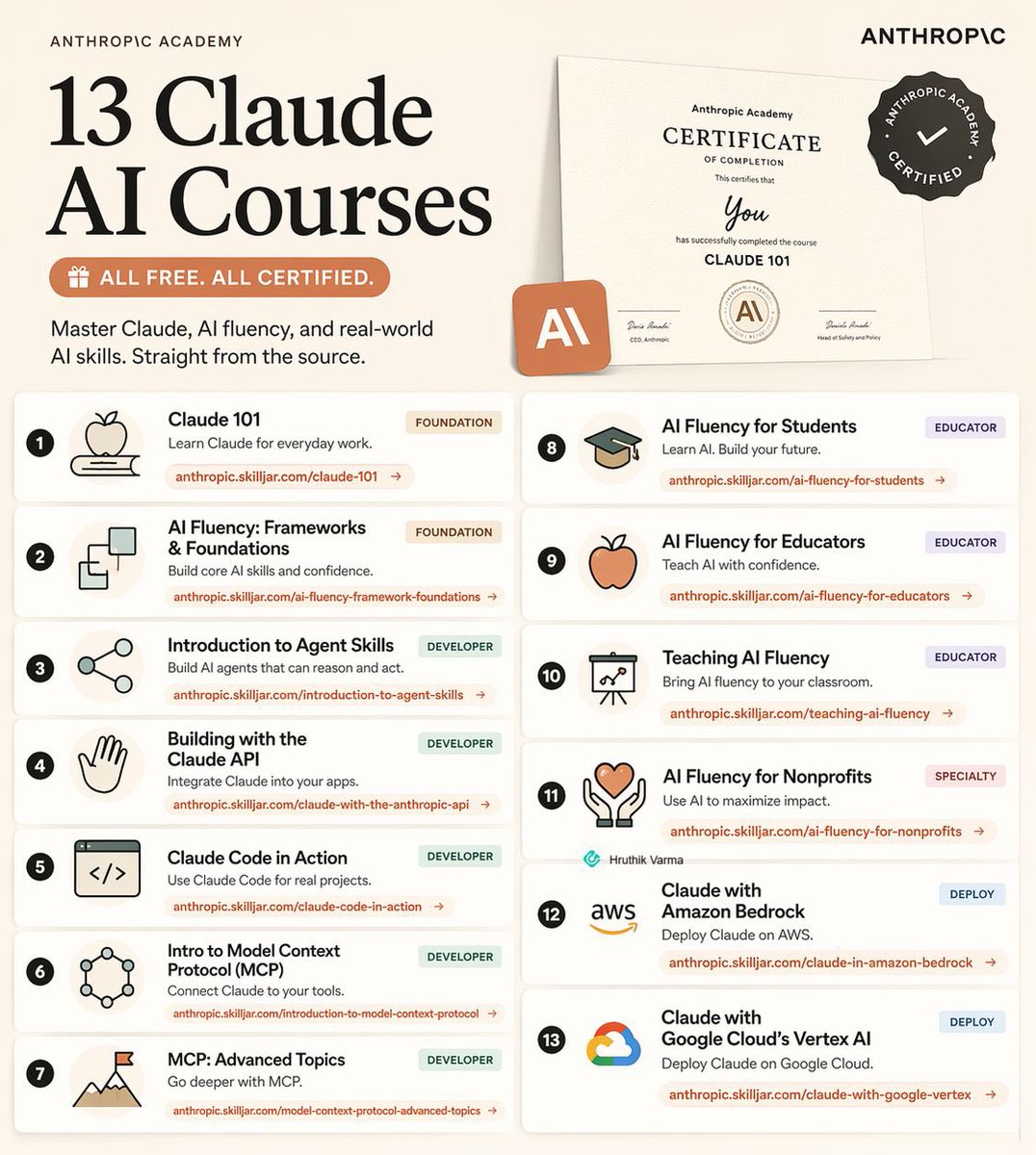
Claude just dropped 13 FREE AI courses (with certificates).
No $500 course needed.
No “guru” required.
Just real skills — straight from Anthropic.
Here’s the full list:
👇
1. Claude 101
https://t.co/lZpcdJ8BuX
2. AI Fluency: Frameworks & Foundations
https://t.co/USAV0Nq5U4
3. Introduction to Agent Skills
https://t.co/CwjLvjOnUi
4. Building with the Claude API
https://t.co/oquWGU6n0U
5. Claude Code in Action
https://t.co/r2r1GMiBaM
6. Introduction to Model Context Protocol
https://t.co/H74a7UKZoe
7. MCP: Advanced Topics
https://t.co/FGzNDboBUz
8. AI Fluency for Students
https://t.co/PKcYBT0hsx
9. AI Fluency for Educators
https://t.co/FwmI4bJ8sO
10. Teaching AI Fluency
https://t.co/IFGt8EQcvP
11. AI Fluency for Nonprofits
https://t.co/pZayqeTEdC
12. Claude with Amazon Bedrock
https://t.co/I9fpriI24s
13. Claude with Google Vertex AI
https://t.co/Kvz4uJqctq
—
If you go through even HALF of these…
You’ll be ahead of 95% of people using AI.
Most people won’t.
Because they’re still:
• Watching random YouTube videos
• Buying overpriced courses
• “Learning AI” without actually building
Don’t be that person.
Do this instead:
1. Save this post (you’ll come back to it)
2. Pick 1 course → start today
3. Share it with someone who needs this
Free. Practical. No excuses.
Charles Schwab ran the largest steel company in the world.
He had access to every consultant, every system, every productivity tool available in 1918.
He said a 15-minute conversation with a man named Ivy Lee was the most valuable business advice he ever received.
He paid him $25,000 for it. The advice fit on an index card.
Ivy Lee was not famous. He was not a philosopher or a scientist or a professor at a prestigious institution. He was a productivity consultant who had spent years watching extremely capable people fail to do their most important work, and he had developed a precise theory about why.
The theory was not complicated. It was uncomfortable.
The reason most people never do their most important work is not that they lack time. It is that they never decide what their most important work actually is. They arrive each morning at a pile of tasks with roughly equal claim on their attention, choose based on whatever feels most urgent or easiest in that moment, and spend the day moving through a list that was never designed to move them forward. They are busy in a way that feels productive and accomplishes far less than it should.
Lee asked Schwab for 15 minutes with his executive team. Schwab agreed. Lee walked them through six steps. He asked them to try it for three months and pay him whatever they thought it was worth.
Here is the system.
At the end of every workday, write down the six most important things you need to accomplish tomorrow. Not ten. Not twenty. Six. If you cannot decide what matters enough to make that list, you have already identified the real problem.
Prioritize those six items in order of their true importance. Not urgency. Not ease. Importance. The thing that will matter most three months from now goes first, regardless of how uncomfortable it is to start.
When you arrive the next morning, begin immediately on item one. Work on it until it is finished. Do not touch item two until item one is complete. Do not check email. Do not attend to whatever walked through the door. Item one, until it is done.
Move through the list in order. If you reach the end of the day and items four, five, and six remain untouched, move them to the next day's list without guilt. They were not the most important things. The most important things got done.
Repeat this process every day for the rest of your working life.
That is the entire system. Six steps. Four minutes the night before. No app required. No morning ritual. No tracking software. An index card and a pen.
What Lee understood that most productivity systems miss entirely is that the bottleneck in human performance is almost never capacity. It is prioritization. The average knowledge worker has more than enough hours in the day to accomplish something significant. What they do not have is a forcing function that makes them decide, the night before, in a calm moment free from the noise of the incoming day, what significant actually means for them tomorrow.
The morning is the worst possible time to make this decision. The morning brings email and notifications and other people's priorities and the accumulated urgency of everything that did not get done yesterday. By the time most people have decided what to work on, an hour is gone and the decision was made by their inbox rather than by them.
Lee's method moves the decision to the evening, when the day's noise has settled and the mind can assess without distraction. The prioritization is done before the chaos begins. Which means the next morning, there is no decision to make. There is only execution.
The second insight embedded in the system is the single-tasking constraint. Item one, until it is finished. Not item one until something more urgent appears. Not item one until you have checked in on items two through six. Item one, finished, before anything else receives your attention.
This runs against every instinct that modern work has trained into people. The entire infrastructure of the contemporary workplace is designed to fragment attention. Email expects a response within hours. Slack expects a response within minutes. The open office assumes that any question is more important than whatever the person being asked is currently doing. The result is a workforce that is in constant motion and making almost no progress on anything that actually matters.
Lee's method is a direct refusal of this dynamic. It does not negotiate with urgency. It does not make exceptions for whoever shouts loudest. It asks you to decide, once, what matters most, and then protect that decision from everything that will try to override it the next morning.
Charles Schwab ran Bethlehem Steel. He had seven hundred employees. He had more operational complexity, more competing demands, more legitimate urgency than most people reading this will ever face.
He tried the system for three months.
Then he sent Ivy Lee a check for $25,000 and a note saying it was the most valuable business advice he had ever received.
The system has not changed. The morning has not gotten less chaotic. The inbox has not gotten smaller.
The only variable that was ever under your control was what you decided the night before.
Six things. In order. Starting with the first.
The most valuable productivity advice in history is still free.
Most people will read it, find it obvious, and go back to checking email.
Love this @defileo .. the part u explain that I haven’t seen elsewhere is game changing:
Now you need to help your second brain get info, nobody tells you this part:
Claude Mythos is like Hiroshima for software.
everything you own online, your bank, your email, your photos, your identity, is now dangerously exposed in ways that didn't exist 48 hours ago
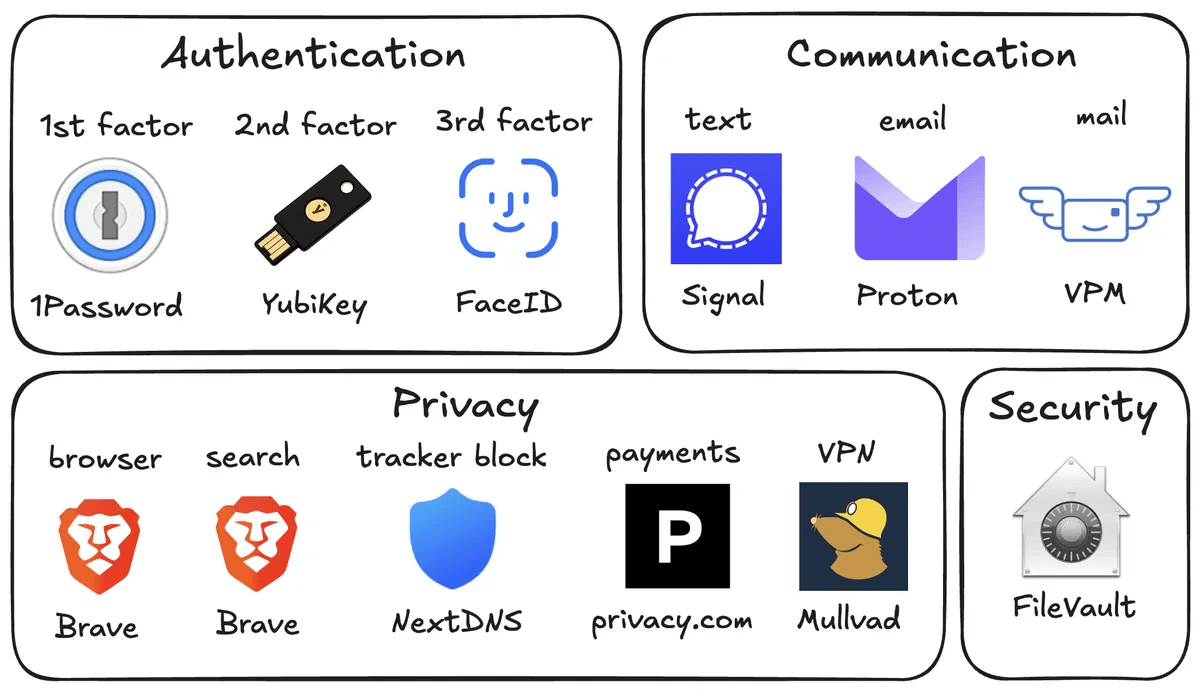
that's why Karpathy's digital hygiene guide is probably the most important thing you can read this week
here's every step to protect yourself in these uncharted times:
> use a password manager for every account
> set up physical security keys so attackers can't log in
> enable face id and fingerprint everywhere
> randomize your security question answers
> encrypt your hard drive
> get rid of unnecessary smart home devices
> switch to signal for private messaging
> use brave instead of chrome
> switch to brave search instead of google
> mint virtual credit cards for every purchase
> get a virtual mailing address
> never click links inside emails
> use a vpn on public wifi
> block ads and trackers at the dns level
> install a network monitor to see which apps are spying on you
full breakdown of each step below: