Part 2 of the Frax article explains how Frax Finance grew FRAX in the stablecoin market. It covers the stablecoin market conditions at the time and how Curve AMO played a pivotal role in its growth. Additionally, it discusses the strategies Frax employed on the Onchain platform.
TL;DR
- Frax Finance defined, through the concept of AMO, the extent to which they could issue more FRAX against their collateral assets.
- Through this leverage, they actively controlled the price of FRAX in the market while managing liquidity in the form of protocol-owned liquidity on the Curve pool.
The Stablecoin Market Conditions in 2021
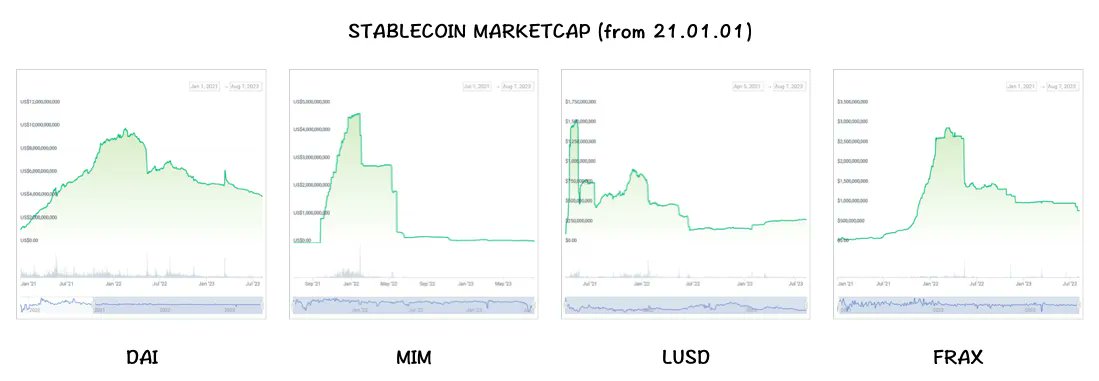
In 2021, the competition among stablecoins was fierce. Major stablecoins had already established themselves in various sectors (centralized - USDC/USDT, algorithmic - UST, leverage farming - MIM). Frax did not have a clear advantage over existing players in terms of being a store of value, a means of payment, or a lending instrument.
Limitations Faced by Frax
Frax aimed to combine the price stability of collateral-based stablecoins with the flexibility of algorithmic stablecoins through its partial algorithmic structure. However, in reality, there was a lack of demand for FRAX in the market, which hindered the increase in FRAX issuance in the market.
Challenges Frax Needed to Address
To grow its stablecoin, Frax needed to maintain price stability while creating utility that would encourage users to continuously mint FRAX. Furthermore, it had to mint as much FRAX as possible using the limited USDC reserves held by the protocol.
Interpretation of AMO and Collateral Ratio
Frax Finance introduced a system called AMO during this period, and they set different methods for calculating collateral ratios for each AMO based on how they utilized collateral assets.
Rather than considering the absolute quantity of collateral assets held by an AMO, they used the collateral ratio calculation based on how the assets were utilized. This allowed Frax to create a foundation for issuing more FRAX compared to USDC collateral, as each AMO determined the minimum price support they could offer for the FRAX they issued based on their asset utilization.
Concept of Curve AMO
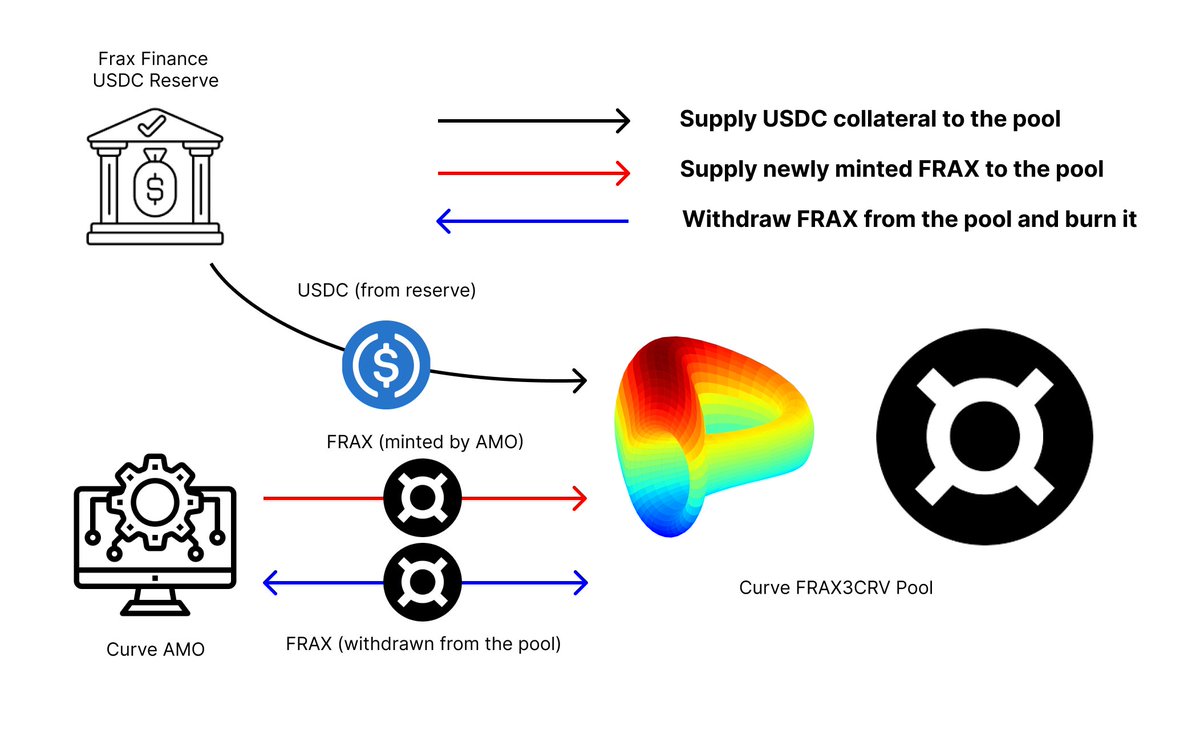
Curve AMO was introduced to create protocol-owned liquidity on the stable swap pool, which is considered the optimal DEX pool for stablecoins. Its purpose was to manage liquidity in the FRAX3CRV pool, primarily held by Frax, by adding or withdrawing liquidity according to market conditions in order to maintain the price.
Curve AMO utilized the unique trading ratio calculation method of stable swaps, interpreting the quantity of collateral assets held by Curve AMO in a way that could be expanded (this aspect can be complex and is recommended to be read in the article). This allowed for the issuance of more FRAX into the market.
FRAX issued through AMO was used to maintain the price of FRAX at $1 in the FRAX3CRV pool. For example, when the price of FRAX was too high, more FRAX was issued and added to the pool to lower the price. Conversely, when the price of FRAX was too low, FRAX was withdrawn from the pool and burned.
Impact of Curve AMO
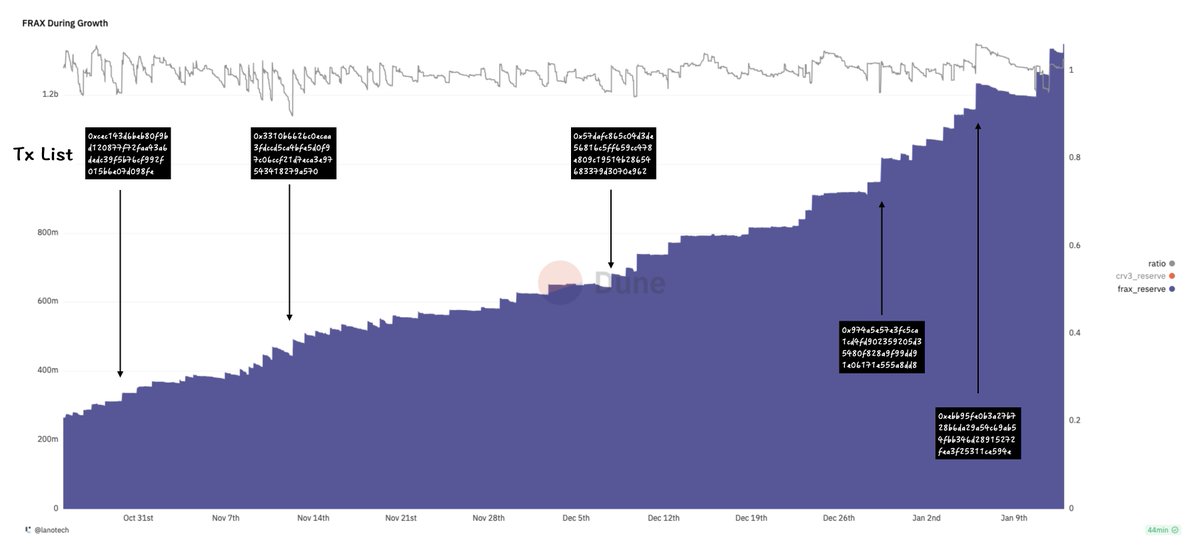
With the introduction of Curve AMO, the issuance of FRAX increased rapidly, and a significant portion of FRAX was minted in the FRAX3CRV pool through Curve AMO. Thanks to the involvement of Curve AMO, the ratio of FRAX to 3CRV tokens in the FRAX3CRV pool remained stable, allowing the pool to grow.
Impact of Curve AMO - Bull Market
Looking at the data from the growth period of the FRAX3CRV pool, we can see that the proportion of FRAX within the pool decreased continuously due to market buying of FRAX. At each instance, Curve AMO issued FRAX to supply the pool, thereby maintaining the price of FRAX at $1 while increasing the size of the FRAX3CRV pool.
It's worth noting that Frax Finance (Curve AMO) held the majority of liquidity in the FRAX3CRV pool. This allowed the Frax team to incorporate the 3CRV tokens sold by FRAX buyers into the protocol's assets. As a result, the Frax team was able to increase collateral assets in line with the increased FRAX supply.
Impact of Curve AMO - Bear Market
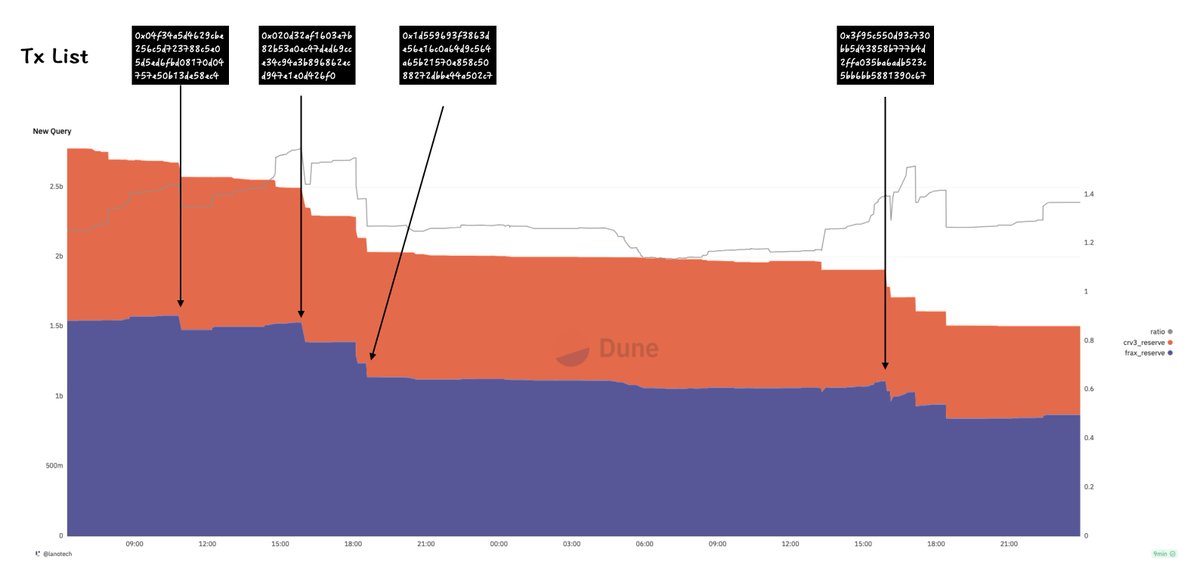
During the bear market (the time of Terra's collapse), continuous selling pressure on FRAX persisted due to uncertainty. This resulted in an ongoing increase in the proportion of FRAX within the FRAX3CRV pool. Whenever the proportion of FRAX exceeded a certain threshold, Curve AMO would withdraw FRAX from the pool.
Through these actions, Frax Finance was able to directly maintain the price of FRAX at $1 on-chain and prevent an excessive depletion of USDC collateral assets by arbitrageurs. Thanks to the proactive role of Curve AMO, FRAX has been able to maintain a stable value of $1, except during USDC de-pegging events.
For more detailed explanation, please read our article!
@fraxfinance@samkazemian
https://t.co/0tBlMEZq1t
Frax는 스테이블코인과 LSD 시장에 비교적 늦게 진입했음에도 영리한 전략을 통해 빠르게 성장했습니다. 하락장에서도 다른 경쟁사 대비 프로토콜 규모를 잘 유지했고요.
Frax가 어떻게 성장했고, 지속가능하게 했는지 분석하는 미디엄 아티클 시리즈를 시작합니다.
https://t.co/QnU8DPtYMm
The real-world asset sector is rapidly evolving. Every week there's a new protocol, deal, or regulation coming to market.
In this thread 🧵 we cover our 5 favorite go-to resources for contextualizing all the latest RWA events 👇
이 글에서 언급한 내용 외에도 저희가 의아함을 느끼고 있던 포인트들이 몇 군데 더 있었습니다.
첫번째는 isolated pool의 미사용이고, 두번째는 유저로부터 KLAY를 예치받은걸 모두 GCKlay로 변환시키면서 청산은 GCKlay로 하면서 GCKlay 유동성과 관련된 매커니즘은 하나도 사용하지 않은 겁니다.
8월 1일 밤, KLEVA에서 악성 부채가 발생하였습니다.
이는 최근에 런칭한 GCKlay 레버리지 파밍 기능에서 발생한 문제인데, 어떤 것이 문제였을지 그리고 프로토콜 상에서 이를 막을 수는 없었을지에 대해서 간단하게 글을 작성하였습니다.
https://t.co/NFnyP1L9Xa
@KLEVA_Protocol
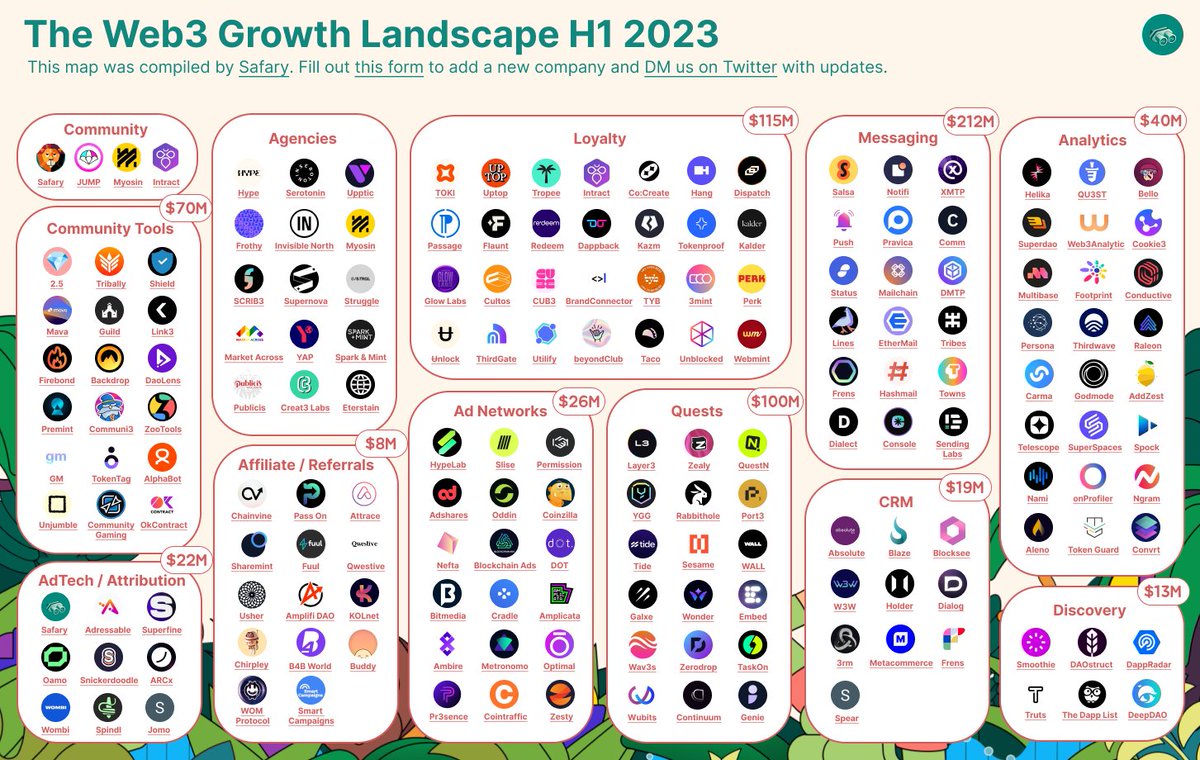
The web3 growth industry is HOT 🔥
$600M+ has been invested in teams working on growth analytics, attribution, community, messaging, adtech, incentives, and more.
We canvased the industry so you don't have to.
Introducing: The 2023 Web3 Growth Technology Landscape 🧵
1/ Token incentives play a pivotal role in fostering protocol growth.
We commonly see three core models:
+ one-time airdrops
+ ongoing rewards
+ campaign models
Let's unpack 6 case studies to understand the effectiveness of these varied token incentive models👇
@0xKofi Totally agree. Some projects already proposed a passkey-based smart wallet.
The ability to implement and deploy custom validation logic is so powerful. It will provide a series of safe and convenient way to manage our account.
If you're launching a token...
Don't do one airdrop.
Do 1000s of microairdrops.
More shots on target to get it right because let's be honest, you won't get it right on your first try.
@Flynnjamm Totally agree. Such onchain data will be the next open, public marketing/business opportunity built on composable and transparent nature of blockchain.
"What are people doing with ERC-4337 Smart Accounts?!" 🪪✨
Thanks to the wizardry of Dune Headmaster @Andrewhong5297, we've upgraded the Smart Accounts dashboard to show which protocols ERC-4337 users are interacting with the most ⚡
The frxETH v2 thread you've all been waiting for!
Here's how @fraxfinance is building the most unique, versatile, & efficient decentralized LSD protocol possible.
🧵👇
How can new projects rekt users with OTC deal(s) with market makers (MMs)?
Users analyze new projects based a lot on initial circulating supply (eg to gauge market cap via comparable analysis with a project’s counterparts), but you may fail to do it due to undisclosed OTC deals!