A welcome step from @hmtreasury this week: plans confirmed to give the @bankofengland a new secondary objective supporting #payments innovation, including #tokenisation, #DLT and digital settlement assets, alongside its financial stability mandate.
Regulatory clarity like this is what moves #programmablemoney from pilots to production. A direction we've long supported, and one that aligns closely with our work in tokenisation, execution and settlement.
Learn more: https://t.co/NcasKkAwD8
Crypto-backed mortgages have moved in.
Borrowers in the US can now use Bitcoin as collateral for a down payment - without having to sell it or face margin calls.
Plus, Coinbase One members can get up to $10,000 back at closing.
Quant's docs list staked QNT as a factor in which node serves your request
Every call through @quantnetwork's Overledger passes a Connector, one per blockchain family, which checks node health and routes the request to a healthy node from its pool. Selection weighs each node's rolling latency and recent error rate.
On public networks, the docs list a third input: the amount of $QNT staked against a node. Nodes that trip their limits drop out of rotation until a reconnection policy readmits them, with Quant's shared nodes as the backup when nothing scores higher.
The staking chapter is still marked as "under construction", tied to a testnet experience, so no live rewards are claimed here.
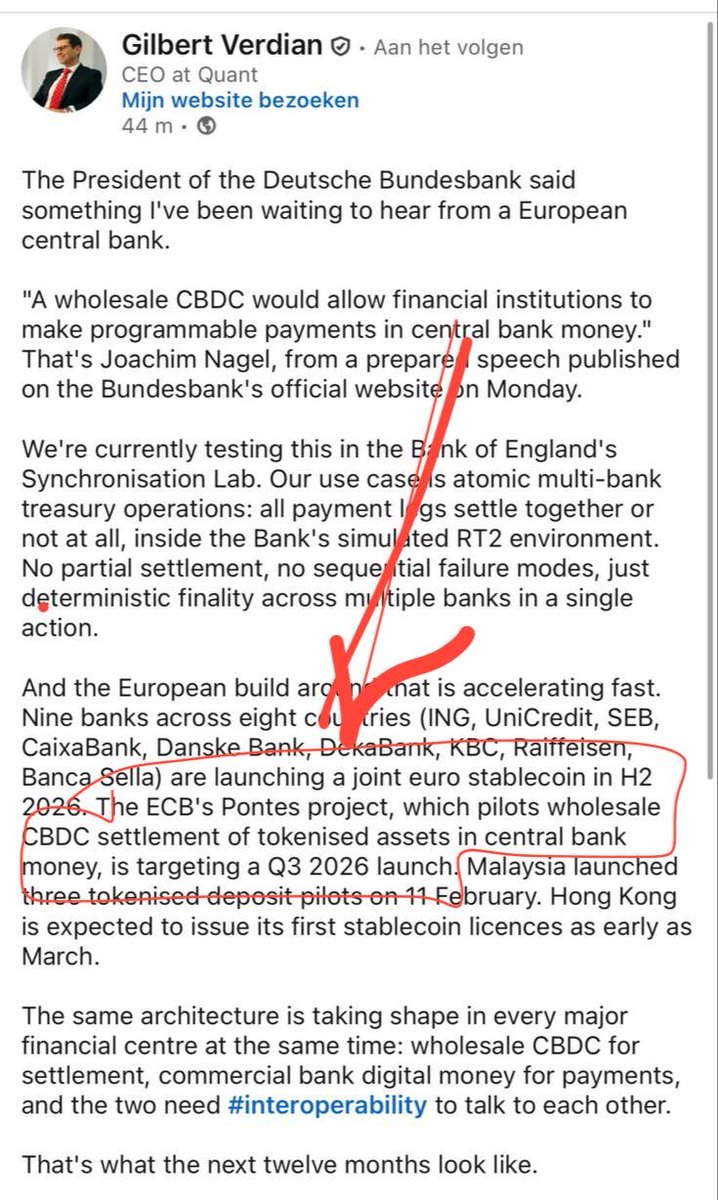
Settlement is where #digitalasset infrastructure gets tested at scale, specifically what happens when the cash leg has to move in lockstep with the asset leg, across multiple banks, accounts and currencies.
This isn't theoretical. Quant is one of 18 firms participating in the Bank of England's #SynchronisationLab as a Synchronisation Operator, testing synchronised multi-bank treasury rebalancing: large corporates coordinating transfers across several banks as a single settlement bundle, rather than as sequential legs each carrying its own exposure.
Discover where the infrastructure is heading, and what institutions building now need to solve for in this article: https://t.co/g2NsJ0Sy1x
#ProgrammableSettlement
Before a bank writes a single line of code for #tokeniseddeposits, there's one architectural decision that shapes everything downstream: where the fiat sits, and which ledger is authoritative for customer positions.
Choosing it late or getting it wrong is an expensive mistake to unwind once a programme is already underway.
In this joint piece with @Capgemini, we break down two account models for tokenised deposits:
- Mirror model - core banking stays the source of truth, the token is a synchronised 1:1 representation
- Omnibus model - a single pooled reserve backs all tokens, and the token ledger becomes authoritative
Neither is universally right. This paper covers where each model holds up, where it strains, and the five-layer architecture emerging for legacy-to-DLT integration: https://t.co/3F1dmHYElR
#Payments #DLT
Quant's Fusion Rollup turns seven copies of USDC into one asset
A stablecoin like $USDC exists as separate, incompatible versions across chains such as Ethereum, Solana and Base, each with its own liquidity pool. Institutions holding it across networks manage seven balances rather than one.
@quantnetwork's Fusion Rollup, live on mainnet since June 2, represents the same token as a single canonical asset inside one execution environment connected to 74 networks. Quant calls the unified versions uUSDC and uBUIDL, one asset with one pool of liquidity.
Each asset keeps its anchoring to its origin chain and can be withdrawn back at any time. Quant describes the design as a Layer 2.5, since $QNT's rollup isn't bound to a single base chain.
Quant runs Overledger the way banks buy software, and that's the design
@quant_network's Overledger is not a blockchain but an API gateway, passing data and instructions between chains and bank systems without imposing any consensus of its own, per Quant's site.
ethereum:0x4a220e6096b25eadb88358cb44068a3248254675 buys access, with paid plans, KYC checks and standard commercial terms handled by Quant Network Ltd directly, per Blockworks' transparency filing. There is no foundation or DAO in the loop, which is unusual for crypto and entirely normal for the enterprise clients Quant sells to.
The newer Fusion rollup extends the same model, with approved node operators staking QNT and Quant running the sequencer.
ethereum:0x4a220e6096b25eadb88358cb44068a3248254675 I get happy the lower it goes so I can scoop more. Another $500 added today. One day soon we will look back and thank ourselves
Seven banks. One shared orchestration layer. Processing real transactions today.
We did it first with UK banks and the Great British Tokenised Deposits (GBTD) initiative. At @Sibos 2026 Miami, we're showing what it could look like worldwide.
Catch us on stage:
🎤 Mon 28 Sept, 10:30am - Discover Stage
🎤 Thu 1 Oct, 1:45pm - Conference Stage 4
Book time with the team: https://t.co/g1yJaw7mbm
#TokenisedDeposits #CrossBorderSettlement #ProgrammableMoney #Sibos