1/ Been thinking a lot about this lately:
What if the cycle everyone was waiting for actually ended in early December 2024 and we’ve already been in a bear market for almost a full year? The OTHERS chart (total crypto market cap excluding the top 10 coins) is the best way to visualize this.
Woke up extremely bullish on DeFi and Ethereum today
Uniswap launched in the 2018 bear, when Ethereum sentiment was at all time lows
Uniswap and other defi projects relentlessly built through that bear market and proved how powerful Ethereum can be, catalyzing defi summer and everything since
Now vibes are down bad again and Uniswap intends to build our way out of it. Last time it was by proving defi is possible. This time it will be by proving defi is inevitable.
The internet brought two disruptive changes: existing businesses moving onto the internet, and the formation of new internet-native businesses
The same duality will exist for defi: the tokenization of all existing assets, and a growing vibrant economy of crypto native assets. And it’s all happening right now, with more and more assets being brought onchain, increasing the value and productivity of crypto native assets.
As this digital economy grows, Defi is being integrated everywhere - payment processors, brokerage accounts, asset issuers. It won't stop until we eat the entire global economy
Uniswap the liquidity layer + Ethereum the settlement layer. The perfect combination of low counterparty risk, permissionless, programmable infrastructure
And all this will result in huge growth in protocol volumes and fee generation. Which reminds me:
UNI burn hit all time highs today, after several new sources of protocol fees came online.
And there are many more to come: v4, uniswap x, aggregator hooks, more chains, etc
Now add in all the new assets coming onchain
We're still at the beginning 🦄
I completely agree Dan. The next stage of crypto and BTC from an investment perspective should come in the application layer of Jensen Huang’s five layer cake with is basically related to software for the agentic world. Right now stocks are being driven by the chip, energy and infrastructure layers of the stack. I expect soon, the investor attention to look for ideas not subject to the bottlenecks and that is when I would expect BTC and crypto to break away from stocks but this time on the upside.
@Sykodelic_ Seeing similarities with 2015 as well but BTC really need to start showing some strength and avoid seeing the RSI dipping back below 30 again. Just my 2 gwei
The Ethereum not ETH stuff is the mental fallacy that triggered me into writing and podcasting in the first place.
There is no strong Ethereum without an ETH worth trillions. Without ETH as a global store of value, Ethereum is a failed project. Full stop.
ETH is economic bandwidth for DeFi. It is the only asset maximized for CROPs, fail at high value ETH, fail at CROPs, fail at Ethereum.
Saying you’re bullish Ethereum not ETH is like saying you’re bullish America not the American economy. They are one and the same - economic engines.
Better to admit Ethereum is a failed project than “Ethereum not ETH”.
So spew that weak blockchain not crypto stuff out of your mouth, it doesn’t make sense for BTC, ZEC, ETH, or any truly crypto native project.
1/ ETH is the best positioned asset:
- To become self sovereign money
- To have a native, uncorrelated yield
- To be globally censorship resistant
- To have customizable privacy
- To be quantum resistant
- To stay decentralized
- To achieve the potential BTC was supposed to
The Bull Case for Ethereum in 2026 - @CloutedMind
0:00 - ETH Sentiment at Eternal Lows
04:30 - [Power Tools]
04:50 - EF Leadership, Vitalik, Value Accrual
09:30 - The “Tech” vs The “Value”
11:20 - $HYPE & $ETH: Solving Financial Problems
15:40 - Clouted on Hyperliquid
21:40 - CROPS: Sovereignty & Security
23:50 - Crypto Conferences are Depressing as Fuck
31:00 - @eth_strategy 2026 Update
36:00 - ETH as Collateral on @synthetix
37:00 - @MicroStrategy & STRC FUD is Overblown
41:30 - Saylor’s “Bad” Bids are Hidden Fees/Rakes
43:50 - Why Bitmine & @fundstrat Will Win
46:24 - The New Bull Case for @ethereum
51:50 - The Most Valuable Things in the World
57:30 - The Future of ETH Must Be Unfuckwithable
⚡️Stablecoins are being absorbed into the legacy payments empire before they fully escape it.
That is the whole move.
Visa and Mastercard can see the threat clearly.
Stablecoins attack the deepest part of their model: settlement friction, cross-border fees, merchant fees, card-network dependency, and the need for banks/payment processors to sit between buyer and seller.
Stripe sees the opportunity from the merchant/software side. Coinbase sees the bridge from crypto custody/liquidity into mainstream dollar payments.
Put those together and the shape is obvious: the incumbents are trying to own the stablecoin transition rather than get routed around by it.
This is regulated dollar infrastructure.
The people replying “this is centralized” are right, but they are missing the bigger point. Of course it is centralized. That is why it can scale into mainstream commerce. The mass market does not want seed phrases, bridge risk, fragmented liquidity, or ideological purity. Merchants want lower fees, faster settlement, fewer chargebacks, cleaner APIs, global reach, and accounting that works. Enterprises want compliance. Regulators want visibility. Networks want control.
This is the institutional stablecoin phase.
Stablecoins started as crypto-native liquidity instruments. Then they became offshore dollar rails. Now they are being pulled into the core payments stack. That means the next phase is not just “crypto adoption.” It is dollar settlement moving onto programmable rails under corporate and regulatory control.
The float question is the real money.
Who holds the reserves? Who earns the yield? Who controls redemption? Who owns the customer relationship? Who sees transaction data? Who sets compliance rules? Who can freeze, reverse, blacklist, or censor flows? That is where the power sits.
If Visa, Mastercard, Stripe, and Coinbase coordinate around a stablecoin platform, they are not launching a toy. They are positioning around the future settlement layer for internet commerce. The token itself may be boring. The control surface is not.
This is also a shot at banks. Banks have lived off deposits, payment rails, card relationships, settlement friction, and regulatory enclosure. Stablecoins threaten to peel away part of the transaction layer. The banks will not disappear, but their monopoly over money movement gets squeezed if stablecoin settlement becomes native to merchant platforms and wallets.
The big risk for card networks is cannibalization. The big opportunity is control. If they wait, stablecoins compress them. If they lead, they can turn stablecoins into another network layer and preserve relevance.
For Coinbase, this is structurally bullish. It places them closer to the regulated interface between crypto liquidity and mainstream commerce. Coinbase does not need every user to become a crypto trader. The bigger game is becoming infrastructure for onchain dollars, custody, compliance, wallets, conversion, and settlement.
For Bitcoin, this is indirectly bullish in the long arc because it further normalizes crypto rails as real financial infrastructure. But it also reinforces the split: Bitcoin remains neutral collateral, while stablecoins become regulated transactional dollars. Different roles. Bitcoin is exit. Stablecoins are upgraded dollar plumbing.
The clean truth:
This is the payment giants conceding that stablecoins are real while trying to make sure the revolution settles through them.
That is the phase shift.
Stablecoins are no longer fringe crypto instruments.
They are becoming the programmable settlement layer the incumbents now have to capture, defend, monetize, and regulate.
While Saylor is testing selling BTC...
and Charles is delivering eulogies for Cardano...
and Solana’s validator count continues to decline and the memecoin casino is over...
and BTC miners are entering existential panic mode...
and while everyone is freaking out about price...
ETH’s supply staked just hit a new ATH.
Introducing ETH as Margin on Synthetix ⚔️
For the first time in the history of @ethereum, you can now use ETH as native collateral for trading perps on Ethereum Mainnet:
🔹 Trade without selling $ETH
🔹 Zero bridge risk
🔹 Seamless basis trades
🔹 Capital efficient margin
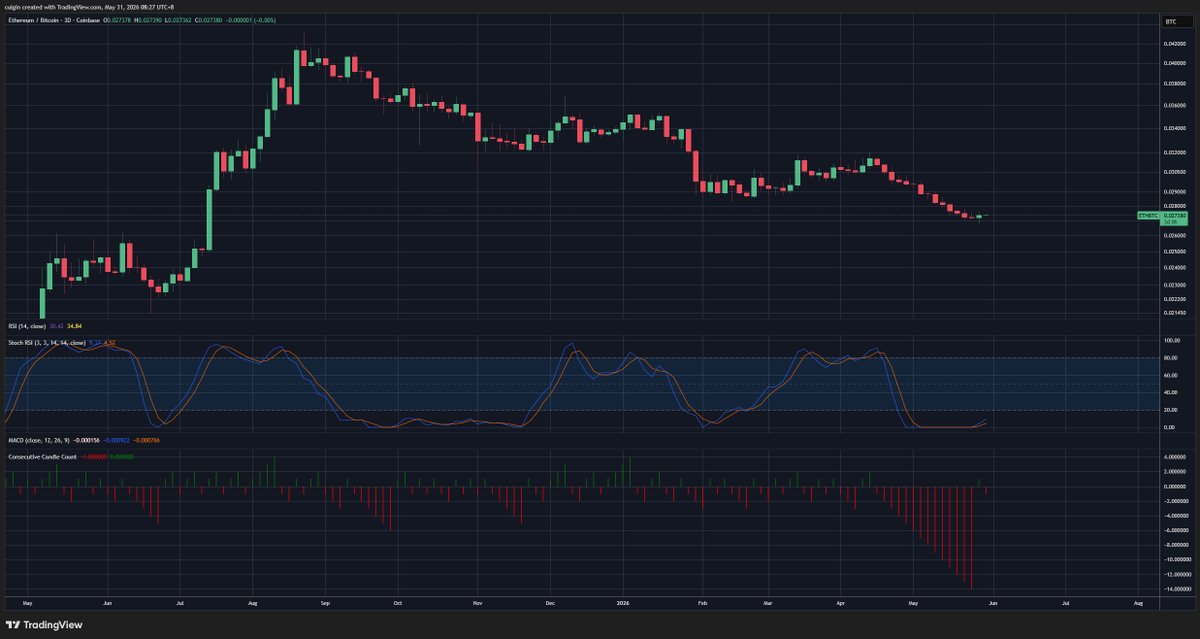
14 consecutive red candles on the ETH/BTC 3-day chart; the longest streak in history, blowing past the previous record of 9.
The latest candle just closed green. Maybe this is the start of somETHing.
Tom Lee: Ethereum DATs can use ~$500 million in annual staking rewards to fund grants for Ethereum ecosystem
“The Ethereum Treasuries — Bitmine and Sharplink among others — now own 7% of the Ethereum supply… Treasury stock is essentially supply permanently taken out from the ecosystem, but we also own the yield. The yield is around 3% so today these public treasuries are generating ~$500 million in rewards, and that is what we can use to fund and grant the crypto ecosystem.”
Lee believes that the Ethereum Foundation narrowing its focus to CROPs (censorship resistance, openness, privacy and security) is the right decision.
“Ethereum is a $240 billion network value entity. It has been operating for 11 years without a single day of downtime. There’s 11,500 nodes in 89 different countries. And there’s 15,000 developers. I think this is too big to be coordinated by a single foundation.”
As Ethereum continues to scale, he believes the ecosystem will move beyond a foundation-centric model and points to private companies like Etherealize, Optimism, Consensys, Enterprise Ethereum Alliance, and Offchain Labs that represent the Ethereum ecosystem and are already doing enterprise engagement.
“This list doesn’t yet reflect the spinoffs coming from the Ethereum Foundation. There’s at least five, and I think Bitmine will play a role in granting and supporting any of those that come out.”
“I think Ethereum is in good hands because the foundation is going to be stronger by staying focused. We have a lot of private sector companies already building products and important L2s on Ethereum. And of course, the treasuries are here to help with funding and granting… If you’re bearish, you are selling at the bottom.”