When you restake tokens using Exocore, they don't cross a bridge.
The tokens stay on their native chain (custodied by you).
Exocore simply monitors state changes using #zk light clients for cross-chain communication. State data is validated with Exocore's decentralized L1 network.
Why implement Exocore as an L1 and not a series of complicated smart contracts?
1️⃣ Security
The more complicated a smart contract, the more likely a vulnerability will eventually be exploited, no matter how many audit badges it has.
Exocore uses only minimal logic on native chains, handling most complexity at the protocol level through the Exocore decentralized L1 network. This system has less smart contract risk and lower probability of overloading social consensus of the underlying native chain.
2️⃣ Decentralization
Because community validators verify state data using restaked tokens, and participate in consensus around slashing conditions, Exocore is governed by a decentralized network of validators and restakers instead of a small group of people operating a multisig wallet.
On Exocore, you actually own the network you're #restaking on.
3️⃣ Cost
Smart contract operations on Ethereum tend to be costly. Ethereum's roll-up strategy is designed to solve the issue of high gas fees. However, that doesn't help a smart contract platform for restaking native ETH.
The high gas fees for getting into a restaking contract eat into the restaking yield, which reduces the rewards for restakers. Exocore minimizes cost by simplifying the smart contract operations on native chains such as Ethereum.
Further, Exocore is an L1 optimized for restaking, so fees will be negligible.
When you restake tokens using Exocore, they don't cross a bridge.
The tokens stay on their native chain (custodied by you).
Exocore simply monitors state changes using #zk light clients for cross-chain communication. State data is validated with Exocore's decentralized L1 network.
Why implement Exocore as an L1 and not a series of complicated smart contracts?
1️⃣ Security
The more complicated a smart contract, the more likely a vulnerability will eventually be exploited, no matter how many audit badges it has.
Exocore uses only minimal logic on native chains, handling most complexity at the protocol level through the Exocore decentralized L1 network. This system has less smart contract risk and lower probability of overloading social consensus of the underlying native chain.
2️⃣ Decentralization
Because community validators verify state data using restaked tokens, and participate in consensus around slashing conditions, Exocore is governed by a decentralized network of validators and restakers instead of a small group of people operating a multisig wallet.
On Exocore, you actually own the network you're #restaking on.
3️⃣ Cost
Smart contract operations on Ethereum tend to be costly. Ethereum's roll-up strategy is designed to solve the issue of high gas fees. However, that doesn't help a smart contract platform for restaking native ETH.
The high gas fees for getting into a restaking contract eat into the restaking yield, which reduces the rewards for restakers. Exocore minimizes cost by simplifying the smart contract operations on native chains such as Ethereum.
Further, Exocore is an L1 optimized for restaking, so fees will be negligible.
Restaking began as a capital-efficient way to extend the decentralized trust of Ethereum's crypto-economic security to AVSs on Ethereum.
But the current state of restaking still falls short of solving the core problem that blockchains are fragmented trust networks and also introduces a few new problems.
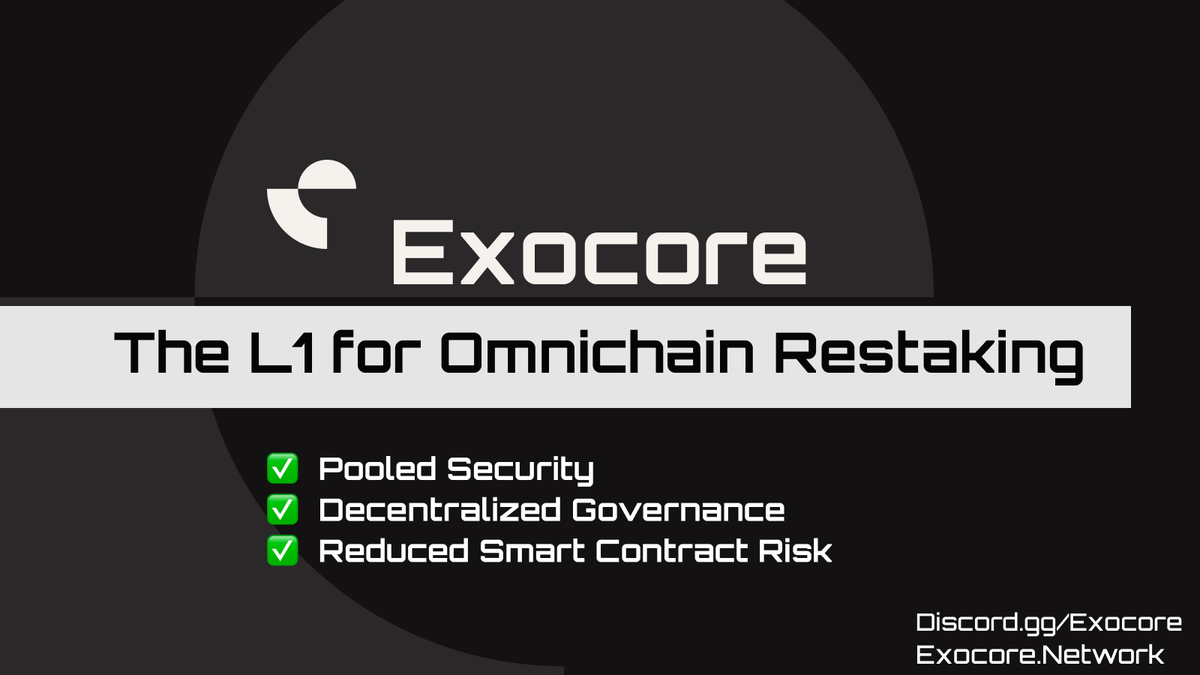
As a solution, Exocore introduces #omnichain restaking, which has ⤵️
1️⃣ Pooled security
2️⃣ Decentralized governance
3️⃣ Reduced smart contract risk
🛡️ Pooled Security
Instead of siloing decentralized security on a single chain (single-player mode), Exocore's omnichain model aggregates the crypto-economic security across multiple chains (massive multiplayer mode) to secure off-chain actively validated services (AVSs) such as bridges, oracles, RPC infra, modular components and more.
🗳️ Decentralized Governance
Instead of a centralized model of governance via multi-sig, Exocore is an L1 for restaking, run by a decentralized network of validators. Exocore's decentralized architecture will drive community governance and ownership. An open market for decentralized trust should be built with decentralized governance.
⛓️ Reduced Smart Contract Risk
Instead of implementing all of the complex restaking logic within the smart contract layer, Exocore handles the complexity of the staking logic at the protocol level. By minimizing the logic needed on smart contracts, Exocore reduces the risk of smart contract vulnerabilities.
In summary, Exocore's omnichain #restaking model pools crypto-economic security across multiple chains, makes restaking more decentralized, and reduces smart contract risk. This results in a new paradigm to extend decentralized trust everywhere.
🔥Swaps are now available in the Telegram wallet!
💸 $NEAR - $USDT swaps go through a decentralized exchange @finance_ref and the "Swap" button appears if you have at least 0.2 $NEAR on your balance.
🌱 We continue to implement features of a full-fledged web3 wallet for smooth onboarding of users. 🦄
𝗚𝗶𝘃𝗲𝗮𝘄𝗮𝘆 𝗔𝗹𝗲𝗿𝘁 🤑🤑
Binance will list the $PIXEL token on February 19, 2024.
I will give $𝟏𝟎𝟎 to one person who will make a correct prediction about the peak price of the PIXEL/USDT on #Binance
To Win 💰
💥 Like this tweet
💥 Repost it
💥 Follow @wiseadvicesumit and @moneygurusumit
𝗚𝗶𝘃𝗲𝗮𝘄𝗮𝘆 𝗔𝗹𝗲𝗿𝘁 🤑🤑
Binance will list the $PIXEL token on February 19, 2024.
I will give $𝟏𝟎𝟎 to one person who will make a correct prediction about the peak price of the PIXEL/USDT on #Binance
To Win 💰
💥 Like this tweet
💥 Repost it
💥 Follow @wiseadvicesumit and @moneygurusumit