1️⃣ @gaib_ai is stepping into robotics!
They are powering the Embodied AI revolution, bringing robots onchain as a new source of yield & investment for AID and sAID assets.
Here’s why this matters & how you can be part of it🧵
The missing link between AI and DeFi .
DeFi revolutionized how we think about money. It took capital once locked up in banks, funds, and traditional finance and made it Liquid, Accessible, and Programmable.
Now, @gaib_ai is bringing the same concept to compute.
Think about GPUs, which is the Heart of AI, Training, inference, scaling everything relies on access to high-performance compute. But the reality? Most GPU power is underutilized. Some sit idle in data centers. Others are siloed in private clusters. Access is fragmented, expensive, and heavily centralized in the hands of a few providers.
GAIB flips this dynamic.
By introducing GPU Liquidity Pools, GAIB enables a decentralized marketplace where compute isn’t wasted. Instead, it is Tokenized, Pooled, and made liquid. Supply meets demand in real-time. Developers, startups, and institutions can borrow GPU resources just like they borrow liquidity in DeFi. On the other side, providers can earn yield on otherwise idle hardware, similar to how capital providers earn in liquidity pools today.
This unlocks powerful features:
1️⃣Efficiency: No idle GPUs; all compute can be put to productive use.
2️⃣Accessibility: Smaller players, not just giants, can access top-tier compute.
3️⃣Liquidity: Compute itself becomes tradable, stake-able, and collectable.
4️⃣Programmability: Developers can build new financial + AI products on top of tokenized compute.
Just like Uniswap made markets for any token, @gaib_ai could make markets for compute power itself.
🔸The implication is huge: Compute transforms from a static resource into a liquid asset class. For investors, it means new forms of yield. For builders, it means cheaper, faster, and more scalable AI. For the ecosystem, it means the true merging of AI x DeFi in a way we haven’t seen before.
Liquidity isn’t just about money anymore, its about compute. And GAIB is setting the stage.
Not all investors approach AI the same way.
@gaib_ai ’s tokenized AI infrastructure is designed to serve both retail and institutional players but the benefits look different.
🟠Retail Investors:
Traditionally locked out of big AI infra plays (think multi-billion dollar GPU clusters or robotics R&D), retail gets fractional exposure through GAIB. With AID & sAID, they can:
1️⃣Access AI yields with small deposits.
2️⃣Stay liquid with tradable tokens.
3️⃣Diversify without needing insider access or huge capital.
GAIB makes the “AI economy” investable for anyone with a wallet.
🟠Institutional Investors:
Institutions seek scale, stability, and structured products. Through GAIB, they can:
1️⃣Allocate large sums into tokenized AI infra with transparent yield models.
2️⃣Hedge or leverage positions using DeFi strategies.
3️⃣Gain exposure to a new asset class (AI infra) without direct operational overhead.
For them, GAIB offers a regulated-friendly, liquid gateway into AI infra without building the infra themselves.
The Bridge:
Retail gets access they never had before. Institutions get efficiency and liquidity they couldn’t get in TradFi markets. Together, both sides feed into a stronger, more liquid GAIB ecosystem.
GAIB isn’t just leveling the playing field, it’s building a new one. 🟠
Most DeFi yields today are built on token incentives, liquidity mining, or speculative trading volume. Exciting in the short term, but once incentives dry up or hype fades, the yields collapse, classic ponzinomics.
@gaib_ai flips this model. Instead of relying on speculation, it ties yields to real-world demand for compute: GPUs training large models, serving inference, or powering robotics workloads. Every time a lab, startup, or researcher rents compute, that demand creates revenue. Revenue flows back into the system, generating yields for investors without endless token emissions.
This makes yields more predictable, linked to real demand, and less correlated with speculative swings. Not “farm & dump,” but sustainable finance.
And this is where the synergy really happens: DeFi provides the rails, liquidity, lending markets, staking, and composability. AI provides the engine, an unstoppable market for compute. GAIB is the bridge that connects them.
The result? Robust, scalable yields that grow alongside AI adoption. For investors, it means gaining exposure to one of the fastest-growing industries without needing billions like Meta or xAI. For DeFi, it means moving beyond hype into real-world, revenue-backed assets.
That’s the future of AI x DeFi synergy, durable, demand-driven yields, powered by GAIB.
Why @gaib_ai Could Make AI Cheaper Over Time.
AI today is bottlenecked not by Ideas, not by Talent, but by Compute. Training frontier models or even running inference at scale is brutally expensive. Why? Because access to GPUs is centralized, scarce, and priced with fat margins by a handful of cloud providers.
This creates a Paradox: AI wants to scale exponentially, but compute costs drag like an anchor.
GAIB introduces a new market dynamic. By tokenizing GPU resources into a decentralized, liquid marketplace, GAIB doesn’t just make compute accessible, it has the potential to drive costs down over time. Here’s why:
1️⃣. Idle supply gets unlocked:
GPUs sitting unused in data centers or private clusters are currently wasted capacity. GAIB’s pools give those GPUs a market, increasing total supply available. More supply = downward pressure on price.
2️⃣. Competition replaces monopoly pricing:
Instead of a few cloud giants setting rates, GAIB enables a marketplace where many providers compete. Decentralized price discovery naturally trends toward efficiency, not artificial scarcity.
3️⃣. Efficiency compounds:
When compute is tokenized, it becomes tradable, lendable, stake-able. This liquidity unlocks secondary markets and risk-sharing mechanisms that squeeze out waste and lower effective costs.
4️⃣. Deflationary loop:
As more participants stake GPUs for yield, total available compute rises. As utilization increases, costs per unit drop. As costs drop, Demand rises (more researchers, startups, and apps can afford AI).
Demand - Utilization - Scale - Lower marginal cost. It’s the same flywheel that drove down costs in renewable energy and cloud storage.
⏪So the bold idea: Could GAIB make AI training and inference cheaper over time?
⏩Yes, because decentralized markets with abundant liquidity historically compresses costs while still rewarding providers fairly.
🟠 Developers: Lower costs to build apps.
🟠 Researchers: Cheaper experiments.
🟠 Investors: Exposure to a real, growing market powered by efficiency, where yields don’t depend on ponzinomics but on actual deflationary efficiencies in one of the fastest-growing industries in the world.
The dream isn’t just access to GPUs. It’s a future where AI compute itself becomes a deflationary asset, the more the network grows, the cheaper it gets to build intelligence.
That’s what GAIB is really aiming at: breaking the compute bottleneck, not with subsidies or incentives, but with market design.
When you hear “Spice” in @gaib_ai, think of it as the testbed economy, a place where Users, Investors, and the Protocol itself can experiment before the launch of AID on mainnet. It’s not just a side-token; it’s a training ground for the future AI economy.
1️⃣. Why Spice matters:
Spice isn’t about hype, it’s about stress-testing.
It lets GAIB test token flows, yields, and strategies in a live environment.
Users can experience the system, try out DeFi integrations, and understand the risk/reward dynamics.
It creates a feedback loop: GAIB learns from user behavior, while users earn yield + rewards for participating.
2️⃣. How Spice ties into AID Alpha:
Spice campaigns are directly linked to AID Alpha, GAIB’s flagship product that turns AI compute into investable DeFi assets.
By joining Spice campaigns, you get points, multipliers, and rewards that will matter when AID Alpha goes live.
It’s essentially the preseason: what you do in Spice helps shape your position in the mainnet launch.
3️⃣. The risk/reward playground:
Spice is designed as a sandbox for strategies. You can:
🔸Try Pendle strategies for boosted yields
🔸Borrow on Morpho against PT-AIDa
🔸Stake and loop assets in different DeFi integrations
Here, the yields can be high, but the risks are real just like any playground, you learn by playing. This gives users a chance to explore without committing fully to mainnet capital.
4️⃣. Why this is important before mainnet:
🔸It decentralizes early participation not just whales or institutions.
🔸It builds a community of trained users who know how to maximize AID Alpha when it officially launches.
🔸It ensures GAIB’s system is battle-tested, so when real AI compute liquidity flows in, it’s ready to scale smoothly.
🟠The takeaway:
Spice isn’t just a side campaign. It’s GAIB’s economic warm-up, where risk and reward meet before the big game.
If AID Alpha is the future of tokenized AI infra, then Spice is the proving ground where early players earn their edge.
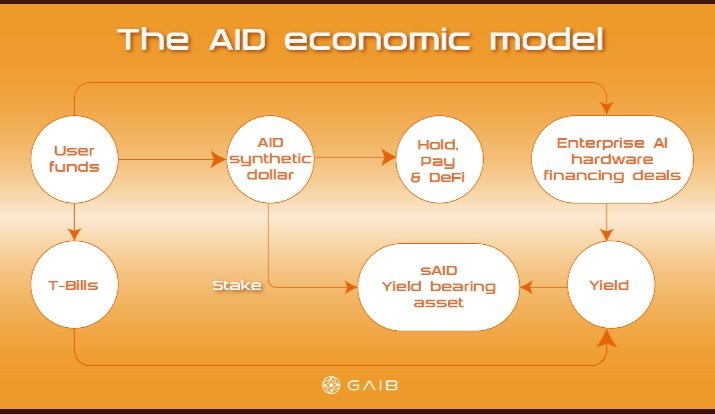
If you're struggling to understand the GAIB and AID economic model, this is your post!
The world runs on compute. And compute runs on money.
Imagine you could borrow the most powerful computers in the world, the kind normally locked away in big tech labs, anytime you wanted, without buying them or even touching them.
AI is like a super-demanding race. You need massive horsepower to make it run fast and well.
That’s what GPUs give you: they can handle billions of calculations at lightning speed. That’s why all serious AI work happens on big, powerful GPUs.
@gaib_ai is building a system where your money doesn’t just sit there; it works by powering real AI infrastructure.
Here’s how it works plainly:
1. You deposit funds or buy AID in an exchange.
Those funds go into two purposes:
-Financing GPU acquisitions for data centers powering AI.
-A reserve of U.S. Treasury Bills for added economic stability.
You now have AID, a synthetic dollar you can use in DeFi, pay with, or hold.
But here’s the best part, if you want your money to earn, you can stake AID to get sAID, a yield-bearing token.
What happens when you stake?
1. Your staked funds help support the AI economy.
2. Real data centers borrow that capital to buy and operate GPU power for AI workloads.
3. They pay interest on that borrowed capital.
4. That interest (plus earnings from the Treasury reserves) gets passed back to you as yield.
You now hold AID, a stable, blockchain-based dollar you can spend, trade, or hold.
This means:
-You’re helping fund the AI infrastructure boom.
-You’re earning real returns from actual GPU usage, not speculation.
-Your funds remain liquid; you can move them around or spend them at any time.
Why this matters:
Most DeFi projects make a yield from short-term trading or risky token games. @gaib_ai is different; it’s directly connecting off-chain compute demand (people and companies needing GPUs) with on-chain capital (your money).
It’s like if you could invest in the power grid of AI , and get paid every time someone turns on the lights.
TL;DR
Deposit → Get AID (GPU + Treasury-backed stablecoin)
Stake AID → Get sAID (earns yield)
Yield comes from real-world GPU deals + safe treasury interest.
In other words, GAIB lets you own a piece of the AI economy, without having to buy a single GPU yourself.
Most AI today is locked in one place, running on one company’s servers.
@gaib_ai flips that model by tapping idle GPUs from anywhere in the world in seconds.
Tokyo today. Lagos tomorrow. Berlin next.
And your stake? It’s not just sitting , it’s powering real AI jobs 24/7, earning yield from actual work.
Borderless. Instant. Decentralized.
🟠🤝
AI needs powerful computers (GPUs) to think and work.
@gaib_ai is like a marketplace where you can easily rent that power , cheaper, faster, and available anytime.
So if you’re building AI tools, training chatbots, or running big AI projects, GAIB makes sure your AI never slows down.
You rest. Your AI keeps working. 💻⚡
The Yield Angle: How GAIB Turns GPU Power into Passive Income
When people talk about “yield” in crypto, they usually mean staking coins, providing liquidity, or farming rewards. It’s basically the art of putting your assets to work so they earn more assets over time.
But here are the problems:
-Bank interest is tiny.
-Staking often comes with lock-ups and risks.
-Mining is outdated and not as profitable for most people.
What if you could earn yield without buying more tokens, running mining rigs and all of that stuff?
@gaib_ai offers a new way to earn yield: by putting your unused GPU power to work and earning passive income, no extra token purchases or lock-ups required.
1. Your GPU Is the Asset: Instead of coins, your GPU (Graphics Processing Unit) becomes what you stake. If you have a gaming PC, workstation, or unused GPUs sitting in a drawer, they’re literally just depreciating hardware right now.
GAIB changes that by connecting them to a global network.
2. GAIB’s AI-Powered GPU Marketplace: Think of GAIB as a rental marketplace, but instead of renting apartments, it rents out GPU's.
Companies, researchers, and AI developers constantly need high-performance GPUs to train models, run simulations, and process data. But they don’t always want to buy expensive hardware outright.
GAIB steps in to connect their demand with your supply.
3. How the Yield Works:
-You plug your GPU into the GAIB network.
-GAIB finds buyers for that GPU’s computing power.
-You get paid for every job your GPU completes.
And here’s the fun part: demand for GPU compute is skyrocketing thanks to AI. The more people train and deploy AI models, the more GPU time is worth. That means your yield isn’t static, it’s tied to real-world demand.
4. Always-On, Always-Earning
This is passive income in the simplest sense:
-No charts to watch.
-No risky token speculation.
-No “did my staking APY just drop?” moments.
You just let your GPU work when you’re not using it. Some people even build small GPU farms at home to scale their earnings.
5. A Win-Win Loop:
-You earn money from unused hardware.
-Businesses save money by renting instead of buying GPUs.
-The GAIB network grows stronger and more Decentralized.
Everyone benefits, and because GAIB is decentralized, there’s no single company gatekeeping access.
Bottom line: @gaib_ai helps you earn passive income by putting your unused GPU power to work. Don’t let hardware sit idle; turn it into an income stream...
🚨 Why AI Needs Decentralized GPU Power 🚨
Here’s the thing:
Right now, the world’s AI models mostly run on centralized GPU farms owned by a few giant corporations.
❌ Problems with that:
-They’re insanely expensive to access.
-They are very limited when demand spikes; Good luck getting GPUs on time.
-It slows things down because Big companies get to decide who uses GPUs, how fast they can use them, and how much they have to pay.
Innovation slows down because not everyone has fair access.
Now imagine a different world, where Instead of waiting for centralized providers, GPU power is spread across thousands of people and organizations globally.
Anyone with GPU resources can plug into the network.
Builders & AI teams can instantly tap into affordable, scalable compute.
No more bottlenecks. No more “only the rich get GPUs.”
That’s exactly what @gaib_ai is building: a Decentralized GPU marketplace where power is shared, not hoarded.
Here’s the kicker 👇
If you’re contributing GPU power, you don’t just help AI scale…
-You earn yield for it. 💸
-Your idle or spare GPU cycles become an asset, powering the future while paying you back.
AI doesn’t need more gatekeepers.
It needs open rails.
It needs decentralized GPU power.
It needs GAIB. ⚡
Most people don’t realize this:
The GPUs that power AI are a lot like cars.
You might buy a car, but how often do you actually drive it? Maybe 1 hour or 2 hours a day. The other 22+ hours, It’s just sitting there, parked, doing nothing. Total waste.
Now imagine the same thing happening with GPUs (The special chips that train AI).
A university lab, a gamer, or even a company might have powerful GPUs sitting idle most of the time. They only get used during certain hours, then they just collect dust while still consuming electricity and losing value over time.
Meanwhile… AI startups, researchers, and builders are desperate for GPU power. They need it to train models, build tools, and test new ideas. But they face two big problems:
1️⃣ GPUs are too expensive to buy outright.
2️⃣ The few big cloud providers who rent them out charge high prices, and often run out of supply.
So on one side, you’ve got GPUs sitting idle and wasted.
On the other hand, you’ve got developers struggling to find affordable compute.
That’s where GAIB comes in.
@gaib_ai connects these two worlds. Think of it like Airbnb for GPUs:
💻 If you own a GPU and you’re not using it, you can “list it” on GAIB.
🤖 If you’re building AI and need power, you can “rent it” instantly.
Instead of letting hardware sit in a corner burning electricity with no purpose, GAIB gives it a second life.
For GPU owners → It’s a way to earn yield. Your unused computer becomes a money-making asset.
For AI builders → It’s cheaper, faster, and fairer access to compute without being locked into Big Tech pricing.
For the world → it’s sustainable. We’re reducing waste by making sure existing resources are actually being used.
In simple words: GAIB makes AI greener, fairer, and smarter by making sure nothing goes to waste. 🌍
AI shouldn’t mean endless hardware waste. With GAIB, every GPU gets a job.
This is compute reimagined. ⚡ @gaib_ai
For a long time, when people talk about the word "assets”, what comes up is : Land, Gold, Oil, Stocks, or Crypto, etc. These are the things people buy, hold, and invest in because they create value or store value over time.
But we’re entering a new era. Today, there’s another asset quietly becoming just as important which is -AI compute power.
Here’s why 👇:
Every AI model from ChatGPT to tools that design drugs, to self-driving cars all depend on compute power (basically, powerful computer chips called GPUs).
GPUs are like the engines that make AI run. The more powerful the engine, the smarter and faster AI becomes.
The problem?
Right now, most GPUs are locked inside giant data centers controlled by just a few big companies which means access is expensive, slow, and limited.
Worse, a huge number of GPUs sit idle when they are not being used, wasting resources and energy.
This creates a weird situation: Everyone wants AI, but the “fuel” which is compute is stuck in silos.
Now imagine flipping the system around.
Instead of GPUs sitting idle, what if they could be pooled together, shared, and put to work for anyone who needs them? That’s exactly what GAIB is building.
@gaib_ai takes underutilized GPUs and connects them to real AI jobs. This means:
1️⃣ Researchers, startups, and builders get faster, cheaper access to compute.
2️⃣GPU owners can rent out their unused power and earn money from it.
3️⃣Waste is reduced, and efficiency goes way up.
4️⃣Think of it like Airbnb, but instead of renting out spare bedrooms, you’re renting out spare compute power.
5️⃣And here’s where it gets interesting: this turns compute into a real asset class.
Just like people invest in property, stocks, or Bitcoin, now you can invest in GPU power. By plugging into GAIB, you’re not just helping AI grow , you’re earning steady yields every time your GPU power is used.
This is a complete shift:
Before, compute was just a cost.
Now, compute can become an income-generating asset.
So when people say “the next big asset class,” it’s not just digital money or land in the metaverse ,it’s the very fuel that powers AI itself.
With @gaib_ai, the future of investing isn’t just about owning real estate, stocks, or crypto. It’s about owning a piece of the AI engine room and getting paid every time it runs. 🚀
In the early 2000s, building an online product was nearly impossible unless you had serious capital.
You needed to:
-Buy racks of servers
-Pay for physical space in data centers
-Hire specialists to maintain the hardware
-Pray your machines wouldn’t crash under traffic spikes.
It was a slow, painful, and expensive barrier that locked most people out.
Then something changed: Amazon Web Services (AWS).
Instead of buying servers, AWS lets you rent computing power on demand. No hardware. No massive upfront costs. Just a credit card and an internet connection.
Suddenly, anyone could launch software at scale. A kid in a dorm could compete with corporations. That moment unlocked an explosion of innovation. Startups like Airbnb, Uber, and Netflix wouldn’t exist without it. The cloud became the invisible backbone of the modern internet.
Now fast-forward to today. We’re in the middle of the AI boom. Everyone’s talking about ChatGPT, Autonomous agents, and new AI models.
However, the truth Is That the Means of building these models are still locked away behind walls of computational power.
If you want to train or run advanced AI, you need GPUs, powerful chips built for this kind of work. But:
-GPUs are expensive (tens of thousands of dollars per unit)
-Supply is limited (big corporations hoard most)
-Access is controlled (only well-funded labs can scale fast)
It’s like the pre-AWS days all over again. The technology is there, but the infrastructure is gated.
@gaib_ai is aiming to become the AWS moment for AI, but with a key difference: it’s decentralized.
Instead of depending on a few mega-clouds like AWS, Azure, or Google Cloud, GAIB taps into a global network of underutilized GPUs. Gamers, Researchers, Enterprises, and anyone with spare computing can contribute their hardware.
That creates a massive decentralized supercloud where developers can:
-Access cheaper compute power
-Train and run AI without gatekeepers
-Scale globally, powered by community-owned infrastructure
In other words, GAIB could do for AI what AWS did for the internet:
👉🏽 Lower costs
👉🏽 Remove barriers
👉🏽 Democratize access
👉🏽 Spark a wave of new builders
Just like AWS enabled the rise of billion-dollar internet companies, GAIB could enable the rise of billion-dollar AI companies, built not in Silicon Valley boardrooms, but by global creators with nothing more than an idea and access to this new compute layer.
AWS unlocked the internet era.
GAIB could unlock the AI era.
And this time, the keys are in everyone’s hands. 🚀
Bitcoin showed us that money doesn’t need banks.
Ethereum showed us that apps don’t need big tech gatekeepers.
Now @gaib_ai is showing us that compute, the fuel for AI doesn’t need to be locked up by giants.
Let’s break this down 👇
1️⃣ Bitcoin (Decentralizing Money)
Before Bitcoin, money was controlled by governments & banks. You needed permission to move it, and it could be frozen, inflated, or censored.
Bitcoin introduced decentralized money. Peer-to-peer. Borderless. Permissionless. No middlemen.
That was Decentralization 1.0.
2️⃣Ethereum (Decentralizing Apps)
Then came Ethereum. It expanded the vision: not just money, but applications themselves could be decentralized.
Smart contracts allowed anyone to build financial tools, games, or communities that weren’t owned by any single company.
That was Decentralization 1.5 - The internet without gatekeepers.
3️⃣ The Next Bottleneck: Compute
Fast forward to today: AI is eating the world. But here’s the catch. AI runs on compute. GPUs.
Right now, GPUs are scarce, expensive, and controlled by a few big players. If you’re not a tech giant with deep pockets, you’re locked out.
This is the new centralization problem.
4️⃣GAIB (Decentralizing Compute)
GAIB is tackling this head-on. Just like Bitcoin decentralized money, GAIB is decentralizing compute.
Instead of GPU power being hoarded by a few, GAIB creates a global, shared GPU network open for anyone to tap into.
No gatekeepers. No monopolies. Just raw compute, on-demand.
5️⃣Why This Matters
Every AI breakthrough depends on compute. The startups of tomorrow can’t wait weeks or burn millions just to access GPUs.
By making compute decentralized and accessible, GAIB unlocks innovation at scale from researchers, to indie hackers, to billion-dollar startups.
6️⃣Decentralization 2.0
👉 Bitcoin = Money without banks
👉 Ethereum = Apps without gatekeepers
👉 GAIB = Compute without monopolies
This is the missing piece of the decentralized stack. The foundation for a truly open AI future.
💡: If Bitcoin gave power back to the people’s money, and Ethereum gave power back to the people’s apps…
Then GAIB is giving power back to the people’s compute.
And that’s how we build a future where AI is open, fair, and unstoppable. 🚀
💡 AI is on track to be the single most transformative technology of our lifetime. It’s already reshaping industries, redefining jobs, and unlocking new possibilities at a scale we’ve never seen before.
But there’s a danger hiding in plain sight. A danger bigger than bad prompts or broken models. It’s about who controls the infrastructure , the GPUs that make AI possible.
Right now? A few tech giants hold almost all the keys. And that’s a problem.
When a handful of corporations control compute, they don’t just own machines, they own the gateways to innovation.
It means they decide who gets access. They decide how much it costs. They decide what kind of projects are allowed to scale.
For startups, independent researchers, or builders in emerging markets? That’s not open innovation, that’s gatekeeping dressed up as progress.
Centralized AI introduces serious risks we can’t ignore:
❌ Censorship → A company can shut you out overnight, whether for “policy violations” or market control.
💰 Price manipulation → Costs can rise whenever it benefits them, not when it benefits builders.
🛑 Single points of failure → When everything flows through one chokehold, the whole system becomes fragile.
This is exactly the kind of bottleneck decentralization was built to eliminate.
-Bitcoin showed us what happens when money is Decentralized → no central bank, no choke points, just peer-to-peer freedom.
-Ethereum took it further by decentralizing applications, giving developers permissionless rails to build the next internet.
🖥️ Now, @gaib_ai is stepping in to decentralize compute itself , the GPUs that form the raw power behind AI.
This isn’t just another step. It’s the next fundamental layer of the stack.
🌍 With GAIB, GPUs that would otherwise sit idle or be locked in walled gardens get plugged into a global, open marketplace.
Instead of needing approval from a handful of giants, anyone can contribute their GPUs. And anyone can tap into that pool to power their AI projects.
Permissionless. Borderless. Censorship-resistant, For the first time, compute power is for everybody.
⚡ What does that unlock?
Resilience → No single entity can choke the flow of compute.
⚖️ Fairness → Pricing comes from open markets, not monopoly-driven control.
📈 Scalability → As more GPUs join, the network grows stronger and more efficient.
The result is simple: AI becomes a tool for everyone, not just a privileged few.
🔥 Here’s the truth: AI without decentralization is dangerous. It gives too much control to too few hands.
🚀 But AI with decentralization? It’s unstoppable. Open, fair, and resilient.
And that’s the future GAIB is building, one GPU at a time.
Everyone talks about AI, but the biggest challenge isn’t ideas, it’s compute. Without access to GPUs, even the best teams get stuck.
@gaib_ai changes that by giving builders the power of decentralized compute. Here’s what that actually means 👇
🔬 Researchers running simulations: Universities + independent researchers often need massive computing power for simulations (climate, medicine, physics). With GAIB, they can tap into GPU clusters without waiting for grants or expensive lab infrastructure.
🚀 Startups training AI models: Instead of raising $10M just to rent compute from the big players, early-stage startups can train and deploy models on GAIB’s network. It lowers the barrier to entry, so innovation isn’t locked behind giant companies.
🧪 Small AI labs experimenting: Experimentation is critical in AI. Labs often need to try dozens of model architectures and datasets before something clicks. @gaib_ai makes it affordable + accessible for small teams to experiment freely.
🎮 Indie devs building AI-powered apps: Imagine being a solo dev or a 2-person team that wants to integrate generative AI into games, design tools, or creative software. GAIB gives them the same access to compute as a Silicon Valley giant.
📉 Enterprises scaling AI workloads, Even big companies benefit: instead of being locked into one vendor, they can flexibly burst workloads across GAIB’s network, reducing costs and avoiding vendor lock-in.
🟠The key takeaway: @gaib_ai isn’t “future hype.” It’s usable infrastructure right now, a decentralized backbone for anyone building in the AI era.
Builders don’t just get GPUs. They get freedom: freedom to build, test, deploy, and scale without gatekeepers.
The GPU bottleneck is real and @gaib_ai has been loud about it.
Right now, a handful of giants control the majority of GPU supply. That means:
1️⃣ Startups can’t scale fast enough.
2️⃣Researchers hit walls before breakthroughs.
3️⃣ Small AI labs can’t even get access.
This is more than a supply issue. It’s a centralization chokehold on the future of AI.
GAIB is breaking that wall. By pooling decentralized GPU power into an open marketplace, compute becomes:
- Accessible
- Fair
- Scalable
The bottleneck doesn’t have to define the AI era. Builders finally get the freedom to create without asking for permission.
Here’s the reality: there are thousands of GPUs around the world sitting idle. Gamers log off, Data centers have downtime, and Research labs finish projects.
All that expensive hardware? Just chilling.
@gaib_ai 's Network Layer is the bridge that brings all these abandoned GPUs back to life.
Think of it like this:
1️⃣Discovery: GAIB first finds idle GPUs by allowing individuals, labs, or data centers to “plug in” their hardware to the network. They install a lightweight client (basically GAIB’s software) that connects their machine to GAIB’s global system.
2️⃣Verification: The network then checks:
-Is this GPU real?
-What’s its power (e.g., RTX 3090 vs A100)?
-Is it healthy and reliable?
This step ensures no one can fake resources or feed junk power into the system.
3️⃣Pooling: Once verified, that GPU is added to GAIB’s global pool of compute. It no longer matters if it’s in Lagos, Tokyo or anywhere in the world. In GAIB’s eyes, it’s just a part of the supercomputer.
4️⃣Allocation: When someone needs power, let's say, a Startup training an AI model, GAIB’s scheduler matches their request with available GPUs from the pool. The task gets split into smaller jobs and distributed across multiple machines.
5️⃣Rewards: The GPU owner earns tokens for renting out their unused hardware, turning abandoned GPUs into income streams instead of wasted electricity.
The beauty is:
-GPU owners don’t need to rent or manage anything manually.
-Builders don’t care where the GPUs physically are.
-GAIB handles matchmaking, splitting, and delivery all in real-time.
So instead of thousands of scattered, forgotten machines… GAIB links them into one giant, living network of computing power.
It’s like turning the world’s abandoned GPUs into a single global engine for AI.
Fair Rewards:
@gaib_ai isn’t just linking idle GPUs, it’s creating a fair and transparent compute marketplace powered by tokens.
Here’s how it works 👇
➡️Contributors: (GPU owners): If you have a GPU sitting idle, whether it’s a gamer’s card or a data center rig, you can connect it to GAIB. Every time your hardware completes a verified job (like AI training, Simulations or Rendering), you automatically earn tokens as rewards.
➡️Users (those who need compute): Instead of paying huge bills or over-subscribing to machines they don’t fully use, users on GAIB only pay for the exact compute they consume. Pricing is transparent, competitive, and settled in tokens.
Because everything runs on-chain, payouts and payments are secure, and tamper-proof. No middlemen. No hidden costs.
This tokenized incentive system keeps the cycle balanced: contributors are motivated to share power, and users get affordable access. Together, it flips GPUs from idle machines into engines of the open compute economy. 🚀