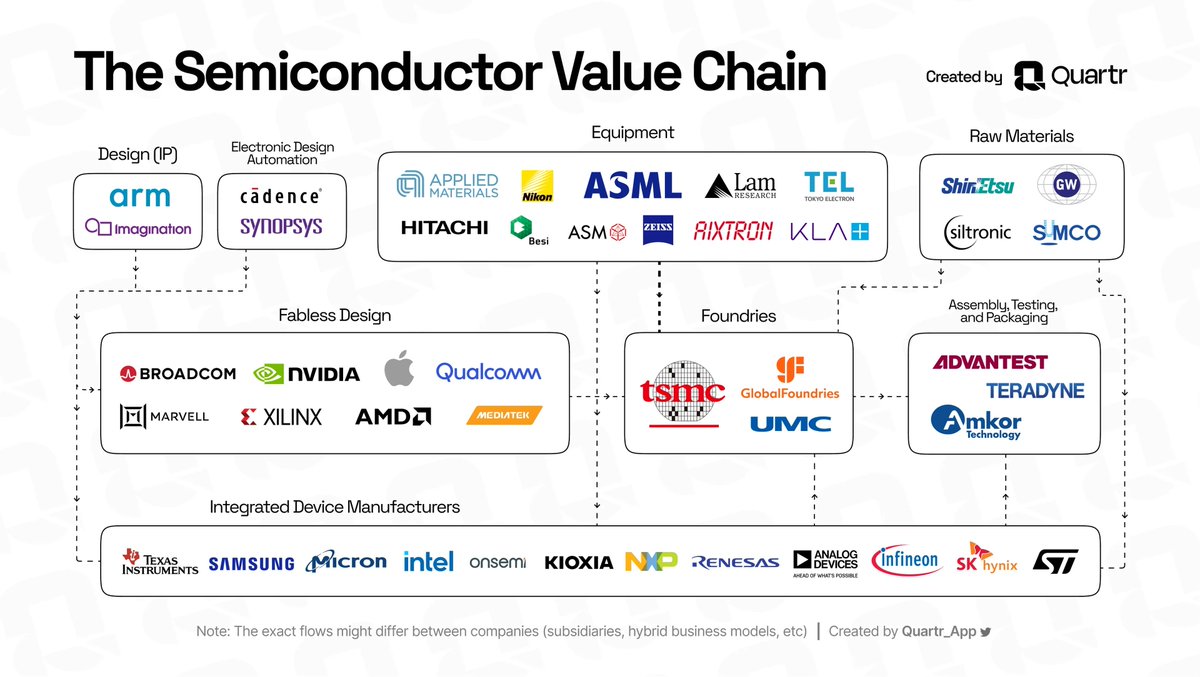
Here's the cheatsheet if you knew nothing about:
NVDA
AMD
INTC
QUAL
AVGO
MU
(Bookmark this to review as reference)
NVIDIA: Products: NVIDIA specializes in GPUs (e.g., GeForce, Quadro, Tesla) and AI accelerators (e.g., NVIDIA A100).
Application: NVIDIA GPUs, especially the Tesla and GeForce series, are extensively used in AI and deep learning tasks such as neural network training and inference.
Impact: NVIDIA has been a major driver of AI advancements due to its CUDA platform and specialized hardware like Tensor Cores. NVIDIA GPUs are prevalent in data centers powering AI infrastructure and in edge devices for inference tasks.
Advantages: Market leader in GPUs, particularly in gaming and professional visualization. Strong presence in AI and deep learning with GPUs optimized for such workloads. Expanding into data center and automotive markets with AI-focused products.
Disadvantages: Relatively higher cost compared to some competitors. Dependency on gaming and cryptocurrency markets for a significant portion of revenue.
AMD (Advanced Micro Devices): Products: AMD produces CPUs (e.g., Ryzen series), GPUs (e.g., Radeon RX series), and APUs (combining CPU and GPU).
Application: AMD's CPUs and GPUs are widely used in AI applications ranging from training deep learning models to inferencing in various industries including gaming, automotive, and healthcare.
Impact: AMD's Ryzen CPUs offer competitive multi-core performance suitable for AI workloads. Their Radeon GPUs, while not as dominant in AI as NVIDIA's offerings, provide cost-effective solutions for smaller-scale AI projects and research.
Advantages: Competitive performance and value proposition in both CPU and GPU markets.
Strong presence in gaming and enthusiast markets.
Increasing market share in CPUs with competitive offerings against Intel.
Disadvantages: Historically, AMD has faced challenges with power efficiency and thermal management compared to Intel.
Limited presence in enterprise and data center markets compared to Intel.
Intel: Products: Intel primarily manufactures CPUs for various markets including consumer, enterprise, and data center (e.g., Core series, Xeon).
Application: Intel's CPUs and emerging products like Nervana Neural Network Processors (NNP) cater to AI workloads, including training and inference.
Impact: Intel's dominance in CPU market share translates to widespread use of its processors in AI servers. With acquisitions like Nervana, Intel aims to strengthen its AI offerings and compete more effectively against NVIDIA in the AI hardware space.
Advantages: Dominant market share in CPUs for PCs and servers. Strong R&D capabilities and manufacturing technology. Diversification into areas like AI, IoT, and FPGA through acquisitions.
Disadvantages: Manufacturing delays and challenges in transitioning to advanced process nodes. Increasing competition from AMD in consumer and server CPU markets. Less competitive in discrete GPU and mobile CPU markets.
Qualcomm: Products: Qualcomm specializes in mobile SoCs (e.g., Snapdragon series), modem technologies, and various semiconductor solutions for mobile devices.
Application: Qualcomm's Snapdragon SoCs integrate AI accelerators for tasks like image recognition, natural language processing, and voice recognition in mobile devices, IoT, and automotive applications.
Impact: Qualcomm's presence in mobile AI accelerates the deployment of AI at the edge, enabling on-device processing for improved privacy, latency, and efficiency.
Advantages: Market leader in mobile SoCs with strong integration of CPU, GPU, modem, and AI capabilities.
Extensive licensing business for wireless technologies.
Diversifying into automotive, IoT, and networking markets.
Disadvantages: Facing challenges in the Chinese market due to regulatory issues.
Increasing competition from companies like MediaTek in the mobile SoC market.
Micron Technology (MU): Products: Micron manufactures memory and storage solutions including DRAM, NAND flash memory, and SSDs.
Application: Micron's memory and storage solutions play a crucial role in AI infrastructure, providing high-speed storage and memory for AI model training and data processing.
Impact: Micron's DRAM and NAND flash memory are integral components of AI servers and accelerators, contributing to the overall performance and efficiency of AI systems.
Advantages: One of the leading producers of memory and storage solutions. Diverse product portfolio catering to various applications including data centers, consumer electronics, and automotive.
Strong focus on innovation and R&D.
Disadvantages: Vulnerability to cyclical demand patterns and price fluctuations in memory markets.
Intense competition from other memory manufacturers like Samsung and SK Hynix.
Broadcom (AVGO): Products: Broadcom offers a wide range of semiconductor solutions including networking, storage, broadband, and wireless communication chips.
Application: Broadcom's networking and communication chips facilitate the deployment of AI applications in data centers and edge computing environments, enabling seamless connectivity and data transfer.
Impact: Broadcom's networking solutions support high-speed data transfer and low-latency communication, critical for distributed AI systems and real-time inference applications.
Advantages: Diversified product portfolio covering multiple segments of the semiconductor market.
Strong focus on acquisitions to expand its product offerings and market reach.
Dominant position in certain markets like networking and broadband.
Disadvantages: Dependence on a few key customers for a significant portion of revenue.
Regulatory scrutiny regarding antitrust issues due to its market dominance in certain segments.
There was some unexpected earnings results from a few from big-box retailers to streaming services. All eyes are on those that still have yet to report: from $ZM to $BIDU & $NVDA, it will be interesting to see if the economic slowdown affects them too. https://t.co/BZHlmcsVK0
You all wont like this but if node projects like @Strongblock_io and @ThorNodes (just examples) want to survive there is only one real solution. Force old investors to re invest. Here’s how they do that. I will use @Strongblock_io as an example. 1/
$CUBO 🧵+ Giveaway
Prize:
- 1 Nano CUBO ($800)
Entry:
- Follow me + @cubo_money
- Like and retweet the post
- Tag 1 friend
- Comment the secret key (at the end of the 🧵)
👇
@unicornnodes - a thread on why I choose to invest in Unicorn Nodes at the moment.
Disclaimer: This is NOT a paid thread, and @unicornnodes did not ask me to write.
#AVAX#NODE#NODES#Nodelife#NodeArmy