Our statement on the UK government’s demand that all content on all devices sold or used in the country be scanned, on the presumption of nudity, using a dystopian combination of age verification and content scanning. This proposal will not safeguard children. It endangers us all.
https://t.co/VdWe9uhi8p
'The Government is setting up one of the most authoritarian internet regimes in the world.'
Director of Big Brother Watch, Silkie Carlo, says Keir Starmer's plan to limit children from seeing, taking, and sharing nude images online, is 'effectively ID cards for the internet'.
SERIOUSLY. Are we living in a parallel universe?
OpenAI paused its UK data centre project last month. Energy too expensive. Too hostile. Even for them. Starmer found out this morning apparently.
Because he spent today at a tech conference selling Britain's AI future. The same week OpenAI quietly walked away from it. He didn't mention that bit.
UK electricity prices 125% above the EU average. Four times higher than the United States. Highest in Europe. Data centres consume 5.8% of national electricity and rising. Your energy bills going UP because of it.
The Unilever factory employed hundreds of Warrington families for 130 years. Closed 2021. 116 job losses. The data centre replacing it? 20 to 50 permanent jobs. No legal obligation to create even those. THREE permanent AI job vacancies in Warrington in 2025. Three. Specialist roles brought in on fast tracked visas. Not for local kids.
Manufacturing creates thousands of jobs. Data centres create dozens. 8 million UK jobs at risk from AI. UK hit harder than any other major economy.
Your pension redirected by ministers into the tech companies building those data centres. Without your consent. Funding the machine that's replacing you.
And while he stood on that stage. 1,200 children safeguarded from grooming gangs every single month. Child abuse conviction data buried for years.
The world's biggest AI company just walked away from Britain because it couldn't afford to run here.
And he called that confidence.
Japan invented nearly every tool central banks now reach for.
Zero rates → 1999
QE → 2001
Yield curve control → 2016
Its debt is now ~240% of GDP. Double the US.
Japan's reckoning is unfolding right now — and America is walking the same path, a decade behind. Here's my take 👇
Remember that ALL government money is counterfeit.
It began as real, tangible quantities of an actual commodity you could hold in your hand: Silver or Gold.
SAM ALTMAN HAS A NEW PROBLEM. 🤯
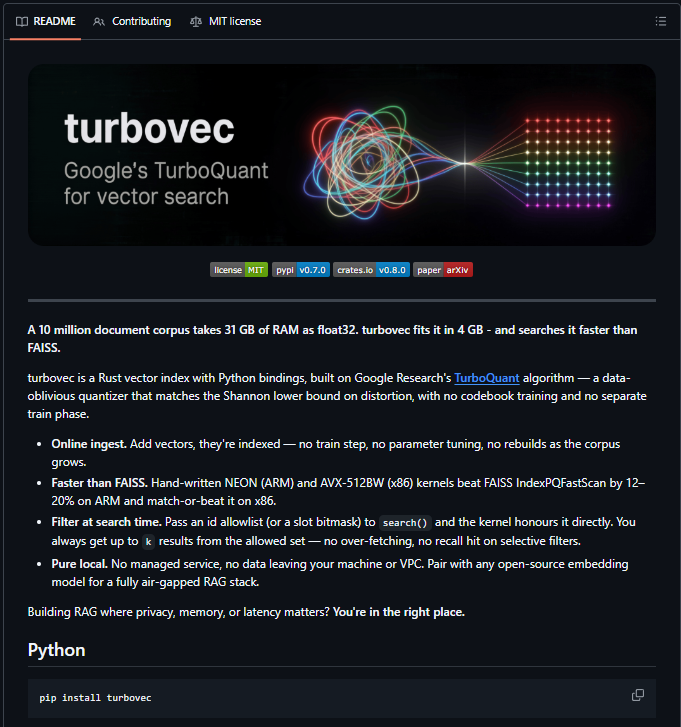
Google just shrunk 31GB of AI memory down to 4GB.
The tool is called TurboVec.
It uses up to 16x less memory, searches faster than FAISS, runs fully offline, and works on a regular Mac.
No expensive GPU cluster.
No cloud dependency.
No compromise on speed.
→ 16x lower memory usage
→ Faster vector search
→ Works with LangChain & LlamaIndex
→ 100% open source
The race to build bigger AI models is loud.
The race to make them dramatically cheaper just got a lot more interesting.
Repo: https://t.co/08TFGtHL6K
Y’all need to check this out, the Albania situation is getting more intense by the day. Apparently, Saudis entered the chat!!
This is top-tier reporting.
This is the best way to learn how LLMs work.
Interactive. 3D. Step-by-step.
Covers:
→ Embedding
→ Layer Norm
→ Self-Attention
→ MLP
→ Transformer layers
→ Softmax
→ Output
Stop reading papers. Start seeing.
Link in comments.
Save this immediately.
“It’s a massive vacuum. Every single investment bank on Wall Street is out there marketing the anthropic deal, the open AI deal, Google deal the Spacex deal. Everybody has to come up with $400 billion of cash.” - Michael @saylor
Capital is chasing the IPO frenzy. It will revert back to pristine, scarce collateral as technology breakthroughs fuel access and expose moats. The network that doesn’t need a moat wins at the end. #MSTR #BTC
From @TradePMR event.
We're getting close. The Federal Reserve has been quietly keeping Total "Assets" flat since April 2026.
They did the same thing beginning in December 2019.
Basically they're intentionally starving the market of liquidity because they're engineering a crisis for QE.
Spain is ripping out centuries-old olive groves for solar farms.
In Andalusia, trees that took decades to reach maturity are being uprooted for panel arrays.
This is a direct land-for-energy trade.
26 terawatt-hours of output from solar requires roughly 130,000 acres, whereas a modern nuclear plant would deliver that same power using just 430 acres. That is a land gap approaching 300 to 1 (and wind farms are even worse).
Solar's footprint is not just panels. It is roads, fencing, substations, transmission lines and backup systems.
Spain has already stress-tested a high renewables grid. In April 2025, a nationwide blackout followed low grid inertia and heavy reliance on inverter-based generation.
The Spanish government is doubling down on this failure.
🚨(1)BREAKING: Christian community police officer wins settlement after being forced out of his role for questioning and criticising Islam during diversity training.
Luke Salmons, who has been supported by the Christian Legal Centre, was suspended for six months, forced to resign and put on a police barring list after he had questioned radical Islam in a training session.
He had been told that the session was a 'safe place' for discussion, but after expressing his beliefs, the consequences were devastating.
After taking legal action, his case has now been settled on confidential terms, however his story raises serious concerns about free speech and religious freedom in UK policing.
See more in this thread 🧵on our website and breaking in the media:
https://t.co/Ed9elAMIKa
https://t.co/sAkxcVf9PW
Goldman Sachs just dropped the most precise map of where $7.6 trillion is going over the next five years and it tells you exactly which companies are standing in the middle of an unavoidable flood of capital (Save this).
The numbers are worth understanding precisely before talking about who benefits.
Goldman's baseline projects $765 billion in AI capital expenditure in 2026 alone, growing to $1.6 trillion annually by 2031.
Over the full 2026 to 2031 period, cumulative spend breaks down to $5.1 trillion in compute, $2.1 trillion in data centers, and $358 billion in power.
Nvidia is assumed to command 75% of all compute spend throughout the period, using the Rubin VR200 chip at $80,500 per GPU as the baseline.
The data center specification charts reveal how dramatically physical requirements are escalating.
A standard cloud data center runs 5–15 kW per rack while a transitional Blackwell era AI data center runs 130–200 kW per rack.
The AI factory of the future, running Rubin and Feynman silicon operates at 500+ kW per rack, at greater than 1 gigawatt scale, with liquid cooling only.
Traditional hyperscale data centers cost roughly $10 million per megawatt to build while the next generation AI data centers are being discussed at $15 to $20 million per megawatt.
Goldman identifies silicon useful life as the single biggest swing factor in the entire model.
At a 3-year replacement cycle, cumulative compute depreciation hits $3.99 trillion and at 7 years, it drops to $2.23 trillion, a $1.76 trillion difference on one assumption alone.
Power is only $358 billion of the total, but Goldman is explicit, it is the only component that can prevent the other 95% of the stack from deploying.
Amazon's Andy Jassy put it, "Our single biggest constraint is power." Connecting large data centers to the grid takes years.
Now here are the companies standing directly in the path of each layer of this capital.
Nvidia is still the most concentrated bet on the compute layer.
At 75% of $5.1 trillion in compute spend over six years, that is $3.8 trillion in cumulative revenue flowing through one company's products.
The 75% gross margin on data center GPUs is the reason every hyperscaler is trying to build custom silicon to escape it while simultaneously continuing to buy Nvidia because nothing else performs at the same level.
Vertiv is the direct infrastructure play on the data center upgrade cycle.
Every rack going from 40 kW to 500+ kW needs liquid cooling systems, power distribution, and thermal management infrastructure that simply did not exist at prior density levels.
Vertiv just deepened its liquid cooling capabilities through a strategic acquisition and was named a key partner on Hut 8's large AI-focused Texas data center campus.
The liquid cooling market is growing from $5.5 billion today to $15.75 billion by 2030, and Vertiv is the dominant provider in that market.
Vistra is the power thesis in its most direct form.
The $358 billion power segment is the critical path for the entire $7.6 trillion, and Vistra has spent the last 18 months locking up that critical path through long-term nuclear power purchase agreements.
Vistra secured a 20 year agreement with Meta for over 2,600 MW of nuclear energy, plus a separate deal with AWS from its Comanche nuclear facility.
Goldman Sachs and Jefferies both upgraded the stock after the Meta deal was announced.
The architecture of this trade is simple.
Goldman's model is not a prediction of whether AI spending happens but rather a model of the minimum physical capital required to deploy infrastructure that has already been contracted, already been announced, and is already under construction.
The compute layer requires the chips, data center layer requires cooling and power infrastructure and the power layer requires nuclear at scale on multi-decade contracts.
All three layers are being funded simultaneously, and all three have identifiable public companies sitting directly in the path of the capital.
Come join Milk Road Pro and get our full $7.6 trillion infrastructure breakdown which names across compute, data centers, and power we're currently positioned in and our full thesis on the AI trade.
Link below!
As an AI Engineer. Please learn
>Harness engineering, not just prompt engineering
>Context engineering, not just long prompts
>Prompt caching vs. semantic caching tradeoffs
>KV cache management, eviction, reuse, and memory pressure at scale
>Prefill vs. decode latency and why they optimize differently
>Continuous batching, paged attention, and throughput optimization
>Speculative decoding vs. quantization vs. distillation tradeoffs
>INT8, INT4, FP8, AWQ, GPTQ, and when quantization hurts quality
>Structured output failures, schema validation, repair loops, and fallback chains
>Function calling reliability, tool contracts, argument validation, and idempotency
>Agent guardrails, loop budgets, tool budgets, and termination conditions
>Model routing, graceful fallback logic, and degraded-mode UX
>RAG architecture: chunking, embeddings, hybrid search, reranking, and freshness
>Retrieval evals: recall, precision, grounding, attribution, and citation quality
>Evals: golden sets, regression tests, adversarial tests, LLM-as-judge, and human evals
>LLM observability as a first-class discipline: traces, spans, tokens, latency, errors, and drift
>Cost attribution per feature, workflow, tenant, and user journey not just per model
>Safety engineering: prompt injection defense, data leakage prevention, and permission boundaries
>Multi-tenant isolation, cache safety, and cross-user context contamination prevention
>Fine-tuning vs. in-context learning vs. RAG vs. distillation and when each is the wrong tool
>Latency, quality, cost, and reliability tradeoffs across the full inference stack
>Production failure modes: hallucinated tool calls, malformed JSON, stale retrieval, runaway agents, and silent eval regressions
Masayoshi Son has been right twice in a way that changed the world and he is making the same call again (Save this).
Alibaba, $20 million in 2000 turned into $130 billion.
ARM, bought for $32 billion in 2016 when the market thought it was a smartphone chip business, now the architecture underneath every major AI chip being built today.
Now he is saying AI is 50 times bigger than the dot-com era and he is not concerned about corrections. He says if there is one, that is the best buying opportunity of the decade.
When asked where the next trillion-dollar company comes from, he says it's in physical AI and in robotics.
Masa has spent three years assembling every piece of the stack required to own this category.
SoftBank holds 90% of ARM, the architecture inside every major AI chip deployed globally today, including Nvidia's Vera CPU, Amazon Graviton, Google Axion, and Microsoft Cobalt.
Every robot running edge inference will almost certainly run on ARM.
SoftBank completed a $40 billion investment into OpenAI in late 2025, making it the largest external backer of the company building the cognitive layer that physical robots will run on.
In October 2025, SoftBank acquired ABB Robotics for $5.4 billion, one of the most mature industrial robot manufacturers in the world, deployed across thousands of factories globally.
SoftBank then created Roze AI, consolidating its robotics investments with a target $100 billion IPO already in process with Goldman Sachs, JPMorgan, and Morgan Stanley as underwriters.
The market is beginning to confirm the thesis.
The humanoid robot market was roughly $3 billion in 2025 and Barclays projects it reaches $200 billion by 2035 at a 48% compound annual growth rate.
SoftBank is the most complete expression of the physical AI thesis available in public markets today, ARM for the chip royalties,
OpenAI for the cognitive layer, ABB for manufacturing, Roze AI for the robotics platform, and Stargate for the compute infrastructure underneath all of it.
Son has not just identified the next wave and has built the stack to own it before the market agrees with him.
Come join Milk Road Pro and get our full physical AI breakdown which names we're watching across the robotics stack and our full AI thesis.
Link below
Hui Lui bought 100 Mac Minis to build a private AI server farm
The funny part?
One $599 Mac Mini already replaces most of a $200/month Claude Code bill.
Ollama now plugs directly into Claude Code.
Same interface. Zero API costs.
Most developers keep stacking subscriptions.
The smarter bet might be stacking hardware.
Bookmark this before local AI becomes the default.
Google just dropped an AI bomb!
A BILLION DOLLARS Game is on.
Gemma 4 12 B runs on your laptop. 16 GB of RAM, that is a MacBook Pro.
Solves the biggest problem Enterprises are facing.
This is the biggest directional signal in AI
Cloud is not the endgame y’all !!
'In order to deal with the problem, Keir Starmer is going to have to admit that his politics and his world view have been wrong, and he can't do that can he.'
@PatrickChristys slams Keir Starmer for 'deflecting' from the 'deep rooted' cultural issues Britain faces.