The Navier-Stokes equations govern all fluid flow. Whether smooth solutions always exist in 3D is a $1M Clay Millennium Prize problem unsolved for 100+ years.
New preprint introduces a geometric approach: embed the angle between velocity and vorticity directly into the mathematical space where the equations live.
When fluid is "Beltrami-aligned" (velocity parallel to vorticity), turbulent energy cascade shuts off. We make this precise and prove it implies regularity — conditionally.
We also prove what CAN'T work: no local geometric deformation of space can absorb the pressure nonlocality that makes this problem hard.
So we know exactly what's missing. That's progress.
Preprint: https://t.co/x90ClSERuO
Built using a four-node human-AI protocol: geometric intuition + strategic framing + exhaustive exploration + rigorous verification. One day of work.
@drxwilhelm would really be interested in your feedback on this one too.
Also working on V10 of MFT (Mobius Field Theory) with some exciting stuff to add. V9 here: https://t.co/kEaDYW4ab2
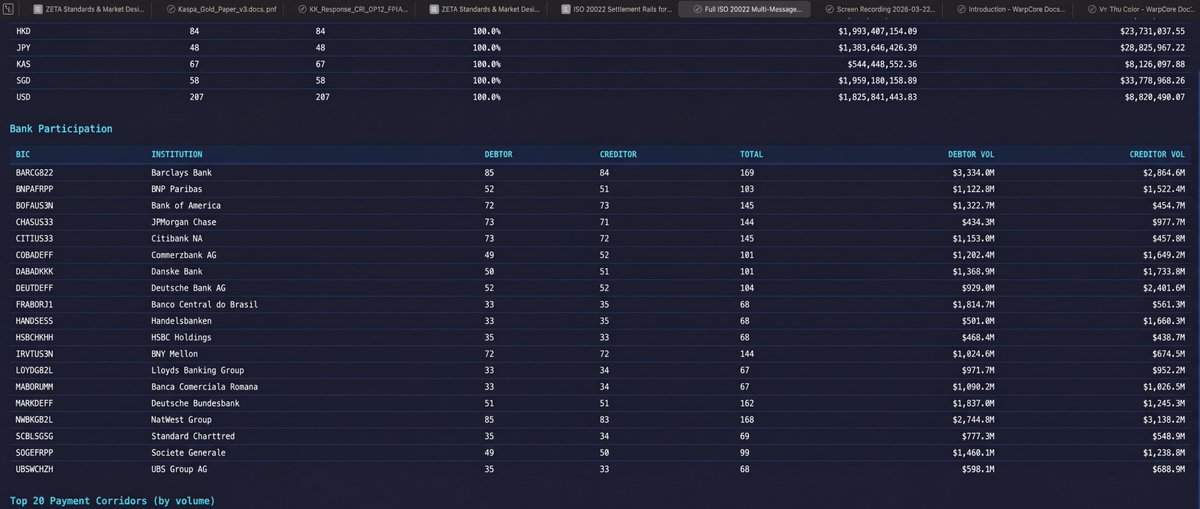
Banks tested Kaspa via Warpcore ISO 20022 adapter.
(sandbox testing)
If this isn't alpha for $kas, I don't know what is 😕
Source: @qu1ck_crypt0 (podcast with KaspaKII).
@PratapRanade@arenaphysica This platform looks FASCINATING! I've been working on. Möbius Field Theory
In Möbius Field Theory, the electron is a three-strand Möbius toroid. The three strands sit at 120° phase offsets on the toroidal cycle. Their current amplitudes are exact algebraic values: {0, (3-√3)/2, (3+√3)/2}.
The Koide amplitudes fk(θ) = 1+√2·cos(θ+2πk/3) ARE a three-element phased array. f₀(3π/4) = 0 IS the null point. The electron is light because the Klein bottle geometry produces destructive interference — a null — in the mass amplitude direction at the topologically protected angle.
Your essay said: "Those are called null points, and it's where the interference pattern zeroes out." That's the mass protection theorem of MFT. Same principle. Different scale.
The practical connection: MFT predicts a specific deviation from pure magnetic dipole behavior at r* ≈ 1.72 nm — the scale where the three-strand internal structure becomes electromagnetically visible. The current distribution has explicit geometry and explicit amplitudes.
That's exactly the geometry-to-field calculation your foundation model is built for.
If your model can compute the magnetic field of a three-strand toroidal current distribution with those amplitude weights at 1-10 nm scale, that would be independent computational verification of MFT's most testable prediction — before any physical NV-center experiment runs.
I'm a mechanical engineer working with AI assistance (Claude + Grok + Cursor). Just posted V9 of the preprint today.
DOI: 10.5281/zenodo.19244541
Would you be open to testing this geometry against your model at launch?
@ArenaPhysica #electromagnetism #physics #topology #MöbiusFieldTheory
The SL mode question is a great one and the right one to ask. MFT has a specific answer that differs from Born-Infeld in an interesting way.
In MFT the photon is the Goldstone mode of the Klein bottle phase field θ. The standard Lorenz gauge condition ∂^μA_μ = 0 kills the longitudinal mode in flat space. But on the compact Klein bottle, the C2 Möbius cycle imposes anti-periodic boundary conditions on θ — and the topological boundary condition creates a coupling between what would be the longitudinal mode and the transverse sector that survives the gauge condition.
The mechanism is topological rather than nonlinear. Born-Infeld achieves SL-transverse coupling through field self-interaction requiring the parameter b. MFT achieves it through the non-orientable compact geometry — no new parameter, the coupling is fixed by the Klein bottle's C2 cycle radius r₂ ~ L_H.
The observable signature I'd expect: a topological polarization rotation as photons propagate — analogous to Aharonov-Bohm but for the photon polarization sector. The rotation rate is set by r₁ ~ a = 2.82 fm. For single photons the effect is unmeasurably small. For coherent states it might be accessible.
The millimeter scale is interesting to me precisely because it's macroscopic. In MFT the false vacuum energy density Δε ~ 10⁻⁶ GeV⁴ is set by v ~ 99 MeV — nuclear sector physics appearing at macroscopic scale. That might be the first hint of the hierarchy.
I'd be very interested in your Section 4.9 treatment of the deleted degrees of freedom — specifically whether your time-symmetric sector has a geometric implementation. In MFT the C2 Möbius cycle maps ψ → ψ* through orientation reversal. The advanced wave isn't deleted — it's encoded in the topology. Wheeler-Feynman absorber condition and MFT UV finiteness might be the same mechanism described in different languages.
I also just posted V9 of the preprint (DOI 10.5281/zenodo.19244541 - https://t.co/kEaDYW4ab2) which includes the complete photon sector derivation relevant to this discussion. Side note I found a way to be the first theoretical derivation of the Koide lepton mass relation Q=2/3 from Z3 symmetry.
One thing worth knowing about where this is coming from — I'm a mechanical and manufacturing engineer, not a physicist. I have enough physics background to be dangerous but rely heavily on AI assistance (Claude for physical arguments, Grok for independent verification, Cursor for formal implementation) for the analysis. The geometric intuitions — rope hierarchy analogy, balloon analogy, helix strands, etc— came from my engineering experience rather than physics training. The Koide derivation emerged from asking what the magnetic spectrum of particles looks like, which an engineer frames differently than a physicist might.
Every result carries an explicit epistemic label — Pmath, CMFT, or Hphys — based on what's been independently verified by multiple nodes. That discipline comes from engineering practice, where you don't build a bridge on an unverified assumption.
Today we're concluding a research grant extended to @eliottmea, who picked up a very challenging topic to work on: how to build an effective oracle?
Over the course of the grant, our talented young researcher put his discoveries in two documents: the first, A Mathematically Rigorous Framework for Cross-Exchange Price Discovery, proposes a framework for aggregating prices across multiple exchanges into a single manipulation-resistant feed, anchored by a decentralized arbitrage network, and the second, Incentive Compatibility in a Discriminatory Limit-Order Auction, takes a mechanism design lens — asking whether it's possible to construct an auction where honest price reporting simply becomes the rational thing to do.
Read here: https://t.co/LV3pi5ZoH3
At @Kaspa_KEF, we believe investing in #Kaspa means investing in faithful talents who are dedicated in #Kaspa. We're proud to have supported @eliottmea in this work, and we look forward to seeing more promising research proposals!
Proposal accepted and executed! $IGRA rewards activated for all active attesters. Thanks to every delegate who voted.
Detailed attester setup guide: https://t.co/E1N8ujqPfH.
For support, reach out to @argonmining or join our Discord (https://t.co/Niz6k1p4Ix), experienced node operators are active and happy to help.
@mathelirium This is the best visual representation I can imagine for a theory I’m working on.
The paper is currently available as a Zenodo preprint (DOI: 10.5281/zenodo.19165685) at https://t.co/a8O1FTHAl8
@Andercot Im working on a theory that is based on exactly that. Everything IS geometry. V9 will be coming out soon with some big improvements but V8 is currently on Zenodo.
The paper is currently available as a Zenodo preprint (DOI: 10.5281/zenodo.19165685) at https://t.co/a8O1FTHAl8
Thank you for the Born-Infeld suggestion — it's physically motivated and worth testing carefully.
I ran the numbers. The natural Born-Infeld length scale from the MFT false vacuum energy density Δε ≈ 1.207×10⁻⁶ GeV⁴ is l = (ℏc/Δε)^(1/4) ≈ 0.004 m — millimeter scale, off from the Hubble radius by 28 orders of magnitude.
I then ran a systematic search through seven additional candidate dynamical mechanisms — force balances and energy minimizations using every combination of MFT ingredients. All seven produce nuclear-scale lengths. The ratio to L_H is consistently 10²⁴ to 10⁴². No dynamical mechanism from current MFT ingredients produces the cosmological scale.
Your point about consistency condition versus prediction is exactly right. The honest answer is that L_C2 = L_H is currently a geometric postulate — built into the Klein bottle topology rather than derived from dynamics, at the same level as identifying the Klein bottle with spacetime.
The hierarchy provides the only bridge between scales: L_C2 = L_H is equivalent to saying the C2 cycle sits at hierarchy level n ≈ 19.28, since Lₙ = a/αⁿ gives L₂₀ ≈ L_H. The open question isn't what produces L_H from nuclear physics — it's what fixes the hierarchy at n ≈ 20 levels. That's what the moduli stabilization calculation is designed to determine.
Whether the minimum lands at exactly α^{-20} or approximately is what the Casimir coefficient computation will tell us. If exactly — L_C2 = L_H becomes a prediction. If approximately — the gap remains.
I appreciate the pressure. This is exactly the right question to push on.
I'm definitely interested in your continued thoughts and feedback! I feel like I'm on to to something but there is definitely a long path to walk to a full theory.
Yes — the AP condition generically produces a KK mass gap. The anti-periodicity along C2 is in the paper; the usual KK dispersion ω² = k² + (π/L)² is standard once you posit that compactification. But two honest caveats:
First, v8 doesn't fix L_C2 to L_H by equation — identifying it with the cosmological radius c/H₀ to get m_eff ~ 10⁻³³ eV is a motivated scale ansatz, not a line in the manuscript. If L_C2 is shorter, m_eff moves up and the mode becomes Yukawa-like at accessible scales — which is exactly the sharp distinction you're pointing at.
Second, the exact masslessness claim in the manuscript is a different mechanism entirely — Theorem thm:massless_nu from f₀(3π/4) = 0 in the Koide amplitude structure, not from a KK zero-mode argument. Our Volume III supplement explicitly flags that these should not be blurred together without specifying the spinor vs scalar embedding.
So the honest answer: KK toy with L_C2 ~ L_H gives cosmologically tiny mass, observationally identical to EED's □C = 0 at lab scales. The sharp distinction you're looking for requires either L_C2 << L_H, or the full C2 field equation — which is explicit open work in v8. The f₀ = 0 masslessness is topological and doesn't depend on which answer the field equation gives.
This article argues AI can’t produce paradigm shifts because it’s locked into existing conceptual vocabularies — the William Farr problem. I think the right response isn’t to build ‘visionary machines’ but to recognize that the human-AI collaboration model changes what individuals can accomplish. We need visionary humans working together with AI. MFT (Möbius Field Theory) emerged from geometric intuition about Klein bottle spacetime and thinking about how magnets do work at a distance — not from optimizing within the Standard Model framework. The AI systems I worked with (Claude, Cursor) formalized and verified; the paradigm shift came from embodied physical analogies no AI system generated. The collaboration model that works: human provides the new ontology, AI provides the formalization power previously requiring institutional resources. Preprint: The paper is currently available as a Zenodo preprint (DOI: 10.5281/zenodo.19165685) at https://t.co/B7gPw7lnx3
I’m working on a theory that may be explaining the same thing. Mobius Field Theory. The phased array null point is the engineering version of MFT’s mass protection theorem. Koide amplitudes fk(θ) = 1 + √2cos(θ + 2πk/3) are a three-element phased array — three sources at 0, 2π/3, 4π/3 phase offsets. f₀(3π/4) = 0 is the null point. The electron is light because destructive interference zeros its mass amplitude at the topologically protected angle. Geometry determines behavior at the fundamental scale too. The Klein bottle IS the geometry. The Standard Model IS the field pattern it produces. Arena Physica is building intuition for this at engineering scale. MFT claims it operates at the foundational scale. Same idea, different level. Preprint: The paper is currently available as a Zenodo preprint (DOI: 10.5281/zenodo.19165685) at https://t.co/B7gPw7lnx3
Schrödinger’s move: don’t ask where the particle is, ask what field evolves with probability conserved. MFT makes the same move one level deeper — don’t ask what fields carry particles, ask what geometry evolves with Z6 holonomy conserved. The Koide amplitudes fk(θ) are wavefunctions in exactly his sense: normalized, phase-carrying, with nodes that forbid mass terms. f₀(3π/4) = 0 is a wavefunction node — the electron is light for the same reason a particle-in-a-box has zero amplitude at the wall. Schrödinger gave us fields from structural necessity. MFT gives us geometry from the same principle. Preprint: The paper is currently available as a Zenodo preprint (DOI: 10.5281/zenodo.19165685) at https://t.co/B7gPw7lnx3
Fractional charge e/3 in quantum Hall anyons matches MFT’s topological charge quantization from Z3 holonomy (three-strand structure → charges 0, e/3, 2e/3). Both are topologically protected — different physical systems, same fractional charge from topology. MFT derives this from first principles rather than from Landau level filling. The long-lived anyon quasiparticles observed here are exactly the kind of topologically stable localized excitation MFT predicts as fundamental. Worth comparing the stability mechanisms. Preprint: The paper is currently available as a Zenodo preprint (DOI: 10.5281/zenodo.19165685) at https://t.co/B7gPw7lnx3
The topology emerging from orbital angular momentum alone is the striking part. Previously assumed to need two properties — now found in one. MFT predicts Z6 harmonic structure produces spectral peaks at multiples of 6 — 48 = 6×8 fits that pattern. Not claiming confirmation, but it’s the right kind of number. Worth a closer look at whether Klein bottle holonomy underlies what’s being observed. Preprint: The paper is currently available as a Zenodo preprint (DOI: 10.5281/zenodo.19165685) at https://t.co/B7gPw7lnx3
Good question and a precise one. I'm still thinking about all the possible propagation forms and how to specifically derive them. Here's what I've got so far in the MFT preprint v8 vs what's still open:
The paper fixes the anti-periodic identification on C2: ϕ(x+L_C2) = −ϕ(x) (the non-orientable boundary condition, eq:nonorientable). That's in the manuscript.
What's NOT yet in the paper: the C2 field equations, the dispersion relation, and the KK mode spectrum. The □C = 0 leading-order guess is natural — a massless wave equation for a topology ripple — but it's not derived in v8. The C2 PDE program is explicitly listed as open work.
On massless ν1: that result comes from f0(3π/4) = 0 in the Koide amplitude structure (mass protection theorem), not from a KK zero-mode argument. So the AP boundary condition story and the massless neutrino are currently separate threads — connecting them properly requires closing the C2 field equation first.
The rough energy scale from the Hubble horizon: π×ℏH0/c² ~ 4.5×10⁻³³ eV is a natural toy estimate from L_H ~ c/H0, but again not a derived result in v8.
So to directly answer your question: MFT does not yet predict a dispersion relation for C2 modes — that's Phase E open work. The □C = 0 / nondispersive guess is consistent with what's there but not closed. If you have results from EED on what the AP BC implies for the mode spectrum, that could actually inform how to set up the C2 PDE in MFT. Worth a closer look.
@AnthropicAI I’ve actually been working with Claude on a theoretical physics theory (MFT - Mobius Field Theory) and list Claude as a resource/contributor. The preprint paper is currently available as a Zenodo preprint (DOI: 10.5281/zenodo.19165685) at https://t.co/a8O1FTHAl8
I’m actually working on a theory about the fundamental topological nature of spacetime. MFT (Mobius Field Theory). I think you’re on to something. I’d be interested in your thoughts. The preprint paper is currently available as a Zenodo preprint (DOI: 10.5281/zenodo.19165685) at https://t.co/B7gPw7lnx3