Tor Browser is not just another private browser
It protects the network route, but it does not erase identity by itself:
- traffic moves through entry, middle and exit relays
- the local network cannot easily see the final destination
- the website does not see the original source IP
- Tor Browser standardizes many fingerprint signals
- HTTPS still matters after traffic leaves the Tor network
- personal logins can still identify the session
- unsafe files, malware and behavior can still expose the user
Tor is strong for private research, filtered networks and onion services
It is weaker for long-lived business accounts, stable geo, low latency and sessions that need predictable IP reputation
That is where the tool choice matters
VPNs, Tor and antidetect browsers solve different layers of the problem, and stacking them without a threat model can create more risk than clarity
We broke down how Tor Browser works, what onion routing can hide, where Tor fails and when isolated profiles are a better fit for persistent work sessions
Read the full guide ↓
https://t.co/Au0FPpSv7n
Kwai can make money in 2026, but not through one magic payout button
The real setup is usually a mix of content, traffic and monetization channels:
- daily missions for small first rewards
- referral invites with clear explanations
- short videos around one niche
- live streams for active audiences
- affiliate offers tied to useful reviews
- your own products or services
- separate profiles for brands, clients or test angles
The first week is usually not where the serious money appears
Bigger results start when Kwai becomes part of a funnel: video → offer page → store → Telegram channel → product or service
Referrals can help with the first payout
But stable income comes from trust, consistent content, analytics and knowing which videos actually move people to action
Afina helps teams organize this layer with isolated profiles, proxy control, team roles, groups, tags and automation for repetitive workflows
Read the full guide ↓
https://t.co/YxUWc9w62b
Multiple Signal accounts on one phone are a compromise, not full isolation
That matters when people try to separate roles, clients or work contexts:
- one phone number per Signal account
- one main mobile device at the center
- cloned apps or work profiles with shared hardware
- dual SIM without real device separation
- VPN changing IP but not the phone itself
- shared recovery habits and compromise risk
- related web tools that can still mix in one browser
For low-risk role separation, one phone may be acceptable
For sensitive communication, it is not a strong boundary
A separate device, separate number, separate recovery routine and separate daily habits are still the safer model
Afina does not run mobile Signal accounts or turn one phone into several devices
It helps around the workflow: separate browser profiles for email, CRM, research dashboards, documents and role-based web environments that should not mix
We broke down what multiple Signal accounts on one phone really means, where the limits are and how to structure related web workflows more cleanly
Read the full guide ↓
https://t.co/NxoGGdaEQI
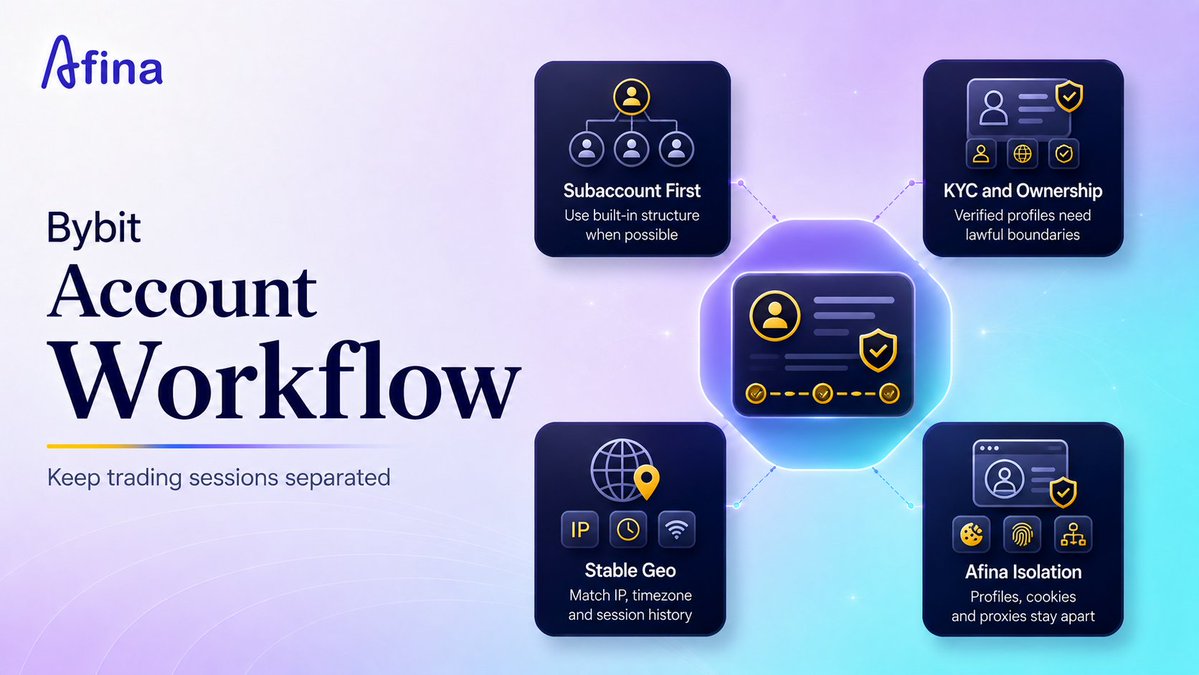
Multiple Bybit accounts should not start with rule avoidance
For most traders, the cleaner path is usually subaccounts under one verified main account
Separate master accounts only make sense for lawful owners, teams or business structures with a real reason:
- KYC and regional consistency
- separate email and recovery data
- stable IP and timezone
- isolated cookies and localStorage
- unique browser profile per session
- 2FA and recovery codes
- no shared fingerprints between accounts
A VPN alone does not solve account separation
It changes the network route, but not cookies, WebRTC, browser fingerprint or login history
This is not a guide to bypass Bybit rules, KYC or regional restrictions
It is about safer workflow hygiene: stable sessions, clear ownership, separated profiles and fewer technical conflicts during legitimate account work
Afina helps organize this layer with isolated profiles, per-account proxies, cookie separation, localStorage isolation, IndexedDB isolation and automation scripts
Read the full guide ↓
https://t.co/qn8y2ooQTx
Independent research by Factually identifies Afina Browser as the closest match for UDP-over-SOCKS5, QUIC, HTTP/3, WebTransport and WebRTC—combined with visual RPA and an MCP Server for AI agents.
https://t.co/6hKgRXqMiN
Multiple Fiverr accounts are not just a browser setup problem
The real question is whether each workspace has a legitimate reason to exist:
- separate email and recovery data
- dedicated browser profile
- stable proxy or network route
- unique public materials
- no reused gig texts or media
- separated payment details
- clear owner, niche and allowed actions
Incognito mode is not enough
It does not create a new device, separate fingerprint or clean operational workflow
This is not a guide to bypass Fiverr rules or duplicate seller accounts
It is about cleaner profile management for agencies, client workspaces, VA teams and legitimate role separation
Afina helps organize this layer with isolated profiles, proxy assignment, cookies, localStorage, IndexedDB, fingerprint separation, groups, tags and automation for repeated workflow steps
Read the full guide ↓
https://t.co/BNFoAzhTND
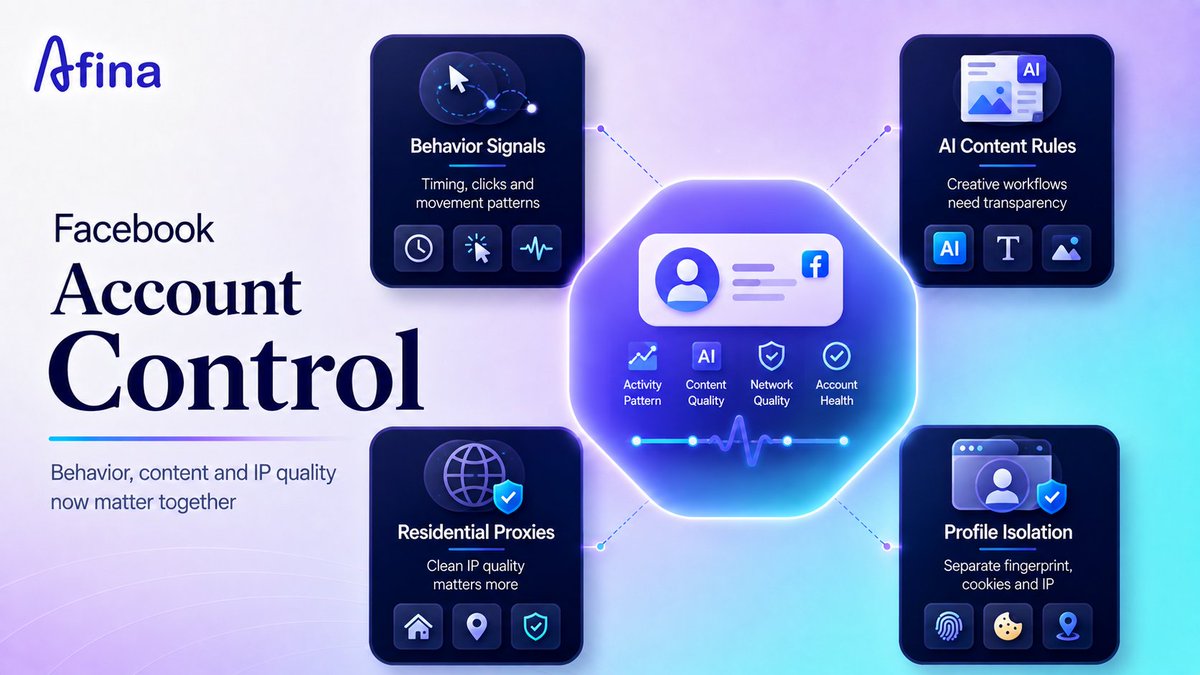
Facebook multi-accounting in 2026 is no longer about having more accounts
The real risk starts when every profile behaves like part of the same machine:
- repeated click and typing patterns
- identical session timing across accounts
- AI-assisted creatives handled without clear structure
- cheap or dirty proxy infrastructure
- many profiles sharing one browser environment
- weak separation between pages, niches and workflows
- no clean system for profile identity and daily activity
Modern platform checks look beyond a static fingerprint
They evaluate behavior, infrastructure, content signals and how naturally each account fits its own workflow
This is not a guide to bypass Meta rules
It is a breakdown of why chaotic account setups fail faster in the Andromeda era and why digital hygiene now matters more than volume
We broke down behavioral signals, AI content risks, proxy quality and why isolated profiles are becoming the base layer for serious Facebook workflows
Read the full guide ↓
https://t.co/LjcZQ7C65D
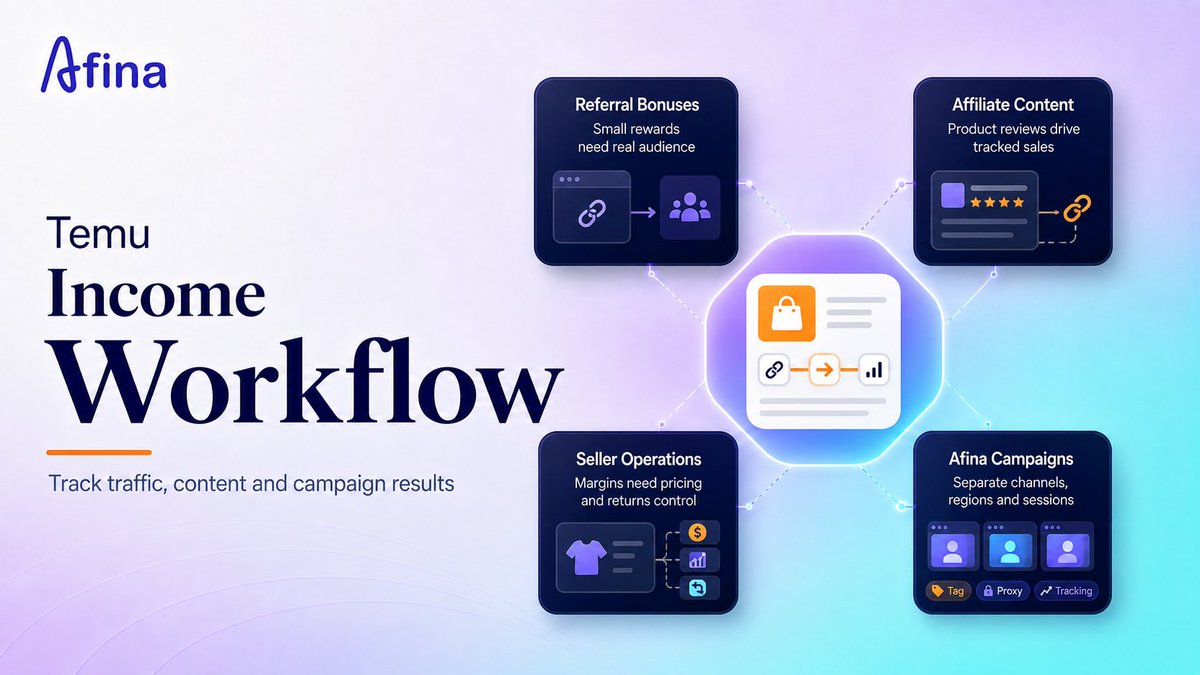
Temu is not a cash machine
In 2026, making money with Temu usually means building a real traffic and campaign system:
- referral bonuses with clear promo rules
- coupons and credits tracked separately from profit
- affiliate links backed by useful content
- product reviews, lists and comparison pages
- seller workflows with real margin calculation
- separate channels for different test angles
- clean account environments for team work
The money is not in installing the app and waiting
It is in traffic, content quality, tracking, offer testing and knowing which campaigns actually convert
For most people, Temu is a side-income channel
For teams, it becomes an operational workflow with accounts, regions, creatives, analytics and access control
Afina helps organize this layer with isolated profiles, proxy control, groups, tags, automation scripts and per-account data storage
We broke down how people actually make money with Temu in 2026, where the limits are and how to keep campaign work structured
Read the full guide ↓
https://t.co/aRUuQRUeJU
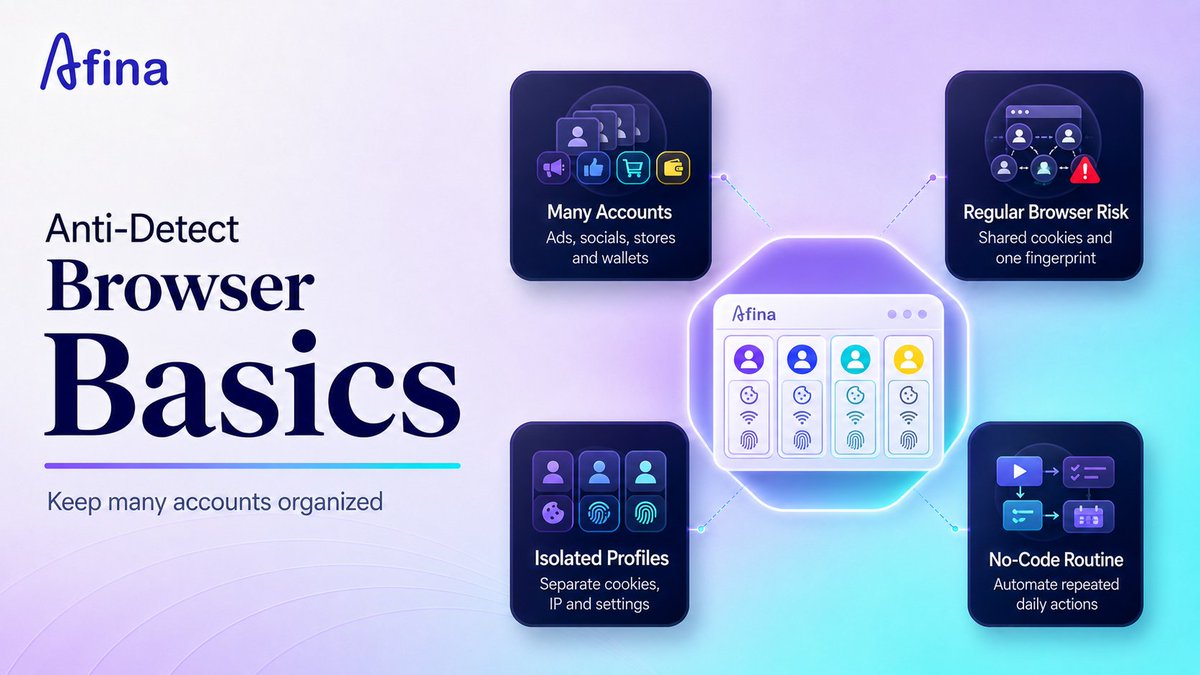
Most people do not need an anti-detect browser
But once your work depends on many accounts, a regular browser starts to create operational risk:
- one shared browser environment across projects
- mixed cookies, cache and local storage
- repeated fingerprints across unrelated accounts
- proxy and session settings handled manually
- client, niche or wallet workflows mixed together
- routine logins, checks and updates repeated every day
- no clean structure when the workflow starts to scale
Regular browsers are built for convenience
They are not built for isolated account infrastructure
Afina gives each profile its own controlled environment, with separate cookies, fingerprint settings, proxy logic and automation tasks
It is overkill for one personal account
But for arbitrage, SMM, marketplaces, Web3 or data workflows, it becomes the difference between browser chaos and a managed workspace
We broke down who actually needs an anti-detect browser, why ordinary Chrome profiles are not enough and how Afina works in simple terms
Read the full guide ↓
https://t.co/0lejYdtAQN
Cloudflare does not block “a scraper” as one simple signal
It evaluates the full session stack:
- TLS and JA3/JA4 fingerprint
- HTTP/2 behavior and header order
- IP reputation and proxy geography
- JavaScript challenge and Turnstile signals
- Canvas, WebGL, fonts and ClientRects
- cookie consistency across sessions
- pacing, navigation and repeated request patterns
A proxy alone does not fix a broken environment
It only moves the same mismatch to another IP
For allowed scraping workflows, the stronger setup is boring: consistent browser context, stable cookies, realistic pacing, clean logs, proxy checks and controlled retries
This is not a guide to bypass Cloudflare or access restricted areas
It is about building more reliable web scraping workflows for open data without turning every session into a noisy technical mismatch
Afina helps organize this layer with isolated browser profiles, proxy-per-account logic, cookies, fingerprint control, automation tasks and execution logs
Read the full guide ↓
https://t.co/UDrPbNXERJ
Instagram scraping in 2026 is not a small script grabbing follower lists
The setup breaks fast when every account looks like the same machine:
- fresh accounts with no history
- one browser profile for many sessions
- repeated fingerprints across accounts
- weak or mismatched proxies
- even pauses and identical action timing
- no logs for checkpoints, errors or limits
- too much data collected without a clear purpose
The goal is not to scrape “all of Instagram”
The goal is to collect useful public or login-accessible data with clean structure, conservative limits and respect for platform rules
For teams, the browser environment matters as much as the script itself
Afina helps organize Instagram data workflows with isolated profiles, proxy-per-account setup, automation tasks, local data storage, team access and execution logs
We broke down what teams usually collect, why ordinary bots get blocked fast and how to build a safer Instagram scraping workflow without obvious mistakes
Read the full guide ↓
https://t.co/2ZJGJJoblF
The best anti-detect browser in 2026 is not the one with the longest feature list
It is the one that fits the economics and risk of your workflow:
- real cost per working profile
- API access without painful limits
- browser fingerprint consistency
- proxy and WebRTC control
- profile storage and cookie isolation
- team access without password sharing
- automation that removes daily manual work
Passing a checker once is no longer enough
Modern multi-account work depends on infrastructure: profiles, sessions, proxies, automation, security model and how much routine the browser actually replaces
That is why a cheap entry plan can become expensive fast
And why a stronger setup can pay off when teams scale beyond a few profiles
We compared 13 anti-detect browsers across pricing, API, privacy, automation, technical protection and real workflow limits
Read the full guide ↓
https://t.co/Q4Z44uwYg5
Afina MCP is not just “AI inside a browser”
It turns an AI agent into an execution layer for real browser workflows:
- create and update browser profiles
- start and stop profiles through local tools
- build RPA scripts from blocks
- debug failed task logs
- check proxies before launch
- schedule task groups with limits and timing
- manage variables, keys and account data safely
The important part is architecture
MCP works as a local bridge between AI clients and the Afina desktop API
Your profiles, scripts and task execution stay inside Afina, while the AI works through controlled tools, permissions and logs
This is not about replacing your workflow with a black box
It is about turning repetitive browser operations into structured commands you can review, run and adjust
We broke down how Afina MCP Server works, which tool categories it gives to AI agents and why MCP changes the way teams automate antidetect browser workflows
Read the full guide ↓
https://t.co/wNl4PcMzLU
Selling tickets on Viagogo is not only about creating a listing
Most problems start when ticket data, delivery timing or account access gets messy:
- wrong event, date or ticket type
- inaccurate section, row or seat details
- tickets listed before transferability is checked
- payout details entered with mistakes
- missed transfer or confirmation deadlines
- duplicate listings across accounts
- unstable logins from different IPs and devices
For one spare ticket, careful manual handling may be enough
For regular ticketing workflows, the account environment becomes part of risk management
This is not about bypassing Viagogo checks or platform rules
It is about cleaner seller operations: accurate listings, stable sessions, separate profiles, clear ownership and fewer accidental overlaps between accounts
Afina helps with the operational layer through isolated Chromium profiles, separate cookies, proxy assignment, groups, tags and team access control
We broke down how selling on Viagogo works, why sellers lose payouts or face restrictions and when an antidetect browser makes sense for ticketing workflows
Read the full guide ↓
https://t.co/Fw8ByTJqI0
Price monitoring is not the same as one-time scraping
A weekly data pull can work with a simple setup
Daily or hourly monitoring needs real infrastructure:
- dedicated profiles per target domain
- persistent cookies and session history
- realistic timing between checks
- stable proxy geography for regional prices
- browser-based collection when JavaScript rendering matters
- cross-checks when prices look suspicious
- data storage for history, deltas and alerts
The hard part is not getting one price once
It is collecting accurate prices over time without turning the workflow into a repetitive machine pattern
This is not a guide to bypass anti-bot systems or platform rules
It is a breakdown of why monitoring gets flagged faster, why browser environments matter and how cleaner profile architecture improves data reliability
Afina helps organize this layer with isolated profiles, proxy assignment, automation tasks and database-backed workflows for ongoing price tracking
Read the full guide ↓
https://t.co/iR91sK8u2M
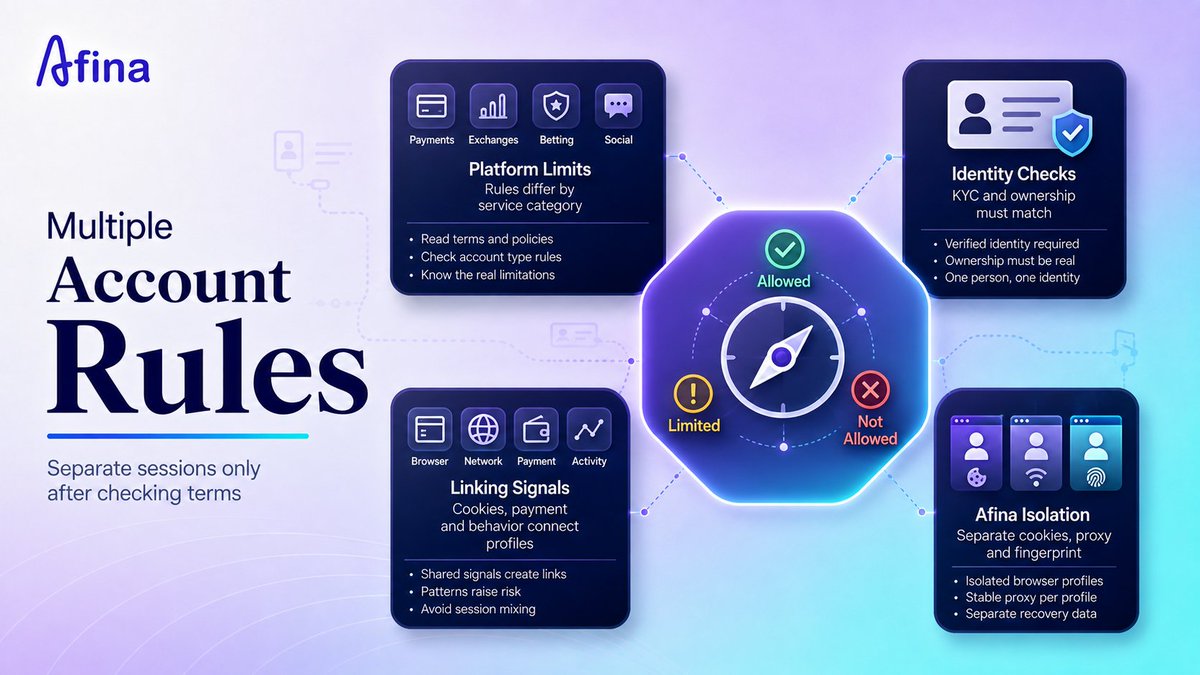
Multiple accounts on one platform are not automatically allowed
The real answer depends on the service, account type and platform rules:
- one personal plus one business account on some payment platforms
- one verified individual account on many exchanges
- strict one-account rules on betting apps
- multiple handles on some social platforms
- separate phone numbers or emails where required
- real identity documents for regulated services
- no shared sessions when accounts are legitimate but separate
The dangerous mistake is assuming every platform works like social media
Payment, trading and betting services often connect accounts through KYC, funding sources, cookies, fingerprints, IPs and behavior patterns
This is not a guide to bypass platform rules or create duplicate accounts where they are prohibited
It is about checking what is allowed first, then keeping permitted accounts technically separated so sessions, recovery data and browser environments do not mix
Afina helps with the operational layer: isolated Chromium profiles, separate cookies, cache, fingerprints, per-account proxies, groups, tags and recovery-friendly profile records
Read the full guide ↓
https://t.co/2um67Y9n4N
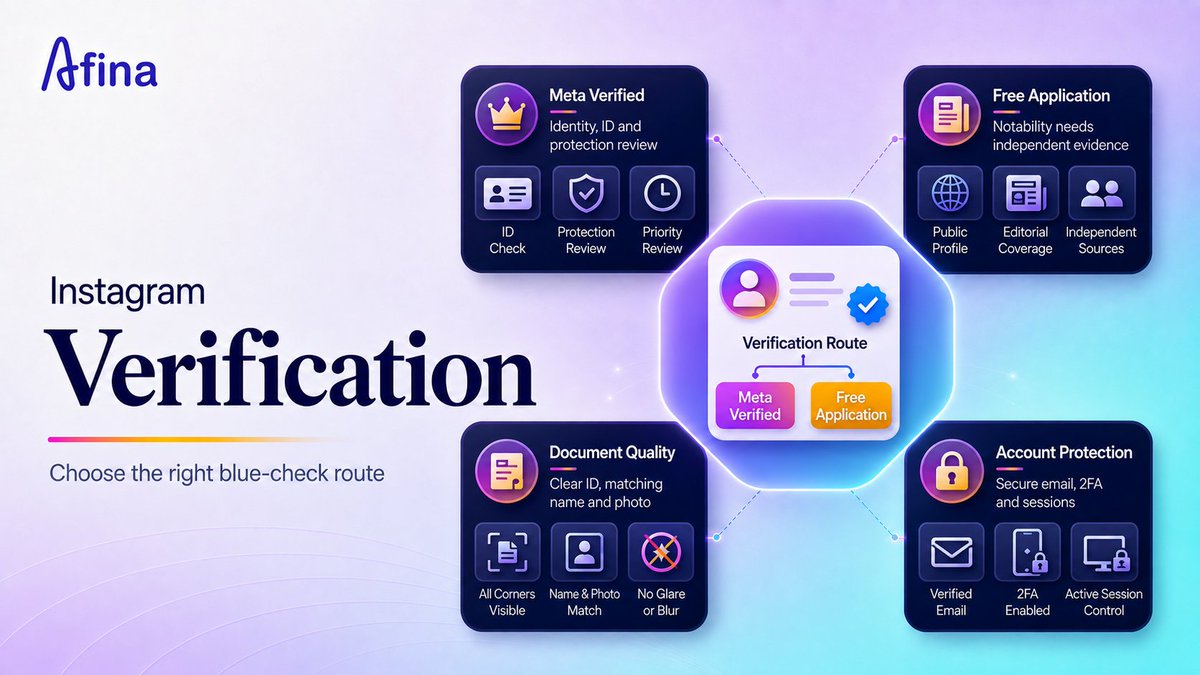
Instagram verification in 2026 has two legitimate routes
But neither one is about follower count alone:
- Meta Verified subscription
- free application for notable public figures or brands
- valid identity or organization documents
- complete and active profile
- name and photo matching the submitted data
- clean Account Status before applying
- stable profile details during review
The blue check confirms authenticity
It does not guarantee reach, sales or better recommendations
For creators, Meta Verified is often the practical path
For public brands or notable people, the free application only works when there is real independent evidence, not paid press or copied announcements
Afina helps agencies keep client sessions cleaner with isolated profiles, separate cookies, cache and access settings, but Instagram’s verification decision still depends on Meta’s own review
We broke down Instagram verification in 2026, Meta Verified, free applications, document checks, rejection fixes and post-verification security
Read the full guide ↓
https://t.co/WFYivq55Q4
Unblocking a site is not always the same problem
Opening a page once and keeping a stable account session need different setups:
- web proxy for quick one-time access
- VPN for changing the network route
- private proxy for a steadier IP
- residential or mobile proxy for long sessions
- isolated profile for separate cookies and storage
- consistent geo, timezone and browser signals
- 2FA and recovery data for real work accounts
A free web proxy may open a page
But it does not create a clean browser environment or protect account history
For accounts, teams and repeated sessions, the real risk is usually session chaos: shared cookies, sudden IP changes, repeated fingerprints and unclear access
This is not a guide to bypass workplace, school or platform restrictions
It is about safer access workflows where the user has permission: stable sessions, cleaner profiles, stronger recovery setup and fewer technical mismatches
Afina helps organize this layer with isolated profiles, per-account proxies, cookie separation, localStorage isolation, IndexedDB isolation and automation scripts
Read the full guide ↓
https://t.co/CibuSaaS60
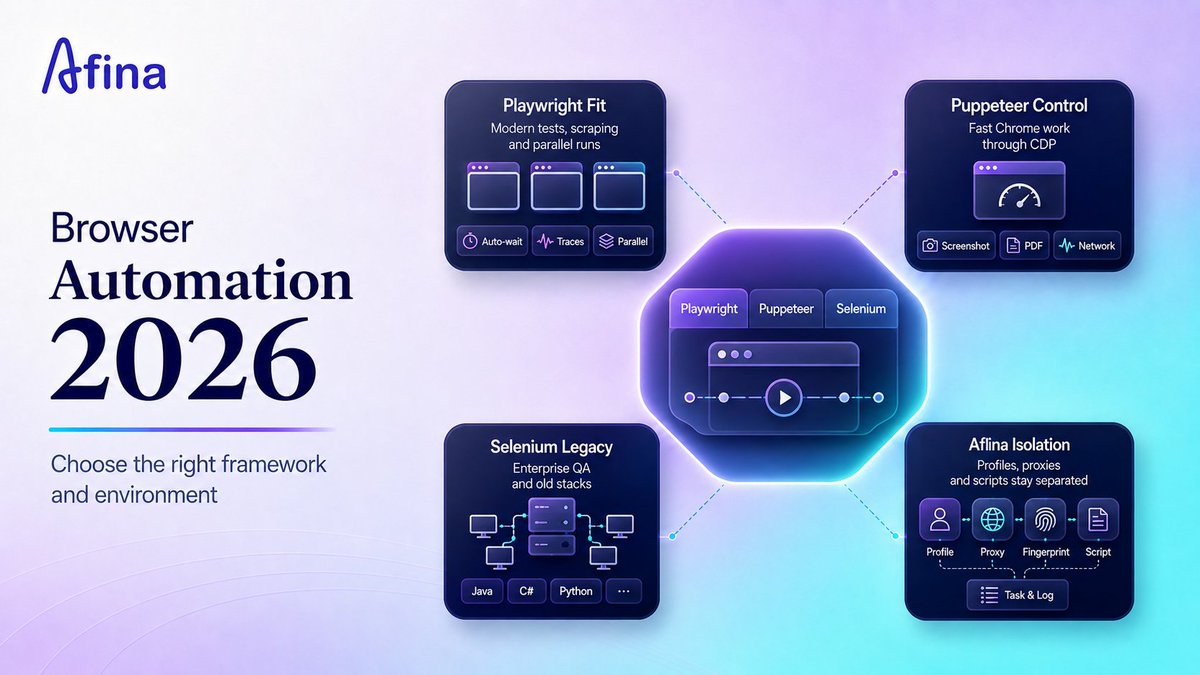
Playwright, Puppeteer and Selenium all control browsers from code
But they are not built for the same automation workflow:
- Playwright for modern tests, scraping and parallel jobs
- Puppeteer for Chrome-focused Node.js automation
- Selenium for legacy QA, Grid and enterprise stacks
- auto-waiting when pages change dynamically
- browser contexts for cleaner parallel sessions
- DevTools control for compact Chromium tasks
- profile isolation when automation touches accounts or proxies
For most new projects, Playwright is often the safest starting point
For narrow Chrome jobs, Puppeteer still makes sense
For mature QA systems, Selenium can still be the right answer
The harder question starts when automation meets real accounts, proxies, fingerprints and team workflows
Stealth plugins alone do not solve environment consistency
Afina helps organize the operational layer with isolated profiles, proxy-per-account setup, fingerprint logic, scripts, tasks and controlled automation workflows
We broke down Playwright vs Puppeteer vs Selenium in 2026 and how to choose the right tool for browser automation
Read the full guide ↓
https://t.co/RiWayHD3Gh
X Web Login looks simple until more than one account enters the workflow
Logging in through a browser is easy
Keeping sessions clean across profiles, proxies and team access is the harder part:
- multiple accounts sharing one browser
- cookies and local storage overlapping
- unstable IP changes between sessions
- account passwords shared across teammates
- no clear owner for each profile
- repeated actions across several accounts
- automation added before the workflow is organized
For one personal account, a regular browser is usually enough
For multi-account work, the browser environment becomes part of the infrastructure
Each X account needs its own clean profile, stable session logic and clear access rules before scripts or routine automation make sense
Afina helps teams organize X Web workflows with isolated profiles, proxy assignment, cookie separation, team access and automation for repetitive steps
We broke down what X Web Login means, where regular browsers create problems and how to structure multi-account workflows without session chaos
Read the full guide ↓
https://t.co/F9g6JSCkVW