Following his ouster as CEO of Nvidia Jensen Huang is reportedly considered for a high executive position at Mistral. Some experts, however, warn that for a high-profile position in France, two affairs might not be enough.
I'm begging you, learn this one setup.
If you close above the support leading to a significant high, you will almost ALWAYS make a new high.
It won't necessarily be immediately, but it will come.
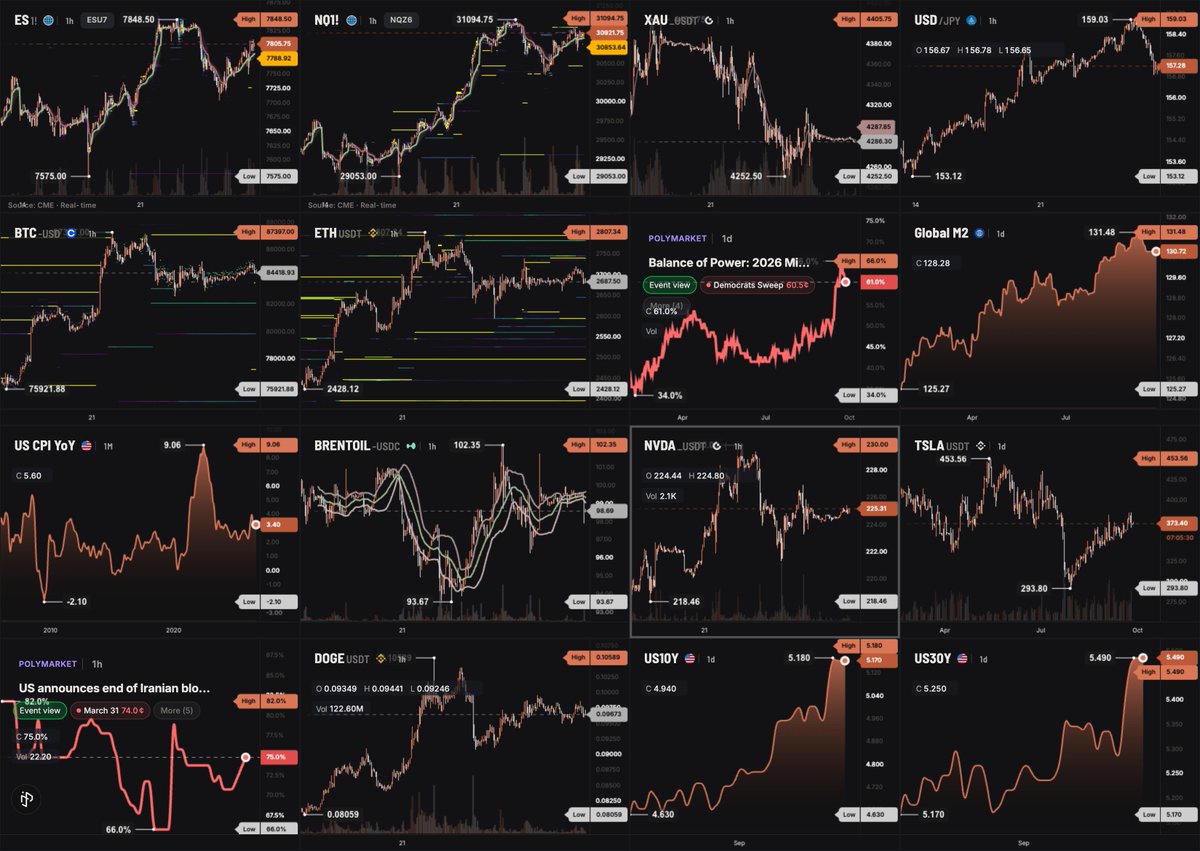
TradingView charges $2,399 a year to plot 16 charts on one screen.
Starting today, you can do the same for free on OpenMarket.
Everyone now gets:
→ up to 16 charts per layout, any grid from 1x1 to 4x4
→ no limit on classic indicators: RSI, MACD, moving averages, Bollinger and more
→ 5,000+ economic series from 200+ countries and 50+ central banks
And beyond candles: footprints from every trade, not estimates, and live order book heatmaps from real depth, on crypto, CME futures and more.
Every market, one terminal:
• US stocks and tokenized stocks
• Crypto
• CME futures
• Forex, commodities, indices
• Prediction markets
• Macro: CPI, GDP, rates, M2 for 200+ countries
https://t.co/U91agdMf58
A new kind of LLM tech has entered the chat.
Jev has been popping up all over my timeline the past few days - kinda reminds me of a new crypto coin or something in that way haha - but the proposition is undeniably intriguing.
Way faster, way way way way cheaper (almost free).
It's different to an LLM, there are things an LLM can do that Jev can't. It's not "generative". It's more of a deterministic decision-maker, in real-time.
The automation use-cases especially intriguing (i mean trading bots alone are gonna completely level up industry-wide presumably). I'm gonna use this thread as like an on-going journal and drop various interesting Jev use-cases i find on my timeline over the coming weeks.
Check it out below
🚨 EDUCATIONAL POSTS
I’m going to compile all my educational posts under this pinned post and will continue adding new ones (or series of them) as and when I publish them.
⬜️Wick Fill Strategy: https://t.co/z3MplJJrsm
⬜️VRVP & FRVP: https://t.co/a41oAsdIfW
⬜️OBs/BBs (Do they really work?) https://t.co/eLhzoiTtKJ
◽️BTC 4 Year Cycle Theory https://t.co/oGRZdBskUR
⬜️BTC 4 Year Cycle Theory (Version 2): https://t.co/zZQ4Ta7ntS
⬜️✔️The Power of Simplicity: Why Your Chart Needs Less, Not More:
https://t.co/ROmMyXsTnp
⬜️A little educational post on trading psychology:
https://t.co/nXLslx9QzY
⬜️A quick Educational Post on TFs:
https://t.co/HFBILfEkfB
every strategy you paid for is on this list 💸- ❌ ICT- ❌ SMC- ❌ CRT- ❌ moving averages, trend lines, fib, ORB- ✅ trend + momentum. thats it. thats the listsorry about your $2k course, champ
Some people have asked for my opinion on the recent post around this 'mentor' so here it is.
The issue is not that someone was once new as everyone starts somewhere. The issue is not that someone improves as people can improve as times goes on.
You can be genuine and improve.
You can be deceptive and improve.
Growth alone does not prove integrity. The issue is not that someone sells coaching, writes a book, or uses AI to polish their writing. Tools are tools. Business is business, and growth is growth.
The issue begins when all of that gets wrapped inside a manufactured image of wealth, authority, experience, and success that does not appear to match the receipts.
That is where it stops looking like growth and it becomes identity inflation. And when identity inflation gets monetized, it becomes credibility laundering. I believe i first read this term in Barncore's timeline during Zero Ika's drama.
Credibility laundering is simple: Borrow the symbols of success before earning the substance of success.
Borrowed luxury, lifestyle, confidence, authority, depth, and scenery. Then sell access to the persona as if the persona itself is proof.
That is the danger, because beginners do not only buy information. They buy belief, certainty, and proximity to success. They buy the illusion that the person selling them advice has already crossed the bridge they are trying to cross.
From what is being shown, there are serious questions. Luxury car-key images allegedly found through reverse image search on Pinterest or Instagram from someone else's account. Travel and suitcase photos that appear to belong to someone else. A timeline that allegedly goes from asking for signals, promoting questionable micro-cap crypto projects, and behaving like a beginner not long ago, to suddenly presenting as a high-level mentor of future successful people, and millionaires.
A coaching program reportedly costing thousands. A book often pushed to beginners while the account simultaneously sells a rich-and-successful lifestyle image. Posts polished aggressively to sound hyper-intelligent while the real-world receipts behind the persona look increasingly questionable.
None of these things alone prove everything, but together they create a pattern.
The issue is not whether he knows more than a beginner. He probably does. The issue is not whether someone learned something from him. They probably did. The issue is not whether he has a selection of good trades. Maybe he has.
The issue is whether the authority being sold is honest, because someone can help a newbie and still misrepresent themselves. Someone can improve over time and still pretend the image was earned long before the receipts existed.
That is the part gullible people miss. The standard is not: 'Did one person say the mentorship helped?'
The standard is: 'Is the person selling the mentorship honest about who they are, what they have done, where their credibility comes from, and what their real lifestyle actually is?'
Because if someone needs borrowed luxury photos to look successful, that tells you something. If someone was asking for signals not long ago but now markets himself like a veteran mentor, that tells you something. If someone was promoting shady micro caps two years ago but now acts like a polished authority figure, that tells you something. If someone needs AI to make ordinary thoughts sound profound while the timeline behind the persona does not match the image, that tells you something.
This is why i do not trust aesthetics. I trust timelines.
Who were you two or three years ago?
What were you promoting?
Were you asking for signals?
Were you selling garbage?
Were you deleting mistakes?
Were you chasing referrals?
Were you pretending to live a life that reverse image search says belonged to someone else?
Did the authority come before the receipts, or did the marketing come first?
Real credibility compounds slowly while fake credibility gets assembled quickly.
Anyone can repost luxury, steal scenery, polish words, use AI to sound deeper than they are, call themselves a mentor, and charge thousands to pretend the price itself proves value. But real authority has weight, history, scars, timing, consistency, receipts that do not need manipulation.
And this is where the second layer begins. In this space, a lot of people are not only looking for market education. They are lonely, confused, ambitious, lost desperate for direction. They want someone to talk to about markets, life, dreams, struggles, fear, failure, money, purpose, past mistakes, and the future.
That creates a dangerous business model, because some people online are not really selling mentorship. They are selling emotional access. A 'high-status' friend. A private confidence dealer. A paid source of certainty. Someone who listens, validates, answers, makes the mentee feel seen. Someone who makes success feel inevitable, just delayed.
That is powerful, and that is exactly why it is dangerous. Because once someone pays thousands, the relationship is no longer only about information. It becomes proximity, attachment, access to a character the mentee believes has already reached the place he is trying to reach.
That is how weak mentors can still receive strong testimonials. Not because they are elite, but because they are available. A beginner usually cannot properly audit the quality of the advice, but he can audit how the mentor made him feel: Supported, motivated, understood, important, closer to the dream.
That feeling can be real, but that does not mean the authority is real. That does not mean the track record is real, neither the lifestyle. That does not mean the person is who they are presenting themselves to be.
Availability can masquerade as expertise.
Emotional support can masquerade as mentorship.
Confidence can masquerade as competence.
And now, with AI, the costume is easier to maintain than ever. If they do not know the answer, they can dodge it with 'I use a completely different system' or 'You are thinking about it the wrong way because you learned from the wrong sources'
Or they can ask AI for the cleanest, deepest, most polished, most human-sounding answer possible. Then the mentee receives something calm, structured, intelligent, and profound, but it may not be earned. It may not be lived.
The mentee thinks he is receiving wisdom from someone who carried the lesson, but sometimes he is receiving polished output from someone who only knows how to stay two steps ahead of the person paying him.
That is the trap. The mentor does not need to be elite. He only needs to know slightly more than the mentee. He only needs to sound certain, to stay available, to keep the mentee believing he is close, improving, and asking the right questions.
And often the mentee does improve, learns something, and maybe conversations help, but none of that answers the real question: Is the person selling the mentorship genuinely who they are presenting themselves to be?
Time is the cleanest audit.
Everyone gets 24 hours per day.
The broke person gets 24 hours.
The millionaire gets 24 hours.
The trader gets 24 hours.
The builder gets 24 hours.
The person scaling something real gets 24 hours.
And the more serious your life becomes, the more selective you become with your time. That does not mean successful people never help others. Of course they do. Some teach because they care. Some mentor because they enjoy it, and some guide because they want to build something bigger than themselves.
But when someone is supposedly wealthy, successful, trading, scaling, building, living the dream, and somehow has endless daily hours for one new mentee who paid thousands, people should ask a simple question: What is really the main business?
Someone wealthy does not accidentally sell unlimited access. Someone wealthy is never chasing small payments. The more valuable your real work becomes, the more expensive your attention becomes. So if someone is going the extra mile every day, for hours, for a paying stranger, that usually tells you something.
That client may not be a side mission. That client may be the business, and that is not automatically wrong but it becomes a problem when the person presents as if the money comes from trading, investing, elite success, and lifestyle dominance, while the real monetization appears to come from selling access to that image. That is where mentorship becomes performance, availability becomes a funnel, and where emotional support becomes a product.
This is why fake lifestyle matters. The car keys are not random. The trips are not random. The suitcases are not random. The polished writing is not random. The calm authority is not random. The 'I mentor millionaires' language is not random. The high-ticket offer is not random.
It all works together as the mentee may 'need' to see a lifestyle that makes sense for the price he's paid. It tells the potential mentee: 'This person is where i want to be'
But if the lifestyle is borrowed, the authority is inflated, the answers are AI-polished, and the time availability does not match the claimed level of success, then people should ask what is really being sold, because maybe they are not buying trading education. Maybe they are buying emotional access to a character. A character built to look wealthy, to sound wise, to feel close enough to trust.
That is why i call it credibility laundering, because the product is not always the book, the course, or the mentorship. Sometimes the product is the illusion of proximity to success.