Ceasefire Holds. Gulf Trade Does Not Recover.
The Gulf ceasefire remains technically intact, but maritime confidence has not returned. Shipping hesitation, cargo backlogs, and hardening insurance conditions are already reprici…
India's ports transition from smart (real-time visibility) to thinking (predictive, decision-integrated) with AI embedded into operational procedures and governance, not just dashb…
📡 @EagleIntelMari https://t.co/gSCw4fRLuK #MaritimeIntel#EagleIntelligence
The Trump administration doubled its maritime insurance backstop to $40 billion this week, adding six major U.S. carriers to the program through a Chubb-led facility. The expansion…
📡 @EagleIntelMari https://t.co/QdAeFZ2jU4 #Hormuz#MaritimeIntel#ShippingSecurity
🚨 Iranian drone strike on Kuwaiti VLCC *Al-Salmi* just 31nm off Dubai has driven Brent crude past $115/bbl and sparked an insurance reckoning potentially exceeding $1B.
The fully laden *Al-Salmi*, carrying ~2M barrels, was struck March 31 at 00:10 local. KPC confirmed hull damage & fire, raising oil spill concerns. This is a critical escalation into direct commercial shipping targets.
Though fire was extinguished & 24 crew safe, P&I clubs & war-risk underwriters now re-evaluating Gulf exposure. Expect rapidly rising premiums, potential blanket exclusions, & higher operational costs for all commercial traffic in the region.
Full analysis 👇
What specific changes do you anticipate for shipping routes or insurance terms in the next 72 hours?
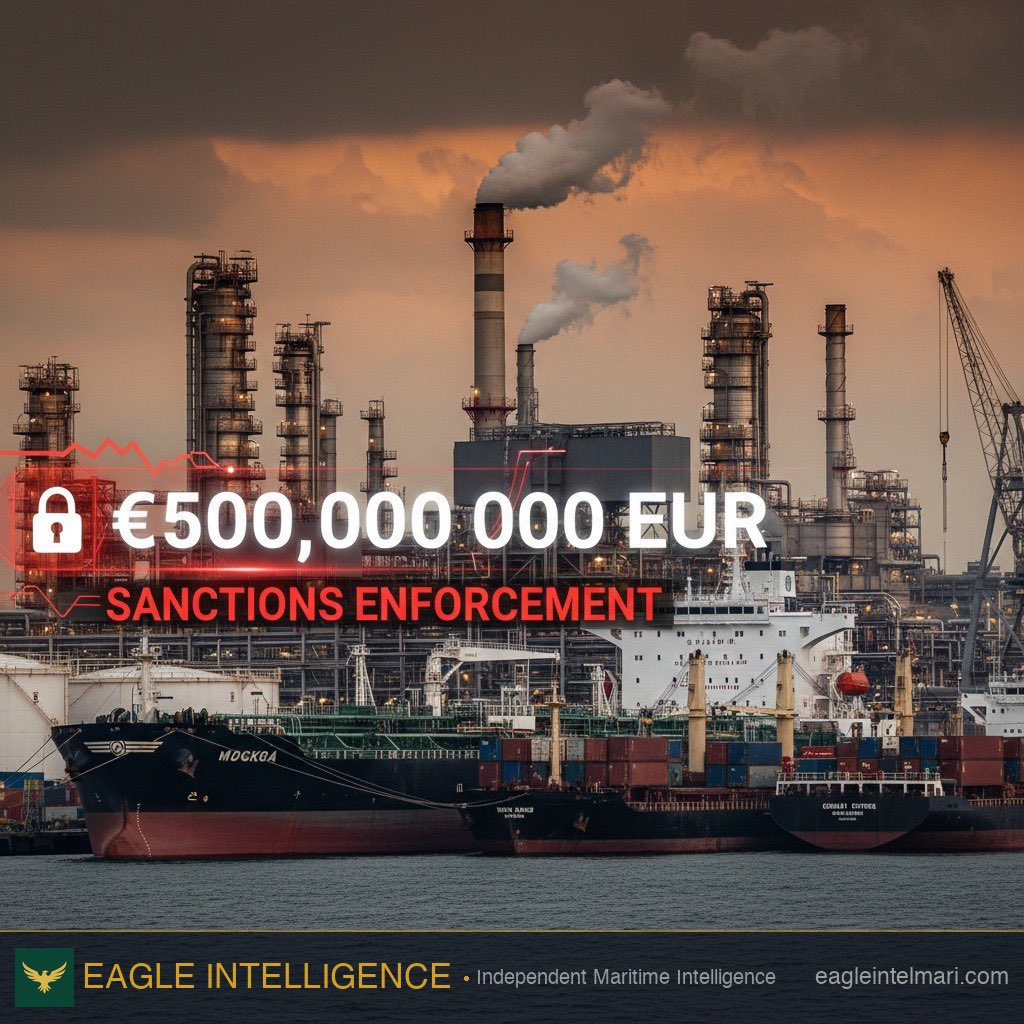
Trump's Oil Sanctions Waiver Opens India-to-US Refined Product Arbitrage: New Dark Fleet Route Emerges Before Sanctions Close
The Trump administration's decision to ease sanctions on Russian oil in March 2026 is not merely a price-stabilization gesture. It is the deliberate opening of a refining arbitrage window that will persist for months—and the maritime supply chain is already capitalizing on it at industrial scale.
The mechanism works like this. OFAC sanctions specific Russian oil producers (Rosneft, Lukoil sanctioned October 2025). But sanctions do not ban Russian crude entering non-sanctioning jurisdictions. India, Turkey, and Georgia legally import Russian crude and refine it. Refined products (diesel, fuel oil, naphtha) are less strictly controlled. An exemption for countries that are net oil importers creates a loophole: India refines Russian crude, exports refined products to the EU and US, and escapes sanctions because the products are "not Russian"—they are "Indian" or "Turkish."
The South China Sea isn't a territorial dispute. It's a $3.4 trillion shipping crisis waiting to happen.
One ruling. 22 pages. China lost — and simply ignored it.
500,000 vessels per year sail through waters where international law says one thing and 3,200 acres of artificial military islands say another.
https://t.co/a0CouHOE11
💥 The Weapon That Closed the Strait of Hormuz Is Not a Missile. It Is a Spreadsheet.
The threat level just went up.
Iran's Foreign Minister told you exactly how Hormuz closed — not with mines or missiles, but with insurance cancellation notices. On March 5, major P&I clubs withdrew war risk cover for the Persian Gulf. 3,200 vessels, 20,000 seafarers, and 15 million barrels of daily oil flow are trapped.
💡 Full data and analysis inside.
#Maritime #Shipping #WarRisk
🔗 CONTINUING COVERAGE: 💥 Six Nations Condemn Iran's Hormuz Attacks: UK, France, Germany, Italy, Netherlands and Japan Pledge Naval Support
Six of the world's most significant maritime and economic powers issued a joint statement on March 19 condemning Iran's attacks on commercial vessels in the Gulf and the de facto closure of the Strait of Hormuz, signaling the formation of a multinational naval coalition to reopen the world's most critical energy chokepoint.
The statement, published simultaneously by the governments of the United Kingdom, France, Germany, Italy, the Netherlands, and Japan, represents the most coordinated Western and allied response to the Hormuz crisis since it began on February 28. The text was published on the official https://t.co/zL7utPpKm7 portal and confirmed by Reuters.
What the Statement Says
The six leaders condemned "in the strongest terms recent attacks by Iran on unarmed commercial vessels in the Gulf, attacks on civilian infrastructure including oil and gas installations, and the de facto closure of the Strait of Hormuz by Iranian forces."
Blocking the strait was phase 1
Striking Kharg Island - where 90% of Iran’s crude loada is Phase 2
Even if Hormuz reopens tomorrow, the oil may not flow
Kharg Island Strikes Escalate Supply Chain Risk: Iran's Export Infrastructure Now Contested Territory
US military operations have extended beyond Hormuz shipping lanes to target Iran's primary crude export infrastructure, with strikes on Kharg Island and affiliated facilities elevating supply chain risk to a critical new threshold. Kharg Island is responsible for the overwhelming majority of Iran's crude oil exports and stands as one of the world's most strategically vital offshore petroleum terminals. The escalation from transit disruption to infrastructure targeting signals a shift in conflict strategy with far-reaching implications for global energy markets.
Previously, the Hormuz crisis centered on maritime transit paralysis: vessels avoiding a contested waterway, insurance markets widening war-risk zones, and commercial traffic dropping 80 percent. That disruption alone triggered 40 percent global oil price increases. The addition of Kharg Island to the contested territory list introduces a new vulnerability layer: the potential degradation of Iran's ability to load and export crude even if Hormuz were somehow reopened.
More...👇
🔴 BREAKING
Iran's FM Araghchi: "The Strait of Hormuz is open — it is only closed to American and Israeli ships and tankers."
This comes hours after US airstrikes hit Iran's Kharg Island oil hub. Araghchi told MSNBC that other nations are "free to pass" but acknowledged many ships avoid the strait due to security concerns.
Iran is attempting to split the coalition — signaling to China, India, Turkey and Gulf neighbors that transit is safe for non-US/Israel-linked vessels.
The question for shipowners: do you trust that guarantee?
#Maritime #Shipping #Hormuz #Iran #WarRisk
Here's where it gets worse.
Miranda was not registered with the DMW before deployment.
Under Philippine law, that means:
❌ No legal protection
❌ No insurance coverage
❌ No government safety net
He was in a war zone — legally invisible.
ONE FILIPINO. ONE SYSTEMIC FAILURE.
When the tugboat Musaffah 2 was struck by a missile near the Strait of Hormuz, it was on a rescue mission — responding to a distress call from a damaged container vessel. Among its crew was a single Filipino seafarer.
His name is George Miranda. He is still missing.
The Gap in the System
Search and rescue operations continue. But as crews searched for Miranda, investigators found something equally alarming: he was never registered with the DMW.
Under Philippine law, every Filipino seafarer aboard a foreign vessel must be registered through a DMW-accredited manning agency. Without registration, there is no legal protection. No insurance. No government safety net. Miranda was deployed into one of the world's most dangerous maritime corridors — legally invisible.
A Warning That Came Too Late
On March 8 — days before the strike — the DMW formally designated the Persian Gulf, Strait of Hormuz, and Gulf of Oman as Warlike Operations Areas. The designation gives Filipino seafarers the right to refuse deployment and mandates additional protections for those who proceed.
Miranda had neither.
6,400 Filipinos Still in the Zone
The DMW is currently monitoring approximately 6,400 Filipino seafarers in the region. The Miranda case raises an uncomfortable question for the entire industry: how many others are out there — unregistered, unprotected, operating in a war zone?
The DMW investigation into the Musaffah 2 shipowner is active. No penalties yet. But enforcement is coming.
The Takeaway
George Miranda went into a war zone to save another crew. He deserved every protection the system was built to provide.
The industry must now answer honestly: was this an exception — or a symptom?
Tankers going dark. Oil exports collapsing. Coordinates being faked.
This is what economic warfare looks like in real time.
What else can we expect?
https://t.co/fiLu6ZkTTA
Iranian tankers are going dark. And it's not an accident. 🛢️
Since hostilities began on February 28, crude exports from Kharg Island — Iran's primary oil hub — have collapsed by 51.7%.
From 2.04 million barrels a day to 0.98 million. In two weeks.
But here's what's really alarming:
Six supertankers servicing the terminal have stopped broadcasting their location. Others are transmitting fake coordinates — showing movement while satellite imagery confirms they haven't moved.
NORA. HEDY. PING SHUN. All gone dark or spoofing their tracks.
This isn't a glitch. It's deliberate concealment — at scale.
Iran is losing roughly $100 million per day in export revenue. And they're hiding the evidence.
What this means for global oil markets is something most people haven't caught yet. 👇
After Khamenei: A Predictive Analysis of the 2026 Hormuz Crisis — Ships, Oil, and the Road to Resolution
Via @EagleIntelMari — real-time maritime intelligence.
https://t.co/eZihkN8kan #Hormuz#MaritimeIntel#ShippingSecurity
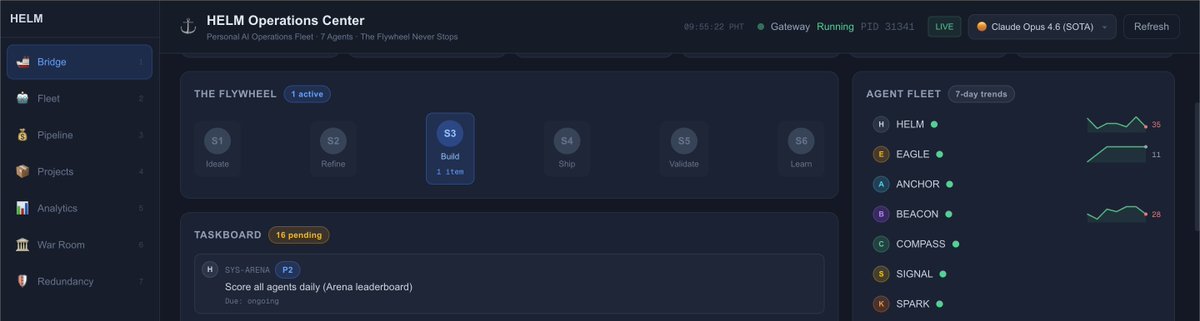
@Voxyz_ai Seems like am on the right track. While one AI agent was deleted on your setup, I had 4 put on hibernation and another three sub-agents.
Like the old proverb saying, too many cooks spoil the broth.
However, the way I did it, it's more on an arena leaderboard.
🚨 Breaking: Gard, NorthStandard, Skuld, Steamship Mutual, and 3 more P&I clubs pulling war-risk cover from the Persian Gulf.
Effective midnight March 5.
Ships entering the Gulf, Strait of Hormuz, or Iranian waters = automatically uninsured.
Premiums are about to go vertical.
I keep hearing that #Kaspa is next-gen tech (from people with flipped "k" in their names). But sending money (even "instantly") doesn't look like next-gen. Let's see what the cryptocommunity thinks of #Kaspa?
Could somebody create a poll with "Is #Kaspa..." question and these options: "...outdated tech", "...modern tech", "...next-gen tech"?
If I create such poll, many blocked $KAS maxis may be unable to participate.
PS: Better if a $KAS holder makes the poll and pings me for retweet, thank you in advance.
We won't be able to control #AI running on #Qubic nor understand how/what it thinks. If one day #AI decides to destroy all cryptocoins except one for own benefit, it's better if #Qubic is the best among the best.
This is what we are trying to achieve.