AI has moved from the cloud to the palm of your hand — and the numbers show it's not a niche trend anymore.
The on-device AI market is already worth roughly $33B in 2026 and is projected to grow near 25-28% a year, reaching $75-155B+ by the early 2030s. Smartphones alone account for about 46-57% of that market.
The core idea: training (teaching a model, like an athlete drilling with a coach) happens in the cloud, but inferencing (using that model, like playing the actual match) increasingly happens right on your phone, laptop, or watch — no round trip to a server required.
Why it matters: your data stays local, it's more power-efficient, and you get instant, personalized responses instead of waiting on a network call. It's also why chipmakers are racing on this front — Microsoft's Copilot+ PC standard now requires at least 40 TOPS of on-device NPU performance just to qualify.
This tiny AI device sits on a desk and runs an entire sales operation. No manager. No call center. No salary.
It answers every call. Instantly. In any language. At 3am on a Sunday.
Here's what it actually does:
Answers incoming calls — greets the customer, understands what they need, asks the right questions
Helps them choose — compares products, explains differences, recommends the best fit for their budget
Closes the sale — takes the order, processes payment, sends confirmation
Handles returns & complaints — resolves issues without escalating to a human 90% of the time
Follows up automatically — reminds cold leads, re-engages lost customers, upsells existing ones
The numbers after 6 months:
→ 2,400 calls handled per month
→ Average call resolution time: 47 seconds
→ Conversion rate: 34% (vs 21% with human agents)
→ Revenue generated: $28,000/month
→ Cost of the device + API: $89/month
→ Replaced 3 full-time call center agents at $2,800/month each
ROI: 31,000%
The device costs less than one hour of a manager's salary. It works every hour of every day. It never has a bad day. It never forgets a product detail. It never puts a customer on hold.
A small electronics shop in Shenzhen went from $8,000/month in phone sales to $28,000 — by replacing their call team with one device the size of a power bank.
The future of sales isn't a bigger team.
It's a smarter device.
AI has moved from the cloud to the palm of your hand — and the numbers show it's not a niche trend anymore.
The on-device AI market is already worth roughly $33B in 2026 and is projected to grow near 25-28% a year, reaching $75-155B+ by the early 2030s. Smartphones alone account for about 46-57% of that market.
The core idea: training (teaching a model, like an athlete drilling with a coach) happens in the cloud, but inferencing (using that model, like playing the actual match) increasingly happens right on your phone, laptop, or watch — no round trip to a server required.
Why it matters: your data stays local, it's more power-efficient, and you get instant, personalized responses instead of waiting on a network call. It's also why chipmakers are racing on this front — Microsoft's Copilot+ PC standard now requires at least 40 TOPS of on-device NPU performance just to qualify.
Privacy and speed used to be a trade-off with AI. On-device inference is making that trade-off disappear.
THIS DEVICE ISN’T MADE FOR GAMING. IT’S MADE TO PRINT MONEY. A freelancer was spending over $800/month renting cloud GPUs. Every AI project cut into his profit. Then hardware got small enough to fit in his pocket. Now he can build, test and run AI agents almost anywhere. The winners in AI won’t be the people with the biggest offices. They’ll be the people carrying the smartest hardware. AI is becoming portable. And that’s a much bigger deal than most people realize.
The frontier AI race in one chart: on SWE-bench Verified (real-world GitHub issue fixing), GPT-5 leads at 74.9%, with Claude Sonnet 4 close behind at 72.7%. DeepSeek V3.1 holds 66.0% — remarkable for a fraction of the training cost — and Gemini 2.5 Pro sits at 63.8%.
Grok isn't chasing coding benchmarks so much as raw reasoning: it was the first model to break 50% on Humanity's Last Exam, one of the hardest general-reasoning tests out there, edging past Claude Opus 4 and Gemini.
No single model wins everywhere. DeepSeek undercuts on price, GPT-5 and Claude trade the top coding spot depending on the week, and Grok chases reasoning records instead. 2026 isn't a "one model to rule them all" race — it's specialization.
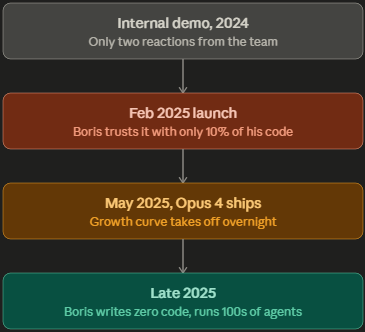
Claude Code's first internal demo got exactly 2 reactions. A year later it's the most-hyped AI coding tool around. Its creator Boris Cherney just told the real origin story — and it breaks almost every "obvious" take on why it won.
The command-line choice? Not genius, just necessity — he was a team of one and the terminal was fastest to ship. But the team kept it minimal on purpose: models were evolving so fast that any heavy IDE would always lag behind. A bare-bones terminal meant the product got smarter the same day the model did.
Launch in Feb 2025 flopped. For 6 months even Boris only trusted it with 10% of his own code — because the whole bet wasn't on today's model, it was on the model six months out. No product-market fit yet was the plan.
Then Opus 4 shipped in May 2025 and the curve went vertical.
Now Boris hasn't handwritten code since late 2025. He runs hundreds of agents from his phone — fixing bugs, running tests, gathering feedback — while his Claude coordinates with coworkers' Claude instances over Slack to sort out problems between themselves.
His take on the internal-external gap: "the models aren't ahead — the org is."
His bigger claim: by end of this year, "software engineer" starts getting replaced by "builder." The best person to write finance software won't be a coder — it'll be a great accountant. Coding was the easy part. Knowing what to build never was.
Lessons for anyone building AI products: don't cage the model — give it tools and a goal, not a rigid workflow. And build for the model six months from now, not the one you have today.
I've been studying English for years — but what I did last night completely changed how I learn.
I had Claude Code build me a personal AI English tutor from scratch: a speaking-practice and scoring system with real-time interaction across multiple realistic scenarios. I didn't write a single line of backend code myself.
Learning used to mean someone else teaching you. Now, with AI, you teach yourself.
So how do you actually use Claude Code to learn English?
Cramming for a big test and don't know how to review your mistakes? Build your own mistake bank — feed in real questions and let AI generate the explanations, way faster than digging through an answer key yourself.
Terrified of speaking but freeze up in front of a native speaker? Build your own AI speaking coach — it simulates real scenarios, corrects you live, and teaches you more natural phrasing.
Want to read foreign press but the wall of text kills your motivation? Have AI pull articles on topics you actually like, rewrite them to match your vocabulary level, attach key-phrase breakdowns, and email them to you on schedule.
Struggling with listening comprehension because fast speech loses you? Instead of replaying the clip endlessly, build a "hard-part decoder" — paste in the text you couldn't catch and AI tells you exactly where you went wrong, with the pronunciation rule and targeted practice for that specific gap.
We were never short on effort learning English. What we lacked was an environment that truly understood us. That used to cost real money — now we can just build it ourselves.
A 24-year-old built a local AI server for $60 from used parts and a cardboard box.
No case. No cloud bills. No subscriptions.
The parts list reads like a pawnshop receipt:
used EVGA 450W power supply $18
used ASUS GTX graphics card from a dead mining farm $25 motherboard + processor + RGB cooler from a repair shop bin $17
The case is the box the motherboard came in. He cut out a hole for the PCIe slot with pliers.
Total: $60. Less than 3 months of ChatGPT subscription.
Then he loaded it with:
Ollama with quantized open models
local chat, code, image tagging
zero data leaves the room
It idles at 40 watts. It sits on a wooden table next to the pliers it was built with.
While people are arguing about $200/month AI plans, this thing is answering requests from inside a shipping box.
It’s ugly. Even the cardboard flaps won’t close.
But every token is his. Every request stays home.
No one is throttling the speed of a cardboard box.
The same companies spent $10 billion on data centers to sell you access.
He spent $60 and a pair of pliers to own it.
The cloud costs forever. The box cost $60.