While currently introduced as a Private Member's Bill—meaning it may not become law immediately—it plays a crucial role in starting policy discussions.
India has already revolutionized payments; tokenisation could be the next UPI moment for investments. 🇮🇳💸
India is standing at the edge of a financial transformation. After regulating Virtual Digital Assets, the next frontier is Real-World Asset (RWA) tokenisation. The Asset Tokenisation (Regulation) Bill, 2026 aims to bridge the gap between traditional finance and blockchain innovation. Let's break it down. 🧵👇 #CryptoUttar #RWA #IndiaCrypto
Despite the massive potential, tokenisation still faces significant hurdles:
Legal classification issues (Are tokens securities or commodities?)
Technology risks, including smart contract vulnerabilities and cybersecurity threats
The challenge of linking digital tokens with actual real-world ownership rights
India’s Travel Rule for VDASPs – A Complete Compliance Guide
The FATF Travel Rule is now fully embedded in India’s PMLA framework.
Unlike many countries, India follows a threshold-free version: every single Virtual Digital Asset (VDA) transfer must carry verified originator and beneficiary information.Key Obligations for VDASPs:
- Originating VDASP → Collect & securely transmit: PAN/full name, verified address/DOB, wallet address + beneficiary details
- Beneficiary VDASP → Verify customer records, monitor, screen sanctions & report STRs
- Unhosted wallets = high-risk (hosted party bears full compliance burden)
Must-have systems:
Robust KYC + blockchain analytics, secure data-sharing (real-time), automated monitoring, 5-year record-keeping, and live Travel Rule demo during FIU-IND registration/renewal.
Proactive compliance isn’t just a regulatory checkbox — it’s a competitive advantage and a pillar of trust in India’s digital asset economy.
Stay compliant. Stay ahead.
#CryptoRegulation #TravelRule #VDASP #PMLA #FIUIND #CryptoCompliance #IndiaCrypto
Regulatory clarity isn't just a win for the crypto industry; it's a defense of American financial dominance.
The $56M spent by legacy institutions wasn't just lobbying—it was a desperate defense mechanism by a monopoly facing real competition.
Establishing a concrete legal framework is a massive step forward. Time for the Senate to cement this. 🔥
#CryptoMarket #CryptoEducation #CryptoCommunity
Regulatory clarity is the real catalyst—not hype.
A structured market framework will:
• Reduce compliance uncertainty
• Enable institutional participation
• Strengthen investor protection
Bullish for long-term adoption, but execution will matter more than headlines.
#CryptoCommunity #VDA #CryptoEducation #CryptoCurrency
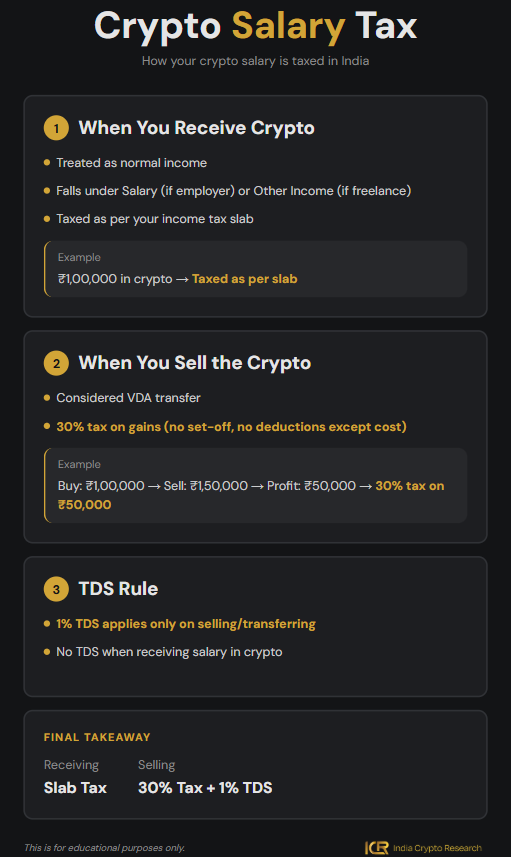
If you’re getting paid in crypto, it’s not taxed at 30% upfront.
When you receive it, it’s treated like normal income and taxed as per your income tax slab.
Only when you sell that crypto later, the 30% tax applies on the profit, along with 1% TDS.
Example:
You receive ₹1,00,000 in crypto
This ₹1,00,000 is taxed as per your slab
Later, you sell it for ₹1,50,000
Profit = ₹50,000
30% tax applies on ₹50,000
That’s where most people get confused.
If you want to quickly check your crypto taxes without doing the calculations manually, India Crypto Research has built a simple Crypto Tax Calculator.
Link in comments 👇
India’s Crypto Policy Put on Hold: What It Signals for Businesses & Investors 🇮🇳
A significant development has emerged in India’s digital asset landscape.
The much-anticipated cryptocurrency policy discussion paper—expected to provide regulatory clarity—has now been shelved indefinitely, largely due to resistance from the Reserve Bank of India.
Key Takeaways:
🔹 Regulatory Pause, Not Prohibition
India has not banned crypto—but it has also not moved toward a structured regulatory framework. The current stance reflects a cautious “wait-and-watch” approach.
🔹 RBI’s Concerns Remain Central
The RBI continues to flag risks around:
• Financial stability
• Monetary policy control
• Unregulated capital flows
This has significantly influenced the government’s decision to delay formal policy direction.
🔹 Status Quo Continues
In the absence of a dedicated framework, the ecosystem remains governed by:
✔️ High taxation on virtual digital assets
✔️ FIU-led compliance and reporting requirements
✔️ Exchange-level regulatory oversight
🔹 Shift in Strategic Focus
Policy attention appears to be gradually aligning toward CBDC (Digital Rupee) as a controlled and sovereign alternative to private cryptocurrencies.
What This Means:
• For Investors: Continued uncertainty and compliance-heavy environment
• For Startups/Web3 Businesses: Delayed regulatory clarity may impact innovation and capital inflow
• For Policymakers: A balancing act between innovation and macroeconomic stability remains ongoing
Conclusion
India’s approach reflects a deliberate prioritization of financial stability over rapid adoption.
While global economies move toward structured crypto regulations, India is choosing to proceed cautiously—keeping options open while closely monitoring risks.
Source : https://t.co/5hJ2tG8lH7
---
#CryptoPolicy #India #DigitalAssets #CBDC #FinTech #Regulation #Web3 #Taxation #Blockchain
The decentralized future isn’t coming.
**It’s already here.**
Read the full blog →
https://t.co/FHjb6Xq4G6
Drop a 🔥 if you’re bullish on Web3 + VDAs
RT & tag a friend who needs to see this!
Follow @CryptoUttar for more Web3 alpha 💎
#Web3 #VDA #VirtualDigitalAssets #CryptoRevolution #Blockchain #NFTs #DeFi #CryptoUttar
🌐 Tired of Big Tech owning YOUR data, YOUR content & YOUR money?
Say hello to **Web3** — the internet where YOU own everything.
And the secret sauce? **Virtual Digital Assets (VDAs)**.
This thread will blow your mind 👇
#Web3#VDA#CryptoUttar
Why this matters in 2026:
- Creators win big
- Metaverses are the new malls
- Your digital identity = your wealth
Analysts say Web3 will add **$1.5 TRILLION** to the world economy.
The question is… will you be part of it?
#FutureOfFinance#Metaverse