FIGHT FOR YOUR RIGHTS MAKE THIS VIRAL ! This was sent to all major papers in USA- **The Age-Verification Rush Is Really About Building Digital ID Infrastructure**
Lawmakers are moving with unusual speed to impose age-verification requirements when visiting websites, and the public framing of this is simple, yet emotionally charged: to protect children. But the policy architecture being drafted goes far beyond this narrow purpose, and we should be honest about what is being built.
To verify an individual’s age online in any meaningful way, platforms must reliably link a real person to a persistent identity, whether it’s through government ID scans, biometric checks, or third-party services. This “digital plumbing” becomes reusable infrastructure that can and will be misused.
Two concerns deserve particular scrutiny.
First, there is the risk of mass data collection. Age-verification systems generate stores of sensitive data, often managed by opaque third-party vendors. Even when companies promise deletion, breaches, repurposing, and scope creep are well-documented. Take the Salt Typhoon hack for example, the FBI told Congress years ago backdoors were safe to use, but soon after, the entire U.S. government was hacked, including the President of the United States. Another example is that as soon as India released its Digital ID in 2018, the system was hacked, and now nearly a billion people have had their personal information stolen. More recently, in January of 2025, tens of millions of Social Security numbers were hacked from the New Jersey vendor, Conduent, which processes payments to health insurers.
The second risk is future-use uncertainty. Policymakers today may have narrow intentions, but infrastructure tends to outlive the political moment that created it.
So what will happen if these sets of rules and laws become commonplace? Not only will people have their data hacked, their credit cards stolen far more frequently and loans taken out in their name, things will get dark quickly. Travel restrictions? Check (China's social credit system already bars millions from buying plane tickets). Banned topics? Check (the EU's Digital Services Act has compelled platforms to remove legal speech). Freezing your bank account? Check (Canada froze the accounts of truckers who donated to a protest in 2022). No Freedom of the Press? Check (reporters in Hungary are systematically shut down). Share a meme? Check (See the Met Police and the UK).
Abstract rules and laws have real victims. Let's put a human face on it. A friend of yours criticizes a politician for their links to organized crime. Soon after it’s your friend that is being investigated by the police (this is standard practice in Hungary, Russia and Turkey today). Or if you criticize a government official for taking bribes? Maybe now instead of the official getting in trouble, you’re the one accused of harassing them. You may be placed on a list, maybe you’re a terrorist? If you’re gay or trans, and the area you live in is more conservative you’ll be watched (see Russia's "gay propaganda" laws or Uganda's Anti-Homosexuality Act). If you’re a religious person in a secular community now you’re a target. (In Sweden Parents have been separated from their children if they’re too religious) You want to homeschool your kids, you’re a threat (home education is illegal in Germany). Opening up a business? Now maybe you won’t be allowed.
What can we do to prevent this 1984 digital dystopia? If age verification is truly necessary in some contexts, then policymakers should be pressed to have strict guardrails, such as:
· Data minimization requirements
· Liability for vendors that retain, sell, or misuse identity data
· Frequent independent security audits and sunset mechanisms
· Limits and transparent rules on how algorithms and AI are used on bulk data
· Narrow scope to avoid mission creep
· Governments should need warrants to access data
So far, the public debate has been moving much faster than the technical and civil liberties analysis would normally justify. Speed is a warning sign in policy.
Before we normalize Digital ID, we should pause and answer a basic question: are we solving a narrowly defined safety problem, or are we quietly laying the groundwork for a far more expansive digital ID ecosystem? Unfortunately, there is a real risk that we will drift toward a Digital Panopticon — a place where widespread surveillance chills legitimate criticism of government institutions or corporations, whether liberal or conservative. Democracy is sacred, but it is not guaranteed. It requires the constant protection of civil liberties, transparency, and limits on concentrated power.
How we handle these issues will shape the future of online speech and privacy for decades.
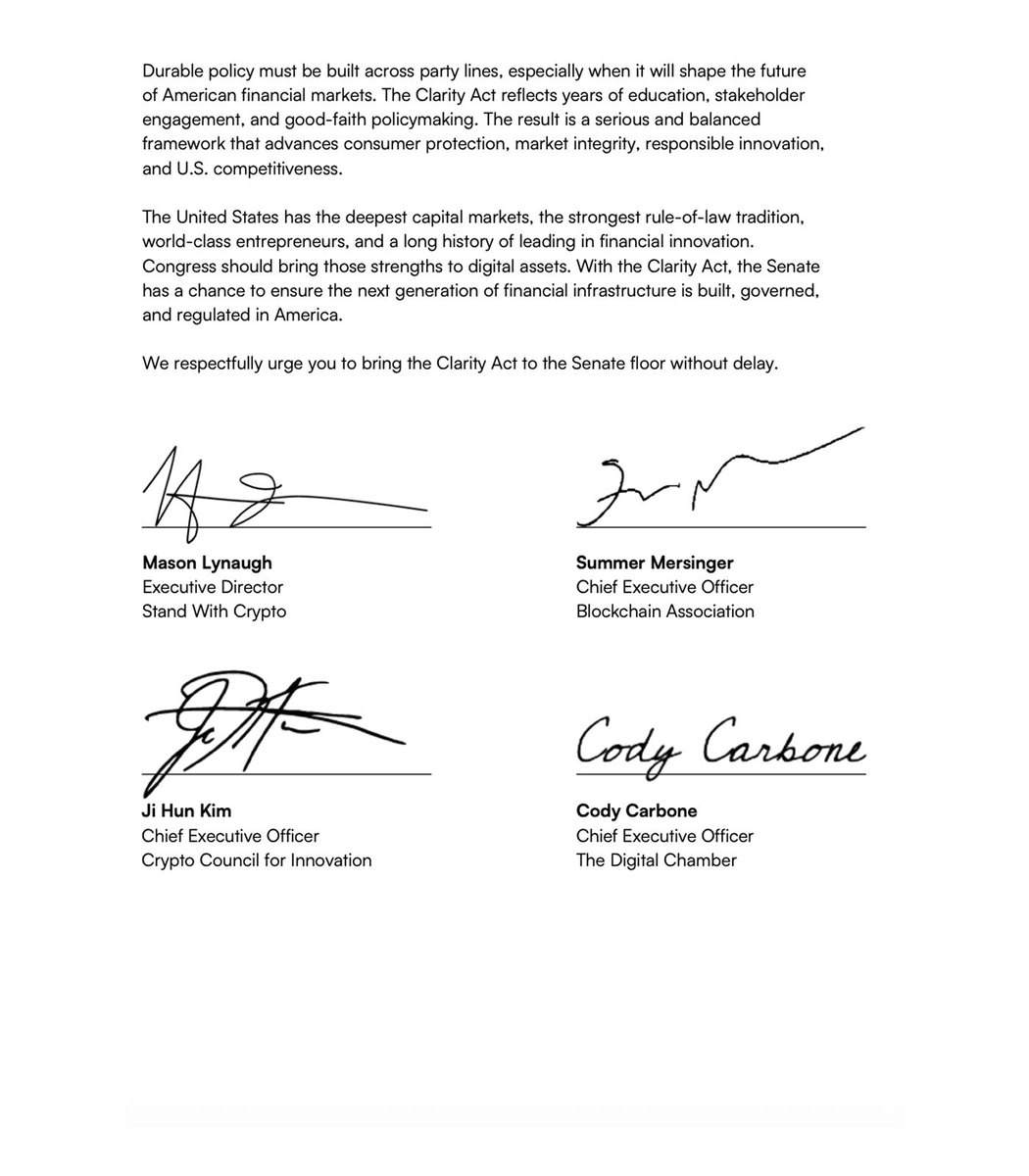
🇺🇸 LATEST: Stand With Crypto and more than 200 companies and organizations have signed a letter urging Senate leaders to bring the Clarity Act to the Senate floor.
🚨 BREAKING: Keir Starmer threatens mandatory ID checks to use mobile phones
"Protecting children online is vital, but these are outrageous plans that will fail to address the underlying causes of online harm. This will only result in population-wide ID checks for all of us to use our phones, tablets and laptops.
"Put simply, the Labour Government is threatening ID checks for the internet. No one in a democracy should need to show their passport just to get online.
"These plans would replace efforts for meaningful tech and parental responsibility with performative, authoritarian government control that children can easily circumvent by accessing adult-registered devices. However, for the UK's 50 million adults using the internet, this backdoor digital ID requirement would invoke the death of anonymity and internet privacy.
"The Government's plan very likely means that unless you submit to intrusive identity checks when setting up your phone or computer, there will be a chokehold on your software and internet access leaving you with a child-locked device. Planned restrictions on messaging, streaming and browsing raise the potential of spyware in our pockets that will be exploited for other purposes before long.
"The Government mandating that all phones in Britain require ID and surveillance software is a crossing of the Rubicon that would make the UK one of the most authoritarian internet regimes in the world. This extreme technological censorship requires rigorous public and parliamentary scrutiny that is currently totally missing" - Silkie Carlo | @silkiecarlo
🇺🇸TODAY: CONGRESS JUST DROPPED 7 NEW CRYPTO TAX BILLS
House Republicans have introduced 7 crypto tax bills to be discussed at House Ways and Means Committee hearing this week.
The proposals exempts staking and mining rewards from taxable income, creates a $10 de minimis exemption for gas fees, and offers a voluntary disclosure program for past crypto tax reporting failures.
I just spent 2 weeks in Europe with activists from some of the world's most oppressive regimes.
One question kept coming up: what are the red flags that people in "free" countries aren't seeing?
Turns out there are many.
https://t.co/FVeXd619fe
https://t.co/KliDUq7fLQ
This app is amazing: it's free and open source, and shows you just how invasive the apps on your phone can be, and how much information they get about you without you realizing, fingerprinting everything you do.
We need more research like this 💛
Well done, @mysk_co
“Twenty-five years ago, the political class was more willing to engage in open debate.”
Today, there is an attempt to cast legitimate criticism of prevailing orthodoxies — whether on diversity, Islam, immigration, or climate change — as misinformation, disinformation, or hate speech.
At the heart of the free speech crisis is an unwillingness on the part of the promoters of these policies to defend them in public.
Instead of engaging in good-faith debate, they portray critics as beyond the pale.
In this relatively recent phenomenon, people are increasingly realising that if they challenge a certain cluster of prevailing orthodoxies, they are likely to be cancelled.
We must push back against this.
Watch the General Secretary of the Free Speech Union, Lord Young, speaking at our event in Belfast 👇