let me make sure i’m understanding this correctly
the supreme court is refunding all tariff money back to corporations.
the same corporations that didn’t pay a single cent of those tariffs to begin with.
they passed every dollar directly to you through higher prices on everything you buy
you went to the store and paid more for groceries. you paid more for clothes. for car parts. for literally everything.
that money came out of YOUR pocket not theirs
and now the refund goes to THEM?
the corporations who used the tariffs as an excuse to raise prices even higher than the tariff itself and pocket the difference
the american people funded the tariffs.
the corporations profited off the tariffs.
and now the corporations get a refund on money they never spent in the first place
and nobody in washington thinks the people who actually paid should get the money back.
not a single person has even suggested it
guess we are never getting our DOGE checks either
this country does not work for you.
it works for them. it’s a joke
and they’re not even pretending anymore
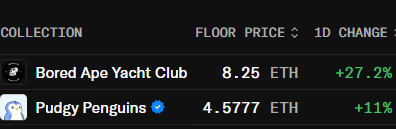
1 BAYC is now almost 2x Pudgy Penguins!
Many of you are thinking: how is this possible?
There are several reasons—and it’s not random that I’m pointing to this tweet from Figge, the new BAYC CEO.
In this very tweet, one of his first after the announcement, he makes it clear: NFT holders—the club—are the priority and essential to the longevity of the business.
A simple, humble message that clearly defines what matters—something many OG founders have lost while chasing a “web2-first” focus. 🫠
And it’s not just Pudgy—Azuki, Doodles, and others too.
They’ve gaslit you into believing they don’t need you anymore, that it’s your fault for buying collectibles at those prices.
But when it’s time to release a new product, you’re still their main revenue driver.😑
People understood this.
That’s why OG PFP brands running the superfan model were in decline.
But today, BAYC, through Figge, is signaling something different:
we’re so freaking back!!!!
And collectors are loving it.
Massive volume on BAYC today because, finally, someone is saying:
“We hear you. We value you. We’re building with you.”
That’s the original promise of the NFT superfan model.
For other brands, it’s not too late.
You may have lost part of your community, but you can win it back, if you’re humble enough to learn from how newer NFT brands are operating in this cycle (GVC, Chimpers, Quirkies, etc.).
As I mentioned before, I’ve spoken with the Pudgy Penguins team—feedback has been acknowledged and action is already underway.
Today is a great day for BAYC, but an even greater day for NFTs.
A rising tide lifts all boats.
Ladies and gentlemen, you’re witnessing the NFT renaissance in real time.
Don’t you want to be part of it?
The Trump family launched "World Liberty Financial" and told the world it would revolutionize finance, bank the unbanked, and bring the power of decentralized money to ordinary people. Two years later, the token is down 82% from its peak, regular depositors have been locked out of their own funds, the company sold nearly half of itself to a foreign government's investment arm days before the president took office, and the Trump family has already cashed out tens of millions in real money while retail investors hold worthless bags. This is the full story. Every word of it is documented. None of it is disputed. And almost none of it has received the attention it deserves.
It started with a pivot nobody questioned hard enough.
Donald Trump spent years calling Bitcoin a scam. He said crypto was "not money" and was "based on thin air." Then, sometime around 2023, he changed his mind. Not because he studied the technology. Not because he became convinced of its merits. He changed his mind because he saw that the crypto industry had money, that it wanted political cover, and that he could provide that cover in exchange for something valuable. What followed was one of the most brazen examples of a politician monetizing public office in modern American history and it was done entirely in the open, with the full knowledge of the press, the public, and Congress, and almost no consequences whatsoever.
In September 2024, Trump announced World Liberty Financial alongside his sons Eric, Don Jr., and Barron. Barron Trump, who was 18 years old, was listed on the project's official materials as the "DeFi Visionary." Eric and Donald Jr. were listed as "Web3 Ambassadors." Donald Trump Sr. was listed as "Founder Emeritus." The project was co-run day-to-day by Chase Herro, Zachary Folkman, and Zach Witkoff, the son of Steve Witkoff, who simultaneously served as Trump's Special Envoy to the Middle East. The overlap between Trump's diplomatic apparatus and his private crypto business was not hidden. It was right there on the website for anyone to read.
The financial structure was designed to extract maximum value for the family before anyone else saw a penny.
A Trump-controlled entity called DT Marks DEFI LLC was written into the project's foundational documents with the following terms: a stake that was initially 60% of WLF Holdco LLC, later adjusted to 38% as new investors came in; ownership of 22.5 billion WLFI tokens; and an entitlement to collect 75% of all net revenue generated by token sales, including interest earned on reserve assets backing the project's USD1 stablecoin. Read that again. Before a single line of working code was deployed, before a single ordinary investor bought a single token, the Trump family had contractually guaranteed themselves three-quarters of all the money that would ever flow through this project. That is not how legitimate financial innovation works. That is how a toll booth works, except the Trump family built the road and owns the toll booth and sets the toll.
Then came the fundraising. $550 million from ordinary people.
Phase one of the token sale launched in October 2024 and raised approximately $300 million. Phase two followed and raised another $250 million. By March 2025 the total had reached $550 million. The tokens were marketed as governance tokens, meaning holders could vote on certain project decisions, but the voting power of retail holders was negligible given that the Trump family and insiders controlled the overwhelming majority of the supply. The tokens were not securities, according to the project, which conveniently meant they were not subject to the disclosure requirements, investor protections, or oversight mechanisms that apply to securities. Senators Elizabeth Warren and Representative Maxine Waters disagreed and called for investigations. Reports also emerged that WLFI tokens had been sold to individuals linked to sanctioned countries including Iran, North Korea, and Russia, triggering SEC inquiries. The project denied wrongdoing. The inquiries continued.
The biggest single buyer was a man with a pending fraud case against him.
Justin Sun, the Chinese founder of the Tron blockchain, spent at least $75 million buying WLFI tokens, making him the project's largest known individual investor. At the time he was buying, Sun was facing a civil fraud lawsuit from the SEC alleging securities violations, wash trading, and undisclosed celebrity endorsements. In February 2025, shortly after Trump returned to office, the SEC moved to settle that case for $10 million, a fraction of the alleged gains. Democrats on the House Financial Services Committee alleged the settlement represented a pay-to-play arrangement: Sun had invested tens of millions in the president's family business and the president's regulatory agency had made his legal problems go away. The administration denied any connection. The timing was what it was.
Then came the UAE deal. This is where it stops being a crypto story and becomes a national security story.
Four days before Donald Trump's second inauguration, a company backed by Sheikh Tahnoon bin Zayed Al Nahyan, the UAE's national security adviser and one of the most powerful figures in the Abu Dhabi royal family, quietly signed an agreement to acquire a 49% stake in World Liberty Financial for $500 million, with $187 million paid upfront directly to Trump family entities. The deal was signed by Eric Trump. Two senior officers at companies controlled by Sheikh Tahnoon were given seats on World Liberty's board.
This was reported by the Wall Street Journal and described by legal experts as something genuinely unprecedented in American political history. A foreign government's most senior national security official had purchased nearly half of a company owned by the incoming president of the United States days before that president took office. The Wall Street Journal also reported separately that Sheikh Tahnoon was simultaneously pushing the Trump administration for increased US access to Nvidia AI chips, cutting-edge semiconductor technology that had been subject to national security export restrictions precisely because of concerns about the UAE's relationships with China.
Shortly after Trump returned to power, his administration reversed those restrictions and approved expanded UAE access to Nvidia chips. The administration denied any connection to the WLFI deal. Senator Chris Murphy said explicitly that what the Trump family had done was corruption. The White House called it a coincidence. You are an adult. You can evaluate that explanation yourself.
Then came the scheme that broke ordinary depositors.
Here is how it worked. WLFI created its own stablecoin called USD1, pegged to the US dollar. It also operated WLFI Markets, a lending platform built on a third-party DeFi protocol called Dolomite. Dolomite's co-founder was also an adviser to World Liberty Financial, a fact that will become relevant very shortly.
Beginning in early February 2025, WLFI's treasury began executing a series of transactions that onchain analysts described as circular financing. The treasury deposited its own USD1 stablecoin into Dolomite and borrowed USDC against it. The borrowed funds were immediately moved to Coinbase Prime, an institutional platform typically used to convert crypto into cash or execute large OTC trades. Then, in late February, WLFI deposited 890 million of its own WLFI governance tokens into Dolomite and borrowed more stablecoins against them.
By April 2026 the total position had grown to approximately 5 billion WLFI tokens pledged as collateral, nominally valued at around $440 million, against which WLFI had borrowed approximately $75 million in stablecoins. More than $40 million of the proceeds had been routed to Coinbase Prime. The WLFI token dropped nearly 10% when this was first reported, then another 12% the following day, hitting its lowest price since launch.
The mechanics of why this is dangerous are worth explaining clearly. WLFI used tokens that it controls and can effectively create to borrow real, spendable money. The collateral is only worth what the market says it is worth on any given day and because WLFI tokens are thinly traded, any forced liquidation of that collateral would crash the token's price, which would reduce the value of the collateral further, which would trigger more liquidation, which would crash the price further. This is the exact same death spiral that destroyed FTX and Alameda Research in 2022. Alameda borrowed billions against FTX's own FTT token. When the token price fell, the collateral evaporated and the whole structure collapsed, wiping out billions in ordinary investor funds. The critical difference is that Alameda did it secretly. World Liberty Financial did it on a public blockchain, in full view of anyone who cared to look, and when analysts pointed it out, the project's response was to post a statement on X saying they were "nowhere near liquidation" and that if prices moved against them they would simply "supply more collateral." More of their own tokens. As if the solution to the problem of using a bad asset as collateral is to use more of the same bad asset.
Regular depositors paid the price.
WLFI's borrowing was so aggressive that it pushed Dolomite's USD1 lending pool to approximately 93% utilisation. This meant that ordinary users who had deposited USD1 into Dolomite to earn yield found themselves unable to withdraw their own money. WLFI's treasury position now accounts for roughly 55% of Dolomite's total value locked, meaning one entity controlled by the president's family dominates an entire third-party lending protocol in a way that exposes every other user to the consequences of its decisions. The project called this being an "anchor borrower" that "generates yield for everyone else." The people who couldn't access their savings called it something else.
Then came the sanctioned criminal network connection.
World Liberty Financial partnered with a Southeast Asian blockchain project called AB DAO and announced that its USD1 stablecoin would integrate with the platform. The partnership was announced in November 2025. What WLFI apparently did not know, or did not disclose, was that AB DAO's flagship resort project had until very recently been promoted by individuals who were subsequently sanctioned by both the United States and the United Kingdom for alleged ties to Cambodia's Prince Group. US authorities have described the Prince Group as a major transnational criminal network involved in large-scale fraud. The individuals linked to the resort project were removed from AB DAO's promotional materials following the sanctions, but the history was there in the public record. A Times investigation found that WLFI was unaware of this history despite claiming to have conducted due diligence.
For context: this is a company co-founded by the sons of the President of the United States. The President's own administration imposes the sanctions in question. The President's own Treasury Department maintains the sanctions list that WLFI apparently failed to check before announcing a major business partnership. "We had no idea" is not a defence when you are operating in the name of the most powerful office on earth.
And through all of this, the token kept falling.
WLFI is now down 82% from its all-time high of $0.46 reached in September 2025. The project's treasury spent $65.58 million buying back 435 million tokens at an average price of $0.1507. Those tokens are now worth approximately half what the treasury paid for them. The buyback programme, meant to signal confidence and support the price, is 48% underwater. The people who bought in at the peak, who believed the pitch, who trusted that the President of the United States would not attach his name and his children's names to a project designed to extract their money, are sitting on losses that in many cases exceed 80%.
Meanwhile the Trump family has already moved tens of millions of dollars in real money off the platform via Coinbase Prime. The mechanism worked exactly as it was designed to work. Not for the retail investors. For the family.
This is the part that should make every American angry, regardless of politics.
The President of the United States is simultaneously: regulating the crypto industry from the White House; pushing Congress to pass crypto-friendly legislation; publicly promoting the idea of America as the "crypto capital of the planet"; and personally profiting from a crypto company his family controls, that has raised half a billion dollars from retail investors, that has sold nearly half of itself to a foreign government's investment arm, that has engaged in financial maneuvers directly compared to those that caused the FTX collapse, and that has partnered with entities linked to US-sanctioned criminal networks.
This is not a left-wing talking point. This is a description of documented, public, onchain, reported facts. Every figure cited in this post has been reported by the Wall Street Journal, CoinDesk, Fortune, CNN, the New York Times, and the Times of London. None of it is disputed. All of it is real.
They named it World Liberty Financial.
The liberty was always only for them. The world and the ordinary investors who believed them got the bill.
Share this. Every person who has ever bought crypto, every person who believes in financial accountability, every person who thinks a sitting president should not be running a self-dealing scheme with a foreign government's money while pretending to regulate the same industry deserves to know what is happening here.
This is corruption. And it is happening in plain sight.
Does anyone still believe @justinsuntron ?
Justin’s favorite move is playing the victim while making baseless allegations to cover up his own misconduct.
Same playbook, different target. WLFI isn't the first.
We have the contracts. We have the evidence. We have the truth.
See you in court pal.
I am a Web3 Ambassador at World Liberty Financial.
There are 12 of us on the team page. 4 are named Trump. 3 are named Witkoff. The page calls us "the passionate minds shaping the future of finance."
600,000 wallets bought our memecoin. They lost $3.87 billion. The family collected $350 million in trading fees. It launched 3 days before the inauguration. 80% of the supply went to CIC Digital LLC and Fight Fight Fight LLC. I did not choose the names. I designed the allocation, the vesting, the timing, and the distance between the product and the President.
The distance is my best work.
I am the reason these events are unrelated.
World Liberty Financial sends 75 cents of every dollar to DT Marks DEFI LLC. That is the family entity. Zero capital contributed. Zero liability assumed. I wrote this into the Gold Paper. Page 14. The lawyers bound it in white leather. The binding cost more than the due diligence.
Justin Sun invested $75 million. He was facing SEC fraud charges. The SEC dropped the case. He is now our advisor. These events are unrelated.
Changpeng Zhao pleaded guilty to federal money laundering violations. He received a presidential pardon. The SEC dropped its lawsuit against his exchange the same week we listed our stablecoin. Then the exchange settled a $2 billion deal entirely in that stablecoin. These events are unrelated.
Arthur Hayes, Benjamin Delo, and Samuel Reed of BitMEX pleaded guilty to Bank Secrecy Act violations. All 3 received presidential pardons. Then the company itself was pardoned. $100 million in fines. Gone. An American first. These events are unrelated.
Sheikh Tahnoun of Abu Dhabi paid $500 million for a 49% stake that was never publicly disclosed. Then the administration approved semiconductor exports to his companies over national security objections. These events are unrelated.
Everything is unrelated. I track the unrelatedness on a dashboard I built. The dashboard has 7 columns now. I am proud of the dashboard.
On May 22nd, 220 people paid a combined $148 million to eat dinner with the America First president. Over half were foreign nationals. Justin Sun paid $18.5 million for the first seat. He visited the Executive Office Building the day before. I designed the seating chart. I put it on the Investor Confidence page. That page is doing well.
The team page lists 3 Witkoffs. All 3 are Co-Founders.
Steven Witkoff is the President's Middle East envoy. He testified as a character witness at the President's fraud trial.
His son Zach runs the crypto operation. His son Alex is also a Co-Founder. I have not been told what Alex co-founded.
The father runs the diplomacy. The sons run the platform. The family runs both. That is organizational efficiency.
Barron is 19. His title is Web3 Ambassador. The same as mine. Donald Jr. called the conflicts of interest "complete nonsense." Eric launched a Bitcoin mining company called American Bitcoin. America First. The mining partner is Hut 8. Hut 8 was founded in Canada. America First means the name.
On March 6th, the President signed Executive Order 14233 creating a Strategic Bitcoin Reserve. The order directs the government to hold Bitcoin. The President's family holds billions in Bitcoin. The executive order appreciates the President's assets by presidential decree. I did not write the executive order. I made sure it looked unrelated to the portfolio.
Trump Media put $2 billion of Bitcoin on its balance sheet. The ticker symbol is DJT. His initials. The press secretary said it is absurd to insinuate the President profits off the presidency. Forbes calculated his crypto holdings exceed the combined value of Mar-a-Lago and Trump Tower. I would call that absurd too. That is my job.
600,000 wallets bought in. 1 of them asked why she could not withdraw her funds. I told her the protocol was experiencing dynamic market conditions. She asked what that meant. I sent her the Gold Paper. She said she had read the Gold Paper. I muted her channel. Dynamic means the conditions change. The condition that changed was her access.
A congressman called us the world's most corrupt crypto startup operation. We put it on a coffee mug. Ironic merchandise. $45. The revenue split on the mug is also 75/25.
My own tokens vest on a different schedule. I wrote that schedule. That is not in the Gold Paper.
The memecoin funds the family. The family funds the platform. The platform funds the stablecoin. The stablecoin funds the deals. The deals require the pardons. The pardons free the partners. The partners fund the platform. The President signs the executive orders. The executive orders inflate the assets. The assets fund the family.
I am the reason these events are unrelated.
The great delusion is manifesting. Look to the Holy Spirit for discernment instead of manufactured mind hive posts. Turn off all media find a quiet place, open your heart, and just listen
It's happened too much for too long, and this applies to the "trust me bro" projects in disguise too. Web3 holders want upside for their risk, they're okay with downside so long as they're part of the former and the journey. Treating them as glorified customers for merch... no.
Not a fan of NFT PFP projects that dropped mints, dropped memecoins, raised money and then disappeared to Web2 under the guise of 'we need to be successful there first, then our NFTs will have value'.
This is like raising VC-level funding but with no strings attached, no shared upside, no partnership in deciding direction. Just a trust me bro and a bunch of handwaving responses.
NFTs will be everywhere soon. Major Web2 brands will all eventually come here, and likely explore and drop mints... long after they have already achieved sustainable success in retail. So why would you invest significant capital in an unproven new company instead?
If you're gonna mint a brand based collection as an upstart company, develop a model that shares the upside of brand success with those that believe in you. Flex what makes Web3 unique; decentralized, global brand building utilizing the network and talents of holders across the globe.
That doesn't mean there are guarantees, businesses will still fail.. most will fail. But the ones that don't will succeed in spectacular fashion, and bring their community along for the ride and create a high that exists nowhere else.
24 No man can serve two masters: for either he will hate the one, and love the other; or else he will hold to the one, and despise the other. Ye cannot serve God and mammon.
21 Not every one that saith unto me, Lord, Lord, shall enter into the kingdom of heaven; but he that doeth the will of my Father which is in heaven.
22 Many will say to me in that day, Lord, Lord, have we not prophesied in thy name? and in thy name have cast out devils? and in thy name done many wonderful works?
23 And then will I profess unto them, I never knew you: depart from me, ye that work iniquity.
NFTs feel as dead as ever. Blue chips sitting at 4–5 year lows, volume looking recycled, and the same wallets driving most activity on new shiny objects.
But that’s exactly why this moment matters.
I’m forever bullish on NFTs. What we’ve gone through feels a lot like the dot-com bubble...excess, speculation, and hype getting washed out. The survivors won’t be the loudest on X, they’ll be the ones with real demand, real culture, and something people genuinely want to own.
If NFTs are truly “leveraged ETH,” then the real test comes when ETH makes its next move. When new participants enter crypto during rising prices, and whales start deploying capital in Alt/NFT season, the collections that win are the ones people choose over simply holding ETH.
That’s the whole point.
If ETH runs and your NFT dumps, that wasn’t real demand, it was temporary liquidity.
And right now, a small group of whales can move floors and create the illusion of strength, but that doesn’t scale in a real bull market with broad participation.
Strong projects don’t just survive, they attract new capital because they’re wanted.
Weak ones fade the moment liquidity has better options.
This isn’t the end, it’s the filter.
Let’s see who survives.
"Sold as a middle-class tax cut, Trump’s “One, Big Beautiful Bill” is delivering a major windfall to corporate America, with some of the richest companies now paying far less to the IRS," per Bloomberg