Oracle just told every AI company on earth the same thing.
Your models are worthless.
Not the technology, talent or the billions spent training them.
But the data they were trained on.
Larry Ellison, the man who built Oracle into the backbone of global enterprise just dropped a bombshell.
He said ChatGPT, Gemini, Grok, and Llama, all of them are training on the exact same data.
The entire public internet, every Wikipedia page, Reddit thread and every news article.
That means they're all converging essentially becoming the same product with different logos.
Ellison's word for it is commodities.
But here's where it gets dangerous.
He says the real gold isn't public data, It's private data.
The medical records in hospital systems, the financial data in bank vaults.
The supply chain secrets of every Fortune 500 and guess where most of that data already lives.
Not Google, Amazon or Microsoft but inside Oracle.
Oracle databases hold most of the world's high value private enterprise data.
So Oracle just launched something called AI Database 26ai.
It lets the top AI models, ChatGPT, Gemini, Grok, Llama reason directly over a company's private data, without that data ever leaving the vault.
They're using a technique called RAG, Retrieval Augmented Generation.
The AI doesn't train on your data, it searches it in real time.
Think about what that means.
A bank could ask AI to analyze every loan it's ever made without exposing a single customer record.
A hospital could have AI diagnose patients using its full medical history without violating HIPAA.
A defense contractor could let AI reason across classified operations without data leaving a secure environment.
Ellison is betting this is bigger than the training market. Bigger than the GPU boom.
Bigger than the data center buildout.
He called it the largest and fastest growing market in history.
The numbers back the ambition.
Oracle's remaining performance obligations just hit $523 billion.
That's contracted revenue not yet delivered and $300 billion of it comes from OpenAI alone.
Cloud revenue hit $8 billion in a single quarter, OCI grew 66 percent and GPU revenue surged 177 percent.
But here's the part nobody's talking about.
If private data becomes the real AI moat, then whoever controls the database controls the future of AI.
And that's a level of power that should make everyone uncomfortable.
Major cheat code for life: Increase your recovery speed. You will get rejected. You will lose money. You will embarrass yourself. The goal isn't to avoid the fall. It's to shorten the time between the fall and the reset. Fast recovery compounds.
i don't know who needs to hear this but in order to become a better person, you must first realize how horrible you really are. not in the dramatic sense, but in the quiet ways you sabotage yourself, repeat unhealthy patterns, hurt people who care about you, or tolerate what wounds you. you cannot grow if you keep pretending you’re innocent in the story you created
Delighted to share that @quantnetwork has been selected for the @bankofengland’s Synchronisation Lab as part of the RTGS Future Roadmap.
Our use case: atomic, multi-bank treasury operations powered by Quant Flow and PayScript®. All payment legs settle together or not at all, eliminating partial settlement risk across multiple banks in a single action.
This is programmable finance that works within existing market structures, not around them.
https://t.co/I5rmbsDLAu
#RTGS #TreasuryManagement #PaymentsInnovation #FinancialInfrastructure #SynchronisationLab #ProgrammableMoney
$500,000 is the magic number.
Once you have that much, you can make $10,000–$20,000 a month selling options.
Then life gets easy.
Work becomes optional.
And you finally have full freedom.
Some shifts in finance are loud.
Others are quiet, but far more important. Today, Quant is announcing a partnership with @dentsusoken in Japan.
Over recent years, our work done in the UK has shown that digital money doesn’t have to sit outside the financial system to innovate. Tokenised deposits and programmable settlement can be designed inside regulation, inside banks, and at institutional scale. What’s interesting now is what happens next.
Japan is approaching these questions in its own way, within its own regulatory and market context. But the direction of travel is clear: major economies are beginning to think seriously about how programmable money fits into real-world financial infrastructure.
This partnership is about building that foundation with institutions at the centre.
#TokenisedDeposits #ProgrammableMoney #Stablecoins #Blockchain
$QNT A Quick analysis of dr Luke Riley’s latest update.
“Hi everyone,
As we approach mainnet launch, we have been showcasing the Rollups public testnet to several major institutions.
The interest has been significant. Throughout these sessions, it has become clear that enhancing our firewall capabilities by introducing additional precompiled contracts at genesis will meaningfully strengthen the system's security framework and offer greater customer-specific configurability.
-Adding extra precompiled contracts at genesis for enhanced firewall capabilities makes a lot of sense. Precompiles allow efficient, low-level operations directly in the EVM (bypassing full smart contract execution gas costs), and including customized ones from block 0 is a solid way to bake in application-specific access controls, transaction validation rules, or even account/whitelist-based restrictions. This can indeed act as a robust "firewall" layer, giving institutions more confidence in compliance, risk isolation, and tailored configurability without relying solely on higher-level contracts that could be more expensive or vulnerable.
We have also identified the need to accelerate the rollout of our "Bring Your Own Node" (BYON) functionality on the public testnet. This will improve performance and increase node distribution for our Rollup, which is already producing millions of RPC (remote procedure call) calls daily
-Accelerating Bring Your Own Node (BYON) on the public testnet is also a smart move. Decentralizing node operation beyond your core infrastructure will help with resilience, geographic distribution, load balancing, and overall censorship resistance—especially as RPC volume scales. It empowers larger users (like those institutions) to run their own nodes for lower latency, dedicated resources, and direct control, while reducing central points of pressure on your hosted endpoints.
”
After these features have been added testnet will be restarted.
NIGGA UR MOM WORKS HARDER THAN YOU
WHEN THAT ALARM CLOCK GOES OFF SHE GETS UP
WHEN ITS TIME TO CLEAN THE HOUSE SHE DOES IT WITHOUT SCROLLING ON HER PHONE FIRST OR NAG
WHEN ITS TIME TO COOK SHE FUCKING COOKS
DO YOU NOT FEEL ANY SHAME?
ANY FUCKING REMORSE?
UR A GROWN ASS MAN
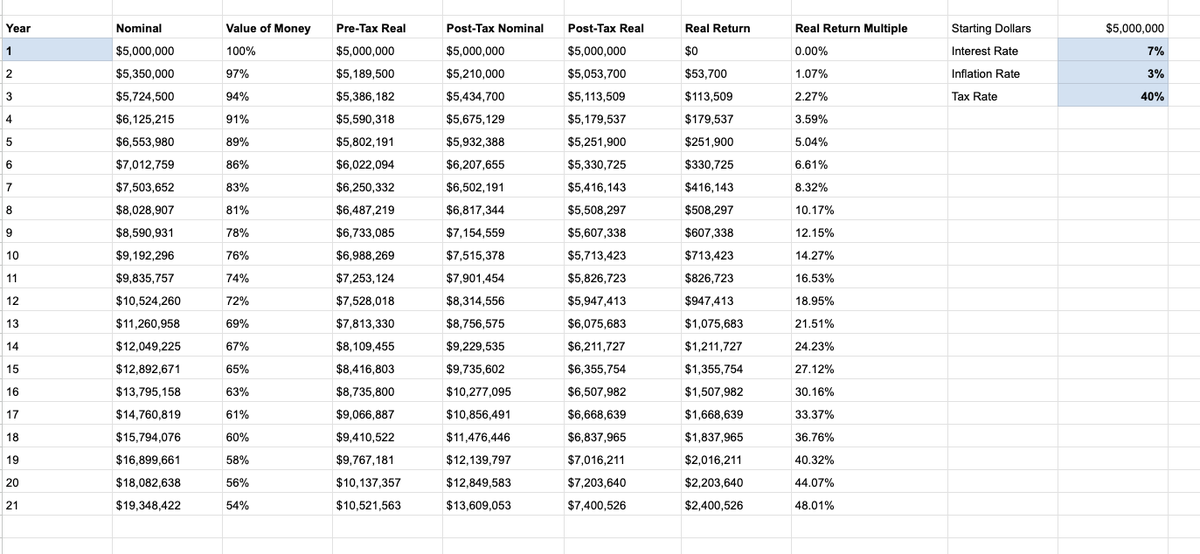
You mathmatically can't compound your way to wealth anymore... 20 years, 7% returns, 3% inflation, 40% taxes -- best case you 1.5x your investment. That is why the kids YOLO it... plain and simple.
Gen Z has it so good
For the first time in history making money isn't connected to "climbing a ladder" + your age, you can get rich within a few years
90% of your competition is addicted to their phone and can't concentrate for more than 20 seconds
You can simply dominate
In 2018 the cost of running an ethereum node was roughly $3200 (32ETH)
Roll forward to 2025 and that same node today is worth $97,600 (32ETH) plus staking rewards of 7 years at 3%
This is why I’m accumulating as much $QNT as possible cheap before the staking date is announced
(Which is Q1)
Remember peeps you won’t be validating transactions for a blockchain thats just good for price feeds and weather reports
You will be validating transactions for the Future of Money !!
🔮🚀����