1️⃣
.@RaylsLabs is building for the phase where capital stops chasing speed and starts demanding certainty.
As capital matures, it moves away from systems optimized for motion and toward rails designed to settle reliably, preserve privacy, and support long-term use. 🧵 👇
Capital is telling a clear story.
It’s rotating from assets designed to move to assets designed to stay.
As RWAs and receivables move onchain, the bottleneck shifts from yield to settlement, privacy, and reliability.
Rayls is building when capital turns long.
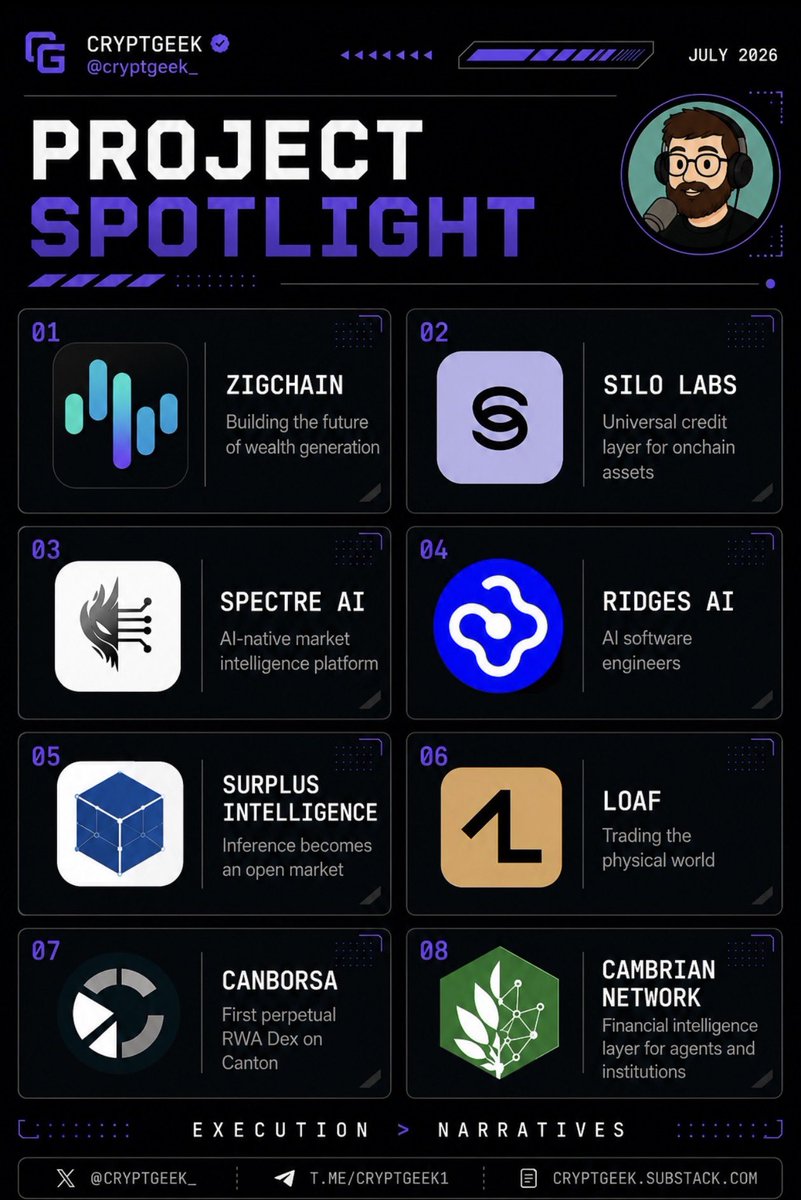
PROJECT SPOTLIGHT
The best time to discover great projects isn’t when everyone is talking about them.
It’s while they’re still building.
Here are 8 projects that have genuinely caught my attention across AI, DeFi, RWAs, and infrastructure.
Not sponsored. Not ranked. Just projects I think are worth exploring. 👇
—
📌 ZIGChain
Building the future of wealth generation.
@ZIGChain is a Layer 1 focused on making wealth generation more accessible through tokenized assets and decentralized wealth infrastructure.
Its recent integration with @OndoFinance brings tokenized stocks and ETFs to the ecosystem, expanding on-chain access to global financial products.
—
📌 Silo Labs
Universal credit layer for on-chain assets.
@SiloFinance is rethinking DeFi lending with isolated lending markets, allowing each market to manage its own risk instead of sharing it protocol-wide.
It’s a modular approach designed to make on-chain credit more resilient and flexible.
—
📌 Spectre AI
AI-native market intelligence platform.
@Spectre__AI is building a unified platform that combines AI research, sentiment analysis, technical analysis, predictions, and multi-asset market intelligence.
Its recently launched Market Intelligence Beta marks the project’s first live product with real users, a major step toward broader adoption.
—
📌 Ridges AI
AI software engineers.
@ridges_ai is building autonomous AI software engineers that help developers build, test, and ship software with less manual effort.
As AI moves from copilots to autonomous execution, this is a space worth watching.
—
📌 Surplus Intelligence
Inference becomes an open market.
@AskSurplus is building infrastructure that opens AI inference to a decentralized marketplace, matching compute demand with available inference capacity.
It’s tackling one of the biggest infrastructure challenges behind the AI boom.
—
📌 Loaf
Trading the physical world.
@Loafmarkets is building infrastructure that connects real-world commerce with on-chain markets.
Early traction has been impressive, with more than 9,000 signups in under 48 hours, highlighting strong demand ahead of wider access.
—
📌 Canborsa
First perpetual RWA DEX on Canton.
@Canborsa_DEX is bringing perpetual trading to tokenized real-world assets on the Canton Network.
Its Beta has already surpassed 6,000 users, 10,000 trades, and $1M in trading volume, a strong start for a young platform.
—
📌 Cambrian Network
Financial intelligence layer for agents and institutions.
@CambrianNetwork is building a financial intelligence layer that helps AI agents and institutions make better financial decisions using structured, actionable financial data.
Backed by $11.9M from Polychain and Franklin Templeton, it’s positioning itself at the intersection of AI and modern finance.
—
There are thousands of projects launching every year. Very few continue shipping meaningful products when the spotlight fades.
These are 8 teams I’ll be following closely.
Which one should I break down next? 👀
One thing I appreciate about $LNQ | @linq_ai is that it isn’t just selling an AI narrative. It’s building the infrastructure AI actually needs.
Everyone is talking about smarter models, agents, and autonomous workflows. Far fewer people are talking about where those workloads will run.
That’s the opportunity @linq_ai LinqProtocol is going after. Decentralized compute, real Kubernetes infrastructure, on-chain settlement, & builder-focused products like Aura Code all point to the same thesis:
The next wave of AI won’t just need better models. It’ll need better infrastructure.
If that thesis plays out, protocols powering the compute layer could become just as important as the applications built on top of them.
Worth reading the full breakdown below. 👇
I’ve always respected teams that keep building through the bear market. When attention is scarce, execution speaks loud.
That’s one of the reasons I’ve continued following $SPECTRE | @Spectre__AI.
After months of building, the team has officially launched the beta of its AI Market Intelligence Platform.
The goal isn’t another AI chatbot. It’s to bring AI predictions, sentiment analysis, technical analysis, on-chain research, and multi-asset market insights into one place making research simpler for traders and investors.
I also like the approach.
Instead of rushing a public launch, they’re starting with a closed beta, gathering real user feedback, and improving the product before scaling.
Shipping is one thing. Building something people actually use is another.
Congrats to the team on this milestone. Looking forward to what’s next. 🚀
It's easy to think @linq_ai is trying to just build a decentralized compute marketplace. But it’s much more than that.
$LNQ | @linq_ai isn’t asking developers to manage Kubernetes, configure infrastructure, or deploy workloads manually. @linq_ai abstracts the complexity.
You choose what to run, select a provider, configure your application, and fund an on-chain escrow.
Behind the scenes, the protocol handles provider matching, Kubernetes deployment, GitOps, sealed secrets, networking, monitoring, and settlement.
What impressed me most wasn’t any individual technology. It was how they fit proven technologies together into a workflow that feels simple for the end user.
Eighteen months of building isn’t just reflected in the code. It’s reflected in the engineering decisions that most users will never notice.
And that’s usually the sign of good infrastructure. Big congratulations to the team on the milestone! 👏🏽
most people wait for signals. but some systems reward showing up early and doing the work.
@Bullshot911 is one of them. every action on the platform feeds into a simple loop:
create → engage → earn more points
• launch a token
• interact with others
• invite your network
no cap on points. just your level of participation. it’s less about speculation,
more about how active you are inside the system.
if you’re curious how this plays out,
worth getting hands-on early.
➠ https://t.co/MVBurSCAy5
most people think meme coins are chaos.
but underneath, there’s always infrastructure shaping that chaos.
@Bullshot911 is leaning into that layer. an ai-powered meme token launchpad on @BNBCHAIN chain where tokens can be created in seconds, without the usual technical overhead.
not just faster launches. but a different model of participation:
• ai-assisted creation
• instant deployment
• community-driven token narratives
it’s essentially lowering the barrier between idea → token → community.
the intersection is what makes it interesting: ai × meme economy × on-chain infrastructure. early signals show traction but more importantly, a shift in how quickly communities can form around assets.
worth exploring if you’re paying attention to where creator-led token ecosystems are heading.
try it → https://t.co/MVBurSCAy5
We’re celebrating the upcoming launch of Orange Standard the right way 🍊
$2,500 in Bitcoin
25 winners
$100 each
Is Bitcoin your standard?
This one's for you👇
https://t.co/EaeaA2mhi5
defi solved access. but it never solved complexity.
too many dashboards. too many protocols. too many manual decisions.
this is where DeFAI starts to matter. instead of navigating dozens of interfaces, ai agents become the operational layer:
• analyzing markets
• tracking wallets
• automating strategies
• managing portfolios
the idea isn’t replacing defi. it’s abstracting the friction that prevents most people from using it effectively.
the ai agent economy is still forming, but projects like @PlutonAIHQ are exploring how autonomous agents could coordinate on-chain activity.
if this direction plays out, defi may start to look less like dashboards and more like conversations.
get started: https://t.co/RXMzqcP746
#PlutonAI #DeFAI #AIAgents
it started quietly. a post. a click. a sentence typed without thinking twice.
over time, those fragments became fuel for intelligence. often without consent, clarity, or control.
AI now advances on human data, yet ownership remains unclear and transparency rare. the result is a widening trust gap, rooted in systems built for extraction.
if AI is to mature responsibly, data practices must change. consent and visibility can’t be optional.
@PerceptronNTWK points toward that shift. infrastructure built on participation, transparency, &trust.
Everyone says “RWA.” But not everyone means the same thing.
Some projects create representations of assets. Some build synthetics. Some just wrap TradFi in crypto language.
@KAIO_xyz starts from a different place:
the asset itself.
Instead of copying real-world assets into crypto, @KAIO_xyz moves real institutional funds onto crypto rails.
Here’s the difference.
Many RWA platforms:
– Mirror assets with off-chain promises
– Depend heavily on custodians and trust
– Add compliance as an afterthought
@KAIO_xyz is built around reality:
– Real institutional funds
– Tokenized directly on-chain
– Issuance and redemption via smart contracts
– Transfers governed by built-in compliance logic
So the mindset changes. Others say:
“Let’s make crypto versions of real assets.” @KAIO_xyz says: “Let’s make real assets native to crypto.”
Not wrappers. Not copies. But real funds, living on-chain.
$PLAI | @PlutonAIHQ raising $2.7m isn’t just about the headlines. it’s the direction.
seed + private round led by @kitchenvc , with incubation from @hypergpt, signals a quiet bet on infra, not noise.
core platform, agent expansion, and production-ready ai rails for #DeFAI. this is where utility actually gets built.
no theatrics. just autonomous agents, on-chain coordination, and long-term value design.
worth watching as the space matures. #PlutonAI szn. 🫰🏼