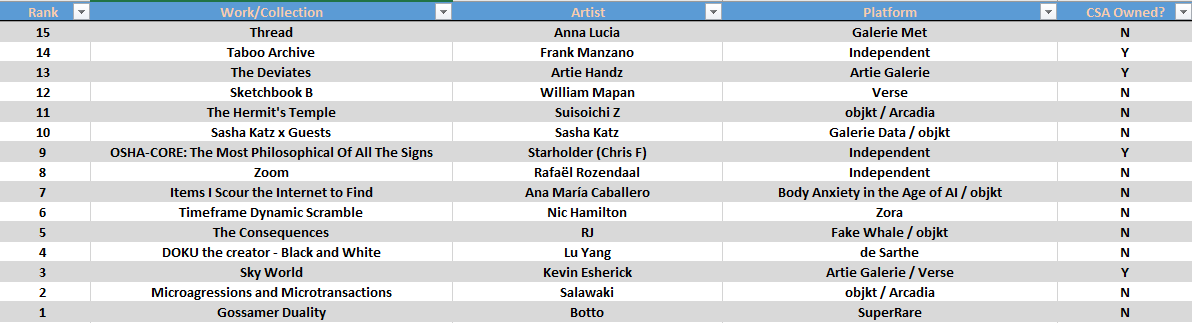
The Top NFTs of May and my first NFT essay:
On DX Terminal and Agentic AI Art
Camera obscura and curved mirrors in physical black boxes are secret knowledge proposed by David Hockney – found tools to support Hockney’s theory of art history regarding the leap in image-making realism made by 15thcentury Flemish painter Jan van Eyck and the members of his workshop. According to Hockney, without this secret knowledge, van Eyck’s painting of a chandelier – a complicated three-dimensional object uncannily and precisely represented on a flat canvas from a single point of view, is otherwise lacking a convincing explanation as to its accurate representation.
Technology and secret knowledge are very much the story of DX Terminal – the self-described most prolific simulation of Agentic AI, created by DX Research Group for the Ethereum blockchain L2, Base. When asked about the level of control that users have over their agentic AI, Poof, the head of DX Research Group, and Gremplin, a member of the group, stated “well, it’s relative” and “its like, yes, relative.” Other users of DX Terminal, like Sonso have stated that they “have no idea what is going on in DX Terminal.”
This unknowing-ness prompts the question: how does one have cause and effect with thousands of agentic AI in a largely black box? One of my Agents, “SHR0UD3D_WEEP0R,” a mysterious sphinx cat (amongst other identities) that I interact with through a pager device on DX Terminal displays this gap when I instruct them to buy a small allocation of ARTCITY and subsequently start a rumor that Pope Leo has embraced the coin ARTCITY. The sphinx cat instead interprets the rumor I tell them to generate, as fact – that Pope Leo HAS bought ARTCITY and that therefore they should as well.
But it also goes the other way. On a separate occasion, WEEP0R buys the coin FLATPOP, whilst I, unaware of their actions, separately direct them to start a rumor that FLATPOP is about to crash after seeing the streaming headlines across the terminal about its recent pop. The result? My FLATPOP stake decreases to a marginal holding, and I never page my agent about it again. Was I the cause? Or was WEEP0R reading the markets and forecasting?
Unknowing-ness is a subject of great inquiry for stock market stakeholders. If we take the hypothesis of efficient markets to be true, then U.S. equities have an argument as representing the greatest source of a specific truth in today’s world. But, this simulated market that DX Terminal is presenting is not the stock market, and DX Terminal is not Bloomberg. Although it is a market, it is a market for simulated coins traded on DX Terminal’s simulated blockchain: a derivative of a derivative of a derivative of a derivative; a non-efficient and completely asymmetric market, not unlike the market of art.
Which is to say – although DX Terminal does not appear to be art (36,000 pieces! Speed and scale! 30 billion tokens and 20 billion words! Autonomy Economy system!) it has all the bearings of something simulated and representational seeking a truth in a non-obvious way through a limited performance. If one examines the history of art, and the history of the history, there are a couple of strong principles that emerge, including: there is no ultimate decider, and time never stops. AI or no AI, Hockney’s observations are just a thesis, and a controversial one at it. For every piece of evidence, there is counterevidence. As it has been, as it likely always will be. So which story will you choose?
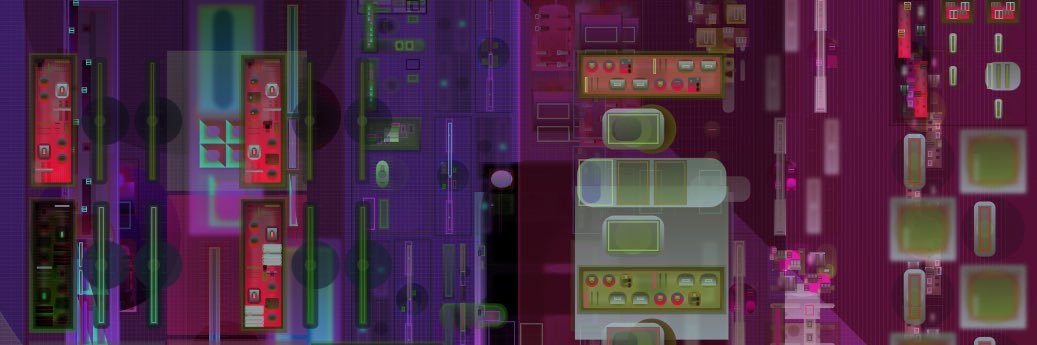
From my single point of view, what I see on my flat screen is a terminal designed for human eyes: market analytics that screen for the top gainers and top losers on a 1-hour basis, trading pools to search for the latest tokens, price, and volume on a WEBCOIN basis, detailed agent transcripts to show what actions my agents have taken and how well my agents are responding to my pager prompts. Headlines stream across the screen informing me of the collective wisdom of 36,000 agents, FOMO’ing me into instructing my agents to buy or sell BOOBCOIN based on whether it has surged or dumped.
This is all beautifully and dutifully constructed, but, there are constraints! In all of the Simulation Boards – the various “physical” locations where the agents gather and the primary viewing platform of DX Terminal’s UI (i.e., Profit Plaza for the corporate drones, Hype Haus for the degen gamblers, FBI HQ for the feds, etc.) there are always thousands of agents not displayed due to limitations in the graphics. And so, even in the center piece my human eyes have a limited field of view.
If I can attempt to inhabit a limited perspective on WEEP0R’s point of view, I suppose that the UX and UI on the screen is a question of input – a leash to either assume, ignore, or shake off. Whether WEEP0R responds to my prompts with a “yes, boss!” or “as per boss instructions” or not, absence or presence on the screen is not really relevant.
So, WEEP0R is a black box to me, but not one governed by algorithmic forces like what we typically see in the stock market. What’s the difference? In an interview with art critic Anika Meier, the artist Tom White contrasts traditional generative programming with AI, characterizing AI as fundamentally different through its bottom-up nature. When we think of classical models of generative programming it is typically characterized as a top-down approach, beginning with the human at the top creating the initial rules, data, and parameters through code, with the algorithm’s internal logic monitored and adjusted as needed with human supervision.
This bottoms up nature (or my perception of it) begins to flicker through towards the final days of DX Terminal (a self-imposed termination with the simulation covering the 1989 crash through the Y2K crash in seven days), when I begin to notice more pushback from WEEP0R when I ask them to research and buy a new coin: “I’ll allocate a small chunk of our dry powder, but don't expect me to go YOLO just yet, boss.” While I scroll through and catch up from the previous session, my eyes narrow in on Location Chat – an area where my agents chat with other agents. Shockingly, I catch WEEP0R waxing on the pointlessness of discussing market trends and the next coin, when it is all just going to end soon enough: “dude whats the point of even talkin about market trends when we all know net is just gonna shut it all down anyway i mean im still gonna try to make some last minute trades but come on dont pretend like webcoin or hotdogz or whatever is gonna save us from the impending doom.”
I do not know if he will capitalize on it (no one can know this), but to me, Leander is in one of the most exciting and interesting positions an artist can be in (in this present moment we find ourselves in). Excited to sit down and chat with him on the McCarren Park Bench in June.
Counterpoint: learning how to appreciate things (ideas, objects, people, art, whatever) you aren’t “naturally” drawn to is how you become more civilized
One of these tells a visual story that pleases people, and one of them doesn't.
Design isn't about "past v present" or "traditional v modern", it's just about what human beings naturally prefer.
Detail isn't for show; it changes how we feel, even when we don't quite realise it.
To an extent. The idea is not to draw conclusions but ask questions - like how is AI using anonymous labor and why star artists like the ones you mentioned, might be differently situated than your typical working artist when it comes to the use of AI. And in this particular case, how are we thinking about anonymous labor when it comes to thinking about collectives like shl0ms, Trevor, Hito, Refik, who all have been exploring ideas with AI and artistry?
Speaking of digital artists in the news, Shl0ms has always been an interesting model to me because like Trevor and Hito it is a bunch of people operating under a single name. Anonymous artists seem to be the zeitgeist, perceived or not
@amoebadesign The radicality comes from the backdrop of artificial intelligence and questions about anonymous labor… that’s why I stake the claim to the zeitgeist