@eskim8@CSDResearchDay @MelinaS_SLP 2/2 It is more difficult for younger people to conceptualize the barriers and consequences associated with hearing loss (a distant problem) while for older populations these consequences are more eminent (a proximal problem).
@eskim8@CSDResearchDay @MelinaS_SLP 1/2 The age effects may be attributed to construal level theory: a theory in which individuals feel more positively about making health changes when a problem seems distant.
@Kellene80049125@CSDResearchDay @MelinaS_SLP 2/2 It is more difficult for younger people to conceptualize the barriers and consequences associated with hearing loss (a distant problem) while for older populations these consequences are more eminent (a proximal problem).
@Kellene80049125@CSDResearchDay @MelinaS_SLP 1/2 This difference for younger adults may be attributed to construal level theory: a theory in which individuals feel more positively about making health changes when a problem seems distant.
@LearningCarlee@CSDResearchDay @MelinaS_SLP 2/2 Younger adults are more likely to show greater intentions to make health positive choices when exposed to a gain-framed message.
@LearningCarlee@CSDResearchDay @MelinaS_SLP 1/2 It would depend on the age group. Previous research in our lab suggests, older adults are more likely to show greater intentions to make health positive choices when exposed to a loss-framed message.
@CSDResearchDay @MelinaS_SLP 8/8 This project aims to gain further insight into the kinds of messaging that may motivate patients to take action to address their hearing loss. More broadly, it will inform approaches to effective hearing care & health communication. #2020CSDResearchDay
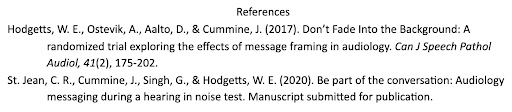
@CSDResearchDay @MelinaS_SLP 7/8 This finding would support and extend previous research showing that older adults are more compelled to take action in response to loss-framed messaging (2017) and that mere exposure to health messages can shape attitudes (2020). #2020CSDResearchDay