#BTC
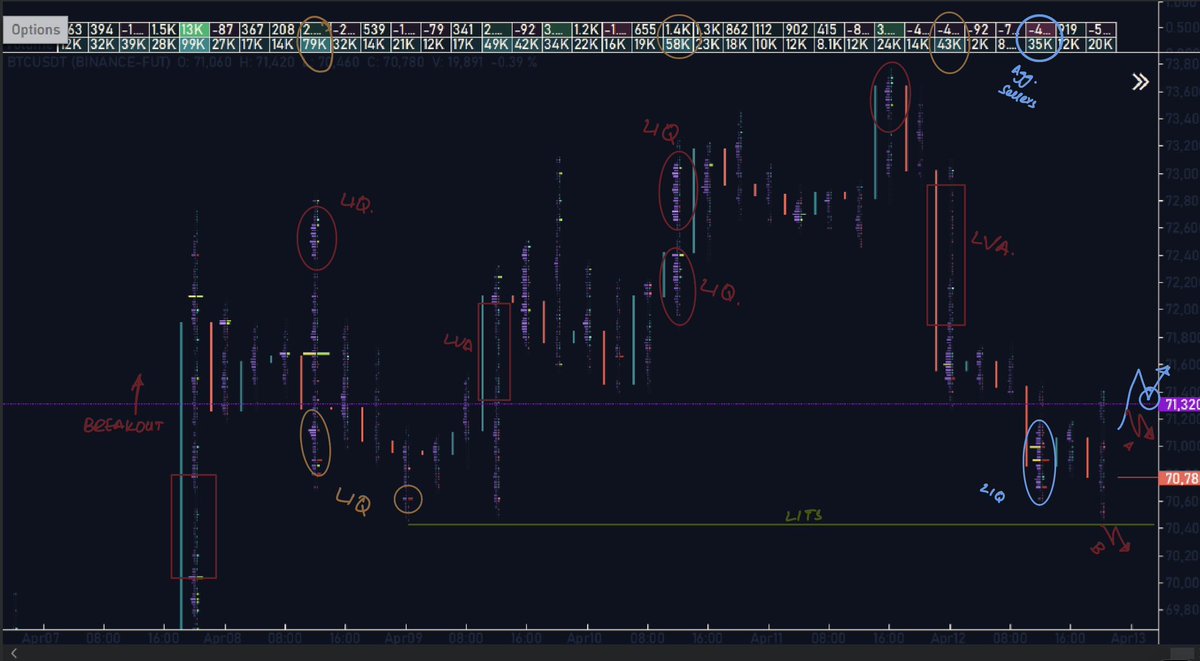
Above 65d rVAH:
1. Sell orders absorbed buys
2. OI increased by 10 percent & price is below macro VWAP> buyers are trapped
3. Breakdown and retest Break point LVAs > HVAs
However,
Beyond Breakdown, orders absorbed agg. Sells hard > Breakup and retest will signal a dev. play
@bull_genius I know how Avwap function. Please explain why are you using them since 30d rwvap does not represent monthly vwap. What edge you get using them over montly vwap. Thanks in advance.
@DieguitoCharts I understand how AVWAP works. Why are you using 7-day and 30-day RVWAP periods? What advantage do these rolling periods provide compared with standard session-anchored weekly and monthly VWAPs? Please reply sir.
The new US National Strategy Paper was released.
A brief overview.📜
🔹The top priority for the US will be in the Western hemisphere, in the Americas. Much like a rebranded Monroe doctrine, the strategic focus of the US will be on fighting "narco-terrorists" and border security.
🔹On the European front, the US will be more overtly supportive of rightwing politics, to "save the dying European civilization".
At the utter dismay of neoliberals in the EU, this could upend the existing power structures in many EU countries. The irony is, the most vocal supporter of the US are exactly the same group of people who Trump wants to overthrow; The neoliberals in the EU.
🔹For Indo-Pacific, the US will take a more back bencher's role, by forcing its vassals in the region to spend more on their militaries.
The main way for the US to confront China, is through economic and the reindustrialization of the US. This can only be achieved by dismantling the industries in their vassals, and shifting it back to the US.
Whatever trade concessions they cannot extract from China, will be taken out on the whipping boys, Taiwan, South Korea and Japan.
🔹Overall, this is just a summary of America First, a populist movement that tries to upend decades of neoliberal globalism.
HOWEVER, just like any populist movement, it lacks the coherent ideology to reform the system from the foundation.
The same forces that controls the neoliberal globalist agenda is still the majority in the US power dynamics.
The same system that facilitated the US-vassal relations still exists, in the form of US dollar hegemony. Which prevents the reindustrialization of the US, because to support the US dollar hegemony, the US needs a trade deficit to supply the world with US dollar.
Unless revolutionary reforms are enacted, which is practically impossible in the US political system, then neoliberal globalism will be back in 4 years or 8 years time. Until the US cannot afford it anymore.
The SIFC is horizontal; it brings everyone to the table. The SIFC should be vertical – directing, overriding, setting deadlines and enforcing compliance
https://t.co/U7UVuTkeFw
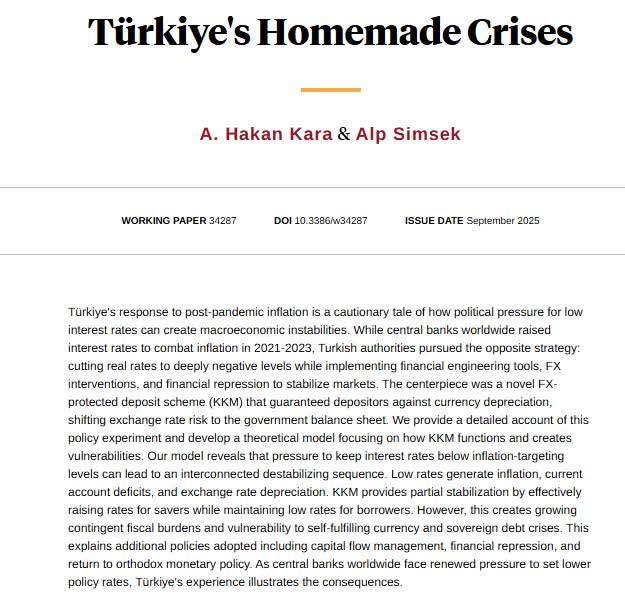
When inflation surged, Türkiye cut rates and used foreign exchange-protected deposits to stabilize markets. Showing this approach created a destabilizing policy sequence and ultimately backfired, from A. Hakan Kara and @alpsimsek_econ https://t.co/CZn3td9KBf
Pakistan’s Path to Environmental Ruin
1/10 Pakistan sits on rare earth mineral deposits valued at $6-8 trillion across Balochistan, Khyber Pakhtunkhwa, and northern regions. Recent geological surveys by Pakistan’s GSP and China Geological Survey mapped 360,000 square kilometers, finding REE concentrations up to 300 parts per million in stream sediments. Extraction produces 2,000 tons of toxic waste per ton of rare earth, including one ton of radioactive residue.
1/11 Why Your Electricity Bill Will Never Come Down: Pakistan's Rs 2 Trillion Scam
On September 25, 2025, Finance Minister Muhammad Aurangzeb signed what he called the "largest financing deal in Pakistan's history." While government officials and bank executives celebrated at the Prime Minister's House, every Pakistani family was quietly handed a bill for the next six years. The government signed a Rs 1.225 trillion loan agreement with 18 banks to address Pakistan's circular debt, which has grown to Rs 2.4 trillion, equivalent to 2.1% of the entire GDP.
Cobra effect can be seen at many places..
1. Social Media Engagement Algorithms
Platforms like Instagram, X, and YouTube reward content with high engagement. The idea was to promote creativity and connection. But creators started posting clickbait, fake news, or extreme/controversial content just to farm likes, comments, and shares.
Result: The platforms got flooded with low-quality, divisive, or misleading content.
2. Anti-Doping Policies in Sports
Sports authorities introduced stricter testing to catch drug cheats.
Athletes, instead of quitting, hired experts to develop new, undetectable performance -enhancing drugs.
Result: More dangerous and advanced doping practices emerged, making sports riskier.
3. Workplace Performance Targets
Companies set rigid targets to improve efficiency (e.g., number of calls made by call-center agents).
Employees began gaming the system: making unnecessary calls, cutting conversations short, or even falsifying reports to meet targets.
Result: Targets were met on paper, but customer satisfaction and actual productivity dropped.
4. Bounties on Invasive Species
In Australia, bounties were placed on cane toads (a destructive invasive species).
Some people began farming cane toads to claim the bounty.
Result: Instead of reducing the problem, the bounty created a bigger one, more cane toads being intentionally bred.
5. Traffic Congestion Policies
Some cities introduced carpool lanes to reduce traffic.
Drivers started buying cheap second-hand mannequins or fake passengers to use the lanes illegally.
Result: Instead of easing congestion, carpool lanes filled with cheaters, defeating the purpose.
Israel's strikes on Qatar have sprung the Arab Gulf into action.
The GCC agreed on a joint defence mechanism while Saudi Arabia and Pakistan inked a "mutual defence pact".
So, what's behind the flurry of deals? And will they really change the region's geopolitics?
𝐓𝐡𝐞 𝐔𝐊’𝐬 𝐫𝐞𝐜𝐨𝐠𝐧𝐢𝐭𝐢𝐨𝐧 𝐨𝐟 𝐏𝐚𝐥𝐞𝐬𝐭𝐢𝐧𝐞 𝐜𝐡𝐚𝐧𝐠𝐞𝐬 𝐭𝐡𝐞 𝐠𝐚𝐦𝐞 (𝐅𝐨𝐫𝐞𝐢𝐠𝐧 𝐄𝐧𝐥𝐢𝐬𝐭𝐦𝐞𝐧𝐭 𝐀𝐜𝐭 𝟏𝟖𝟗𝟎)
The United Kingdom’s recognition of Palestine marks more than a symbolic shift in foreign policy. It also opens the door to a legal reckoning for British nationals serving in the Israel Defense Forces. Under the long-forgotten Foreign Enlistment Act 1870, it is an offence for a British subject to enlist in the army of a foreign state at war with another foreign state at peace with Britain. For decades, Israel’s clashes with Palestinians were treated as asymmetric conflict with non-state actors. Recognition changes that calculus. Palestine is now, in the eyes of the British government, a state. Israel’s military actions are therefore no longer against “groups” but against a foreign state at peace with the UK.
The implications are stark. A British citizen who signs up to the IDF can be said to be fighting in a war against a recognised state with which Britain maintains peaceful relations. On paper, that is exactly the mischief the Act was designed to prevent. Successive governments have avoided enforcing it, wary of political fallout. But recognition strips away the legal ambiguity. If the law means anything, then dual nationals fighting in Israel’s ranks are no longer merely controversial, they are potentially criminal.
Why has the Pakistan Stock Exchange (PSX) failed to evolve into a world-class national institution?
In my view, the core issue lies in the lack of separation between its regulatory and commercial functions. This fundamental conflict hampers both governance and growth.
The board of directors is often composed of individuals who lack meaningful experience in capital market regulation and have little understanding of the operational and structural challenges that hinder PSX's business development.
More critically, those in charge, whether board members or senior management generally have no skin in the game.
Nominee directors, appointed without real accountability, have minimal personal or strategic stake in steering PSX toward becoming an institution of national importance.
As for the CEOs (with a few notable exceptions), many treat the role as an opportunity for networking and PR, rather than focusing on institutional reform or long-term vision.
The net result? SECP is forced to micromanage not out of choice, but because of a vacuum in leadership, direction and accountability within PSX itself.
I have consistently advocated for removing PSX’s regulatory role altogether.
Instead, a single self-regulatory organization (SRO) should be established to oversee all three key capital market institutions: PSX, CDC and NCCPL.
This would allow the Pakistan Stock Exchange to focus solely on business development innovation and market expansion, rather than being bogged down by regulatory responsibilities it is neither equipped for nor incentivized to manage effectively.
The defence pact between Pakistan and Saudi Arabia seems to be a game changer. The United States has apparently lost its credibility as a defense ally due to Israel’s attack on Qatar and alleged complicity of US forces stationed there. Saudis have long been looking up to Pakistani forces as a credible, though cosmetically, nuclear capable muslim security apparatus to defend holy places.
Our recent triumph over Indian aggression has put us in a leadership role in the muslim world. The agreement for a joint defense in case of an attack on either of the two signatories is significant thiugh not without complications and dangers. Though hugely symbolic it should be a cause of concern for Israel. And why not. A nuclear capable muslim Pakistan openly declares its intention to defend Kingdom of Saudi Arabia against its well known and only enemy that is Israel. It is yet to be seen if the agreement only talks about conventional threats and conventional defence.
Some analyst are over reacting to the development as something which pitches Pakistan in direct conflict with the USA and Israel. This can never be the case. This defense pact could not have happened with a nod from the US govt which seems to have lost direct influence over Israel’s defense policy. Pakistan’s entry into the Middle Eastern diplomatic and defense arena may be a feeble attempt by Trump administration to warn an expansionist friend of irrational and unpredictable consequences of an unending aggression against the Arab world.
The devil being in the details we are yet to see if the earlier arrangement between Pakistan and Saudi Arabia of raising and managing a joint Islamic Army (recently lead by General Raheel Sharif) has only been reshaped into a govt to govt arrangement this time -requiring increased deployment of our armed forces in Saudi Arabia- or this time it means joint headquarters and actual war. This may also mean an indirect and unusual defense cooperation of the two countries with China and even Iran.
Back home for Pakistanis the real question to be raised is how and when such a huge decision has been taken without the consent and approval of our Parliament. A decision that can potentially trigger a direct war between nuclear capable Pakistan and similarly empowered Israel. A parliament which was once reluctant to send its forces to Saudi Arabia (to defend against Yemenis attacks) has been bypassed over the huge decision to go to war for another country.
Can Pakistan deliver as a new charismatic leader and ultimate regulator of the sentiments in the Muslim world amid an ongoing massacre and catastrophe in the Middle East is a one billion dollar question.