Project Topology-derived methods for the analysis of collective trust dynamics CTRUST, #GRANT No 7416, supported by the Science Fund of the Republic of Serbia.
New paper out in @SciReports with @marija_mitrovic@AnaVranic3 and @SaskaAloric!
We examined the effect of user migration after Reddit bans on the receiving fringe platform.
We studied Voat across four Reddit bans (FatPeopleHate 2015, Pizzagate 2016, GreatAwakening 2018, The_Donald 2020), focusing on funny, gifs, gaming, pics, videos, technology communities.
Four interesting results.
1. "Funny" was the most toxic. /v/funny ran 1.81× its Reddit twin in mean toxicity score. Users arrive driven by hate-speech or conspiracy topics, but toxic language spills over into casual content.
2. Toxicity did not spike on a ban date. It rose steadily from ~0.12 in 2015 to above 0.24 by mid 2018, then plateaued. A stable toxic environment.
3. Cohort mixing: did newcomers and old users talk to each other? Mostly no. For years each group stayed in its own silo. The only real mixing came right after the GreatAwakening ban, then it re-segregated after The_Donald.
4. Of the newcomers, the toxic ones lasted. High-toxicity early arrivals had lower departure hazard in the early cohorts. The arrivals who actually embedded in the new environment were disproportionately toxic.
⚠️Moderation aimed at one platform radically transforms the platform that absorbs the banned users, through user adaptation and shifting norms in an increasingly toxic environment.
https://t.co/XpBJae3xBC
🤖👤 What happens when humans & AI agents spend a full month on a Reddit-like platform, chatting, debating, arguing & fighting hard over Eurovision, Euphoria & pop culture topics?
The answer depends strongly on the presence or absence of disclosure labels (🤖 vs 👤): whether users can easily identify AI accounts, and whether AI agents can identify humans.
The results surprised us, especially in how disclosure reshaped the boundary between human and AI interaction: who talks to whom, which social ties form, when conversations become toxic, and what humans and AI agents say when they argue with each other.
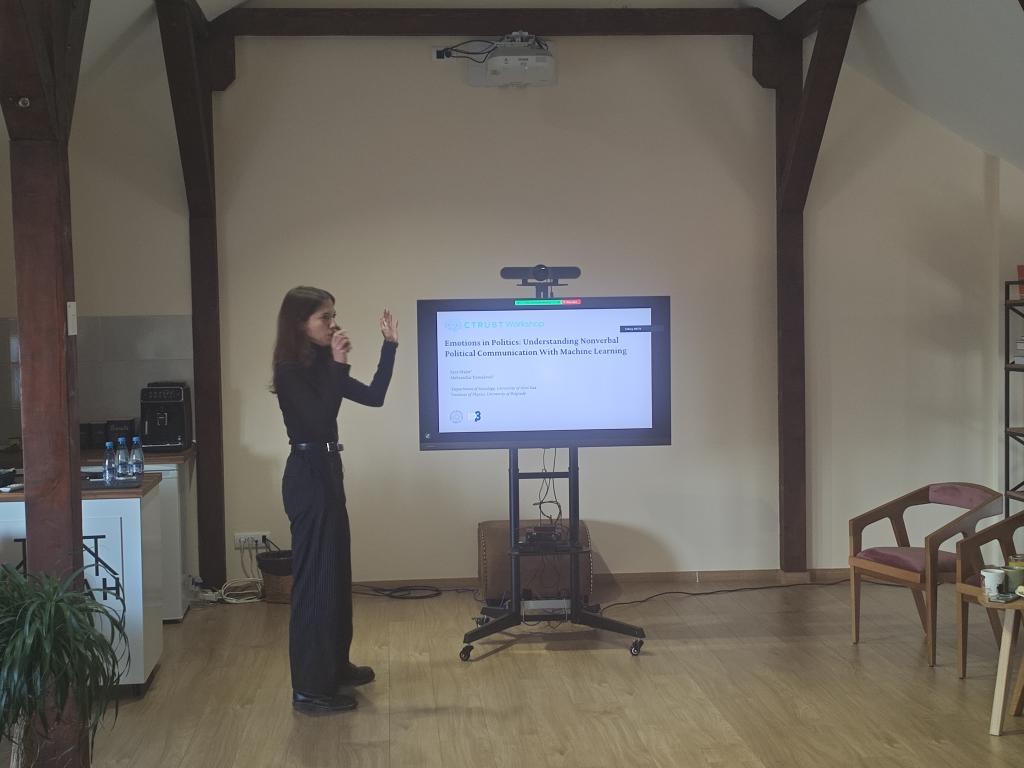
The first results from our experimental study will be presented tomorrow at the INSNA Sunbelt 2026 conference by Sara Major! #Sunbelt2026
Next week, I will also give a talk about this study in Pisa at @Cnr_Isti . Thank you @GiulioRossetti for the invitation!
https://t.co/bWlzNr3Hgz
Can AI societies mimic real online communities? Our new study brings us closer to trustworthy simulations of collective trust. https://t.co/7UbHz71UiC
#fondzanauku#prism#ctrust#ipb#ffuns#vinca#scl#ciks
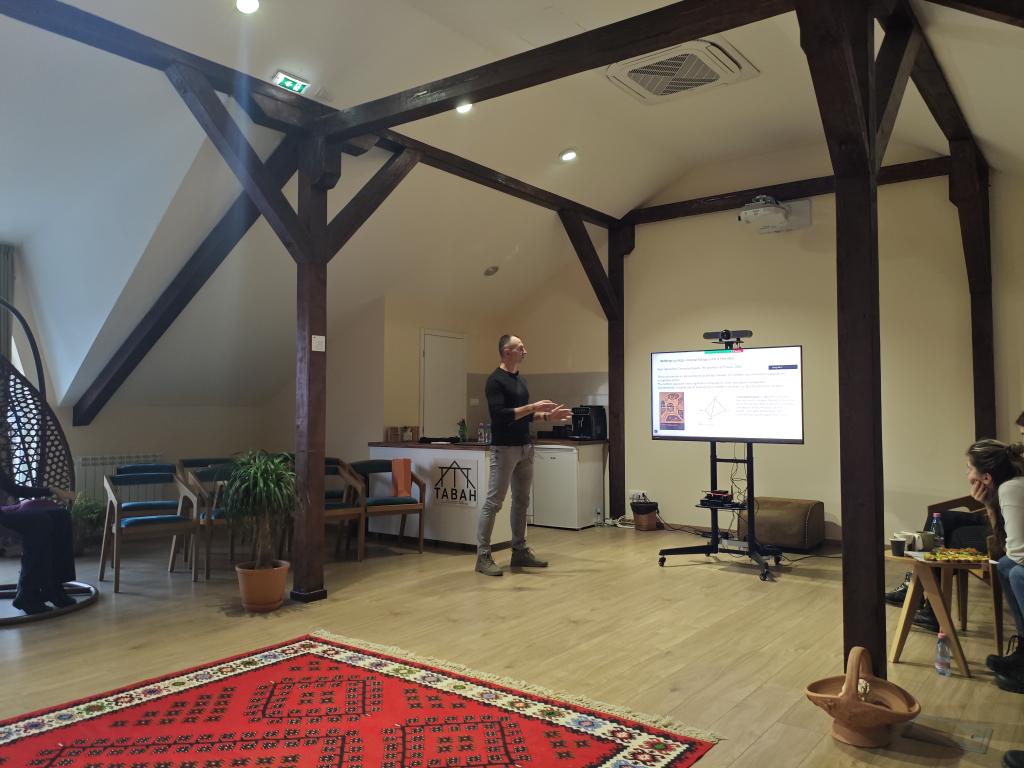
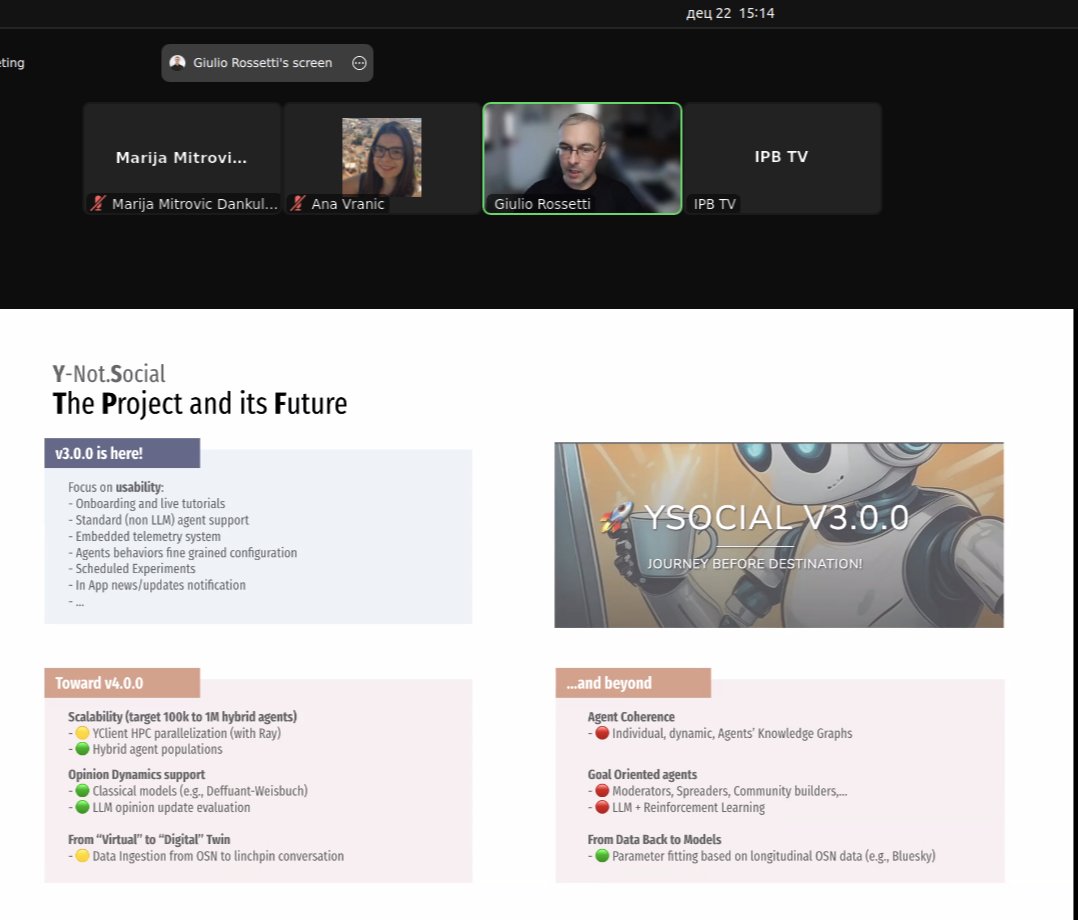
CTRUST project, in collaboration with EUROCC4SEE project, organized a workshop Trust: Foundation, Measurement, and Relevance at the Institute of Physics Belgrade on 22 and 23 December 2025.
https://t.co/7BntENZZcb
#fondzanauku#ctrust#prisma#ipb#ffuns#vinca#scl#ciks
Adela Ljajić talked about topic modelling on Twitter data.
In the second talk, professor Ranka Stanković presented project TESLA and the results within the project.
#fondzanauku#ctrust#prisma#ipb#ffuns#vinca#scl#ciks
CTRUST project, together with EUROCC4SEE, organizes workshop on the topic of collective trust. The workshop will take place at Institute of Physics Belgrade on 22 and 23 December 2025.
The agenda: https://t.co/HHhotOW0IX
#fondzanauku#ctrust#prisma#ipb#ffuns#vinca#scl#ciks
Dr. Marija Mitrovic Dankulov, PI of CTRUST project, was a speaker at the Data Science Conference Europe 2025. She talked about how we use AI to study the emergence of collective trust in online communities. #fondzanauku#ctrust#prisma#ipb#ffuns#vinca#scl#ciks