Every data platform now says it makes your data "AI-ready."
Catalogs, governance suites, lakehouses, synthetic data tools. Same phrase, four different meanings.
Most of them mean the data is discoverable, permitted, and documented. Real work, and you want it.
None of that tells you the model will still work after the demo.
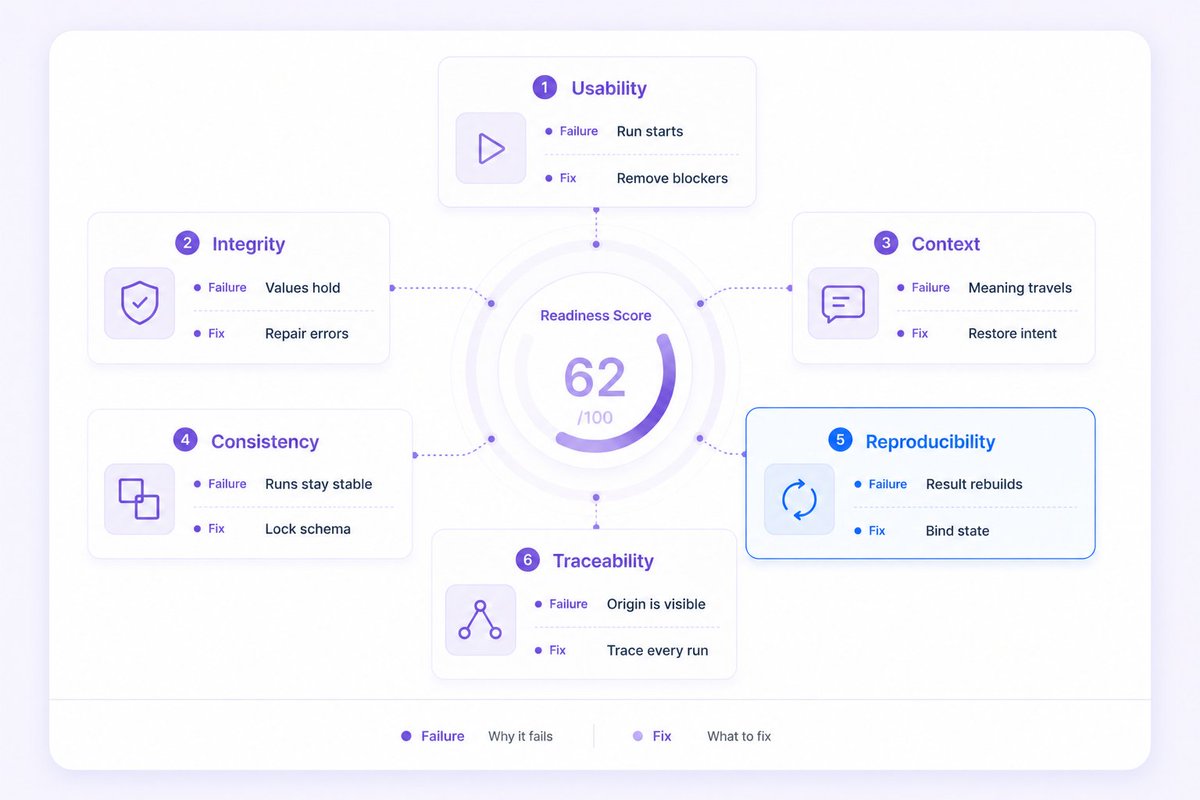
Grade a dataset on six axes. Four of them ask whether the data can be used at all: usability, completeness, context, consistency. The other two are where production breaks: traceability and reproducibility.
A catalog makes data discoverable. Governance controls who touches it and logs what they did. Neither one captures the exact data state a run executed on, then replays it when the data moves.
That last column is the one almost nobody built. It's where a real lift survives the next quarter, or vanishes with no way to explain why.
Syntitan lives in that column. It captures, versions, and replays the exact state behind a run, so the result reproduces on demand.
The rest of the stack governs the estate. This is the layer that reproduces the run.
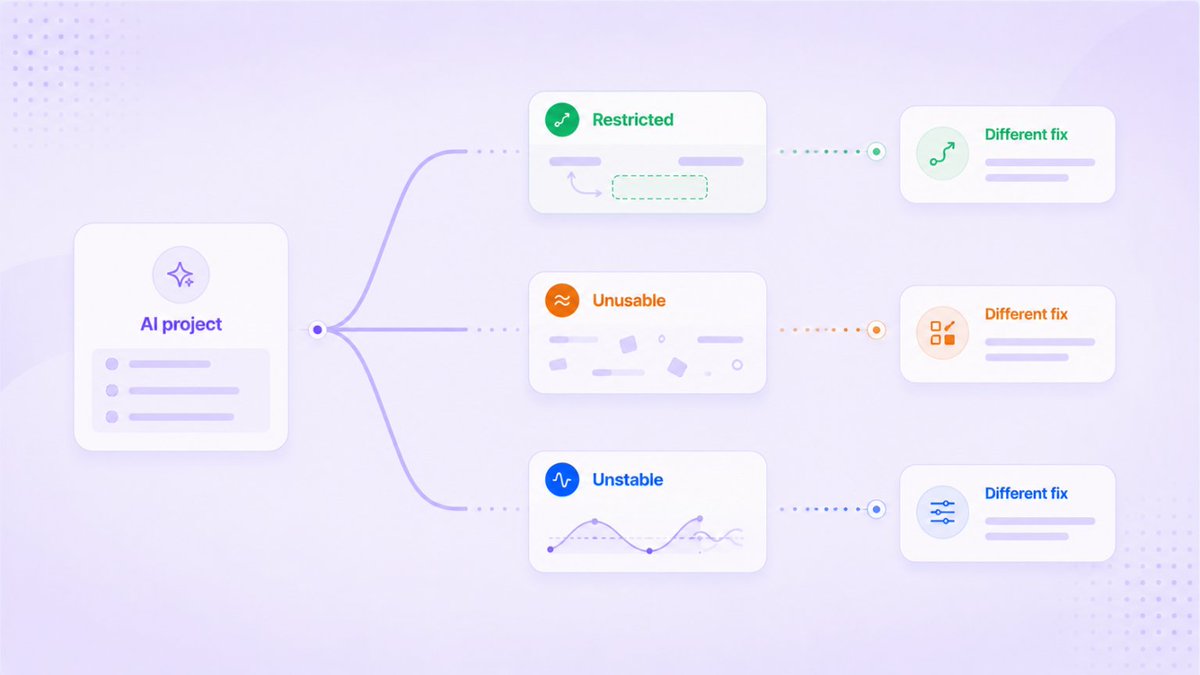
"The data wasn't ready" is three different problems wearing one label.
More than 80% of AI projects fail, twice the rate of IT projects with no AI (RAND, RRA2680-1). Most of that traces back to data. But "bad data" hides three separate blockers.
- Restricted: the data exists and would work, but you can't legally touch it.
- Unusable: you can touch it, but the model can't learn from it. Missing values, sparse rare cases, definitions that shift between teams.
- Unstable: it worked at first, then stopped reproducing. The model didn't change. The schema, the libraries, and the permissions did.
Each one needs a different fix, and naming which one you're hitting is the first move. Teams that skip that step spend months on the wrong remedy.
The one teams underestimate most is unstable. That's the column Syntitan lives in: it binds each run to a data state you can diff and restore.
CUBIG has been recognized in two recent Gartner® research reports on the technologies accelerating enterprise Agentic AI.
It has been identified as a Tech Innovator in the 2026 Gartner Emerging Tech: AI Vendor Race: Tech Innovators in Agentic AI — Solution Accelerators, and named among the sample providers in the 2026 Gartner Emerging Tech: AI Vendor Race: Most Prominent Use Cases in Agentic AI by Industry.
Enterprise AI breaks at the data layer. The model is rarely the problem. Data that can't move, can't be trusted, or can't be traced stops agents before they reach production.
CUBIG turns trapped, sensitive and low-quality enterprise data into AI-ready states agents can run on. Syntitan, DTS and LLM Capsule make that data usable, traceable and reproducible for AI workflows.
As enterprises move from pilots to production, data readiness and operational trust stop being a preparation step. They become part of the operating layer for scalable enterprise AI.
Every data platform now says it makes your data "AI-ready."
Catalogs, governance suites, lakehouses, synthetic data tools. Same phrase, four different meanings.
Most of them mean the data is discoverable, permitted, and documented. Real work, and you want it.
None of that tells you the model will still work after the demo.
Grade a dataset on six axes. Four of them ask whether the data can be used at all: usability, completeness, context, consistency. The other two are where production breaks: traceability and reproducibility.
A catalog makes data discoverable. Governance controls who touches it and logs what they did. Neither one captures the exact data state a run executed on, then replays it when the data moves.
That last column is the one almost nobody built. It's where a real lift survives the next quarter, or vanishes with no way to explain why.
Syntitan lives in that column. It captures, versions, and replays the exact state behind a run, so the result reproduces on demand.
The rest of the stack governs the estate. This is the layer that reproduces the run.
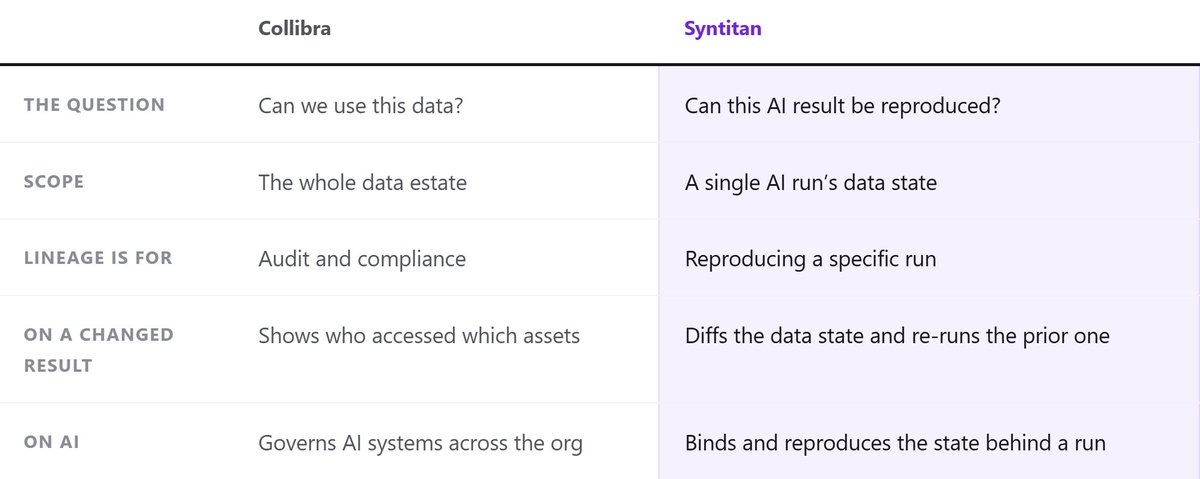
Collibra tells you which data you're allowed to use.
It governs the whole estate: it catalogs assets, tracks lineage, and proves the right people touched the right data. If you get audited on how you handle data, you want that.
It answers whether a run was permitted, not whether it reproduces.
Lineage shows which assets a model used and that the team followed policy. It doesn't rebuild the exact data state that model ran on.
Those are two different guarantees, and governance only covers the first.
You run into it the moment the data changes. The estate stays governed; the run doesn't come back.
You can prove what data a model used. You can't replay the run that used it.
Syntitan captures, versions, and replays that exact state, so one AI run reproduces on demand.
It works alongside Collibra, not against it. Collibra keeps the estate governed. Syntitan keeps the run reproducible.
Most teams running AI in production need both.
Databricks governs almost everything in your stack.
Unity Catalog covers the estate: tables, models, lineage, who can touch what. Lakebase serves the live operational data under it. If you run models in production, you want all of that.
It answers a different question than the one an auditor asks two quarters later.
Governance tells you the estate is in order right now. Delta time travel rolls a table back to an old version. MLflow logs a run's parameters and metrics.
None of them rebuild the exact data a specific model saw the day it shipped.
That gap opens the moment a result moves. A regulator asks how a decision was made. A model drifts. Someone has to retrain from the same ground.
You can read the run's metrics. You can't rebuild the run.
Syntitan captures and versions that exact state, so one AI run reproduces on demand.
It sits on top of Databricks, not against it. Unity Catalog governs the estate, Lakebase serves the data, Syntitan makes the run repeatable.
Most teams in production need all three.
Our first webinar has two things going for it: real enterprise AI problems, and real cats. 🐱
EP1: why your model works in the demo and breaks in production, even when the data looks clean.
Founder Bae Ho + host Rob Clements on what actually broke. Bring your own demo-to-prod horror story.
Live next Thursday: https://t.co/42sIeycGsS
Snowflake Horizon can tell an agent what your data means: what a column is, where the customer table joins, where a field came from. That's real, and Horizon is strong at it.
It answers one question, across the whole estate: what does this data mean?
A second question sits one layer up. Your model ran last week and gave one answer. It runs this week on a refreshed table and gives another. Which data state did the working run depend on, and can you reproduce it?
A semantic layer explains the meaning and the lineage. It doesn't capture, version, and replay the exact state behind that one run.
That's where Syntitan sits: on top of the estate, not against it. Keep your data governed, and make a single run reproducible when the data moves. In production you want both.
95% of enterprise AI pilots returned no measurable profit last year.
The popular explanation is that the buyers weren't ready: not strategic enough, not mature enough.
MIT's own data says otherwise.
The pilots that worked weren't the ones with the best strategy.
They were the ones the business could measure, run bottom-up by the line manager who owned the workflow.
And measuring a result means proving the AI is what produced it. That's the part nobody sells a course for.
A pilot can move a real number and still land in the 95% if no one can reproduce the conditions it ran under.
Same model next quarter, the data has changed underneath it, and the lift is gone. Model, prompt, or data state? With no way to rebuild that state there's no answer, and the next budget cycle wants one.
Measuring the return on AI starts with reproducing what each run ran on. That sits under strategy, not after it.
@adelbucetta As the scope of AI applications in the enterprise expands, there will come a point where we can no longer just “wing it”
when that happens, “AI-Ready” will become a term as widely accepted as “model” is today
Everyone in enterprise AI agrees the data has to be "AI-ready." Almost no one can put a number on it.
So readiness becomes a feeling. A team looks at a dataset, decides it seems clean enough, ships it, and finds out in production whether it was.
A single "data quality" score hides how the data is about to break the model. Data fails in six different ways, and they don't share a fix: unusable, wrong, stripped of meaning, unstable across runs, impossible to rebuild, or impossible to trace.
Fold all six into one digit and you can't see which one is dragging your release down.
Score each axis on its own, and "is the data good?" stops being an argument and turns into a number, with a ranked list of what to fix first.
A single model call survives thin data. A human reads the one answer and catches any miss.
An agent that chains ten steps has no such safety net. Each misreading just feeds the next decision.
Take an agent reconciling invoices. A few rows in the amount column are blank, not because the value is zero but because those invoices were never issued.
A person knows the difference. The agent reads the blanks as zeros, marks the accounts paid, and starts issuing refunds against the gap.
One misread at step one becomes a wrong payout four steps later, and nothing in the chain catches it.
That's the bar agents raise: they don't just retrieve your data, they act on it. So it has to carry its own meaning, permissions, and freshness.
Strip that out while cleaning and the agent still runs, just on a reading it should never have trusted.