New in @TheAJNR :
I’ve never written a paper in quite this format before, but it came from a recurring issue I see in #spinalCSFLeak care.
For selected patients with suspected SIH, the neuroradiologist’s role may need to extend beyond the report.
The task is not just to interpret images, but to integrate the clinical story, prior imaging, myelographic technique, procedural options, and uncertainty into a coherent next step.
In a disease where the tests are imperfect and the techniques are evolving, patient-facing neuroradiology can meaningfully change care.
https://t.co/Ah5mIkT1AK
New in @TheAJNR :
CSF-venous fistulas usually arise from meningeal diverticula, but not always.
In this multi-center series led by @AjayMadhavanMD, we describe CVFs arising without an associated diverticulum, including fistulas arising directly from the common thecal sac.
Practical takeaway: absence of a diverticulum should not by itself end the search when the clinical/imaging picture still supports SIH.
Grateful to Ajay for leading this and to the multi-institutional group for helping define another subtle but important CVF variant.
https://t.co/Xf6l58uZWC
Proud to have collaborated with the @spinalCSFleak Foundation and a remarkable group of patient advocates on this project. Patients are the true experts on the financial, professional, and emotional costs of navigating a fragmented diagnostic journey. This study helped quantify those burdens and underscores the value of including patients as partners in research.
To quantify the barriers to care spinal CSF leak patients face, the Foundation collaborated with @AndrewCallenMD and @DanielM737 on a patient survey and paper.
We are thrilled to share that it has been accepted by @TheAJNR!
Abstract here: https://t.co/UgsJV8Jl9z
New @TheAJNR#CSFLeak paper out today:
https://t.co/7pOA0dlPT0
We focused specifically on low-Bern patients, the diagnostically ambiguous group where clinical history often drives the decision to pursue myelography for suspected CVF.
One of the most interesting findings was… ↓
#SIH, #IIH, & related #CSF pressure disorders may be better understood as a dynamic physiologic continuum rather than isolated syndromes
🎥 Author interview now live: https://t.co/lVX4gvemv6
📄 Read or revisit the review: https://t.co/0uEoS0X4ek
https://t.co/lVX4gvemv6
Now online in @TheAJNR :
In patients with suspected #spinalCSFleak but negative myelography, higher spinal compliance was associated with clinical benefit after subsequent empiric blood patching.
Not a decision rule, but an interesting physiologic signal in a tough subgroup.
https://t.co/KueEoWECGW
Join us for this exciting ASSR session at #ASFNR26 and listen to these phenomenal speakers @WendeNGibbs@AndrewCallenMD and Drs. Lehman and Madhavan. Don't forget to submit your abstracts by 6/19.
For meeting details and schedule visit:
https://t.co/V5P2K7tNf6
Ran across the street today to hug my former residency PD, Soonmee Cha, right before her Grand Rounds at @CURadiology today.
She’s a world-class @UCSFimaging brain tumor expert who has stayed deeply committed to residency training in a way that’s honestly rare. She expects excellence, but more importantly, quietly demonstrates it every day, even in the smallest things.
She’ll show up on day one having memorized every resident’s name, their family, and their story. And somehow still asks about all of it years later.
She’s the kind of person who will go to bat for a resident at 3am, and then show up the next morning like nothing happened.
Hard to explain how much that kind of presence shapes people. If you trained under her, you know.
#Soonmee
Most patients with CSF pressure disorders don’t read the textbook.
This review is about what to do when the imaging, symptoms, and physiology don’t line up, and why “high” vs “low” pressure is often the wrong framework.
🔓Open access:
https://t.co/YnLJG2asav
Sacral dural tears in #SIH are probably under-recognized.
Why?
Because the sacrum often isn’t scrutinized, or sometimes even included in the field of view on routine spine imaging.
In a new multicenter @AJNR study we found:
• Sacral leaks often produce isolated sacral CSF collections
• Image-guided patching can lead to meaningful clinical & imaging improvement
• Longitudinal imaging suggests some lesions mimicking “Tarlov cysts” may actually represent chronic or partially healed leaks
Encouraging to see multicenter collaboration continue to emerge in SIH imaging/treatment research.
https://t.co/jDd8Mv0QTW
One of the most common excuses for not using atraumatic needles for LPs: “They cost more”
New study shows the opposite is true when you look downstream:
• 19 fewer PDPH per 100 LPs
• Fewer hospitalizations & blood patches
• Net cost savings
The cheapest needle is the one that doesn’t cause a leak.
https://t.co/gRE8SEknqO
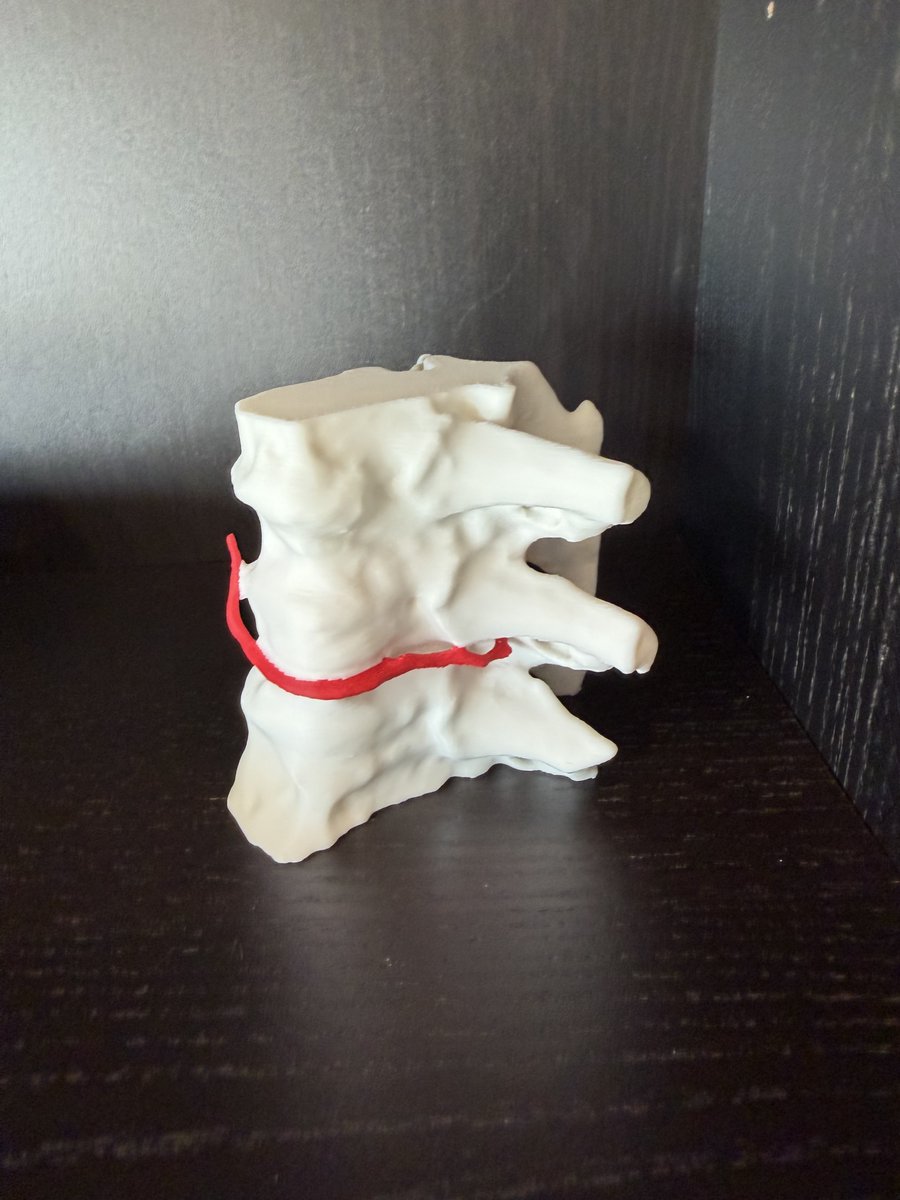
A CSF-venous fistula… in your hand.
My brother 3D-printed this model from a volume rendering created by our 3D lab tech Amanda from a dynamic CT myelogram.
I think we should be doing more of this for patient education: there’s something powerful about visualizing what’s happening inside your body.
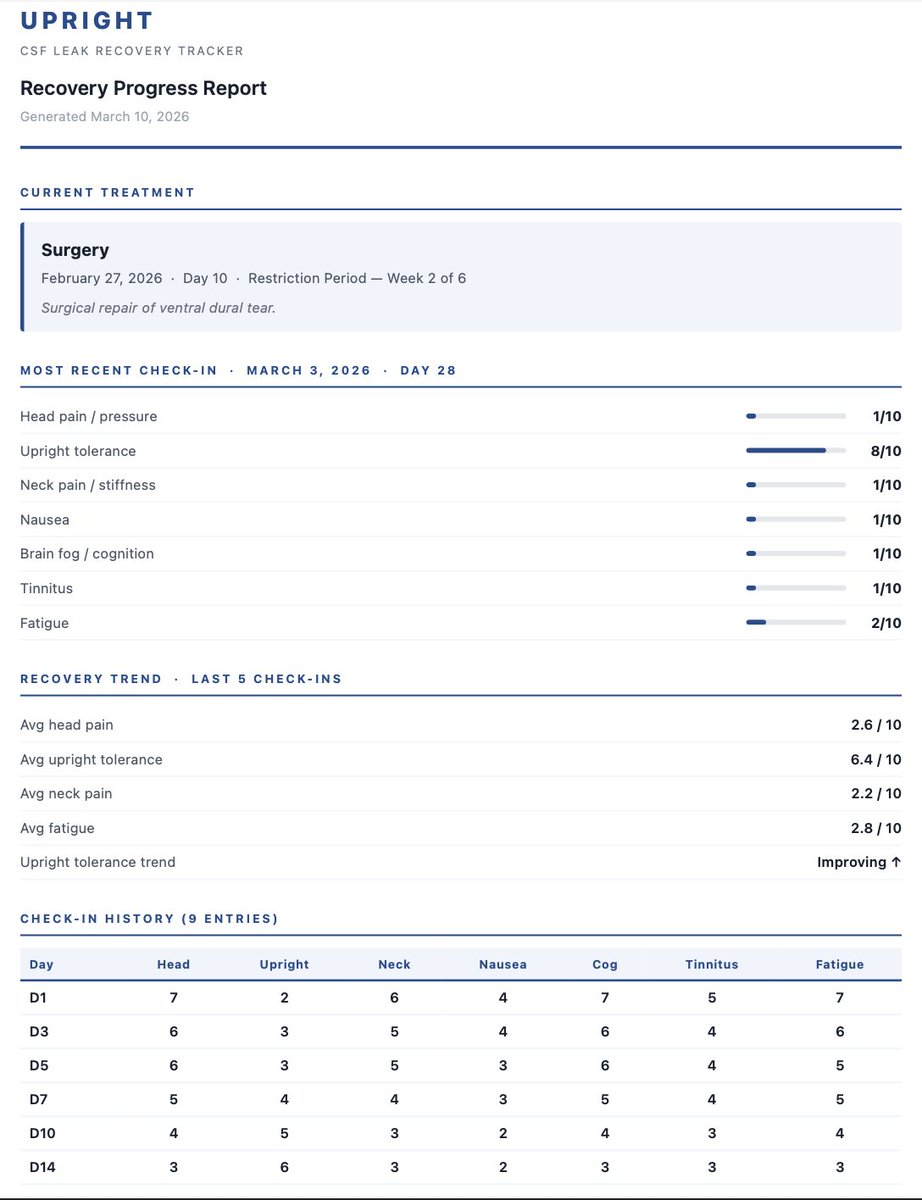
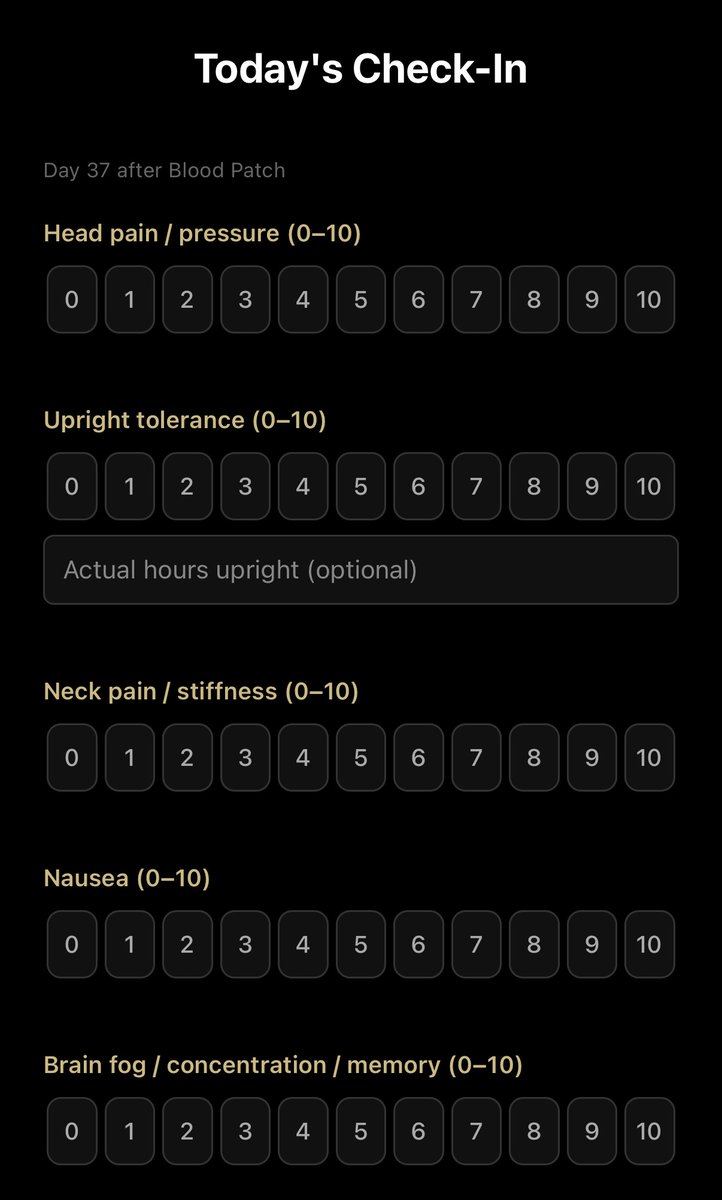
One feature I wanted was the ability to generate a simple summary patients can bring to appointments or upload to their chart.
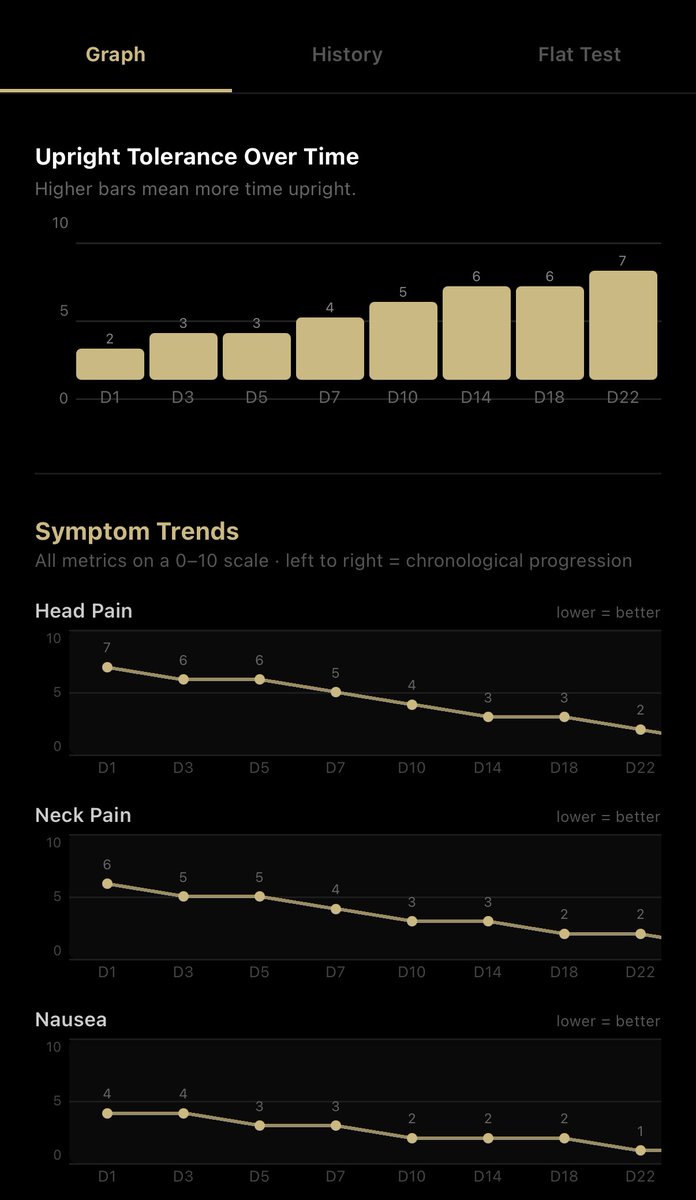
The app can export a report showing symptom trends, treatments, medications, and flat test results in one place.
One thing I’ve learned from caring for patients with #spinalCSFleaks is that many already track their symptoms, upright time, treatments, and medications in notebooks or spreadsheets.
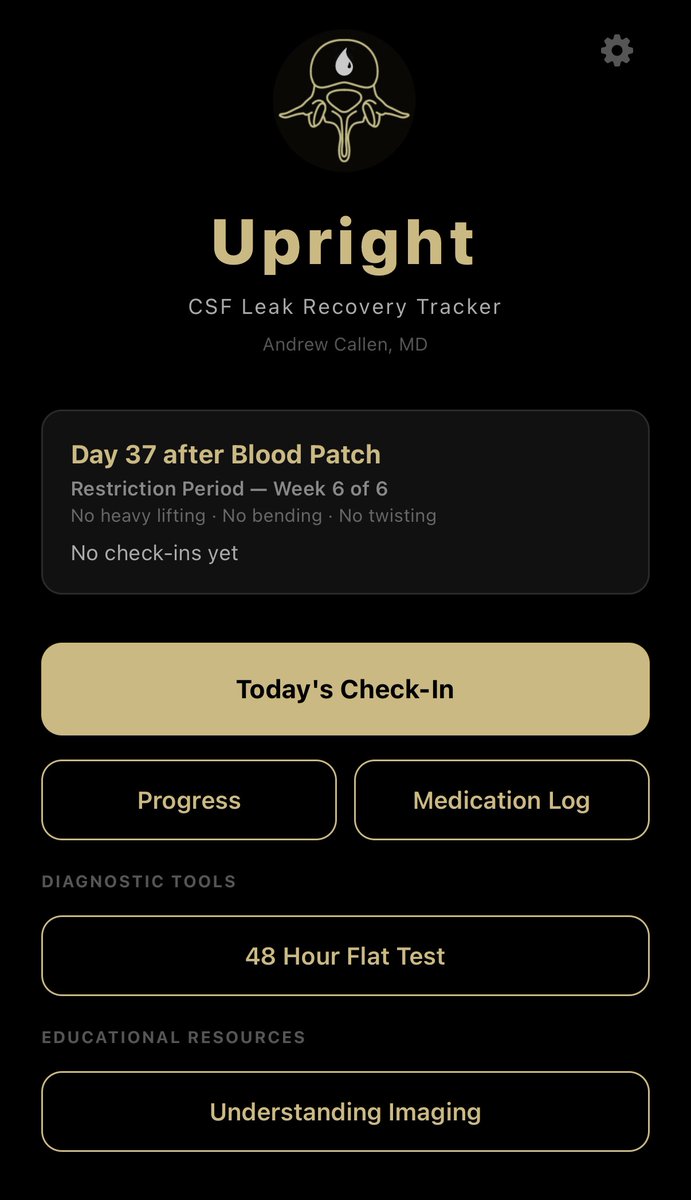
After seeing this repeatedly (and learning a lot from patients who have been doing this thoughtfully for years), I have built a simple app to help organize that information and generate a clear recovery timeline that can be shared with their doctors.
My hope is that making this information easier to track and export may help facilitate better care, and eventually research.
Hoping to release #Upright soon and will keep the community posted.
New @AJNR#CSFLeak paper from @CUneurorad and our outstanding fellow Dr. Cara Campbell. Meningeal diverticula seem to be the substrate from which CVF develop, yet the prevailing thought is that diverticula are incidental. This work challenges that idea.
https://t.co/XnQQ5U8nXA
Thank you to our partners at The Spinal CSF Leak Foundation @spinalCSFleak and to our amazing patient and physician speakers for making this year’s Spinal CSF Leak: Bridging the Gap Conference a great success!
"Patterns of Epidural Patch Distribution: The Influence of Spinal Level, Injection Technique, and Patch Volume/Composition on Craniocaudal and Ventral Epidural Dispersion"
https://t.co/yMDaCLoTQN
@DanielM737; @AndrewCallenMD; @The_ASSR
Patients with #SIH often wait years for a diagnosis—but not all wait equally. Our new @TheAJNR paper explores these disparities and what they mean for equitable neurologic care.
Congrats to @Mariapuello18 for leading this project!
https://t.co/GD8M1zAXBK