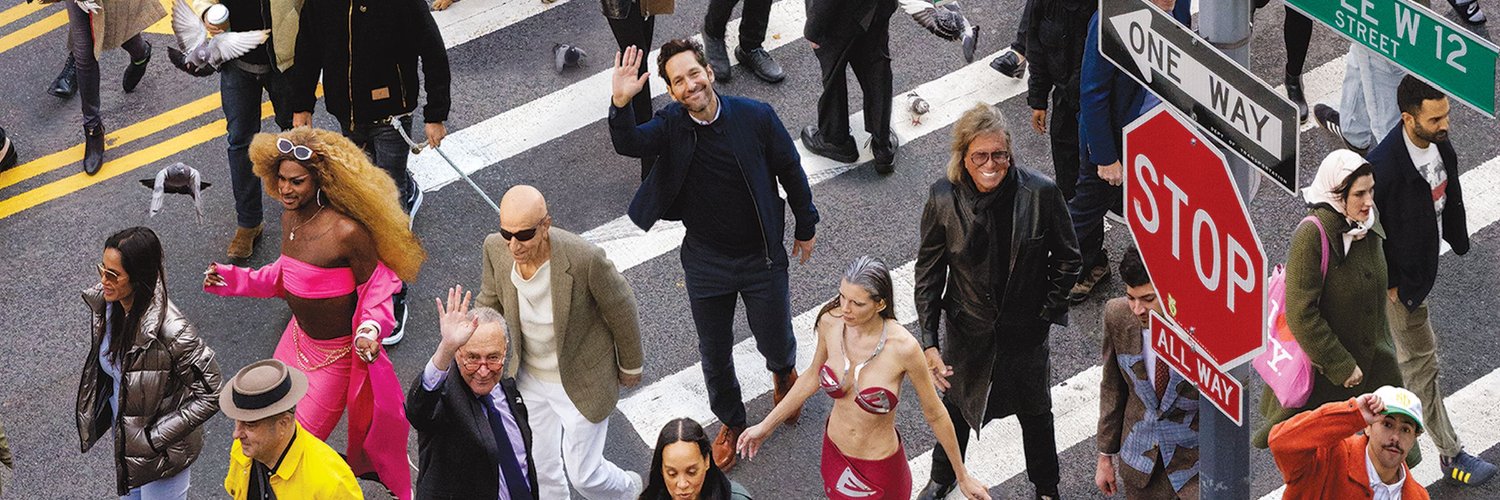
Early signs suggest the newly wealthy approach philanthropy differently than their predecessors: They are younger and more interested in funding ambitious, high-ROI projects that traditional foundations and charitable vehicles can’t readily take on. There is, of course, only so much that private philanthropy can solve. But there are many areas of city life where a private donation of $100 million or less could make a dramatic difference.
A few months ago, we loosed reporters across the city to speak to insiders about what some of these projects could be. They probed experts and practitioners in different industries, policy wonks, local nonprofit directors, and lawmakers. Other proposals were inspired by listening to the themes that arise when New Yorkers are asked what could improve city life.
With those ideas, our reporters set about finding specific solutions, sometimes taking inspiration from other cities, or looking at small-scale programs that could be expanded. Then we painstakingly drilled down on both feasibility and cost to come up with 34 meaningful philanthropic investments. We hope some of our readers are inspired to write a check.
Explore our menu of variously sized, variously inventive projects, all of which we’re certain would make New York more livable, more compassionate, or simply more beautiful: https://t.co/MlhxxkPnO0
Some families are finding that renting or even buying an apartment in New York for the grandparents is still cheaper than the other options for childcare. https://t.co/V3piz8xCdc
On a recent Sunday afternoon, members of the Coney Island Polar Bear Club Swim took an early-season dip in the Atlantic, where the water was around 60 degrees. https://t.co/oXclCcgzpI
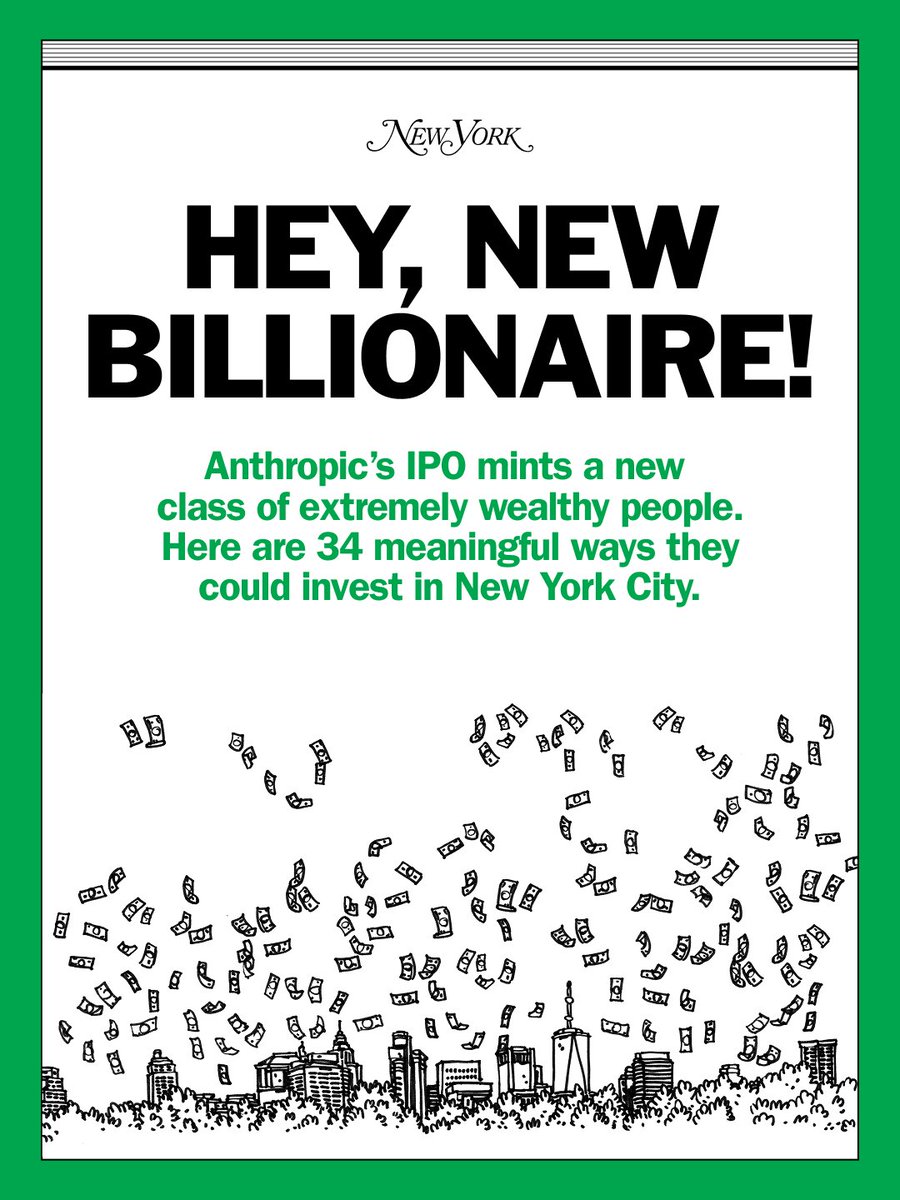
With the Anthropic IPO and other AI IPOs on the horizon, American cities are on the brink of enormous wealth creation. And early signs suggest the newly wealthy approach philanthropy differently than their predecessors: They are younger and more interested in funding ambitious, high-ROI projects that traditional foundations and charitable vehicles can’t readily take on. There is, of course, only so much that private philanthropy can solve. But there are many areas of city life where a private donation of $100 million or less could make a dramatic difference.
A few months ago, we loosed reporters across the city to speak to insiders about what some of these projects could be. They probed experts and practitioners in different industries, policy wonks, local nonprofit directors, and lawmakers. They almost immediately happened on a trove of projects that were all but ready to go yet had lost funding. Other proposals were inspired by listening to the themes that arise when New Yorkers are asked what could improve city life.
With those ideas, our reporters set about finding specific solutions, sometimes taking inspiration from other cities, or looking at small-scale programs that could be expanded. Then we painstakingly drilled down on both feasibility and cost to come up with 34 meaningful philanthropic investments. We hope some of our readers are inspired to write a check.
Explore our menu of variously sized, variously inventive projects, all of which we’re certain would make New York more livable, more compassionate, or simply more beautiful: https://t.co/NJVjKIG3gA
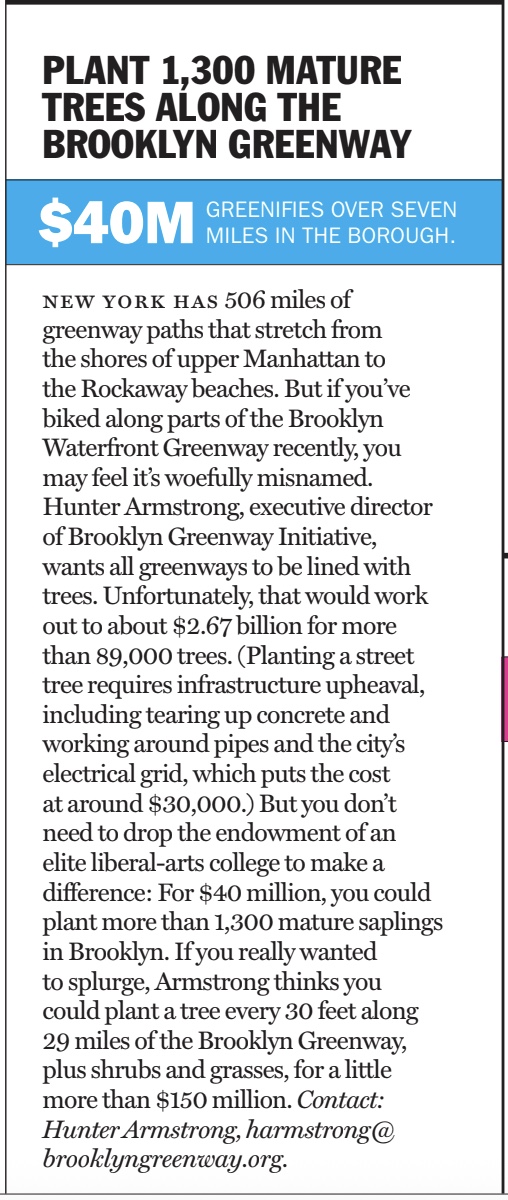
Got an extra $40 million burning a hole in your pocket form that Anthropic IPO? Biederman LLC client @BKGreenway has a use for it, featured in this week's New York Magazine...
Anthropic’s $1.4 trillion IPO will mint a new generation of extremely wealthy people. From beautifying public restrooms to killing the rats, here are 34 meaningful investments they could make in New York City. https://t.co/0zhdrd6U6U
After mostly dating long-distance for three years, reality star Ariana Madix and boyfriend Daniel Wai are apparently serious enough to buy a place together: a $2.9 million loft in the Printing House building on Hudson Street. The condo is right off the 1 train at Houston Street — an easy commute up to Broadway, where Madix is starring in an extended run of ‘Just in Time.’ Wai, a longtime New Yorker, works as a personal trainer and might find it convenient to pop around the corner for workouts at the Equinox that took over the old Printing House Squash and Fitness Club.
The unit isn’t the building’s fanciest. It was renovated recently with “top of the line finishes,” per the listing, but a renovation also attempted to squeeze in more rooms. A lofted floor over the kitchen has two smaller rooms with low ceilings, and a wall between the downstairs bedroom and the living area would make those rooms seem tiny if the ceilings weren’t so incredibly high: 15 feet.
Read more about the couple’s new pad: https://t.co/trNhiQ0quv
The New York ‘Times’ ’ former executive editor paid $1.17 million for a thoroughly renovated one-bedroom with river views and proximity to diehard print readers. https://t.co/tDvuJS9umC
For two friends who work in film, living on a decommissioned sailboat docked in Newtown Creek has plenty of downsides: no running water, no walls, no space. But the rent’s just $360 each. https://t.co/lCGLwH1jz2
Rent-or-buy calculators often seem a little bogus, assuming as they do that there’s money for a down payment, the ability to get a mortgage, and enough reasonably priced inventory to even consider moving out of your current place. But for all their faults, the calculators do illuminate certain market realities, writes Kim Velsey. A new report from StreetEasy on the New York neighborhoods where buyers can break even fastest underscores that the choice between renting and buying has gotten murkier; it now takes a buyer purchasing a median-priced apartment of $900,000 nearly 15 years to pull ahead of a renter, or two more years than in 2025.
There are simply not enough apartments to go around, driving up the rents and sales prices for those that do come on the market. And it’s not as though rents were affordable before: This spring, median rents in the city hit an all-time high of $4,120 a month. There are some surprises, however: In a few tony neighborhoods, the rental prices are so high that buying is now the better option.
Read more from Velsey: https://t.co/KsNwwl4sjN
StreetEasy ran the numbers to see in which neighborhoods it makes more sense to buy than rent, and there were a few surprises: Brooklyn Heights and Gramercy Park. https://t.co/Q638LlAXb6
The ‘Chariot’ singer-songwriter paid $849,000 for a one-bedroom, one-bath in Gramercy pre-war co-op that’s both fairly spacious and fairly meh. https://t.co/jZIUKQrVte
Here are some apartments to buy in New York City for under $1 million, including options in Greenwich Village, Jackson Heights, and Brooklyn Heights. https://t.co/RIr6xRxqzd
On Park Avenue in midtown, an office worker commuting home might pause to take in the Lever House lobby, which glows with more than a dozen hanging paper lanterns, or Akari, the name Isamu Noguchi gave to his delicate sculptures of washi paper and bamboo. That installation, along with a number of other Noguchi sculptures and models placed throughout the building, is not just your standard office art; it’s also a reminder of the connection between Gordon Bunshaft, the architect of the glassy office tower, and Noguchi, whom he commissioned in the early 1950s to design sculptures for the courtyard.
Noguchi would never fulfill that commission, but he would, around this time, develop the lights that would become nearly ubiquitous. In 1951, the mayor of Gifu, Japan, tapped him to help revive the region’s centuries-old paper-lantern industry. His Akari series, which would total more than 200 models in all, stripped the lanterns of any writing and most of their color, stood them on thin metal stands, and replaced the oil lamps and candles that illuminated them with electric bulbs. The result was spare, geometric, and weightless. To honor the 75 years since their inception, the Noguchi Museum recently opened the exhibition “No Ordinary Light: Akari at 75,” which will run until September 5, 2027.
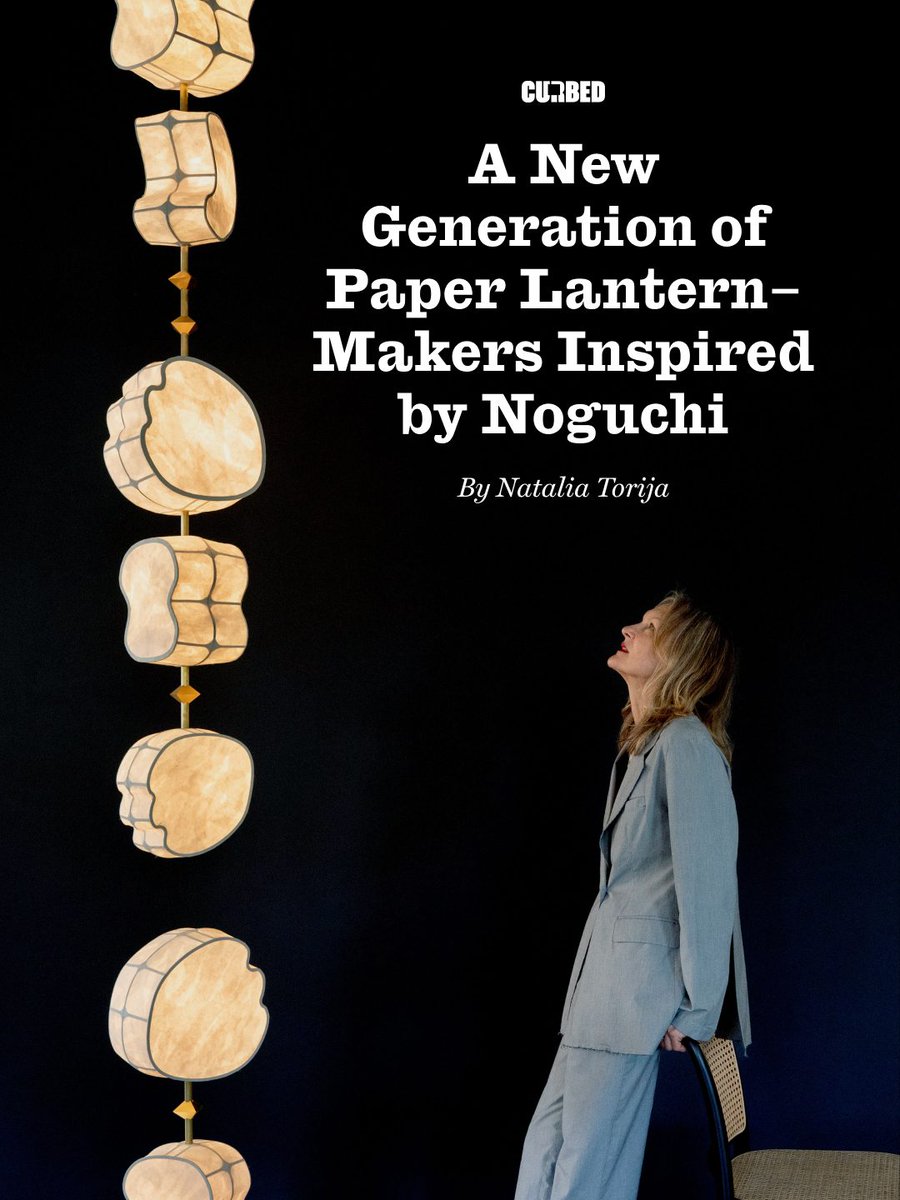
Revisiting Noguchi’s Akari also presents an opportunity to talk with a new generation of designers working with paper and light and their relationship to the artist. Read more from Natalia Torija on four studios rethinking the paper lantern: https://t.co/8J3UzMi88P
Celebrity broker Carl Gambino was diagnosed with pancreatic cancer a year ago. His team did $700 million in sales while he underwent treatment, keeping his diagnosis a secret. In remission since April, the broker is now discussing his experiences. https://t.co/s6DWva0kTX
Celebrity broker Carl Gambino was diagnosed with pancreatic cancer a year ago. His team did $700 million in sales while he underwent treatment, keeping his diagnosis a secret. In remission since April, the broker is now discussing his experiences. https://t.co/JdSesju3Nn
Schools from California to Kentucky may need a cherry picker if they want to peel themselves away from Jensen Huang’s reputation. https://t.co/ihqIjQOOYf
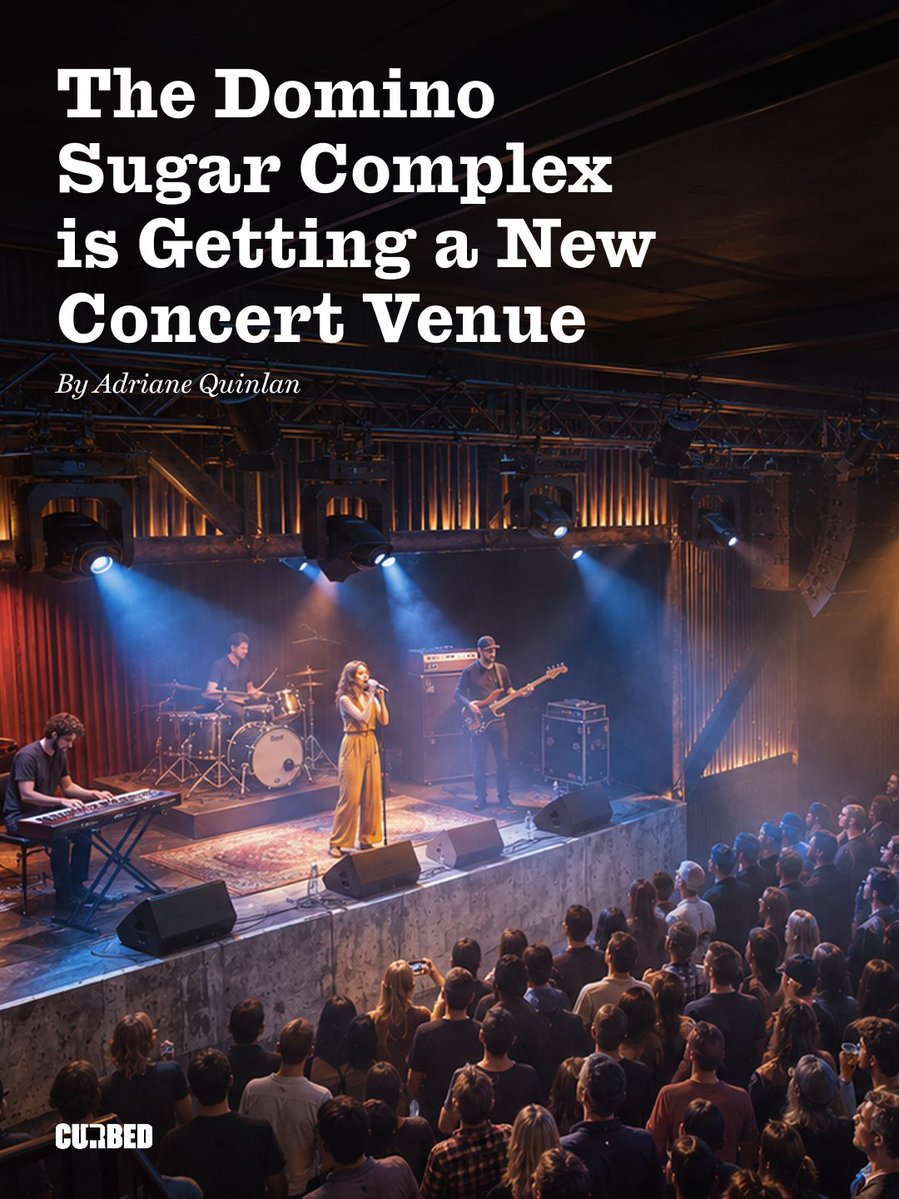
The former Domino Sugar Refinery on the Williamsburg waterfront will soon offer the neighborhood a new amenity: a music venue. The room, a project announced today and set to open in April, can fit 750 people, and it will be operated by TVG Hospitality, a group led by a member of Mumford & Sons. The old factory building, adapted into office space, is now known as the Refinery, and this new space, next to the building’s new Equinox gym with an entrance on the river side, will be called Domino.
The location is, if you’re of a certain age, interesting, writes Adriane Quinlan. Old-timers may remember nights nearby at Glasslands, 285 Kent, and Death by Audio — all within one block, and all closed by 2015. The generation of glossier spaces that followed those has also gone dark: The local Knitting Factory shut in 2022, and the Music Hall of Williamsburg will close this December. But with fewer competitors, Domino may have an easier time scraping together audiences.
Read more: https://t.co/P65T04dzaU
The best NYC apartment listings available for rent this week in neighborhoods including Crown Heights, Windsor Terrace, Kensington, Park Slope, Prospect Heights, and Prospect–Lefferts Gardens. https://t.co/kMelfZb3xO
“During that February blizzard in New York City, I was foolishly walking between meetings to kill time and tried to find some spiritual and meteorological respite with a pitstop in the McNally Jackson bookstore on Prince Street,” writes David Michon. “Instead, it induced a sort of rage. “Its ‘interior design’ section felt like a collection of 150 megasimilar monographs and books with the word “curated” in the title. Nobody who cares about décor, absolutely nobody, has a bookshelf that looks like that.”
So when 'For Scale,' Michon’s Substack and print magazine, was plotting some kind of collaboration with Santa & Cole (makers of the crucial bookshelf lamp the Bib Luz), Michon wanted to see a décor shelf he was more familiar with. Hence, a weeklong interiors bookshop hosted at Park at Kims in Nolita, which closes tomorrow, Nov. 13, at 6pm. Michon and his team asked their favorite interiors people to share their favorite titles and sourced affordable copies of their choices.
“The man to help us find them was Geoff Snack, the founder of Wrong Answer, a book shop inside the USM showroom in Soho,” writes Michon. “We had a chat about what’s on our (wacky, custom USM) shelves, and the state of décor books and magazines past and present.”
Read more: https://t.co/NdRidroVMl