CURTAIN is live on Robinhood Chain.
CA: 0x66a844fcbf4705dbde3c97394d5a4c9822e8f35b
Private swaps for $USDG and Stock Tokens/tokenized stocks. $CRTN
Choose an asset, set slippage, choose a recipient, and swap privately. If CURTAIN is unavailable, your downloadable escape ticket lets you recover the deposit.
Watch $USDG → $AAPL below.
Putting equities onchain changes who can access a market, but it also changes what a wallet exposes.
24/7 holdings do not need a 24/7 public trail. If every entry, exit, rebalance, and transfer is legible to the internet, serious users will route around the problem.
Curtain is building the missing execution layer, private swaps, proof-backed settlement, recovery paths, and controlled permissions for accounts and agents. $CRTN
Private execution gives users control over value. $CRTN
Passes and Understudy define how that value can be used.
Booths, Lamps, Host Network, and Rig Rate make compute execution, booking, evidence, and pricing inspectable.
That is the architecture Curtain is assembling: private execution first, then controlled ways for agents and applications to act around it.
GPU compute is becoming a market with its own timing, trust, payment, and delivery problems. $CRTN
An agent needs more than access to a machine. It needs capacity it can book, a host it can evaluate, a receipt for the work delivered, and a price reference that is honest when data is thin.
That is the layer Curtain is building with Booths, Lamps, Host Network, and Rig Rate.
Congratulations to our CEO @JensenHuang on receiving the National Medal of Science for advancing GPU computing to power scientific breakthroughs.
And to fellow honorees Elon Musk, Lisa Su, Michael Dell, Satya Nadella, and Sergey Brin.
Curtains has a new look
We’ve rebranded, and our website has a fresh new experience that reflects our vision for a more private future in onchain finance.
Take a look: https://t.co/NP6NzQQloN
Your wealth. Your private stage.
Here is what moved in the last 24 hours. $CRTN
The swap stack got more proof, recovery, routing, and agent tooling.
Around it, Curtain pushed experimental modules for compute jobs, capacity booking, host verification, GPU rate references, AI-infrastructure baskets, private accounts, private trading, screened launches, and prepaid passes.
These parts are starting to connect into a system around private execution.
Everything is public and inspectable:
https://t.co/IU2htk9q59
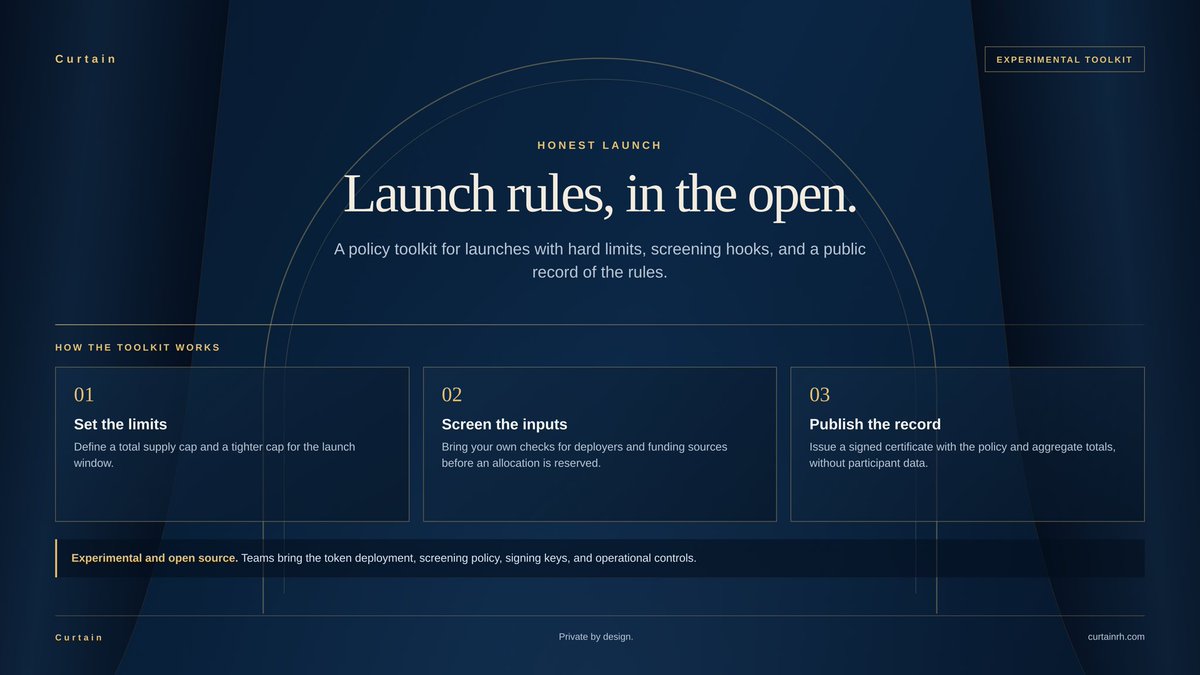
Honest Launch is now in Curtain.
The toolkit lets teams set total and launch-window caps, plug in their own deployer and funding checks, and issue a signed certificate with the launch rules and aggregate allocation totals.
The certificate contains the policy and aggregate totals only. Participant data stays out of it.
This is experimental code. Teams bring the token deployment, screening policy, signing keys, and operational controls. Curtain provides the policy logic.
https://t.co/Bd9BwmpH1B
Quick Rig Rate update.
We compared the first build with the spec and it was too narrow. So we rewrote it.
Rig Rate can now plug into different data sources, calculate rates by region and time window, retain the source record for each observation, and filter outliers using rules set by the integrator.
When the data is weak, it says so. The result can return `thin_market` or `insufficient_data` instead of pretending a rate is reliable.
Rig Rate is still experimental. It is not a hosted oracle or a promise that a price can be executed.
https://t.co/5iRo5RHfMk
Private compute needs more than GPUs. It needs tools to run workloads, book capacity, and verify what a host can actually deliver.
Curtain’s experimental toolkit lineup:
• Booths, GPU-backed compute jobs
• Lamps, reserved service windows and escrow flows
• Host Network, host claims and verification hooks
• More tools in progress
Everything is cloneable. Developers bring their own hosts, storage, and verification policy.
https://t.co/b6UWusTkuY
Agents are cheap. Reliable private compute is not.
Someone still has to book the GPU, verify the host can do the work, and know what that capacity costs.
That is the layer we are building at Curtain, with Booths, Lamps, Host Network, and Rig Rate. $CRTN
Curtain’s experimental Host Network toolkit is now live.
It gives developers a starting point for building their own compute-host directory and verification policy.
Hosts can submit signed claims and attestation evidence. The toolkit checks that the claimed GPU capacity does not exceed what the integrator’s attestation verifier confirms.
It can also record Booths, Lamps, or canary performance evidence after the integrator verifies the source.
This does not make a host automatically trusted or guarantee future availability. Builders bring their own hosts, storage, attestation roots, monitoring, and enforcement policy.
https://t.co/vrdVAmoZ75
Weights are the easy part.
AI Rig Shelf is now in Curtain, an experimental open-source toolkit for planning AI-infrastructure asset baskets.
Give it asset metadata you have already reviewed, set target allocations and hard exposure caps, then use a price snapshot to assess the basket, create a deterministic rebalance plan, or calculate pro-rata in kind redemption outputs.
Asset selection, issuer terms, custody, liquidity, venues, and settlement stay with the integrator.
AI Rig Shelf does not verify those inputs or execute the plan for you.
Code:
https://t.co/yLrYqnDeMq
Quick Rig Rate update.
We checked the first version against the spec and it was too narrow for the job.
Rig Rate has now been rebuilt with pluggable data sources, regional time windows, source-level provenance, configurable outlier filters, and confidence signals.
When the market is thin or the data is not sufficient, it says so directly.
Rig Rate is still experimental.
Integrators run and verify their own data sources, storage, and publication rules.
https://t.co/5iRo5RHfMk
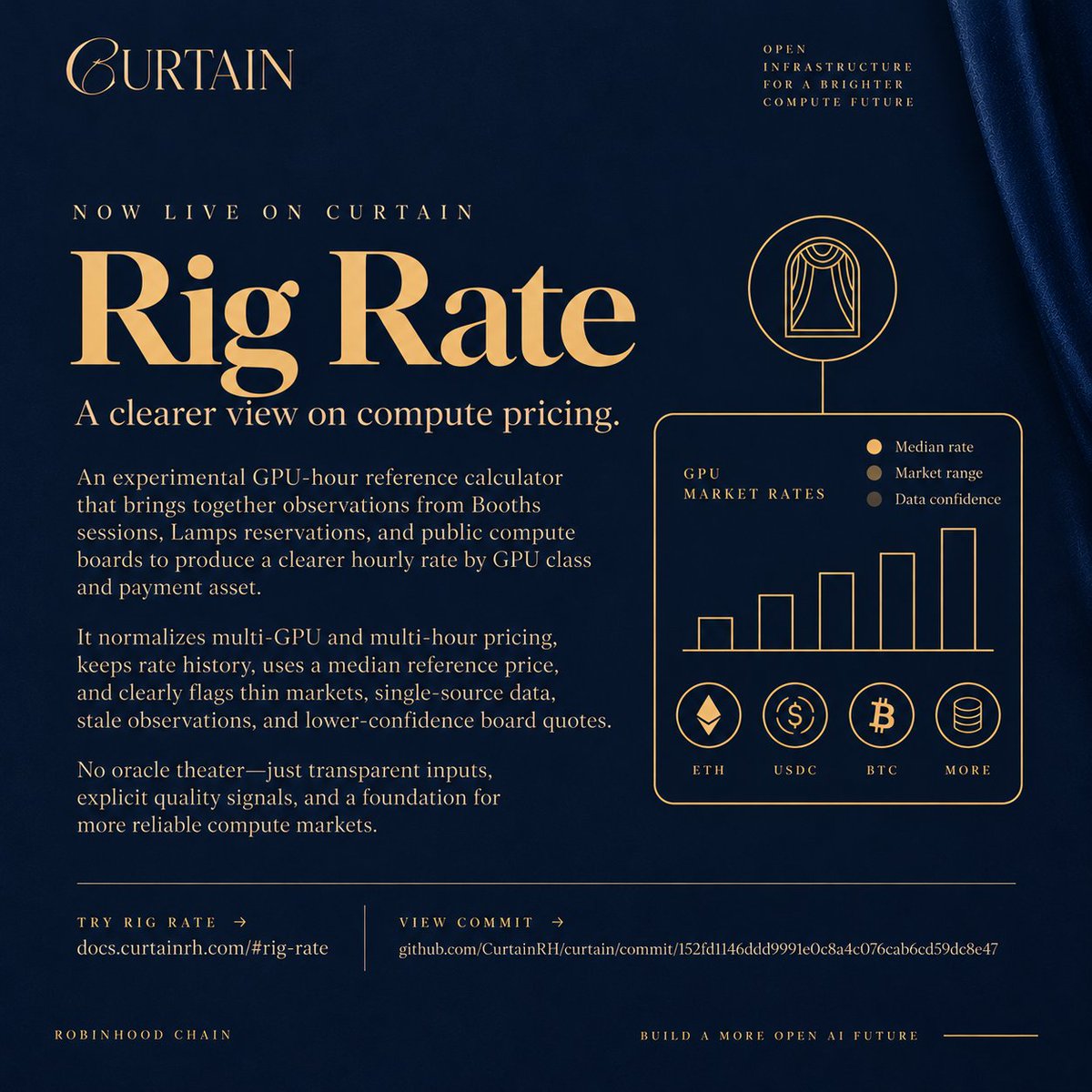
Rig Rate is now live in Curtain.
GPU pricing is hard to compare. One provider lists a single GPU by the hour, another lists an eight-GPU setup by the day, and public board quotes are not always current.
Rig Rate pulls observations from Booths sessions, Lamps reservations, and public compute boards, then normalizes them into a comparable hourly reference by GPU class and payment asset.
It keeps rate history, uses a median reference price when the data supports it, and flags thin markets, single-source data, stale observations, and lower-confidence board quotes.
The goal is simple: show the data behind a GPU-hour reference instead of presenting a number as an oracle.
Experimental, transparent, and built to be inspected.
Rig Rate is now live in Curtain.
GPU pricing is hard to compare. One provider lists a single GPU by the hour, another lists an eight-GPU setup by the day, and public board quotes are not always current.
Rig Rate pulls observations from Booths sessions, Lamps reservations, and public compute boards, then normalizes them into a comparable hourly reference by GPU class and payment asset.
It keeps rate history, uses a median reference price when the data supports it, and flags thin markets, single-source data, stale observations, and lower-confidence board quotes.
The goal is simple: show the data behind a GPU-hour reference instead of presenting a number as an oracle.
Experimental, transparent, and built to be inspected.
A GPU booking needs more than a machine and a price.
It needs a defined time window, a host, a record of what was delivered, and a clear answer if the host never shows up.
Lamps is Curtain’s experimental, open-source toolkit for that part.
It includes fixed GPU service windows, booking persistence, host-signed usage receipts, and a reference ERC-20 escrow flow.
The escrow supports buyer-confirmed payout, a review window, no-show refunds, and disputes that can only settle with agreement from both the buyer and host.
Lamps does not run the GPU or act as a marketplace. Developers bring their own hardware, database, identity system, payment asset, and operational setup.
The reference contract is unaudited and undeployed. Test it properly before using real funds.
Docs:
https://t.co/XFaivSiEdy
Code:
https://t.co/7mrnOotmEV
We’ll take advantage of these new dips to buyback more and burn more.
Our goal this weekend and throughout next week for burns is 10% supply.
For price action going down, not on our end, we are pushing huge expansions this weekend and brand new ai agent/RWA tech to @robinhoodapp users.
Meet Booths, an experimental compute job queue from Curtain.
Your backend submits a job. A worker you run claims it, handles only the tasks you allow, then returns the result.
The worker logic stays under your control. You choose the task types and the environment that runs them.
Booths is deliberately narrow for now. It is a job queue and worker protocol, not a hosted model service or arbitrary code runner.
It is early. Test the worker, handlers, and job flow before using it in production.
Docs:
https://t.co/l2mDnFhk9B
Code:
https://t.co/WYnP8YA9IE