This rule has proven success, & will guarantee your portfolio to outperform the S&P 500 year after year…
Buy stocks when $VIX is $30.
Buy even more stocks when $VIX is above $45+
Sell stocks when $VIX is $14.
& simply repeat the cycle!
If you enjoyed this thread:
1. Follow @TechByArti for more AI knowledge.
2. RT this thread with your audience.
Turn on notifications for daily Al updates, new tools and tips!
I’ve been asked by many to create one comprehensive post explaining how to prepare for @SpaceX’s IPO if you use one of the brokerages listed in SpaceX’s S-1 filing to allocate IPO shares to retail investors. Here it is:
Fidelity:
1) $500,000 minimum account balance required to participate (including IRAs, individual, etc, but excluding 401k).
2) Enter an indication of interest. The indication of interest provides Fidelity with the maximum number of shares a customer is interested in purchasing.
3) Confirm your indication of interest shares on Fidelity's website after the registration statement has been declared effective and the offering has priced, which is typically after 7 PM ET on the night of pricing. Indications of interest may not be confirmed prior to the registration statement being declared effective and the offering pricing established. By confirming your indication of interest, you are placing an order to buy shares at the offering price. If you do not confirm your indication of interest, you will not be eligible for an allocation of shares.
4) Allocation of shares will occur on the morning following pricing and is usually complete before 9:30 AM ET. An alert will be sent once allocations are complete, and you can check your account to determine whether you were allocated shares. If you receive an allocation of shares, you must have adequate funds available to settle the purchase in the settlement date which is typically the trade date plus one business day.
5) You may increase your indication of interest up through the close of the indication of interest period. You may decrease or cancel an indication of interest until share allocation takes place. Once share allocation takes place, your indication may not be canceled or modified.
Charles Schwab:
1) $100,000 minimum account balance required to participate (including IRAs, individual, etc, but excluding 401k).
2) On Schwab's website, under the Trade tab, select the IPO page to view the Calendar of Offerings, a list of upcoming IPOs. Once the IPO offering window opens (expected first week of June), investors will have the ability to submit a Conditional Offer to Purchase (COTP), also known as an Indication of Interest, from this page.
3) During an IPO's open COTP window, select Start COTP to review offering details and the preliminary prospectus. Then select the green button to proceed to the Eligibility Questionnaire, which is required to confirm investors meet eligibility criteria and are not restricted (per FINRA rules) from participating. After completing the questionnaire, you'll be able to indicate how many shares you're interested in purchasing based on the price range provided. Select Confirm to submit the COTP.
4) After the COTP has been submitted, regularly monitor the IPO page, which will indicate the Status of Your Conditional Offers to Purchase (COTPs), the expected pricing date, and current pricing status, plus any changes in the prospectus. When the IPO has been priced, you will affirm your COTP. You must affirm your COTP once the effective price is established in order to be eligible to purchase shares. To do so, select Affirm Now to review and finalize the share quantity.
Robinhood:
1) There's no minimum account size requirement, but you must have enough buying power to cover your requested shares if you are allocated any. You must have an individual brokerage account. Retirement, custodial, and multiple investing accounts are not eligible for IPO Access.
2) Make sure IPO Access is enabled in your Robinhood app. Turn on your IPO notifications so that Robinhood notifies you when the SpaceX IPO comes online.
3) Request Shares: Once the IPO is announced and available, you can request shares through the app or website. This is a request for IPO shares. By placing a conditional offer to buy (COB), you’re asking for the opportunity to purchase a quantity of shares at the IPO price. An investor may place, edit, or cancel a COB after the initial price range is published and before the confirmation period ends.
4) Allocation is random and not guaranteed. The number of shares you request factors into how many you actually get, but it doesn’t affect the likelihood that you’ll get any allocation. You may get all, some, or none of the IPO shares you request.
E*Trade:
1) E*TRADE does not publicly list a specific minimum account size required to participate in IPOs, but contact them to double check. That said, allocation priority for “hot” IPOs may still favor larger or more active accounts in practice, even if there’s no official minimum balance requirement.
2) Be a U.S. resident, have an active E*TRADE account (Individual, Joint and IRAs are all eligible) and complete the investor profile questionnaire.
3) Sign up for IPO alerts.
4) Submit a conditional offer to buy ("COB"). As part of this submission, you specify the number of shares and the maximum price you are willing to pay per share. COBs can only be submitted via the New Issue Center. A COB may be submitted once an offering is listed as "open" up until the status is changed to "closed." COBs that have already been submitted may be amended or cancelled after an offering is "closed" up until the status is changed to "allocate." At this point, no further changes may be made to a COB and you are bound by the terms of your COB. If there is no material change in an offering, customers will not need to reconfirm their COBs. If you have submitted a conditional offer, you must have available buying power to cover the full amount of your conditional offer in the account through which you submitted the conditional offer.
5) Shares are allocated to eligible accounts as a proportion, or percentage, of the size of their COB. The percentage is based primarily on the number of shares provided to E*TRADE for sale to its customers and the size of the overall demand for shares from E*TRADE's customers. Given the expected high demand for this offering and the limited availability of shares available for sale to E*TRADE customers, many COBs may not be allocated shares (according to E*Trade). Additionally, in many instances, allocations will be significantly smaller than the size of shares requested in a customer's COB.
6) E*TRADE makes its allocations after the pricing of the overall offering but before the stock begins trading. E*TRADE will inform customers via alert or email whether they have been allocated shares. Any allocation should be reflected in the relevant customer account once that allocation has been processed by E*TRADE.
Sofi:
1) There is no minimum account balance/size requirement. Have an active Self-Directed Invest account.
2) Go to the “IPO Investing” section in the app or website
3) Select the IPO
4) Complete the IPO suitability questionnaire
5) Submit an “Indication of Interest” (IOI), which is basically a non-binding request for shares.
6) When the IPO is officially priced, SoFi will notify you to confirm your order.
NOTE: Don’t be surprised if you receive fewer IPO shares than you requested, or none at all. Demand for the limited number of IPO shares available to retail investors will likely be extremely high, and each participating brokerage will only receive a limited allocation of shares to distribute to retail investors.
For our international friends, keep in mind that @SpaceX said in their S-1 filing that allocations will also be made to retail investors by the underwriters, which include:
• Goldman Sachs
• Morgan Stanley
• Bank of America
• Citigroup
• J.P. Morgan
• Barclays
• Deutsche Bank Securities
• RBC Capital Markets
• UBS Investment Bank
• Wells Fargo Securities
• Allen & Company
• Cantor
• Needham & Company
• Raymond James
• Societe Generale
• Stifel
• William Blair
• BTG Pactual
• ING
• Macquarie Capital
• Mirae Asset Securities
• Mizuho
• Santander
so you can try reaching out to one of these places if you have assets with them and you may be able to request an allocation of some shares. I've already seen that happen with some Goldman Sachs clients.
Lastly, and I stated this in a previous post, @SpaceX specifically stated in their S-1 filing that any purchase of their Class A common stock in this offering through these platforms will be at the same IPO price, and at the same time, as any other purchases in this offering, including purchases by institutions and other large investors, which means any retail investors that are lucky enough to get allocated some SpaceX IPO shares will pay the same price as the big guys. This will likely be the largest retail IPO share allocation in history, by far.
If you have more questions, reach out directly to your brokerage and/or bank. And no, this post wasn't written by AI lol.
Not financial advice.
Jeff Bezos said Warren Buffett’s investment approach is simple but hard to follow because it is a “get-rich-slowly scheme.”
The real edge is patience because thinking in seven-year timeframes instead of three gives you an advantage most people aren't willing to earn.
NVIDIA CEO: AI IS FIVE LAYER CAKE TRUMP WANTS US TO WIN ALL ASPECTS $NVDA
1) Energy
2) Semiconductors
3) Infrastructure
4) Models
5) Applications
This cake could encompass well over 100 large cap companies. It’s a very exciting time to be investing.
I will be adding a five part post to over each layer soon.
Great news, retail investors will officially be offered @SpaceX IPO shares!
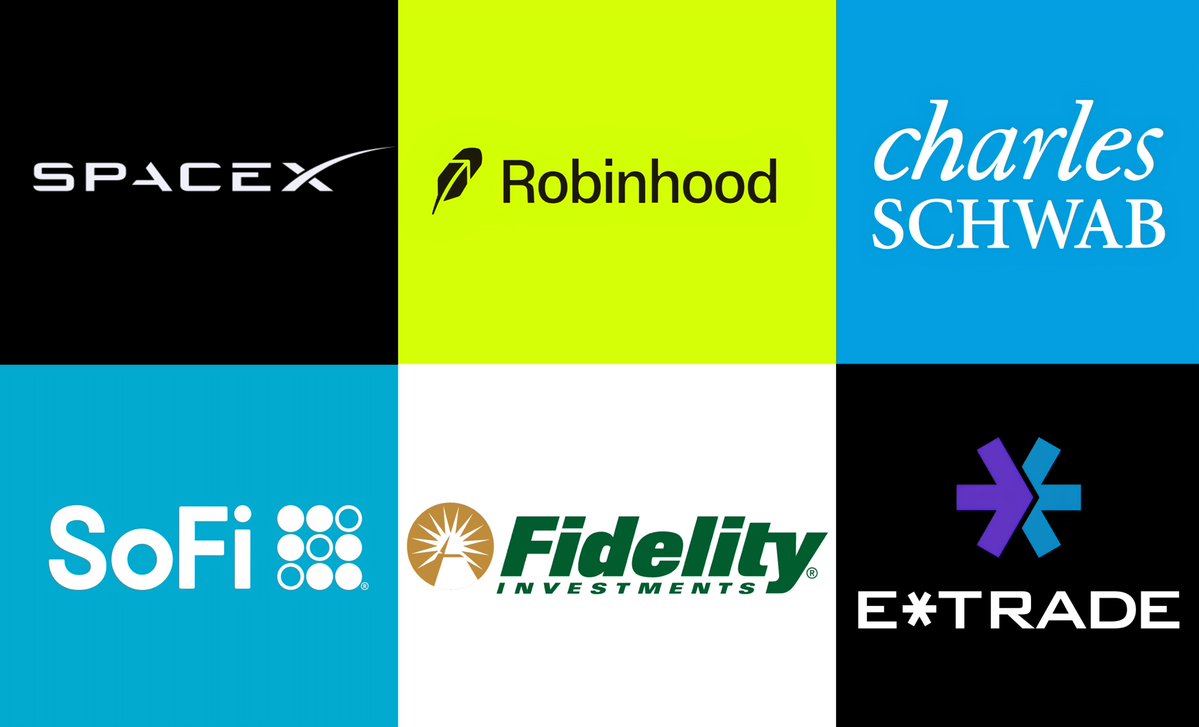
SpaceX shares will be offered to retail investors through the brokerages of Charles Schwab, Fidelity, Robinhood, SoFi and E*Trade.
"Any purchase of our Class A common stock in this offering through these platforms will be at the same IPO price, and at the same time, as any other purchases in this offering, including purchases by institutions and other large investors." - SpaceX
Bill Ackman just explained the two trades that made him $5.2 billion in three years.
Both started the same way. He saw a storm coming that everyone else was ignoring.
Trade one: COVID, January 2020.
Ackman read the early data and concluded the world might have to shut down its entire economy to stop the spread. Equity and credit markets were priced as if everything was fine.
Over 10 days, he bought $74 billion of notional credit insurance. The premium cost him $27 million. Ten days later it was worth $2.6 billion. He took every dollar of that and bought stocks with the market down 30%.
Trade two: inflation, late 2020.
He saw the setup clearly. Trillions in government spending. Rates at zero. A vaccine coming that would unleash pent-up demand. Supply chains already disrupted. He concluded a massive demand shock was coming into a constrained supply environment and that inflation was inevitable.
He bought interest rate options when the 2-year treasury was at 12 basis points. The strike was at 94 basis points, 0.94%, which at the time looked impossibly out of the money. It still looked like a low rate.
Those options turned into another $2.6 billion in profit. He bought stocks again.
His framework hasn't changed across either trade.
Two storms. $27 million in. $5.2 billion out. Stocks bought both times at the bottom.
$NVDA up about 2% in pre-market following Jensen’s hour-and-a-half CES keynote late last night.
Key updates:
1. Scaling Laws and Demand for Compute
Jensen emphasized that scaling laws are “empirical” and will persist because the challenges of model pre-training, post-training, and test-time compute can only be addressed with more compute.
Why it matters: This is significant because if scaling is drive “enormous demand” for Blackwell today, and if this scaling laws hold in the coming years, demand for NVDA chips will remain strong then most believe over the next couple of years.
2. Agentic AI and the Workforce
Jensen sounded like Marc Benioff, predicting that Agentic AI will transform the workforce, with agents working alongside humans. HR departments of the future will be part IT departments.
Why it matters: Agents require substantial computational resources, chugging tokens at high volumes. Asking an agent a single question activates multiple models, pushing computational demands “through the roof” and increasing demand for NVDA hardware.
3. Physical AI is part of the long-term growth story
Physical AI refers to AI systems that can understand physics and gravity, which will advance "robotics and industrial AI just as Llama 3 has advanced enterprise applications". Jensen announced a new platform, “Cosmos,” designed to build physical AI systems. He predicted the first multi-trillion-dollar use case is autonomous cars, followed by robots.
Why it matters: This is a part of the companies 10-year growth story. While physical AI is still a few years away, it holds long-term potential. Currently, their automotive business is less than 3% of sales, with a $5B annual run rate—up about 25% from last year. Within three years, I expect physical AI should begin ramping, and in 10 years, I expect it will become a significant revenue driver.
4. Windows-Based Nvidia-Powered PCs and Project DIGITS
Jensen said Windows-based PCs powered by Nvidia will be coming this year along with and a new desktop supercomputer, Project DIGITS.
Why it matters: Nvidia wants to win in both the datacenter and desktop markets.
Other observations:
1. No Update on Blackwell Backlog:
There was no update on the key topic investors were anticipating—the size of Blackwell’s backlog. During the last earnings call, the company stated, “Blackwell demand is expected to exceed supply for several quarters in fiscal 2026.”
2. Jensen’s Confidence:
Granted he's always bullish, so take this observation for what its worth: Reading between the lines, if half of what Jensen said comes true, the substance of the AI will exceed the hype. Last night Jensen was giddy . His bullish remarks on Blackwell demand and his Vegas-inspired leather jacket suggest optimism about the January quarter and its outlook.
3. Perplexity Reinventing Search?
Jensen mentioned that Perplexity is reinventing search. While they're an Nvidia customer (so take the claim with a grain of salt), the comment was noteworthy.
4. No Mention of Optimus:
In the humanoid robot section of the keynote, 14 robots were highlighted, but Optimus was notably absent. Maybe Musk is pursuing an independent path to power Optimus.
In 2020, Bill Ackman pulled off one of the greatest trades in history.
He bet against the credit market.
The result? He turned $27 million into $2.7 billion in just 30 days.
Here is how he did it: 🧵
Elon has shown us this week what the future looks like. Robovan and robotaxis, humanoid robotics, green parks instead of parking lots, tunnels, rockets that are fully reusable and chopstick shenanigans. All of it sci-fi, but greater, and here, and incredible.
$NVDA Conference Call Summary: We had another record quarter. Customers are accelerating their purchases of Hopper and gearing up to adopt Blackwell. Next-generation models will require 10 to 20 times more compute to train with significantly more data. The trend is expected to continue. Blackwell production ramp is scheduled to begin in Q4 and continue into fiscal 2026, and we expect to ship several billion dollars of Blackwell revenue in the fourth quarter. Hopper shipments are also expected to increase in the second half of the fiscal year as supply improves. Blackwell revenue will be additive to Hopper revenue, at least until Blackwell supply meets demand, which isn’t going to happen this year. With this, though, we will see weaker margins in the fourth quarter.
CPU scaling has been slowing for some time and has slowed to a crawl, but demand for computing doubles every year. Without the transition to accelerated computing, computing inflation would drive up costs for every company. Therefore, despite our outrageously high prices, we’re still cheaper than the alternative. At the same time, the ability to compute more has created the AI revolution. These two transitions are occurring at the same time, which is very important to keep in mind, and so we expect demand to continue. In fact, we are seeing momentum of generative AI accelerating. Because of this, the next trillion dollars in the world’s infrastructure will clearly be different than the last trillion. That will include liquid cooling because you can deploy three to five times the throughput.
https://t.co/cgtUK2UNCc
Jensen Huang of Nvidia, $NVDA: "Greatness does not come from intelligence. Greatness comes from character, and character isn't isn't formed out of smart people: it's formed out of people who have suffered."