These are 3 well-known brands that are also listed as case studies of AI content scaling tools
They scaled a lot of page templates that can manipulate AI answers, like excessive "best X" content, self-promotional listicles, scaled comparison/alternative pages, etc. There's also some spammy structured data in the mix.
Each was hit hard by the Jan 20 update this year, and the crash has continued ever since. This last core update only accelerated the declines.
These are views of the US organic Google visibility across their entire domains (via @sistrix); even though the AI content generation appears to have been isolated to one subfolder on the site (from what I can tell), the impact is happening across the full domain
Now all companies are at the lowest visibility they've seen in 5+ years
Google is not playing around.
New AI reporting features finally coming to GSC.
Reporting on impressions and not clicks says a whole lot here 🫠
But yes, grateful to have any AI reporting at this point 🙏🏽
https://t.co/7MWjkYuNEh
Massive SEO News: Google is launching the most requested report in Google Search Console ever. A new AI performance report!
Here's what we know so far:
• It will include dedicated reports for both Search and Discover
• The data will be reflected within Search for AI Overviews and AI Mode, alongside AI features in Discover
• The report will only be focused on impressions within generative AI features, not clicks
• The rollout will start with a subset of websites, allowing thorough testing (so keep an eye out!)
There are some major limitations to this initial testing phase, where the actual queries that users are searching won't show in the report, with only impressions for pages, countries, devices, and dates.
Though the dataset will be limited, this is certainly a step in the right direction!
I will be covering this rollout within my newsletter, so make sure to subscribe if you aren't already: https://t.co/J6GbI1tB27
No es una novedad, pero el analista de Google Gary Illyes lo remarca de nuevo:
Si tu web tiene el contenido en HTML y no en JavaScript, los LLM pueden gestionarlo mucho mejor para su entrenamiento, así como para sus búsquedas en tiempo real y las de sus agentes.
Como digo, nada nuevo en SEO: Cuanto menos JavaScript mejor. Y el que haya, siempre en SSR.
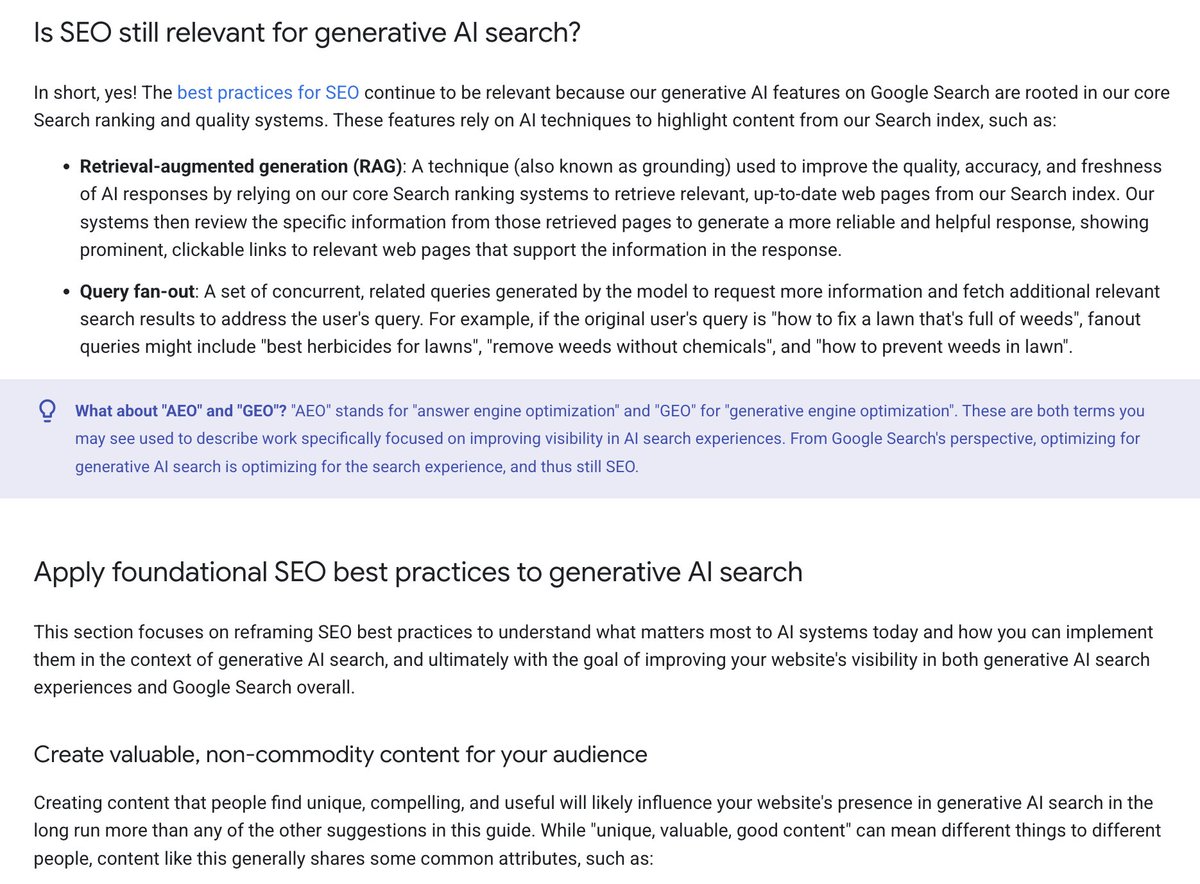
🚨 Google has published its official guidance on optimizing for generative AI experiences in Search, including AI Overviews and AI Mode 👇 Going through:
1. How SEO is still relevant for generative AI search:
The best practices for SEO continue to be relevant because their generative AI features on Google Search are rooted in our core Search ranking and quality systems.
2. How to Apply foundational SEO best practices to generative AI search:
** Creating valuable, non-commodity content for your audience: Providing a unique point of view, Creating non-commodity content that's helpful, reliable, and people-first, Organizing content in a way that helps your readers, adding high-quality images and video, focusing on what your users want, and avoid overdoing it.
** If you're using generative AI tools to assist in content creation, be sure that your work meets the standards of the Search Essentials and our spam policies.
** Building and maintain a clear technical structure: meeting the Search technical requirements, following crawling best practices, focusing on human readability and don't worry about perfect HTML code, if you're using JavaScript, be sure to follow JavaScript SEO best practices, providing a good page experience, reducing duplicate content.
3. Mythbusting generative AI search: what you don't need to do
Things you can ignore for Google Search:
** LLMS.txt files and other "special" markup
** "Chunking" content:
** Rewriting content just for AI systems
** Seeking inauthentic "mentions"
** Overfocusing on structured data
4. Explore agentic experiences
AI agents are autonomous systems that can perform tasks on behalf of people, such as booking a reservation or comparing product specifications, they can take many forms; for example, browser agents may access your website to gather the data they need to complete these tasks, such as analyzing visual renderings (like screenshots), inspecting the DOM structure, and interpreting the accessibility tree.
Check out the available agentic experiences and review the guide to agent-friendly website best practices recently published here: web(.)dev/articles/ai-agent-site-ux
Read the full Google guide here: developers(.)google(.)com/search/docs/fundamentals/ai-optimization-guide
PS: This is by far the most in-depth, actionable guide that Google has published so far for AI search, tackling some of the major misunderstandings and myths SEOs face in the day to day... thank you @googlesearchc team 🙌
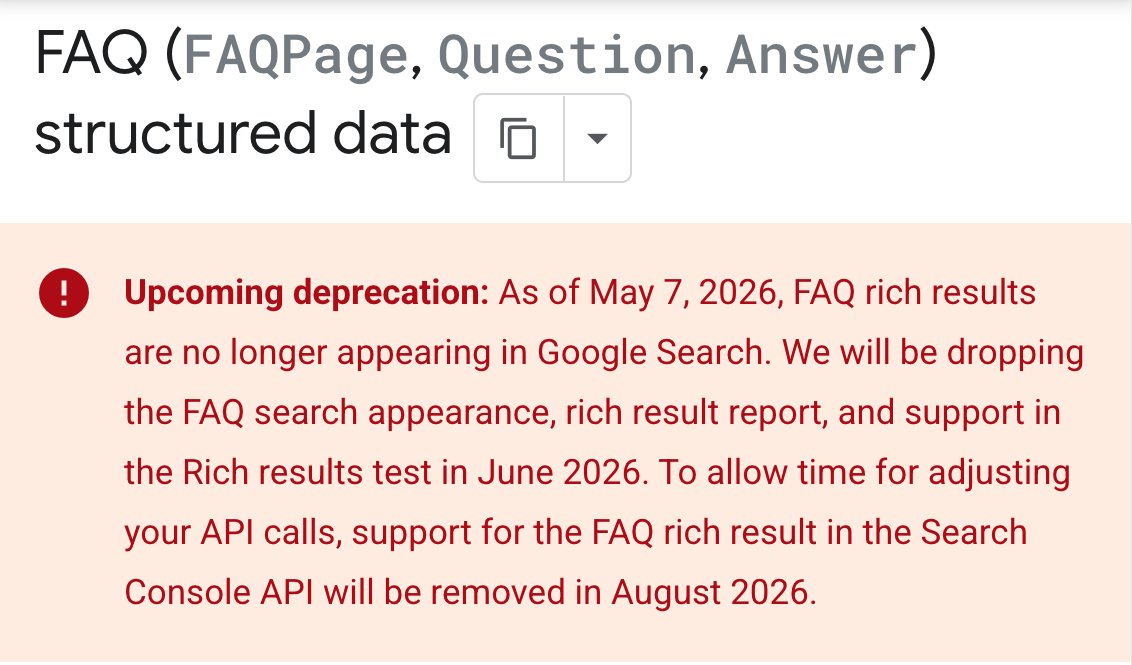
You may have heard by now that Google is dropping support for all FAQ rich results
So, should you remove all FAQs from your content?
No. No. And probably not.
Google previously stopped showing FAQs for the vast majority of publishers in August 2023, except for a handful of high-authority government and health sites. This means most of us weren't seeing the search results benefits from FAQs for ages now.
That said, there's plenty of evidence that *answering relevant questions with helpful content* CAN help your SEO visibility:
- A recent experiment by @SearchPilot showed a 9.7% increase in organic traffic after adding page-specific FAQs
- A study last year via @AlsoAsked found a strong, positive correlation between Google ranking and pages that fully answer "People Also Ask" questions. Note: this isn't exactly the same thing as FAQ, but the concept is similar
- Related but relevant: An earlier 2024 study from SearchPilot removed FAQ Schema—but kept the content—and found no negative impact on ranking
In the past, we favored the FAQ rich results to drive extra traffic. But if the content is good and solves user problems, that can be a benefit too.
My 2¢: Remove the FAQ Schema if you want. SEO plugin vendors should remove it as an option.
But by all means, LEAVE THE CONTENT IF IT'S HELPFUL. In fact, consider answering additional questions if you don't already.
Happy FAQ'ing
Quick update on the GSC impressions drop Google mentioned a few weeks ago. @suzukik asked Google about the impact to *other* metrics at the Search Central Live event in Toronto and they did explain that CTR was affected as well. That makes total sense since how could it not be impacted if impressions were impacted?? See updated screenshot below.
From Kenichi on Linkedin:
"Google updated the report on the data logging error that began about a year ago. Previously, they said it only affected impressions. However, it actually affected CTR as well. I asked Daniel Waisberg about this at Search Central Live Canada. I think he suggested the update." https://t.co/sXIgIbHaKb
Over the years, I’ve used various tools, Chrome extensions, and (obviously) the browser itself to diagnose JavaScript-related SEO issues. But now with AI search, I’ve found myself needing a quick and easy way to check if a page’s JS setup is “LLM-friendly” - so I built a tool myself.
My “LLM Content Visibility Scanner” shows you what (non-Google) AI crawlers like GPTBot (ChatGPT), ClaudeBot and PerplexityBot actually see when they look at your page, without executing JavaScript (the way most LLM bots fetch content.)
Just paste a URL and it quickly audits the raw HTML for client-side rendering issues, missing structured data, paywalls, alt text gaps, and crawlability problems.
It then hands you a prioritized mini-action plan with specific URLs to address, plus some other metadata information.
Note: there are some known limitations listed at the bottom, so the tool isn’t always 100% perfect. And it’s certainly not meant to serve as a replacement for a proper technical SEO audit. But it’s a good starting point and a quick tool to use for this purpose when you’re on the go.
Let me know what you think and feel free to DM me any feedback/bugs you might encounter!
https://t.co/Qv6z4ohdCS
🔴 HOY ES EL DÍA.
Esta tarde arranca el Curso Intensivo de GEO con Luis Villanueva y MJ Cachón.
Gratis. En directo. A las 18:00h.
Si aún no sabes qué es el GEO… esto es exactamente lo que necesitas. 👇
https://t.co/jT4tKo1f1M
🚨BREAKING: Google just dropped another hit!
It's called Always-On Memory Agent and it gives your AI a memory that never turns off.
It perfectly pairs with Gemini 3.1 Flash-Lite. That means it runs all day and all night without costing you much money at all.
No complicated setup. No special databases. No forgetting.
Here's how it works:
3 helpers run in the background
→ One reads your files — notes, pictures, audio, videos
→ One connects your ideas every 30 minutes while you sleep
→ One answers your questions using everything it learned
Here's the coolest part:
Most AI tools forget everything after you close them. This one keeps learning and connecting dots just like your brain does at night while you dream.
Drop a file in a folder → the AI reads it in 5 seconds.
100% Open Source.
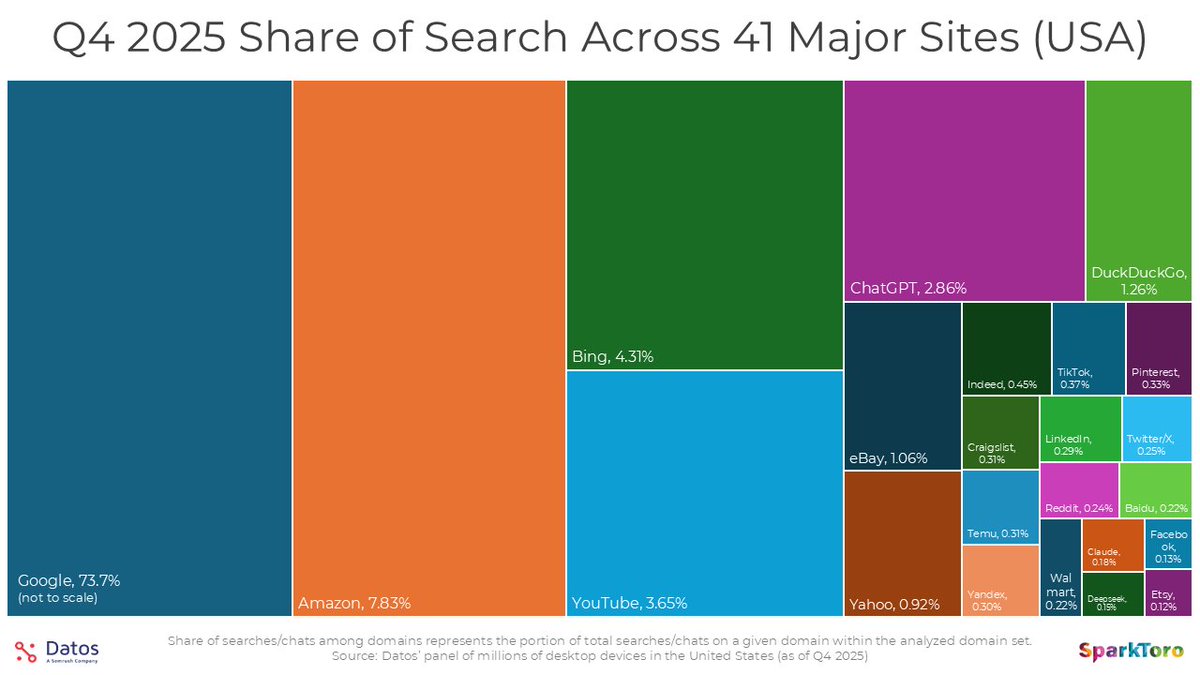
🚨 Google is responsible for nearly 3/4ths of all desktop web searches; ChatGPT is smaller than you might think - A new study from @randfish showing how:
* Google’s 2025 US market share is closer to ~70% than 90% when platforms beyond traditional search engines are included.
* Most AI Search and AI Answers happen on Google: Even if you combine every prompt on ChatGPT, Claude, Deepseek, and the rest and assume every prompt is a search-equivalent, Google dwarfs them.
* Amazon, Bing, and YouTube still receive more desktop search activity than ChatGPT, despite the latter’s buzz. If you’re worried about AIO/SEO-for-AI/GIEIO, you should be worried about search visibility in those places, too (if their audiences are relevant to your business).
Much more! Check it out: https://t.co/XFvRInB4sA
🔴Hoy publicamos el primer estudio que analiza el impacto de AI Overviews en los medios de España.
El estudio realizado con @mjcachon, en el marco de un proyecto de la @UniBarcelona, se publicará como paper académico próximamente y analiza la presencia de las respuestas de IA en el buscador. Hoy lo hemos presentado en la @aprensamadrid.
Principales conclusiones:
📌Google muestra AI Overviews en casi 3 de cada 10 búsquedas analizadas.
📰AI Overviews vs. Top Stories: Exclusión mutua. AIO aparece en el 34,6% de búsquedas atemporales mientras que solo un 1,1% de las ocasiones para las noticias de última hora.
➡️La extensión de la palabra clave y el tipo, determinante en la activación de AIO.
💚El 75,2% de las keywords analizadas que activan AIO son de tipo evergreen.
❓Mayor presencia de AI Overviews en las keywords con términos interrogativos relativos a las 6W del periodismo.
🔎La IA generativa no impacta por igual a todas las secciones de un diario.
📢El tráfico de un medio no significa ser más citado por la IA.
Puedes leer aquí todas las conclusiones y descargar el informe👉https://t.co/VDQC3qNLYf
3.1 Pro -> Google rolls out Gemini 3.1 Pro, which it says is "a step forward in core reasoning", for all users in the Gemini app; the .1 increment is a first for Google
"3.1 Pro is designed for tasks where a simple answer isn’t enough, taking advanced reasoning and making it useful for your hardest challenges. This improved intelligence can help in practical applications — whether you’re looking for a clear, visual explanation of a complex topic, a way to synthesize data into a single view, or bringing a creative project to life." https://t.co/arSXDZF9s1