I don't cut them off, I just fly far away from because I need to protect my iner peace, my positive energy, my peaceful life. sometimes they call me just to have an argument for unnecessary problem, I am so exhausted so I turn off the call and blocked them right away.
Have you ever been around people whose presence alone just makes you feel mentally exhausted? Like… every word coming out of their mouth, the gaslighting, the victim mentality, their vibe in general are literally soul-sucking energy. (Problem is… sometimes…they’re family)
Learned it the hard way: SETTING BOUNDARIES is not selfish. It’s NECESSARY.
#notetoself
Ga terpikir di otak baila nyebut sumbawa. My sweet home. Hidup berdekatan dng laut, daratan yg luas dan dekat sama pulau santoda, teluk saleh, pulau moyo. Pulau kenawa, pulau kambing. Belu.lagi keindahan samudra hindia dan pantai selatan.
@BadBunny_03@memekcita@erinluckyone East Indonesian are latino, I am frome East Indonesian and my pinoy talk tagalog to me. They said my face so similar to one of her cousin. She said me and her cousin are like twins.
tahan, baru sampe kosan, besok aku posting tentang gimana ambisi korea selatan untuk energi hijau.
tapi di sisi lain, mereka merusak banyak negara, termasuk indonesia.
besok seluruh nama bank yang mendanai dan nama perusahaannya aku kumpulkan.
@sanida1129 @jaya_mekar18180 Which region in china, only macau and hk are allowed, kpop not allowed in mainland China. Every week in have fans meet. I know it cus i meet some other artists while trolling around venetian last sunday.
Di hongkong ada korupsi juga dan walaupun under china. Nyatanya di wok fu ini pasti ada korupsi pas renovasi building. Hk$330M, itu udah berpa ratus or triliun yg abis.
【Tai Po Fire, Bid-Rigging, and Bamboo Scaffolding in NSL-Era Hong Kong】
The Tai Po fire was not just a tragic accident; it was the predictable outcome of a broken system. A system where estate management, renovation contracts, and public safety have long been undermined by collusion, bid-rigging, and zero accountability. And since the NSL, Hong Kong has no civil society or independent media strong enough to hold these networks to account. Even when residents and expert and activists like Jason Poon, took their own samples of the netting and tried to expose the risks, they were ignored.
Wang Fuk Court was in the middle of a HK$330M “mega-repair.” Residents had protested the sky-high cost, accusing the owners’ corporation of force-pushing the plan through despite objections. Transparency was minimal. Oversight was weak. This is exactly how bid-rigging works in HK housing estates: pre-selected contractors, inflated prices, limited competition, opaque decisions, and incentives to cut corners on materials and safety, because no one is genuinely checking, nor can the civil society did what it used to do-- to hold different people to account and raise awareness of these issues.
During the renovation, the contractor wrapped the buildings with mesh, and foam boards that allegedly failed to meet fire-resistant standards. Some residents took a sample of the netting material to test on their own; videos showed it burned and dripped-- hardly in compliance with the regulations [1]. Here, cheaper, flammable materials meant higher profit margins and higher risk. The Wang Fuk Court contractor ignored safety again and again, with a long trail of corruption and violations. In 9 years, they racked up at least 17 regulatory breaches and fines.
When the fire started, the netting as shown in many videos, burned quickly. A slow fire became an inferno in minutes.
Police arrested multiple directors and engineers from the construction company. ICAC launched an investigation into the renovation contract itself — including how a controversial HK$330M plan was approved and whether corruption was involved.
This is the cost of collusion: Bid-rigging doesn’t just overcharge residents. It kills oversight, kills competition, and, in this case, helped create conditions that killed people. Hong Kong’s building maintenance system has tolerated collusion and corruption for years. The Tai Po fire is the clearest possible warning: corruption in estate management is not just a financial issue. It tells us a lot about HK-China relationship.
Beijing could and had rewritten Hong Kong’s political system overnight and crushed organised dissent, but it has never been able to cleanly uproot the entrenched construction and maintenance networks that profit from this model of “business as usual.” And this is where the politics of bamboo scaffolding enters the picture.
There is a long-understood agenda from Beijing to undermine Hong Kong’s bamboo scaffolding industry, not because it is unsafe, but precisely because it is a local craft, part of the Hong Kong identity, practised safely for decades, and one of the last corners of construction work where Chinese state-owned developers and their preferred contractors have never managed to gain a foothold. Bamboo scaffolding is not standard in the PRC; metal scaffolding is. And right now, mainland China faces a record glut of metal scaffolding materials, made worse by recent scandals over fake steel being used in their production , scandals that have no counterpart in Hong Kong’s bamboo trade.
So when the Hong Kong Government suddenly pushes a mandatory shift to metal scaffolding “for safety,” it is hard to ignore the timing. Yahoo Finance reports that Hong Kong experts defending the safety of bamboo scaffolding are being aggressively dismissed by PRC netizens, while the Government doubles down on the same narrative. In other words, this is not really about fire safety. It is a political and economic project to replace a resilient local craft with PRC-standard practices, conveniently absorbing a mainland oversupply while sidelining an industry Beijing has never been able to capture.
Thus, the tragedy is being used to accelerate “integration,” dressed up as technical modernisation. On paper, it’s about protecting the public; in practice, it sidesteps politically connected local players without ever reckoning with the actual causes of the fire: opaque estate governance, weak enforcement, collusion, and the hollowing out of watchdogs under the NSL.
We, Hongkongers, outside or inside the city do not trust the government or any of its proxies. Five years of national security crackdowns, media censorship, and relentless state messaging have not repaired the rupture exposed in 2019. That distrust is alive, deep, and justified.
HKSAR Gov and co are clearly not acting in good faith. Now, as you are reading, volunteers who organised themselves to help were reported to the police for unlawful assembly, a move that looks less like public order and more like spite. It is yet another sign that the Government now treats ordinary civic-minded Hongkongers as adversaries. And I fear reporting them is not the end of it, as Hongkongers came up with 4 very reasonable demands asking for investigation and accountability.
For us, the fact that John Lee decided to thank Xi Jinping first, rather than giving the credit to the brave firefighters, showed us that they are replicating the Mainland disaster-stagecraft: PR-first, people-last; party-state-first, people-last.
Taken together, the political economy of scaffolding, the erasure of civil oversight, and the Government’s behaviour during the crisis reinforce the same truth: the problem is not bamboo. The problem is a system where power, profit, and propaganda take precedence over safety, accountability, and the lives of Hong Kong people.
[1] https://t.co/1kEPkMcyEj
During 2019, we were not allow to talk about what was happening in Hong Kong because it will put us in risk of losing our job. I kept my mouth shut and brought a heavy heart to work. My Indian senior hold my hand and told me: “I am not born here but I consider Hong Kong my home. I build my family here. We don’t look the same but I have you guys back.”
She proceeded to tell me she learned to cook Chinese cuisine so she can bring food for the kids in university.
A lot of unspoken words in our conversation but we understand each other. Different nationality. Different colours but we share the same love for this tiny little city.
喺呢片小土地上我地都係面冷心善既香港人呀
https://t.co/Pd6wctdtjn
🔥🇭🇰 The Truth About the Hong Kong Fire: What Really Happened 🇨🇳🔥
A lot of people are spreading wild claims, so here’s the full picture based on Chinese media reporting and the actual investigation.
Let’s deal with the biggest lies first: “China didn’t report the materials or the mesh.” or "media blackout."
Wrong! Mainland and Hong Kong Chinese media reported more technical detail than the Western press ever did.
Here’s what we know:
1️⃣ The facade mesh WAS identified.
It was a 密目式安全立网 (dense safety net).
Inspection documents posted in the estate show it came from a Shandong rope-net manufacturer, tested by the Binzhou Inspection & Testing Centre.
HK01 even tried to verify those test numbers online, the files didn’t show up, which is now part of the investigation.
2️⃣ The real problem wasn’t the manufacturer, it was the contractor.
Only Hong Kong contractors, subcontractors and engineering consultants have been arrested.
Why?
Because they chose the materials.
They installed flammable foam boards over the windows.
They wrapped the building in plastic tarps.
They certified the mesh as “fireproof.”
This was negligence on the Hong Kong side, not a manufacturing cover-up.
3️⃣ Beijing’s response was immediate and nationwide.
The State Council ordered a country-wide fire-safety inspection of high-rise buildings.
It also prohibited bamboo/wood scaffolding and non-flame-retardant mesh in high-rise facade work.
Mainland China phased out bamboo scaffolding years ago, Hong Kong didn’t.
👉 And here’s why:
Under One Country, Two Systems, Hong Kong sets its own building codes.
It kept bamboo scaffolding because it treats it as a traditional craft and cultural heritage.
Beijing doesn’t micro-manage Hong Kong’s construction standards, so HK’s outdated methods stayed in place.
💬 Bottom line:
The mesh and materials WERE reported.
The investigation is transparent.
The arrests hit the right people, the ones who selected, certified and installed unsafe materials.
And the tragedy came from local negligence and old practices, not some mysterious mainland conspiracy.
Facts matter.
And the facts aren’t on the side of the anti-China narrative.
🔥🇭🇰 The Truth About the Hong Kong Fire: What Really Happened 🇨🇳🔥
A lot of people are spreading wild claims, so here’s the full picture based on Chinese media reporting and the actual investigation.
Let’s deal with the biggest lies first: “China didn’t report the materials or the mesh.” or "media blackout."
Wrong! Mainland and Hong Kong Chinese media reported more technical detail than the Western press ever did.
Here’s what we know:
1️⃣ The facade mesh WAS identified.
It was a 密目式安全立网 (dense safety net).
Inspection documents posted in the estate show it came from a Shandong rope-net manufacturer, tested by the Binzhou Inspection & Testing Centre.
HK01 even tried to verify those test numbers online, the files didn’t show up, which is now part of the investigation.
2️⃣ The real problem wasn’t the manufacturer, it was the contractor.
Only Hong Kong contractors, subcontractors and engineering consultants have been arrested.
Why?
Because they chose the materials.
They installed flammable foam boards over the windows.
They wrapped the building in plastic tarps.
They certified the mesh as “fireproof.”
This was negligence on the Hong Kong side, not a manufacturing cover-up.
3️⃣ Beijing’s response was immediate and nationwide.
The State Council ordered a country-wide fire-safety inspection of high-rise buildings.
It also prohibited bamboo/wood scaffolding and non-flame-retardant mesh in high-rise facade work.
Mainland China phased out bamboo scaffolding years ago, Hong Kong didn’t.
👉 And here’s why:
Under One Country, Two Systems, Hong Kong sets its own building codes.
It kept bamboo scaffolding because it treats it as a traditional craft and cultural heritage.
Beijing doesn’t micro-manage Hong Kong’s construction standards, so HK’s outdated methods stayed in place.
💬 Bottom line:
The mesh and materials WERE reported.
The investigation is transparent.
The arrests hit the right people, the ones who selected, certified and installed unsafe materials.
And the tragedy came from local negligence and old practices, not some mysterious mainland conspiracy.
Facts matter.
And the facts aren’t on the side of the anti-China narrative.
A dog has been reunited with its owners, who had been anxiously waiting outside Wang Fuk Court in Tai Po after it went missing for two days during the massive fire that broke out on Wednesday.
The Hong Kong Society for the Prevention of Cruelty to Animals (SPCA) said that, as of Friday morning, 92 pets had been rescued from the fire. The figure includes both surviving animals and deceased ones.
A total of 243 animals were affected in the blaze, according to the SPCA's tally.
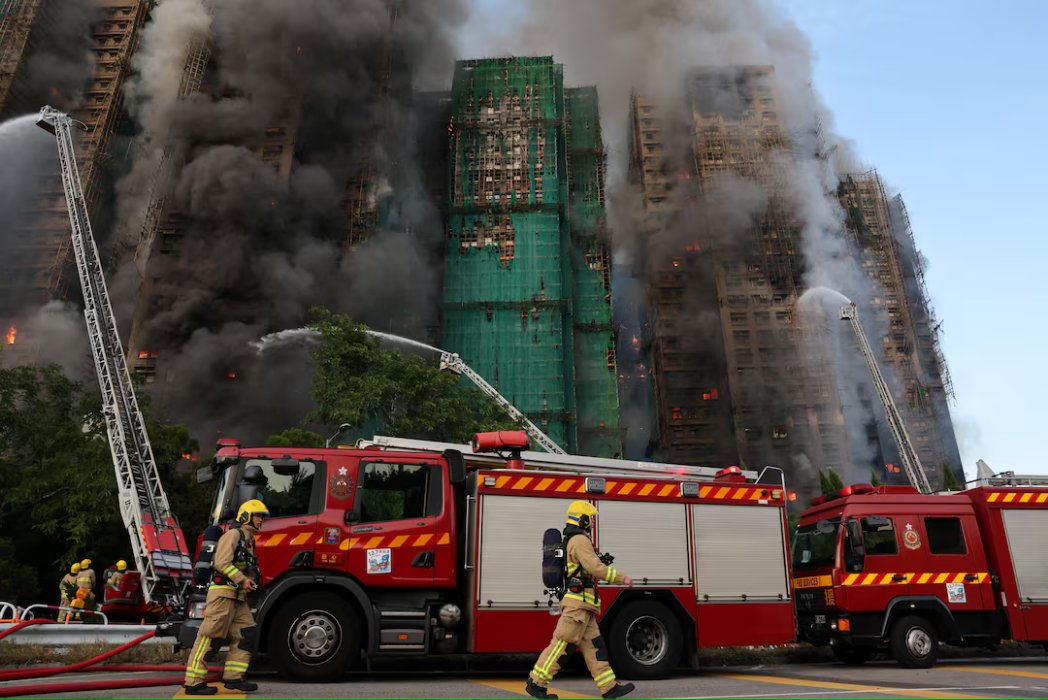
The fire - Hong Kong's deadliest in decades - has killed at least 94 people, including a firefighter and two Indonesian domestic workers. A rescue operation is still underway.
Photo: Kyle Lam/HKFP.
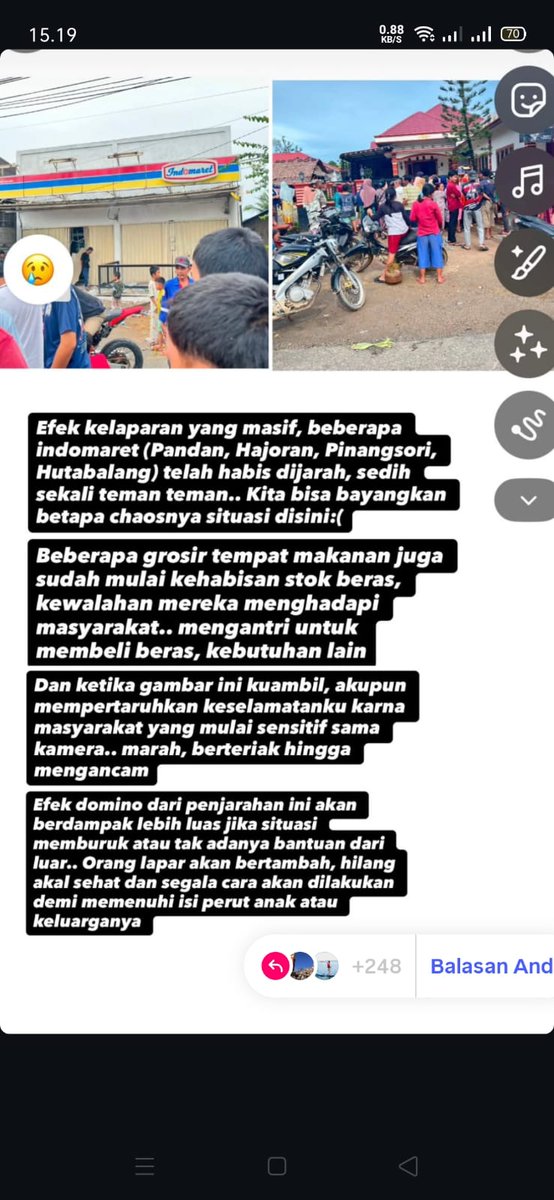
Tapteng (Sibolga, Pandan, dsk) darurat! Sudah seminggu banjir dan longsor, kini kondisi makin parah. Masyarakat sudah kelaparan, stok beras habis, bahkan Alfamidi diserbu! Pemerintah pusat dan daerah, tolong cepat tanggap! Terapkan Darurat Nasional SEGERA! Warga butuh bantuan sekarang! 😭 #PrayForSibolga #DaruratTapteng
The arrest of the student who launched a petition over the deadly Tai Po fire shows how little free speech #HongKong really has. The CCP tolerates mourning, but anyone who dares to seek accountability or hold criticism is treated as a "national security" threat and crushed.
Translation:
Hong Kongers are truly a fascinating group.
On the surface, we often appear a bit harsh, a bit indifferent, sometimes even seem a bit aggressive.
But if you take a closer look, you'll discover—in those tiny cracks, we actually harbor a great deal of warmth.
On a street corner, someone might quietly point out your untied shoelaces; on the subway, someone might indicate your backpack isn't properly fastened; when you think you're crying alone on the street, a hand will silently slip you a pack of tissues.
Then the stranger, still expressionless, without uttering a single extra word, turns and walks away.
Yesterday, a devastating fire broke out in my area.
Thick smoke blanketed the sky, and news kept pouring in—people were missing, some would never return home.
As night fell, the weather grew even colder. I rummaged through my belongings and found a few blankets, thinking they might at least provide some warmth to those in the affected area.
Before leaving, it suddenly occurred to me: perhaps someone in my area also wanted to send supplies, but didn't have a vehicle. So I sent a message in the local group chat, simply asking, "Does anyone need help delivering supplies?"
Within twenty minutes, my car was packed.
Those who handed me the supplies all maintained that familiar, understated expression, as if afraid of being seen as gentle.
But they still said very softly, "Thank you for your hard work, be careful on the road."
At that moment, my tears almost silently fell.
_________________
Keep all the affected families on your mind. Aside from the horrible scene, please also remember the warmth radiating from people in this concrete forest. Remember how resilient all of us are. How strong this community is.







![chungchingkwong's tweet photo. 【Tai Po Fire, Bid-Rigging, and Bamboo Scaffolding in NSL-Era Hong Kong】
The Tai Po fire was not just a tragic accident; it was the predictable outcome of a broken system. A system where estate management, renovation contracts, and public safety have long been undermined by collusion, bid-rigging, and zero accountability. And since the NSL, Hong Kong has no civil society or independent media strong enough to hold these networks to account. Even when residents and expert and activists like Jason Poon, took their own samples of the netting and tried to expose the risks, they were ignored.
Wang Fuk Court was in the middle of a HK$330M “mega-repair.” Residents had protested the sky-high cost, accusing the owners’ corporation of force-pushing the plan through despite objections. Transparency was minimal. Oversight was weak. This is exactly how bid-rigging works in HK housing estates: pre-selected contractors, inflated prices, limited competition, opaque decisions, and incentives to cut corners on materials and safety, because no one is genuinely checking, nor can the civil society did what it used to do-- to hold different people to account and raise awareness of these issues.
During the renovation, the contractor wrapped the buildings with mesh, and foam boards that allegedly failed to meet fire-resistant standards. Some residents took a sample of the netting material to test on their own; videos showed it burned and dripped-- hardly in compliance with the regulations [1]. Here, cheaper, flammable materials meant higher profit margins and higher risk. The Wang Fuk Court contractor ignored safety again and again, with a long trail of corruption and violations. In 9 years, they racked up at least 17 regulatory breaches and fines.
When the fire started, the netting as shown in many videos, burned quickly. A slow fire became an inferno in minutes.
Police arrested multiple directors and engineers from the construction company. ICAC launched an investigation into the renovation contract itself — including how a controversial HK$330M plan was approved and whether corruption was involved.
This is the cost of collusion: Bid-rigging doesn’t just overcharge residents. It kills oversight, kills competition, and, in this case, helped create conditions that killed people. Hong Kong’s building maintenance system has tolerated collusion and corruption for years. The Tai Po fire is the clearest possible warning: corruption in estate management is not just a financial issue. It tells us a lot about HK-China relationship.
Beijing could and had rewritten Hong Kong’s political system overnight and crushed organised dissent, but it has never been able to cleanly uproot the entrenched construction and maintenance networks that profit from this model of “business as usual.” And this is where the politics of bamboo scaffolding enters the picture.
There is a long-understood agenda from Beijing to undermine Hong Kong’s bamboo scaffolding industry, not because it is unsafe, but precisely because it is a local craft, part of the Hong Kong identity, practised safely for decades, and one of the last corners of construction work where Chinese state-owned developers and their preferred contractors have never managed to gain a foothold. Bamboo scaffolding is not standard in the PRC; metal scaffolding is. And right now, mainland China faces a record glut of metal scaffolding materials, made worse by recent scandals over fake steel being used in their production , scandals that have no counterpart in Hong Kong’s bamboo trade.
So when the Hong Kong Government suddenly pushes a mandatory shift to metal scaffolding “for safety,” it is hard to ignore the timing. Yahoo Finance reports that Hong Kong experts defending the safety of bamboo scaffolding are being aggressively dismissed by PRC netizens, while the Government doubles down on the same narrative. In other words, this is not really about fire safety. It is a political and economic project to replace a resilient local craft with PRC-standard practices, conveniently absorbing a mainland oversupply while sidelining an industry Beijing has never been able to capture.
Thus, the tragedy is being used to accelerate “integration,” dressed up as technical modernisation. On paper, it’s about protecting the public; in practice, it sidesteps politically connected local players without ever reckoning with the actual causes of the fire: opaque estate governance, weak enforcement, collusion, and the hollowing out of watchdogs under the NSL.
We, Hongkongers, outside or inside the city do not trust the government or any of its proxies. Five years of national security crackdowns, media censorship, and relentless state messaging have not repaired the rupture exposed in 2019. That distrust is alive, deep, and justified.
HKSAR Gov and co are clearly not acting in good faith. Now, as you are reading, volunteers who organised themselves to help were reported to the police for unlawful assembly, a move that looks less like public order and more like spite. It is yet another sign that the Government now treats ordinary civic-minded Hongkongers as adversaries. And I fear reporting them is not the end of it, as Hongkongers came up with 4 very reasonable demands asking for investigation and accountability.
For us, the fact that John Lee decided to thank Xi Jinping first, rather than giving the credit to the brave firefighters, showed us that they are replicating the Mainland disaster-stagecraft: PR-first, people-last; party-state-first, people-last.
Taken together, the political economy of scaffolding, the erasure of civil oversight, and the Government’s behaviour during the crisis reinforce the same truth: the problem is not bamboo. The problem is a system where power, profit, and propaganda take precedence over safety, accountability, and the lives of Hong Kong people.
[1] https://t.co/1kEPkMcyEj](https://pbs.twimg.com/media/G63Y-cTXcAA0yUp.png)