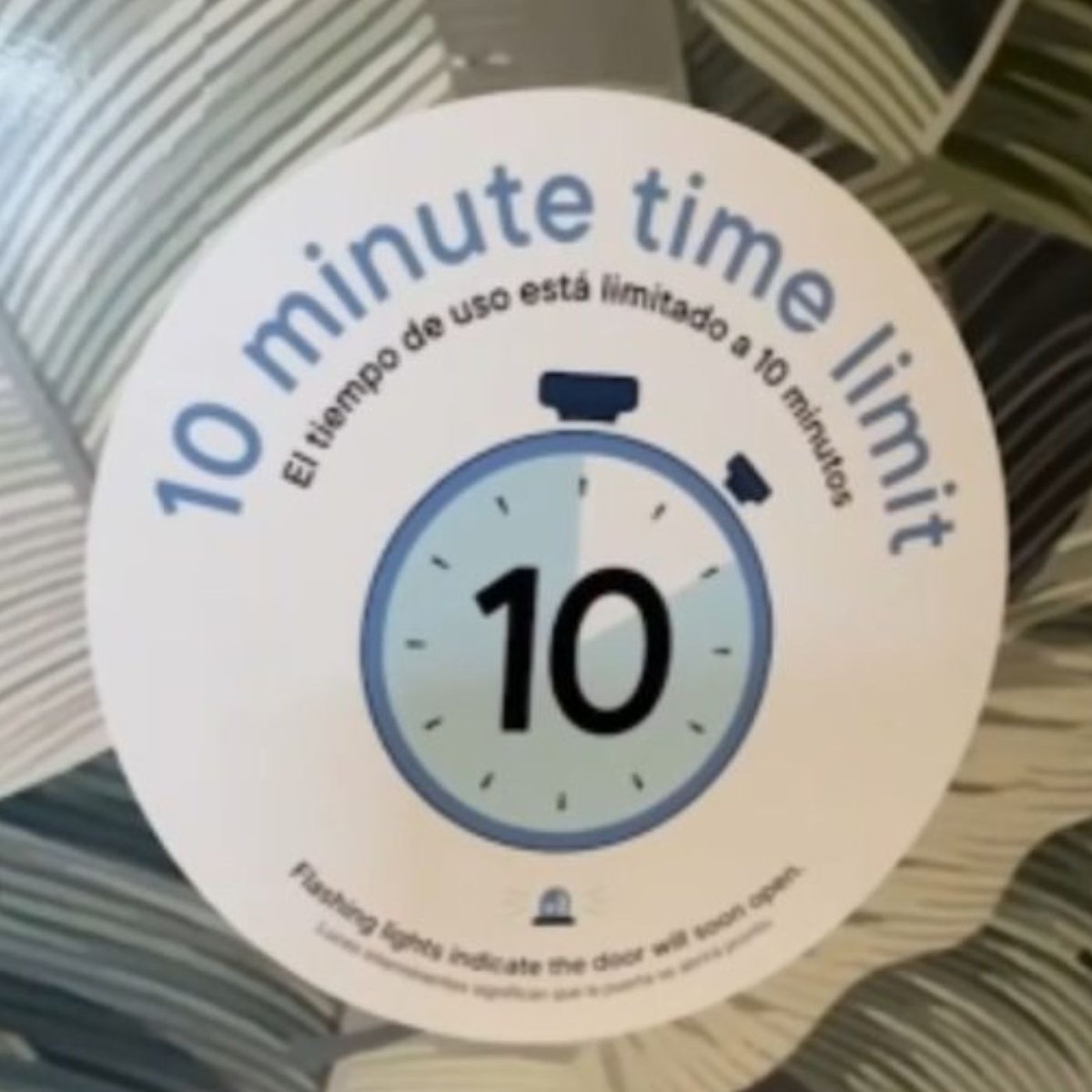
New York City is rolling out public toilets that only give you 10 minutes to finish
An announcer warns if time is running out before the door slides open, potentially exposing users to the public
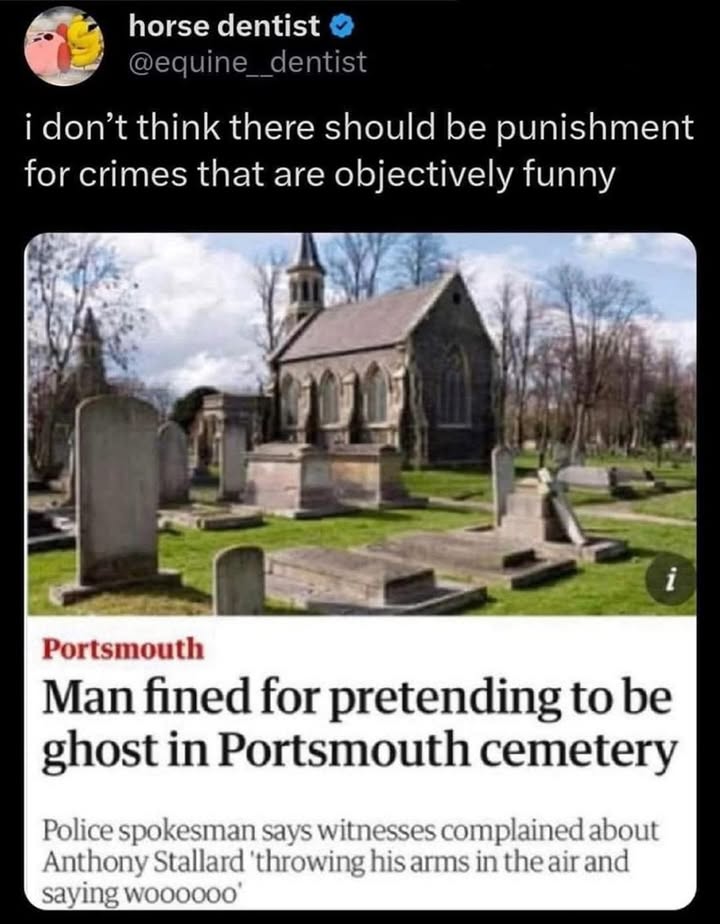
@ThatEricAlper Dressing up as a ghost in a UK churchyard or cemetery can be a crime. While simply wearing a costume isn't illegal, doing so in a way that causes distress, offends mourners, or disrupts the peace breaks specific public order and civil laws.
@ThatEricAlper In 2014, a UK man named Anthony Stallard was arrested and fined after entering Kingston Cemetery in Portsmouth, where he kicked a football around, waved his arms, and made "wooooo" ghost noises near people visiting the graves of loved one.
My dog will not go to bed until I make him a peanut butter sandwich..
I got in the habit of making one before getting ready for bed a few months ago, and I’d share it with him.
Now, I just make him a half sandwich and he eats it, then runs to the room to go to sleep. Last night I forgot his peanut butter sandwich and he literally stood next to the bed and kept gently poking my face with his wet nose .. like “mom , youve forgotten an important step in the bed time ritual…👀” 🤦🏻♀️
…. He did end up getting his bed time sandwich & I’m def not forgetting tonight.
Four bananas have been sitting on top of the vending machine at my gym since Monday. Every day, one disappears and a fresher one takes its place. I finally asked the front-desk guy if they were free. He said one of the older members brings a banana for anybody who arrives without breakfast. There’s no sign because the man thinks signs make kindness “look sponsored.” I took one yesterday after an early workout. This morning, he was restocking them and asked if it was ripe enough. I said it was perfect. He nodded and wrote something in a tiny notebook. Apparently the bananas have quality control.
🚨 HANDICAP PLOT JOBS THREAD 🚨
I’ve gone through the upcoming handicaps looking for horses whose current mark, recent form and likely target race could be hiding significantly more ability than the market suggests.
A few VERY interesting ones 👀👇
At the end of May, Aidan O'Brien seemed to be building an outstanding squad in his bid for a third Prix de l'Arc de Triomphe, but plenty of the headline contenders have stumbled since
Read with Racing Post+ 👇
📎 - https://t.co/zSQZrUKnG3
@RacingPost Diamond Necklace's pedigree does NOT suggest "a step up in trip may suit". Her sire was a 10f horse. He has yet to sire a horse that has won a group race over 12f. Her dam won a 11f listed race, and unplaced over 12f. Not saying she can't do it however.
@MakisMedicine No sir.
Either way Daniel is cooked.
If he's stupid enough to take it, time will not be on his side. More so, a potentially very painful death. If he is simply trying to get others to take it, universal karma will not be pretty for him.
From FB: I know the exact pressure it takes to crack a rib during CPR. But last Tuesday, I learned a patient’s silence can break a doctor’s soul.
His name was David Chen, but on my screen, he was "Male, 82, Congestive Heart Failure, Room 402." I spent seven minutes with him that morning. Seven minutes to check his vitals, listen to the fluid in his lungs, adjust his diuretics, and type 24 required data points into his Electronic Health Record. He tried to tell me something, gesturing toward a faded photo on his nightstand. I nodded, said "we'll talk later," and moved on. There was no billing code for "talk later."
Mr. Chen died that afternoon. As a nurse quietly cleared his belongings, she handed me the photo. It was him as a young man, beaming, his arm around a woman, standing before a small grocery store with "CHEN'S MARKET" painted on the window.
The realization hit me like a physical blow. I knew his ejection fraction and his creatinine levels. I knew his insurance provider and his allergy to penicillin. But I didn't know his wife's name or that he had built a life from nothing with his own two hands. I hadn’t treated David Chen. I had managed the decline of a failing organ system. And in the sterile efficiency of it all, I had lost a piece of myself.
The next day, I bought a small, black Moleskine notebook. It felt like an act of rebellion.
My first patient was Eleanor Gable, a frail woman lost in a sea of white bedsheets, diagnosed with pneumonia. I did my exam, updated her chart, and just as I was about to leave, I paused. I turned back from the door.
"Mrs. Gable," I said, my voice feeling strange. "Tell me one thing about yourself that’s not in this file."
Her tired eyes widened in surprise. A faint smile touched her lips. "I was a second-grade teacher," she whispered. "The best sound in the world... is the silence that comes just after a child finally reads a sentence on their own."
I wrote it down in my notebook. Eleanor Gable: Taught children how to read.
I kept doing it. My little black book began to fill with ghosts of lives lived.
Frank Miller: Drove a yellow cab in New York for 40 years.
Maria Flores: Her mole recipe won the state fair in Texas, three years running.
Sam Jones: Proposed to his wife on the Kiss Cam at a Dodgers game.
Something began to change. The burnout, that heavy, gray cloak I’d been wearing for years, started to feel a little lighter. Before entering a room, I’d glance at my notebook. I wasn’t walking in to see the "acute pancreatitis in 207." I was walking in to see Frank, who probably had a million stories about the city. My patients felt it too. They'd sit up a little straighter. A light would flicker back in their eyes. They felt seen.
The real test came with Leo. He was 22, angry, and refusing dialysis for a condition he’d brought on himself. He was a "difficult patient," a label that in hospital-speak means "we've given up." The team was frustrated.
I walked into his room and sat down, leaving my tablet outside. We sat in silence for a full minute. I didn't look at his monitors. I looked at the intricate drawings covering his arms.
"Who's your artist?" I asked.
He scoffed. "Did 'em myself."
"They're good," I said. "This one... it looks like a blueprint."
For the first time, his gaze lost its hard edge. "Wanted to be an architect," he muttered, "before... all this."
We talked for twenty minutes about buildings, about lines, about creating something permanent. We didn't mention his kidneys once. When I stood up to leave, he said, so quietly I almost missed it, "Okay. We can try the dialysis tomorrow."
Later that night, I opened my Moleskine. I wrote: Leo Vance: Designs cities on paper.
The system I work in is designed to document disease with thousands of data points. It logs every cough, every pill, every lab value. It tells the story of how a body breaks down.
My little black book tells a different story. It tells the story of why a life mattered.