⚡️The “DoorDash lifestyle” is an artifact of three massive structural shifts older generations don’t see because they didn’t grow up inside them.
Let’s break the illusion.
1. The marginal cost of money changed for Gen Z
For older adults, spending thirty dollars feels like spending thirty dollars.
For kids today, the psychological cost is closer to:
“three microtransactions worth of friction”
Because their financial environment is built on:
•instant digital payments
•low-commitment gig incomes
•parents transferring money fluidly
•side hustles paid in irregular small bursts
•stimulus-era normalization of cash flow volatility
Teenagers today often have:
•$30 now
•$0 tomorrow
•$50 on Friday
•$15 in crypto
•$70 in Cash App from someone they did homework for
•a $20 Venmo from grandma
•$60 from a weekend shift
There is no “budget.”
There is flow.
And in a flow economy, a $30 DoorDash order is not a “luxury”.
It is just another digital outflow in a stream of constant micro inflows.
2. Consumption is now social currency
Older generations spent money to solve problems.
Gen Z spends money to signal identity, reduce friction, and avoid emotional drag.
DoorDash is not about food.
It is about:
•eliminating effort
•eliminating planning
•eliminating discomfort
•eliminating logistics
•eliminating decision fatigue
This generation pays premiums to remove negative psychic load.
Food delivery is an anxiety-management subscription.
And they learned this from:
•Amazon Prime
•Uber
•TikTok dopamine tuning
•frictionless apps
•the collapse of effort-based value signals
Convenience is the default baseline now.
3. The middle class collapsed, but lifestyle costs decoupled from income
This is the part most boomers and Gen X don’t understand.
Kids aren’t behaving like they’re poor.
They’re behaving like people living in a post-middle-class economy where:
•ownership is dead
•savings are pointless
•buying a home is impossible
•college is a debt sentence
•inflation destroys the dollar
•wages do not map to adult milestones
•upward mobility is gone
So what happens?
They shift to a present-maximization mindset.
If the future is unaffordable anyway,
why not buy the burrito now?
Younger people are not reckless.
They are rational inside a broken incentive system.
The real truth
DoorDash is a symptom.
A society where:
•future stability is gone
•wages stagnate
•housing is unattainable
•attention is fragmented
•convenience is normalized
•friction feels archaic
•everything is mediated digitally
…will produce kids who treat $30 like a tap on a screen, not a financial decision.
They’re not “funding a lifestyle.”
They’re surviving inside the economy they were handed.
Bitcoiners need to understand this, because the reality is simple.
Michael Saylor built the first functioning refinery for digital capital.
He takes raw Bitcoin, stabilizes the volatility, and turns it into scalable credit instruments.
Those instruments unlock yields that appeal to an addressable market more than 150 times larger than Bitcoin itself.
That is what real adoption looks like.
Bitcoin is not going to absorb trillions just because a small group of holders promise to “never sell.”
The capital has to enter the system somewhere, and it only enters when the asset becomes usable.
There are people who insist Bitcoin will hit $2 million while pretending the inflow mechanics do not matter.
They never explain where the money will come from, which markets will rotate in, or what incentives will pull global capital into the network.
A commodity does not become global reserve infrastructure by sitting inert. Oil had refineries. Steel had mills. Electricity had grids.
Bitcoin needs financial architecture that makes its properties accessible to the world, not just to cold-storage purists.
That is exactly what Saylor is building.
He is refining digital commodity money into credit rails that any institution can plug into.
That unlocks yield, improves balance sheets, and gives Bitcoin a surface area large enough for global capital to interact with it.
Cold storage is foundational, but it is not a business model for the planet.
Refinement is what turns Bitcoin from a savings tool into a functioning monetary substrate.
And that is why the future flows through Bitcoin-backed credit.
I am a die-hard Bitcoin maximalist, and I see other maximalists that do not seem to understand that Bitcoin is not a simply currency that you keep under your mattress.
Bitcoin is MONEY. And the best money brings the a new monetary operating system altogether.
Enabling people to use Bitcoin without holding Bitcoin feels like heresy to maxis, but it is the only path that actually scales.
Nobody out there is begging for blockchains. They just want their problems gone.
If Bitcoin solves those problems behind the scenes, then Bitcoin wins without anyone even noticing the victory.
Normies are not signing up to learn seed phrases, mining difficulty, or timechain metaphysics.
They want smoother payments, better yield, cheaper credit, and stability.
If Bitcoin delivers those outcomes invisibly, adoption happens automatically.
Every successful technology hides its guts. Apple never forced users to learn ARM architecture. Netflix never taught anyone how video codecs work.
Bitcoin is the only technology on earth that keeps insisting everyone must become a protocol scholar before they’re allowed to benefit from it, which is why Facebook has three billion users and Bitcoin has maybe fifty million people who even understand what they own.
The future is simple.
Bitcoin wins the moment it disappears into the background and powers the world without demanding people worship the machinery.
🇳🇴 Hot «free money» tip til norske ASK kontoeiere: Hvis du har cash på din ASK konto, så får du - per lov - ikke renter på dem *). Hvis du i tillegg har tilgjengelig innskudd - som du kan ta ut skattefritt - så ta ut cash tilsvarende det tilgjengelige skattefrie innskuddet, og sett det på en høyrentekonto. Staten sin «Finansportalen» er flott for å finne kontoer som yter høy rente (som også er beskyttet mot konkurs på lik linje med din vanlige bank) - det er nært garanter ikke din vanlige bank som yter best.
*) Brokeren din, altså f.eks DNB, hvor du har din ASK konto, får imidlertid renter, eller kan låne dem ut - superlukrativt for dem!
*) . og du kan heller ikke ha rentepapirer eller -fond på ASK!
*) Cash på ASK er ofte heller ikke beskyttet på lik linje som en bankkonto (via Bankgarantifondet - en tvungen forsikringsløsning som banker må være med i: Opptil 2 mill per kundes konti). Bankkontoen de benytter er typisk en klientkonto sett mot brokeren, men de kan allikevel benytte disse midlene. Dersom de går konk, så er den totale kundemassen sine ASK cash beskyttet som *en* konto!
The Cost Of Our Inheritance: A Generation's Vision For Ethical Money
One of the most personal and important keynotes I've ever given on broken money, generational injustice, and Bitcoin as our moral imperative.
The future isn't something we wait for, it's something we build ✊
What if I told you we’re living through a depression?
The silent depression. The great debasement.
Dollars create the illusion of prosperity. Fiat lies.
#Bitcoin makes the invisible visible.
Me and my pal o3 working with a new variant of the Bitcoin price chart - "Bitcoin root axis". Since the first day I saw a log-chart of the Bitcoin price in 2016, I thought that it must be possible to tweak the Y axis to straighten that curve out. Then the log-log and power law stuff came up with @Giovann35084111. But I dislike the log X date axis. So, finally, I took an hour and let o3 teach me that yes, that would be possible, and the "inverse" of the log X axis would be a root-scale for Y. And I like it!
Eric Schmidt says intelligence is about to decouple from us.
“The computers are now doing self-improvement.. They don’t have to listen to us anymore.”
Within six years: a mind smarter than the sum of humans -- scaled, recursive, free. We have no language for what’s coming.
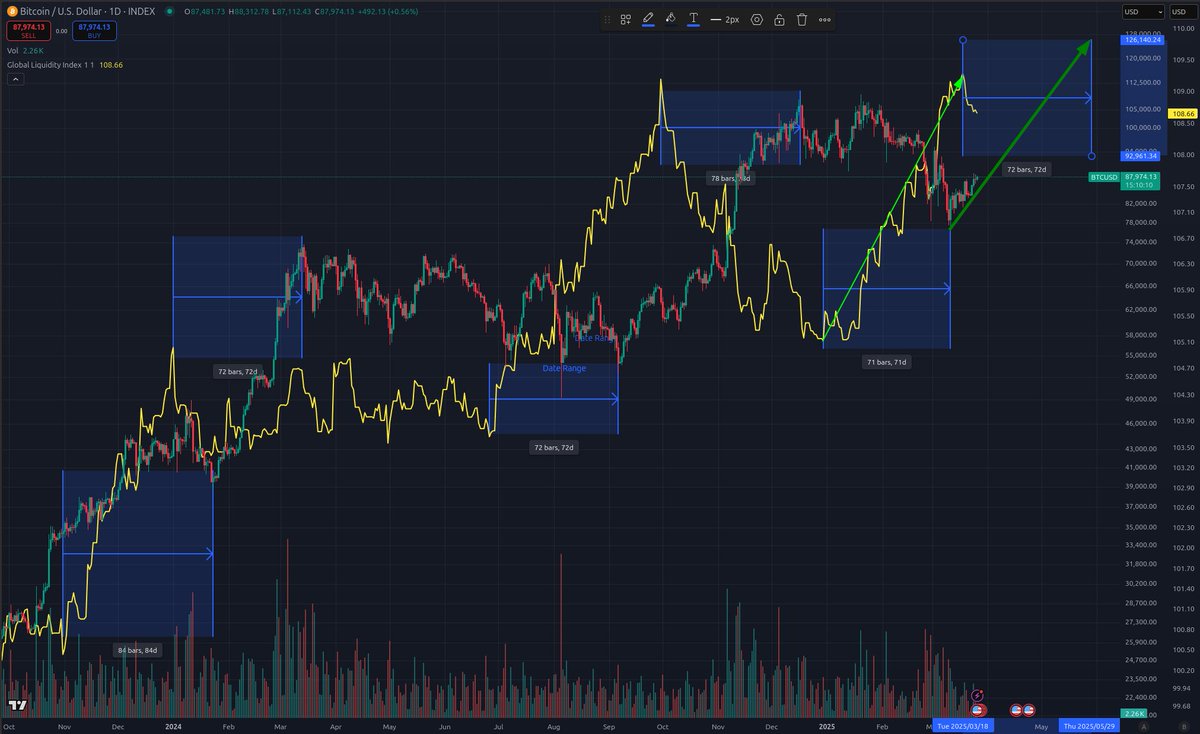
*Extremely* interesting Bitcoin price prediction charts by @egrindhe! They are two different ways to move the previous three 4-year cycles onto this cycle, and thus visually see how it might fare in the coming months and years.
🚨 BITCOIN PRICE PREDICTION! 130k @ 2025-05-29
Global liquidity seems to have turned upwards at 2024-12-30, and after 71 days, 2025-03-11, Bitcoin turns upward.
Liquidity seems just topped out at 2025-03-18, and thus ~72 days later, 2025-05-29, Bitcoin might have a local top.
Bitcoin vs. Global Liquidity: Have we already started the Bitcoin updraft? A little premature vs. the earlier "turning point delays", ranging from 72 to 84 days - this now being just 59 days.