Contemporary Velocity Field for Turkey Inferred from Combination of a Dense Network of Long Term GNSS Observations https://t.co/fYRWJqmskR and the data https://t.co/9E4xo6mKxu
@akbayram_kenan Latex'e olan sadakatin her sene sadece daha fazla arttı :) overleaf oldukça iyi bir hizmet, @akbayram_kenan başlayacaksan en kullanıcı dostu olan arayüz.
@xonurtan@dertuncay@cagrimbakirci oldukça farklılar. E.g. Helen - Kıbrıs gecisindeki slab yırtığı çok farklı. Kıbrıs adasının doğusu çok farklı ve esas Helen W-B Zone amfitiyatro geometrisi birinde belirgin değil.
@DepremDairesi@LastQuake odak cozumleri katalogunda sadece MT cozumleri mi var, yoksa first motion polarity de bulunuyor mu? Katalogda otomatik cozumler ile elle yapilan cozumleri ayirmanin bir yolu var mi?
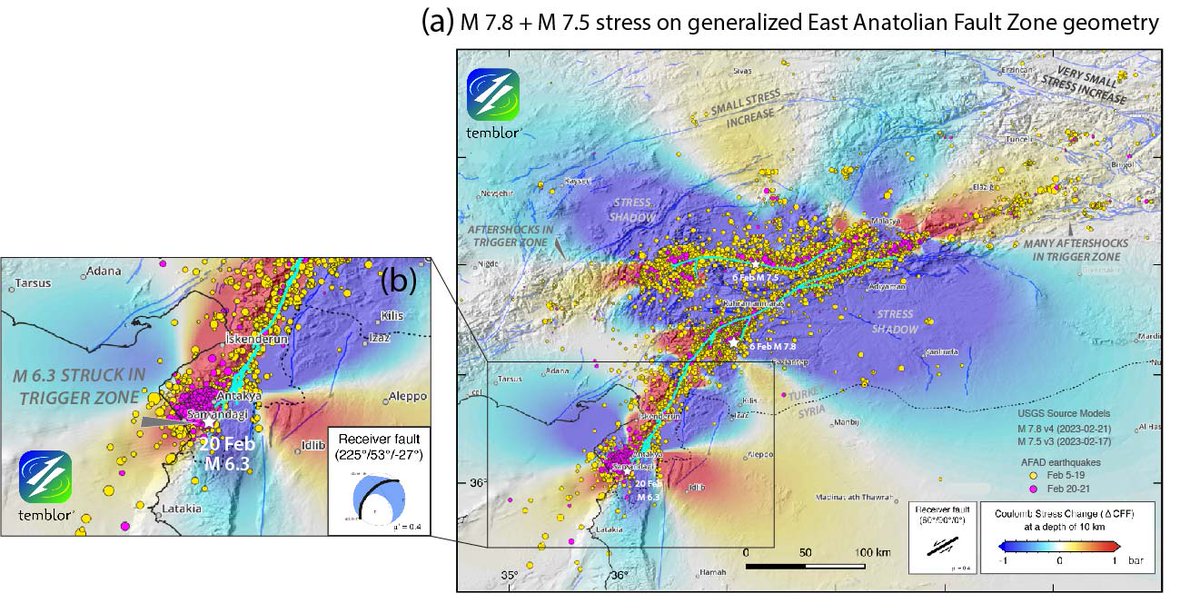
Here is @rstein357 et al.'s latest article, featuring a new, more fully analyzed set of Coulomb stress transfer calculations using the latest available @USGS_Quakes source models. They explore stress transfer + aftershocks... (1/n)
https://t.co/UDKu8dQEwp
@AybigeAkinci@Paleosismolog@AybigeAkinci Ölüdeniz ile Dogu Anadolu fayinin güney kesimi icin Sbeitani vd. 2005 çok iyi bir yayın (https://t.co/fSju5fJmOM). Deliller ve yorumlar net bicimde ayrilmis. Bunun yanında Meghraoui vd. 2003 EPSL de gayet iyi.
Here's @temblor's preliminary Coulomb stress analysis for the 2023 Türkiye earthquakes that can help understand *where* aftershocks are most likely (but not when or how big).
Article by @EeWkKI8KqQLHUqz@rstein357 et al.
https://t.co/Xed6yOyySU
@maratumba As the Ml is the first magnitude to be released, the press picks it up, and uses everywhere. KOERI calculated an Mw7.7, in agreement with that of USGS.