@amitylee13 Would of loved to join (and went the past few times with the fellow Catholic libertarians at the conventions), but I have more or less given up on a political solution to the issues of the day.
I hope it goes well though.
There is only one thing you need to know about @RepThomasMassie campaign and it’s not even that he’s the best congressman in the country with a voting record second to none.
It’s that the Israel lobby is attempting to unseat a congressman for the crime of exposing them and their disastrous war.
No self respecting nation can allow that to happen.
Don’t believe the bs last minute accusations and betting market shifts. These are obvious signs of a concerted effort.
Just double down, send him money if you can, call whoever you know in his district, share his videos or posts.
We need to win this one.
@Nina7Infinity I knew of Luke from the 2012 Ron Paul revolution days, and I had no idea he was working with Jeremy, until I saw Joon the King's documentary, and I am glad to hear that, Luke isn't associated with him anymore.
If you’re voting against Massie for a dude that uses AI to write his posts, is too scared to debate, avoids press, and gets community noted in a majority of his posts…
just because Trump told you to…
I just feel sorry for you.
Your brain has been captured.
I remember when Laura Ingraham, use to be one of the few who had @RonPaul on her show, during his 2012 presidential campaign, and was friendly towards him.
It sounds like to me, that Bishop Robert Barron is saying, that if a state says that their war is just, then it is just. If this is what just war theory amounts to, then it's pretty useless.
Thankfully, that is not what the church teaches on what just war theory is.
There is a way past the absurd and deeply divisive “war” between the President and the Pope, which has been enthusiastically ginned up by the press. And it is indicated in the Catechism of the Catholic Church, paragraph 2309 to be precise. After laying out the various criteria for determining a just war—proportionality, last resort, declaration by a competent authority, reasonable hope of success, etc.—the Catechism points out that “the evaluation of these conditions for moral legitimacy belongs to the prudential judgment of those who have responsibility for the common good.” The assumption is that the just war principles function, to use the technical term, as heuristic devices, designed to guide the practical decision-making of those civil authorities who have to adjudicate matters of war and peace.
The role of the Church, therefore, is to call for peace and to urge that any conflict be strictly circumscribed by the moral constraints of the just war criteria. But it is not the role of the Church to evaluate whether a particular war is just or unjust. That appraisal belongs to the civil authorities, who, one presumes, have requisite knowledge of conditions on the ground. So, is the war in question truly the last resort? Is there really a balance between the good to be attained and the destruction caused by the war? Are combatants and non-combatants being properly distinguished in the waging of the conflict? Do the belligerents have right intention? Is there a reasonable hope of success? The posing of those questions—indeed the insistence upon their moral relevance—belongs rightly to the Church, but the answering of them belongs to the civil authorities.
The Pope has said, on numerous occasions, that he is not a politician and that his role is not the determination of any nation's foreign policy. But he has just as clearly said that he will continue to speak for peace and for moral constraint. In making both of these claims, he is operating perfectly within the framework of paragraph 2309 of the Catechism. If we understand that the Pope and the President have qualitatively different roles to play in the determination of moral action in regard to war, we can, I hope, extricate ourselves from the completely unhelpful narrative of “Pope vs. President.”
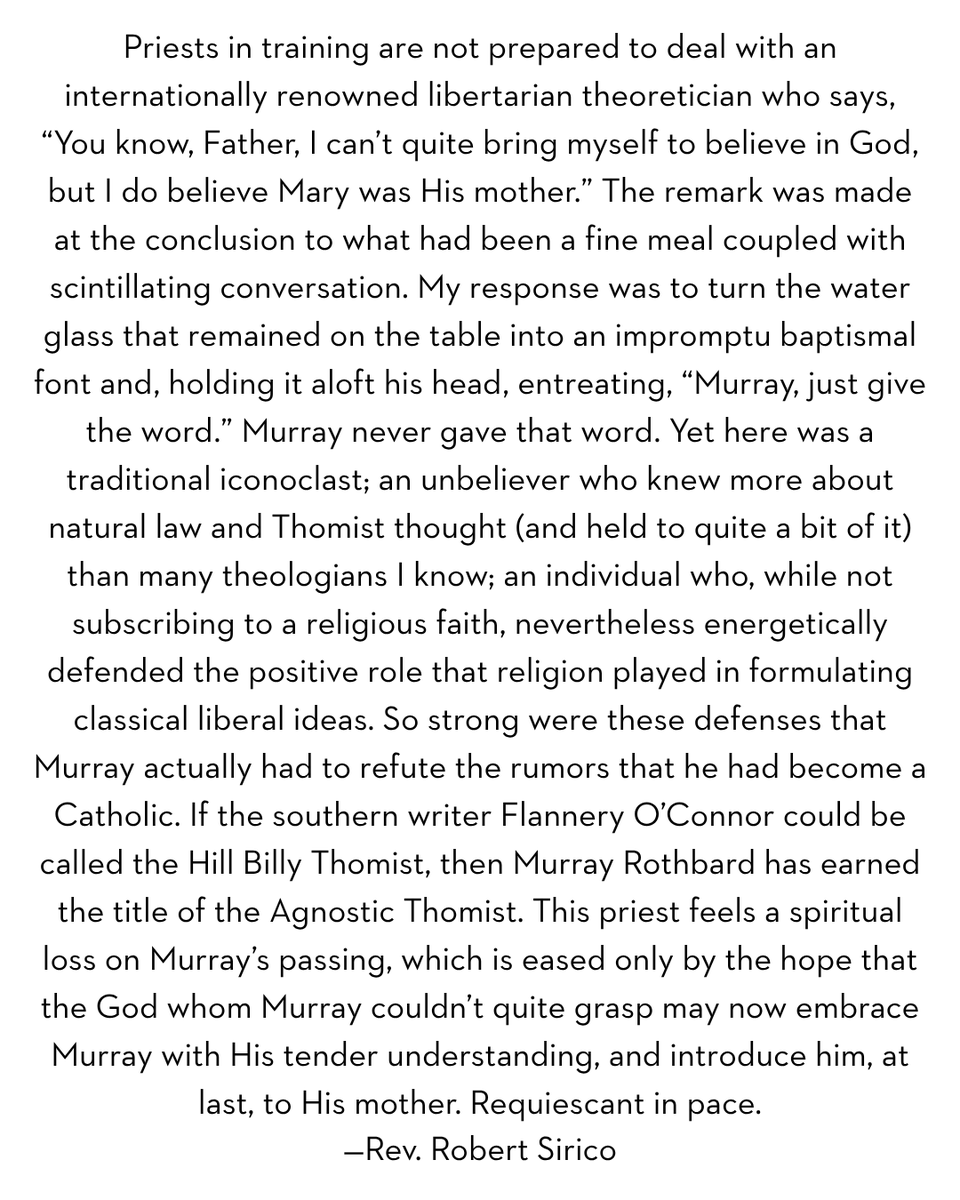
I was reminded by my algorithms that this is the centenary of the birth of the rambunctious economist Murray Rothbard. He was an eclectic thinker who contained in himself an abrasive yet charming character reminding me of many neighbors I grew up with in our native New York. I certainly did not agree with everything he proposed, but enjoyed my exchanges with him. Here is the short memoriam I wrote on his passing in 1995. RIP
Today, many Eastern Churches celebrate Easter according to the Julian calendar. In communion of faith in the Risen Lord, I extend my heartfelt wishes for peace to all these communities. Let us #PrayTogether for all those suffering due to war, particularly for the dear people of Ukraine. May the light of Christ bring comfort to afflicted hearts and strengthen the hope for peace. May the international community’s attention to the tragedy of this war not waver!
Eight years ago, I interviewed @ThomasEWoods about Catholicism, and at the end of the episode, I told him "Well, I'm still open to Catholicism. Maybe I'll see you at Mass some day."
But really, I was just being polite. I would have put the chances of conversion at less than one percent. Technically possible (hey, anything can happen), but extremely unlikely for somebody with my hyper-independent approach to philosophy.
The trajectory at that time was looking like I'd end up with a bespoke religion -- a religion with one member, myself, attempting to synthesize everything I've learned together into a coherent whole.
Well... look who got the last laugh. I think Tom was right. Today, my wife and I joined the Church and were confirmed Catholic. A totally unexpected plot twist in my pursuit of truth.
@RealAngelaMc There are good Catholics who have talked about how other things could be what is causing those things as well.
@JimmyAkin3000
https://t.co/xqLUuWA6NB