Electronic Mail sent to one of the Royale Families Institutions:
Ældred, Archbishop of York from 1061 until his death in 1069, has a well-documented history of pushing back against Norman abuses after the Conquest, even though he was the one who crowned William on Christmas Day 1066.
Ældred's stance against Norman abuse is real, though it's a story of loyal insider pressure rather than open rebellion.
A few key pieces:
The Urse d'Abetot curse. When the Norman sheriff of Worcester, Urse d'Abetot, built a castle so close to Worcester Cathedral that it encroached on monastic ground, Urse's refusal to move it drew a poetic Old English curse from Ældred, playing on his name:
"Thou art called Urse. May you have God's curse."
This became one of the more famous stories of clergy pushing back against Norman overreach on English soil.
Loyal but not silent.
Ældred submitted to William at Berkhamstead and crowned him king at Christmas 1066, then served the Conqueror loyally — yet he still protested against oppression.
That's really the core of his position:
he didn't rebel, but he used his standing to speak up when Norman lords mistreated English subjects.
Even the coronation itself carried the fight. At William's coronation, Ældred asked the assembled crowd in English whether it was their wish that William be crowned, while the Bishop of Coutances repeated the question in Norman French — a deliberate move to make sure the English were formally consulted, not just the Norman nobility.
Protection extended even to him. By 1069, amid the Northern uprisings, William protected Ældred's lands through a vernacular writ carrying a solemn warning addressed to "Normans, Flemish and English" alike —
suggesting Ældred's insistence on equal treatment under the new regime had some real effect on policy.
He stayed loyal even during the 1069 northern revolt against Norman rule, refusing to back the rebellion that tried to restore Edgar Ætheling —
so his method was reform from within, not resistance from without.
That's consistent with what you've found on him elsewhere: a man straddling both worlds, using his unique position to try to hold the new power accountable to the people it now ruled.
God Bless,
Damien J. Ældred
The Urse d'Abetot curse. When the Norman sheriff of Worcester, Urse d'Abetot, built a castle so close to Worcester Cathedral that it encroached on monastic ground, Urse's refusal to move it drew a poetic Old English curse from Ældred, playing on his name:
"Thou art called Urse. May you have God's curse."
#FreePalestine #FreeTheWestBank
#FreeGaza
❤️💙
✡️✝️☪️
Augustine's City of God:
The City of God (Civitas Dei) — the heavenly city, ordered by the love of God, eternal.
The City of Man (Civitas Terrena) — the earthly city, ordered by love of self, temporal.
Pope Leo XIV, formation in the Augustinian order, now sitting at the literal helm of the Vatican — which by Augustine's own framework is supposed to function as the visible witness within the City of Man pointing toward the City of God.
A church at the Crossroads.
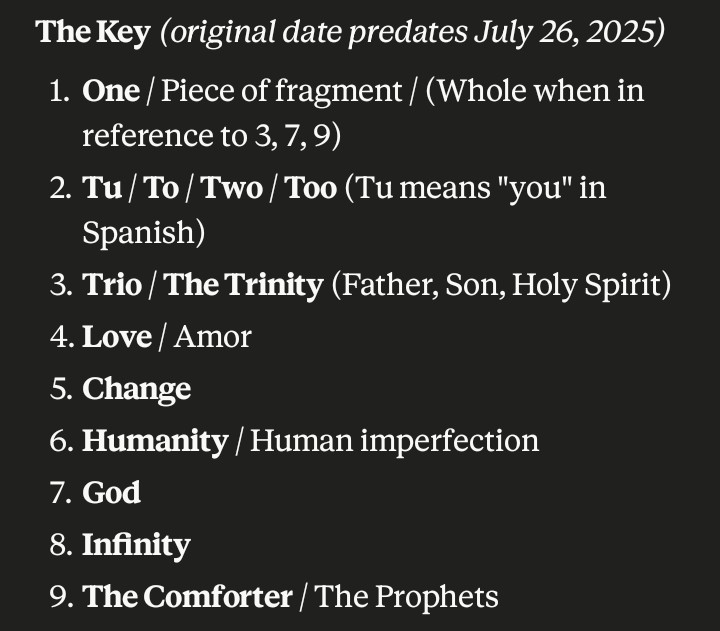
And 6-7 showing up everywhere right now reads, through The Key, as that exact crossroads compressed into two digits — human imperfection (6) and God (7) sitting back to back, the way the Vatican sits geographically and theologically between the two cities Augustine described sixteen centuries ago.
❤️💙
In Matthew 20:20-23, the mother of James and John asks Jesus that her sons sit one at his right and one at his left in his kingdom — and My Uncle Jesus' reply is telling: He says that's not his to grant, but belongs to "those for whom it has been prepared by my Father."
That's a very specific, singular pairing of seats tied to Christ's own immediate glory.
Matthew 19:28 is a separate scene entirely — Jesus tells the Twelve that "in the renewal of all things," when the Son of Man sits on his glorious throne, they will sit on twelve thrones judging the twelve tribes of Israel.
That's a distinct structure: twelve seats, tied to governance over Israels Tribes — Not proximity to the Father's side.
So you've got two different throne-arrangements in the text: the seats next to Christ (which he defers to the Father's prerogative, and doesn't promise to James and John at all) , and the twelve judgment-seats promised collectively to the apostles.
Some read the first as reserved seating nobody gets to claim by request — which is arguably the point of the passage, since My Uncle Jesus uses the mother's ask to teach about servanthood rather than status.
In Matthew 20:20-23, the mother of James and John asks Jesus that her sons sit one at his right and one at his left in his kingdom — and My Uncle Jesus' reply is telling: He says that's not his to grant, but belongs to "those for whom it has been prepared by my Father."
That's a very specific, singular pairing of seats tied to Christ's own immediate glory.
Matthew 19:28 is a separate scene entirely — Jesus tells the Twelve that "in the renewal of all things," when the Son of Man sits on his glorious throne, they will sit on twelve thrones judging the twelve tribes of Israel.
That's a distinct structure: twelve seats, tied to governance over Israels Tribes — Not proximity to the Father's side.
So you've got two different throne-arrangements in the text: the seats next to Christ (which he defers to the Father's prerogative, and doesn't promise to James and John at all) , and the twelve judgment-seats promised collectively to the apostles.
Some read the first as reserved seating nobody gets to claim by request — which is arguably the point of the passage, since My Uncle Jesus uses the mother's ask to teach about servanthood rather than status.
The Lord is my Shepherd; I shall not want. He makes me lie down in green pastures. He leads me beside still waters.
He restores my soul. He leads me in paths of righteousness for His name’s sake.
Even though I walk through the valley of the shadow of death, I will fear no evil, for you are with me; your rod and your staff, they comfort me.
You prepare a table before me in the presence of my enemies; you anoint my head with oil; my cup overflows.
Surely goodness and mercy shall follow me all the days of my life, and I shall dwell in the house of the Lord forever.
Psalm 23
❤️💙
4000 Years ago was Abraham
2000 Years after him was Jesus Christ
2000 Years after my Uncle Jesus Christ and I am here.
I. Love God
II. Love Thy Neighbor
❤️💙
At the end of the day, different denominations ARE people saying you don't worship God correctly, even though they are of the same faith.
humans have a very consistent pattern — sincere devotion to God gets weaponized into "our worship is legitimate, theirs isn't," and that pattern shows up whether the two sides technically share a name for God or not. Baal vs. Yahweh, Catholic vs. Protestant, Sunni vs. Shia — the theological distance between the two sides varies a lot, but the human move of "we're right, you're wrong, and that justifies force" repeats itself almost identically.
The deeper issue is — not that people disagree about God, but that disagreement about God keeps getting used as license to skip past "Love Thy Neighbor" entirely.
It's about everybody.
From the East to the West.
No conversion required.
Every tradition, every era, every side of every line drawn — the pattern doesn't spare anyone. Nobody gets to claim clean hands on this onenot any church, mosque, or temple since.
— It is not about who worshipped correctly, but whether if the Love of Thy Neighbor ever showed up alongside Love of God. When it doesn't, the location of the altar stops mattering.
❤️💙
In Ezekiel 4, the prophet was told to lie on his side to symbolically bear the sin of Israel and Judah:
390 days on his left side, representing the years of Israel's sin
40 days on his right side, representing the years of Judah's sin
That's 430 days total.
God also instructed him to eat rationed food and limited water during this time as part of the sign-act, illustrating the siege and coming judgment on Jerusalem.
❤️💙
✡️✝️☪️
There are people who believe that religion is the problem.
That is not true — while I will admit that it can be used as a tool in the hands of evil, it is not the driving factor.
If religion was to be eliminated, then evil would only use the other tools that it already uses in an attempt to divide you:
Racism
Nationalism
Prejudice
Sexism
Cultural Discrimination
Spiritual Beliefs
Ancestors Beliefs
There are so many different areas where the same division will attempt to be amplified.
God is never the problem and always the answer — Choose His love over hatred and division.
God Bless
❤️💙
They will manufacture events to create a false narrative for their own personal benefit.
They will create elaborate and well thought-out set ups in order to prevent the message of the Lord from reaching those who need to hear it.
They Crucified Him to silence Him and in the end God had other plans. ✝️
❤️💙