Discussing behavioural genetics & its social implications | PhD in Behavioural Genetics @KingsCollegeLon, BA in Philosophy @UniMelb, Director of @Futureproof.
A great conversation with @RussWarne about my three part series 'Behavioral Genetics and Human Agency' on the @RiotIQ Human Intelligence podcast. Links to each article below:
Part 1: https://t.co/V3tiIzbkHE
Part 2: https://t.co/snoc9u0G3S
Part 3: https://t.co/USfka3QqSA
In this fantastic episode, Dr. @DamienMorris challenges assumptions about free will, IQ, and ethics. He discusses "free will by subtraction," why genetics doesn’t erase agency, and how our views on determinism shape criminal justice and inequality. https://t.co/LbivDTSYtj
@JDHaltigan I have not, but it's interesting that he can find the time to blog about a tweet criticizing the rhetoric he used in a recent abstract but can't seem to find the time to respond to my detailed scholarly critique of his most cited discussion papers. 🤷🏻
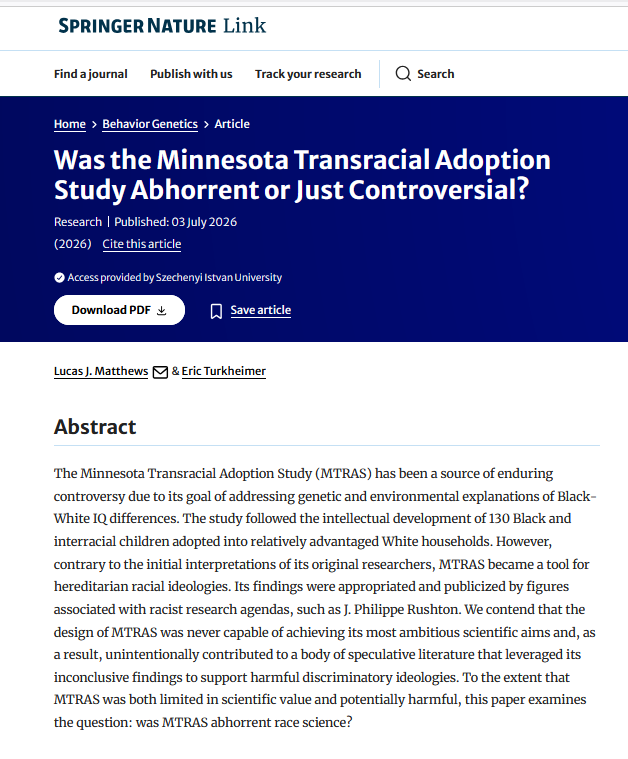
I don't think I've ever seen such a rhetorically manipulative abstract. Let's change the subject of the sentences to demonstrate how squalid this is: "Is Eric Turkheimer abhorrent or just controversial? To the extent that his work has been both limited in scientific value and potentially harmful, this paper asks the question: was his work abhorrent pseudoscience?" It's amazing that such a hatchet job can be published in an academic journal. And to think that Matthews sits on the BGA Public Science Committee which presumes to tell the rest of the behavioural genetics community what is appropriate to say and think. Shame on Matthews and Turkheimer for writing this and shame on Behavior Genetics for publishing it.
I can't pretend to know this literature very well, but my impression is that the jury is still out as to whether observed differences in politically sensitive traits between different populations are partly due to genetic differences. What I do know is that we now have good methods to answer this question if scientists are allowed to ask it. Many scientists and ELSI scholars seem very eager to prevent this question from being answered forever, which is a strange position to have if you're adamant that genetic differences do NOT meaningfully contribute to group differences.
@jon_stewartmill That's a very different sense of the 'constrained' tradition to the constrained tradition described by Thomas Sowell! 😅. We need to stop bombarding students with ideas from the unconstrained/technocratic vision & expose them to more thinkers from the constrained/tragic vision!
Words don't mean whatever you choose them to mean, Sasha. I'm not calling for anyone to be fired, nor am I saying they can't publish a scathing critique of the Minnesota study if they want. It's got nothing to do with cancel culture and everything to do with maintaining professional standards in academic writing. A critique of the study could have been written without resorting to rhetorical slime, and it is inconceivable that a title and abstract like this could have been published in Behavior Genetics forty years ago. Standards are slipping and Turkheimer has been leading the charge downhill.
Phrases can have capricious histories. As discussed in our previous exchange (after @FriedrichHayek joined in) "equality of opportunity" seems to have started out with a broadly classical liberal connotation before being subverted to mean "artificially orchestrating equal prospects of success for everyone". Conversely, "meritocracy" notoriously started as a pejorative to describe a hierarchical technocracy but was effectively repurposed to mean something like "a society that rewards excellence/talent" during the Blair years (much to Michael Young's chagrin!). More recently egalitarians in the social sciences have tried to subvert the meaning of "meritocracy" to ALSO mean "orchestrating equal prospects of success for everyone" — a meaning it never had before, even back in the 1960s — but they haven't fully succeeded yet. As the replies to your post suggest, some politically sympathetic followers are befuddled by your disavowal of these terms because they see them as principles they support (principles that separate them from the egalitarian left).
I fully understand why you want to disavow them (and why e.g. @NateAFischer and @eriktorenberg have previously done the same), but I think the more important job is to disaggregate and reject the illiberal and authoritarian concepts these terms sometimes refer to rather than disposing of the terms altogether. I think we can bring more people with us that way. But I also recognize that seeing these terms being rejected from an unexpected quarter can be the shake some people need. The most important thing is that the conversation is taking place.
@cfchabris Perhaps I need to be reading more of the non-fiction you are reading. I read a lot of terrific non-fiction, but whenever I read popular stuff for general audiences I often feel like most of it is a waste of the reader's time.
I don't think we have to disown "equality of opportunity" just yet. It's true that its meaning has been co-opted by socialists and laundered by the social sciences, but I think we can still salvage the conception "that all should be allowed to try" (Hayek) from the socialist conception that everyone should have equal prospects regardless of their environmental (or genetic!) starting point in life and that we have to re-engineer society so no one has a measurable chance of succeeding over anybody else.
As the language through which liberal political principles is constantly co-opted and inverted, there's always the tactical question of when we give up on certain terms. "Equity" died long ago and "liberalism" (without the "classical" prefix) is dead except in the negative ("illiberal"). But I think we should fight to reclaim "equality of opportunity" alongside "meritocracy" (which has been co-opted by the social sciences in exactly the same way). For many ordinary people, these are the only phrases they have to refer to political principles they rightly cherish and feel are under threat.
I don't think we have to disown "equality of opportunity" just yet. It's true that its meaning has been co-opted by socialists and laundered by the social sciences, but I think we can still salvage the conception "that all should be allowed to try" (Hayek) from the socialist conception that everyone should have equal prospects regardless of their environmental (or genetic!) starting point in life and that we have to re-engineer society so no one has a measurable chance of succeeding over anybody else.
As the language through which liberal political principles is constantly co-opted and inverted, there's always the tactical question of when we give up on certain terms. "Equity" died long ago and "liberalism" (without the "classical" prefix) is dead except in the negative ("illiberal"). But I think we should fight to reclaim "equality of opportunity" alongside "meritocracy" (which has been co-opted by the social sciences in exactly the same way). For many ordinary people, these are the only phrases they have to refer to political principles they rightly cherish and feel are under threat.
Hi @capitalismandfreedom. Thanks for saying this. Glad it finally clicked! Yes, the key idea is that responsibility is either compatible with determinism or, if it isn't, noone is responsible for anything. There's no coherent halfway position where the KNOWN causes of your behaviour diminish your responsibility while UNKNOWN causes do not (not unless you believe that some of our behaviour is magically self-caused). It's all or nothing. However this halfway position seems to be the default view across much of the social sciences and is now being extended to behavioural genetics. By clearly articulating that philosophy and highlighting how it connects to social justice politics, Turkheimer and Harden have inadvertently exposed it's weaknesses.
For the avoidance of doubt, I'm not saying that someone who's in the grip of a psychotic delusion or is severely mentally impaired should be held legally responsible if they, e.g., assault someone. But the reason they're considered less responsible isn't because we know the causes of their incapacities (we often don't!) but simply because they lack the moral and cognitive capacities of unimpaired people. Whether people can be held responsible for their actions depends on their capacities and capabilities, not on whether the causes of their behaviour are known or unknown.
I use the phrase "selective determinism" in the subtitle because it's a more familiar and accessible concept to non-philosophers, but the key idea is really SELECTIVE INCOMPATIBILISM, i.e. accepting all human behaviour is determined but maintaining only SOME causes of behaviour are incompatible with free will (i.e. the social and genetic determinants of behaviour identified by the biosocial sciences). It seems academic philosophers have largely neglected to address this common philosophical mistake because it's a fairly basic one and they have been more interested in tackling more complex problems. But this folk theory of free will appears to have played a major role in the politicization of the social sciences and infected much of public life.
Hi @capitalismandfreedom. Thanks for saying this. Glad it finally clicked! Yes, the key idea is that responsibility is either compatible with determinism or, if it isn't, noone is responsible for anything. There's no coherent halfway position where the KNOWN causes of your behaviour diminish your responsibility while UNKNOWN causes do not (not unless you believe that some of our behaviour is magically self-caused). It's all or nothing. However this halfway position seems to be the default view across much of the social sciences and is now being extended to behavioural genetics. By clearly articulating that philosophy and highlighting how it connects to social justice politics, Turkheimer and Harden have inadvertently exposed it's weaknesses.
For the avoidance of doubt, I'm not saying that someone who's in the grip of a psychotic delusion or is severely mentally impaired should be held legally responsible if they, e.g., assault someone. But the reason they're considered less responsible isn't because we know the causes of their incapacities (we often don't!) but simply because they lack the moral and cognitive capacities of unimpaired people. Whether people can be held responsible for their actions depends on their capacities and capabilities, not on whether the causes of their behaviour are known or unknown.
I use the phrase "selective determinism" in the subtitle because it's a more familiar and accessible concept to non-philosophers, but the key idea is really SELECTIVE INCOMPATIBILISM, i.e. accepting all human behaviour is determined but maintaining only SOME causes of behaviour are incompatible with free will (i.e. the social and genetic determinants of behaviour identified by the biosocial sciences). It seems academic philosophers have largely neglected to address this common philosophical mistake because it's a fairly basic one and they have been more interested in tackling more complex problems. But this folk theory of free will appears to have played a major role in the politicization of the social sciences and infected much of public life.
I’ll have to admit it took me some time to understand the importance of the @DamienMorris treatise on free will.
But today the light bulb turned on.
I’ve always thought that circumstances and genetics determined outcomes.
And they do. To an extent.
The issue, though, is if you are *selectively deterministic*.
I.e., men are more violent due to genetics. And probably some men are even more violent due to their specific ancestry or circumstances.
But should we give men a pass or consider any of this exculpatory because of their prediliction? Or give certain sub-groups of men an even bigger pass?
The logical issue is we can’t give passes to a sub-group without giving passes to everyone.; you are either deterministic or you aren’t.
And if we give passes to anyone committing violence, the game is over.
I think I have tended to be illogical on this point; and I don’t think I’m alone.
I’ve thought that some people were born with a leg up in life and that’s somewhat unfair.
But there is a hazard here; you are potentially prone to a huge sliding shift toward selective determinism according to your biases.
Also, once society starts adopting any determinism at all as a concept, the concept of individual agency and responsibility slowly degrades. People begin to use their circumstances as an excuse. They throw in the towel.
You can easily envision scenarios where a public policy that embraces determinism leads to anarchy and destruction. No one would be accountable.
And, also, logically, *any* amount of determisim in public policy is a cancer. It’s cancer because it’s invariably subject to the same issues as full determism, just to a lesser extent.
And that’s why this is an important treatise. It’s clear that a selective determinism has creeped into our public policy - and it needs to be excised.