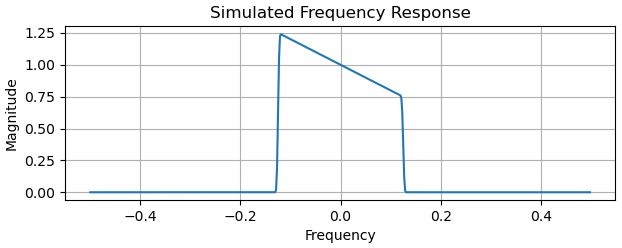
@ea4gpz@dEnergy_dTime In my answer I use the impulse response (IR) for the sloped channel to get the freq response (FR), from which we directly see the ISI is the result of a R-H-S. But since you did your FR with FFT's, you didn't have the IR, how did you arrive then at the R-H-S conclusion?
@ea4gpz@dEnergy_dTime@StackSignals So now that you see that with the simpler BPSK case, without simulating to see the answer, what do you expect to happen to the QPSK constellation under this condition of going through a channel with a linear passband slope? (The original QPSK question)
@ea4gpz@dEnergy_dTime@StackSignals Yes! And for QPSK which is basically two BPSK waveforms in quadrature you lose that independence resulting in each of those two introducing interference in the other. So we get a quadrature ISI! For BPSK, we violate the Nyquist criterion for zero ISI but still get 0 ISI! Details!
Now is the perfect time to register for @DanBoschen's upcoming and highly acclaimed "Python Applications for Digital Design and Signal Processing" online course.
https://t.co/Fg2p26jUll
#DSP#Python
@ea4gpz@dEnergy_dTime@StackSignals I cleaned up the question so hopefully it is very clear that we needn’t know anything about the receiver. And that we did all necessary pulse shaping in the transmitter to have a zero ISI QPSK waveform to get an unrealistically perfect rectangular magnitude in frequency-
@ea4gpz@dEnergy_dTime@StackSignals Actually here is a lot better for ongoing discussion / chatter which is otherwise discouraged on StackExchange in the comments for posts. I’m just not a heavy Twitter user so wasn’t even aware there was a DSP StackExchange twitter feed until now!