Ancient Greeks Invented World’s First Telecommunications Device -
The hydraulic telegraph, invented by the ancient Greeks, had the capacity to send long-distance messages as early as 4th Century BC.
The ingenious apparatus is dubbed as the world’s first telecommunications device. It was designed for military purposes by Aeneas Tacticus with the purpose of more efficiently sending pre-arranged messages across the vast empire of Alexander the Great.
Operation of hydraulic telegraph is described in detail in Aeneas’ work on sieges, Poliorcetika, which was retrieved by Polybius. The messages sent were along the lines of: “Enemy on sight,” “Cavalry attack,” “We need wheat,” “Infantry in action,” “Cyclical movement,” and so on.
The hydraulic telegraph was used by the ancient Greeks during times of war. There were numerous telecommunication groups of beacons placed on carefully selected hills in ancient Greece. The apparatus was operated by messengers who stood at a given hill and used clay or metal cylindrical containers of equal size filled with water up to three cubits in height and up to one cubit in width. In each container, there was a cork floating. It was a little narrower than the mouth of the container. Rods, divided into equal parts, were inscribed with the same pre-agreed messages on each and attached to the center of the floats.
The operator-transmitter would lift a burning torch, signaling the operator-receiver for the sending of the message and then waiting for confirmation with rising of the torch from the receiver. Thereafter, the transmitter lowered his torch so as to signal for simultaneous opening of both taps on their devices. The rods with messages descended, and when the desired message to be sent appeared at the rim of the transmitter’s device, he raised the torch once again, signaling the receiver for the simultaneous interruption of the outflow.
Due to the geometric similarity of the devices, the desired message also appeared on the receiver’s device. It was of utmost importance that there be absolute simultaneity between transmitter and receiver operators. Both had to be quite careful not to send the wrong message, which would be disastrous in wartime. The description of hydraulic telegraph was rescued by the historian Polybius in 2nd Century BC.
Technology of hydraulic telegraph seems rather simple, but its invention was marveled by ancient Greeks as a significant advancement in communication technology, as it allowed for pre-determined messages to be sent across long distances. In the event of an intrusion or enemy approaching, they would only witness the brief torch flashes and would not be able to intercept the message in any way.
This development was also a great advancement in military communication and strategy. Messages were sent from Sicily to Carthage during First Punic War (264-241 BC) using hydraulic telegraph, also known as a Semaphore line. Through this noteworthy invention, the military then had the ability to send specific messages that allowed other groups of military personnel, as well as civilians, to better prepare for potential land or sea invasions.
This early form of long-distance communication was especially innovative for its time, and it paved the path for future forms of communications, which have led to the numerous methods currently available. Today, there is a replica of the hydraulic telegraph of Aeneas Tacticus and pertinent messages from periods of war at OTE Group Telecommunications Museum in Athens.
📷 : A relief of the ancient Greek hydraulic telegraph of Aeneas, artist/period unknown.
#archaeohistories
The chariot was the elite arm of ancient Indian armies in the Vedic (1500 BCE – 1000 BCE) and Epic periods (described by the Ramayana and the Mahabharata, 1000-600 BCE) because of the advantages it conferred and the selection...https://t.co/7qTOGy0Jm5
The Aztec sun stone, also known as the Calendar Stone, is a late post-classic Mexica sculpture housed in the National Anthropology Museum in Mexico City. It’s perhaps the most famous work of Mexica sculpture. The stone measures 3.6 metres in diameter, is 98 centimetres thick, and weighs 24,590 kg.
Despite its name, the stone is not a functioning calendar. Instead, it’s an elaborately carved solar disk, which for the Aztecs and other Mesoamerican cultures represented rulership. The stone depicts the five consecutive worlds of the sun from Aztec mythology. The central face of the stone could represent either the sun god Tonatiuh (the Day Sun) or Yohualtonatiuh (the Night Sun) or the primordial earth monster Tlaltecuhtli.
Around the central face at four points are the other four suns which successively replaced each other after the gods Quetzalcoatl and Tezcatlipoca struggled for control of the cosmos until the era of the 5th sun was reached. The suns are known by the day name on which their final destruction occurred.
The stone was discovered in December 1790 in the central plaza of Mexico City. It was once a part of the architectural complex of the Temple Mayor. The stone would originally have been laid flat on the ground and possibly anointed with blood sacrifices. When it was discovered, the stone was lying flat and upside down, perhaps in an attempt to prevent the final cataclysm - the fall of the 5th and final sun - as the Aztec world fell apart following the attack from the Old World.
The Aztec sun stone is a testament to the rich and complex history of the Aztec civilization and provides valuable insights into their religious beliefs and practices. It’s a fascinating piece of history that continues to captivate researchers and enthusiasts alike.
#drthehistories
Uncover the ancient tales of the Hindu deity Brahmani in Kanchipuram, Tamil Nadu, dating back 1200 years. Explore the truth behind myths like the breast tax and breast clothes.
Src Asian Art Museum in San Francisco
#Archaeology
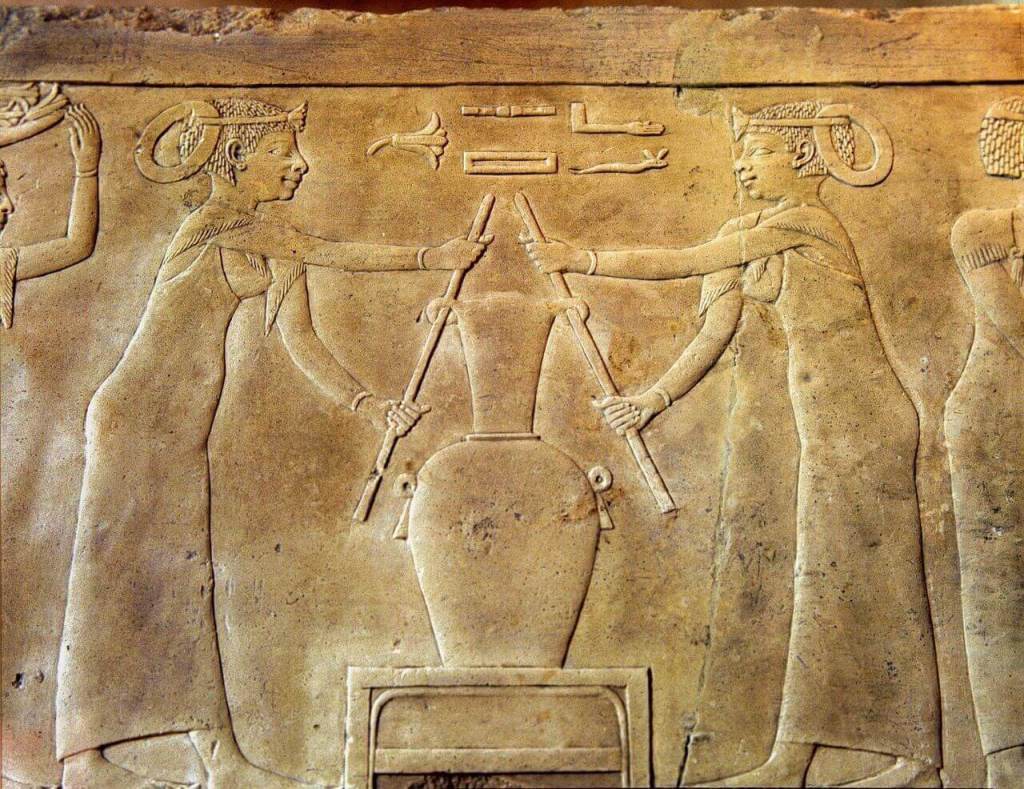
An Egyptian Limestone Relief 'Making of Lily Perfume' - Late Period, 26th-30th Dynasty, 664-332 BC.
Relief depicting women squeezing oil from lily flowers in a press for use in perfume. Fragment from a decoration of a tomb. The Ancient Egyptians loved beautiful fragrances. They associated them with the gods and recognized their positive effect on health and well being. Perfumes were generally applied as oil-based salves, and there are numerous recipes and depictions of the preparation of perfume in temples all over Egypt.
Lily perfumes held significant importance in ancient Egypt and were commonly used by both men and women. The lily flower, particularly the white water lily (Nymphaea lotus), was highly revered and associated with beauty, purity, and rebirth in Egyptian culture. The petals of the lily were often used to create fragrant oils and perfumes.
The ancient Egyptians extracted the essence of the lily flower through various methods, such as maceration or distillation, to produce perfumes. These perfumes were used for personal adornment, religious rituals, and as offerings to the gods. The scent of lily perfumes was believed to have a pleasing and purifying effect on the body and soul.
The most highly prized perfumes of the ancient world came from Egypt. The most popular were Susinum (a perfume based on lily, myrrh, cinnamon), Cyprinum (based upon henna, cardamom, cinnamon, myrrh and southernwood) and Mendesian (myrrh and cassia with assorted gums and resins).
The god of perfume, Nefertem, was also a god of healing who was said to have eased the suffering of the aging sun god Ra with a bouquet of sacred lotus. The most widely known is Kyphi, made with terebinth resin, saffron, raisins, cinnamon, wine, myrrh, honey and other ingredients. The recipes remained secret, because this scent was used to honor the gods.
Perfume has been a cherished luxury product for thousands of years and ancient Egypt was no exception. Perfumes had many uses. Initially, the rarity of perfume made it a product for the gods: aromatic powders were burnt to honor the gods and to curry favor.
While specific ancient Egyptian lily perfume formulas may not be known, the use of lily as a fragrance and its association with beauty and spirituality are well-documented in ancient Egyptian art, texts, and archaeological findings.
(H: 25.8cm; W: 37cm, T: 4cm)
Louvre Museum (E 11162)
#archaeohistories
Manhattan of the Middle Ages.
Between the XII and the XIII century, Bologna was a city full of towers. Their number was high, possibly up to 180.
Fewer than twenty towers can still be seen in today's Bologna. The tallest, Torre degli Asinelli, 97 meters high, still stands and was completed in 1119, close to the smaller but more leaning Torre Garisenda.
Cleopatra's Eye Makeup Warded Off Infections ?
Cleopatra and her kin knew a thing or two about crafting an alluring smoky eye. Thick coats of black and green eye makeup partially made from lead may have boosted the immune systems of ancient Egyptians, a new study suggests.
Now French researchers suggest that the ancient Egyptians' heavily painted eyelids did more than attract admirers—they also protected against eye infections.
Artifacts and documents from ancient Egypt show that everyone, man or woman from servant to queen, wore black and green powders coated thickly around the eyes. "People wore it on a daily basis," said study co-author Christian Amatore, from the Université Pierre et Marie Curie in Paris, France.
According to ancient Egyptian manuscripts, the eye makeup was believed to have a magical role, in which the gods Horus and Ra would protect wearers against several illnesses. Bacterial eye infections such as conjunctivitus, for example, would have been a common problem along the Nile's tropical marshes. But previous chemical analyses of powder residue, taken from ancient makeup containers, had isolated four lead-based compounds. That would seem to suggest that the makeup was harmful, since lead can be highly toxic to humans.
Instead, the new study found that the low doses of lead salts in the makeup may have actually had beneficial properties: When the salts come into contact with skin, they boost the body's production of nitric oxide. This chemical is known to stimulate the immune system and help fight off disease-causing bacteria. Based on the amount of the lead compounds in the ancient makeup, a wearer's nitric oxide levels would have increased by 240 percent, the study found.
"Two of these chemicals do not occur naturally, and would have taken 30 days of hard work to make," Amatore said. "In my opinion, [the ancient Egyptians] were aware that these compounds brought good health, and they were making them on purpose."
- Subscribe for Detailed Post -
#archaeohistories