🤖 A Robot Just Built Part Of An Antenna In Space. And Astronauts Didn't Have To Do The Construction.
For decades, building large structures in orbit has depended on astronauts performing difficult and risky work outside their spacecraft.
But that could begin to change.
Researchers at Caltech have demonstrated ASTRA, a robotic system funded by DARPA that can assemble structures directly in space.
During its demonstration, ASTRA built part of an antenna frame, creating a structure about 1.4 metres wide.
And here's what makes this interesting.
The robot did the physical construction while engineers on Earth sent commands to guide its work. No astronaut had to float outside a spacecraft and manually put the pieces together.
This matters because building in space is very different from building on Earth.
There is no floor to stand on, no ordinary construction equipment and no easy way to handle large objects. Even a simple task can become difficult when everything is floating.
But robots could change that.
Future space telescopes might be too large to fit inside a rocket. Instead of launching them fully assembled, we could send smaller parts into orbit and let robots put them together.
The same idea could help build larger antennas, solar power systems and even future space stations.
ASTRA is still an early step, and humans remain part of the process. But it shows that robots may soon take on some of the hardest construction jobs beyond Earth.
One day, we might look up at a giant telescope in orbit and realise that no astronaut ever built it by hand.
Would you trust a robot to build the next giant space telescope? 🚀
#SpaceTechnology #Robotics #SpaceExploration
🌌 A Spacecraft Launched In 1977 Is Now So Far Away That Even Light Needs 24 Hours To Reach It
Humanity has sent a machine so far into space that a message travelling at 300,000 kilometres per second needs an entire day just to reach it.
And it's still moving away.
NASA's Voyager 1 has reached approximately 25.9 billion kilometres from Earth, putting it at a distance known as one light-day.
Think about what that means.
Light travels around Earth more than seven times in a single second. It reaches the Moon in about 1.3 seconds and takes just over eight minutes to travel from the Sun to our planet.
But Voyager 1 is so distant that even light needs 24 hours to get there.
Launched on September 5, 1977, Voyager 1 began its journey to explore the outer planets. It flew past Jupiter and Saturn, sending back images and scientific data that changed our understanding of these distant worlds.
In 1990, it turned its camera toward home and captured the famous Pale Blue Dot image. Earth appeared as a tiny point of light suspended in an enormous darkness.
In 2012, Voyager 1 became the first human-made spacecraft confirmed to enter interstellar space.
But its journey isn't over.
The spacecraft continues travelling through space, carrying a Golden Record containing sounds, music and greetings from Earth.
There's another remarkable detail. At this distance, radio signals travelling at the speed of light take about 24 hours to reach Voyager 1. A round-trip exchange with Earth takes roughly 48 hours.
A command sent today may not receive a response for two days.
And despite being nearly half a century old, this little spacecraft continues to push the limits of human exploration.
We built it on Earth in 1977.
Now, it's one light-day away from home.
🌍 A tiny machine carrying a piece of humanity into the space between stars.
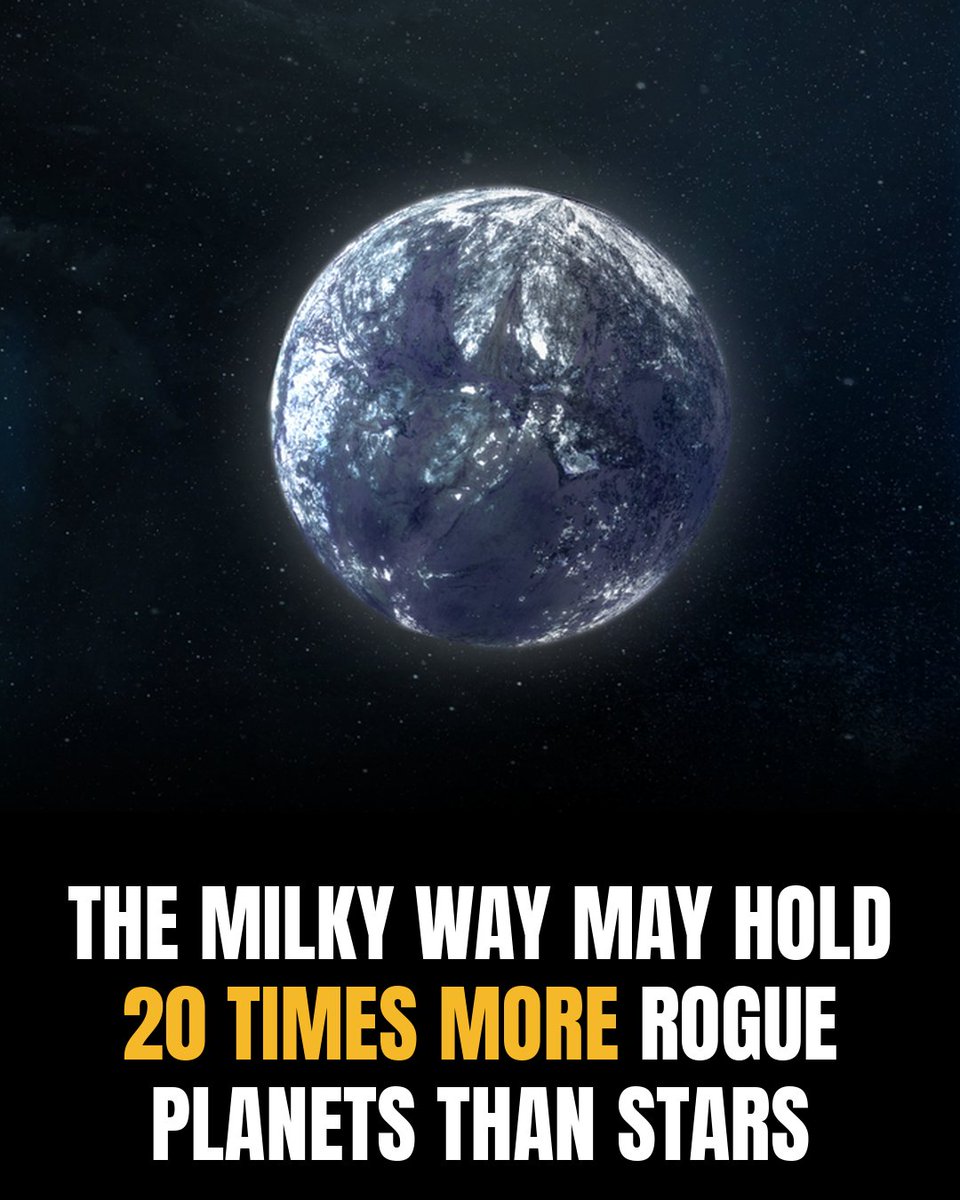
Some planets never see a sunrise.
And there may be trillions of them.
Astronomers call them rogue planets, worlds drifting through space without orbiting any star.
Some may have been thrown out of their home systems by gravitational interactions. The lighter the planet, the easier it is to fling loose.
One NASA-supported estimate suggests our galaxy could hold about 20 times more rogue planets than stars. Other studies suggest fewer, so the true number is still debated.
No star. No sunrise. Just a planet travelling through the dark.
The source image is small and landscape, so I used about 66% of its width, with the planet centered. It was upscaled about 1.65x, so it looks slightly soft at full size.
Two NASA spacecraft left Earth last year, then turned around and came back. And that was the plan all along.
ESCAPADE launched in November 2025, when Earth and Mars sat on opposite sides of the Sun. So the twin probes waited in space.
Once the planets lined up, they looped back and used Earth's gravity plus a long engine burn to slingshot toward Mars. This view of home was taken just 3 hours after the second flyby.
Arrival is set for September 2027, where they will study how Mars lost its atmosphere.
Sometimes the road to Mars starts with a U-turn.
NASA Is Building A Nuclear-Powered Flying Robot To Explore Saturn's Largest Moon
NASA is preparing to send something extraordinary to another world: a nuclear-powered drone about the size of a car, designed to fly across the surface of a distant moon.
Its name is Dragonfly, and its destination is Titan, Saturn's largest moon.
Titan is one of the strangest places in our solar system. Its surface temperature is around minus 290°F (minus 179°C), its atmosphere is thicker than Earth's, and instead of water, its rivers and lakes contain liquid methane and ethane.
Recently, technicians installed and tested all seven of Dragonfly's science cameras. These cameras will serve as the spacecraft's eyes, allowing it to photograph the landscape, examine surface materials and study places that could contain clues about the chemistry needed for life.
Each camera looks through a specially designed window in an insulated foam shell. This protection is important because Titan's extreme cold could damage sensitive equipment.
Dragonfly will also carry a radioisotope power system, which uses heat from radioactive decay to generate electricity. Unlike solar-powered spacecraft, it won't need sunlight to keep working in a place where sunlight is extremely weak.
One of its most interesting tasks will be studying organic molecules across Titan's surface. These carbon-rich materials are important because they help scientists understand the chemical processes that may have played a role in the origins of life.
The mission is currently planned to launch in July 2028, with arrival at Titan expected in late 2034.
Think about that for a moment. A flying laboratory, powered by nuclear energy, will travel billions of miles to explore an alien world where lakes fill with liquid methane and the sky is orange.
Humanity is preparing to send its first flying robot to explore the surface of another moon.
🌍 What If You Fired a Cannonball So Fast That It Never Hit the Ground?
Imagine firing a cannonball from a mountain. At first, it travels a short distance before gravity pulls it back to Earth. Fire it faster, and it lands farther away.
But Isaac Newton imagined something extraordinary: what if the cannonball travelled so fast that, while falling toward Earth, the planet’s curved surface kept dropping away beneath it?
At the right speed, the cannonball would keep falling without ever reaching the ground.
This is the idea behind Newton’s cannonball thought experiment, a powerful way to understand how orbit works.
Near Earth’s surface, an object travelling horizontally at roughly 7.9 kilometres per second can enter a low circular orbit, assuming air resistance and terrain are not in the way. It is still falling because gravity continuously pulls it toward Earth. But its sideways speed carries it forward fast enough to keep missing the surface.
Go faster, and the orbit can become elliptical rather than circular.
Increase the speed to about 11.2 kilometres per second, and an object can escape Earth’s gravity without needing further propulsion, provided it receives no additional energy or significant external influence. This is Earth’s approximate escape velocity from the surface.
The astonishing part is that orbit and escape aren’t different kinds of motion. They are different outcomes of the same force: gravity.
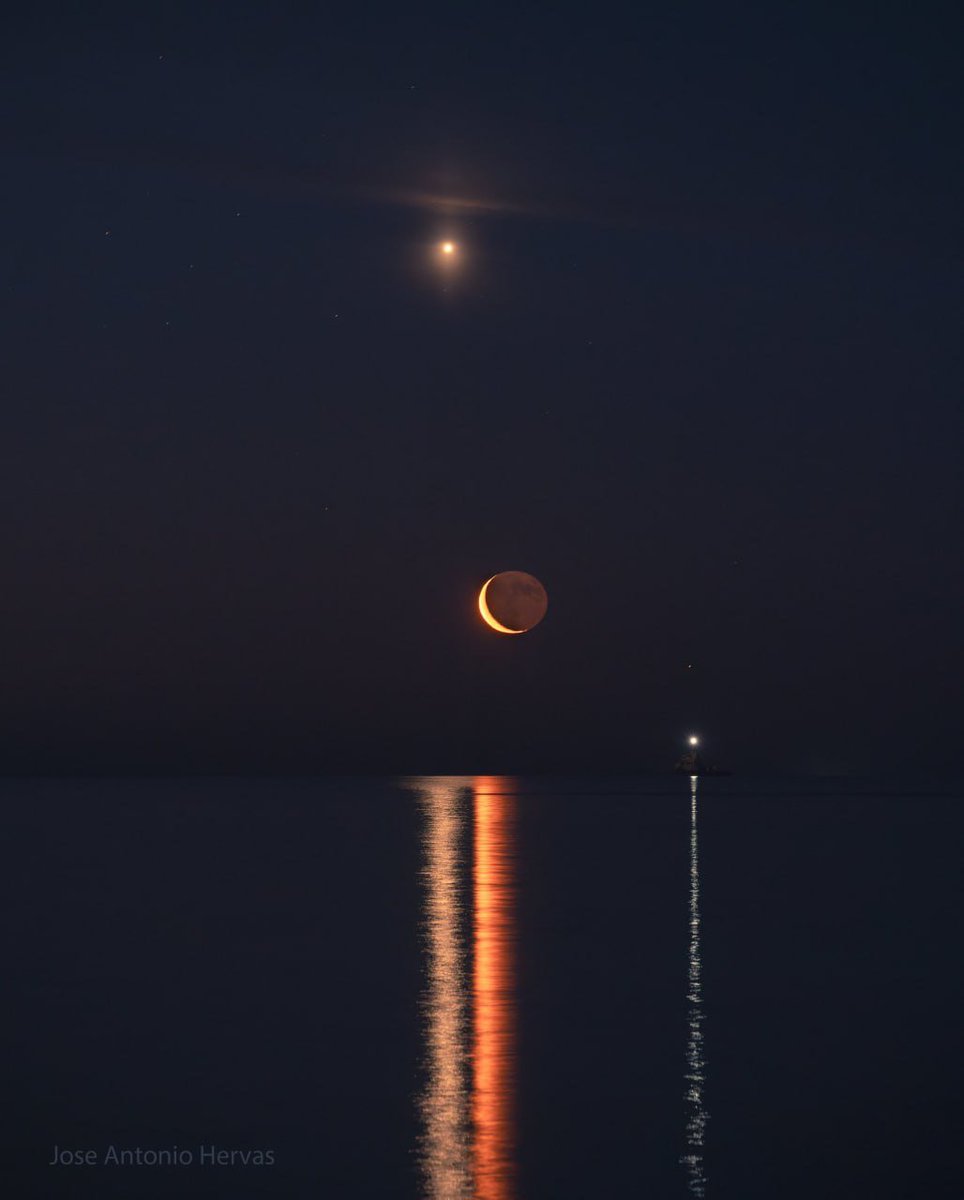
The Moon follows the same basic principle. It is continually falling toward Earth, but its sideways motion keeps it in orbit.
So the next time you look at the Moon, remember: it’s falling, too. 🌙
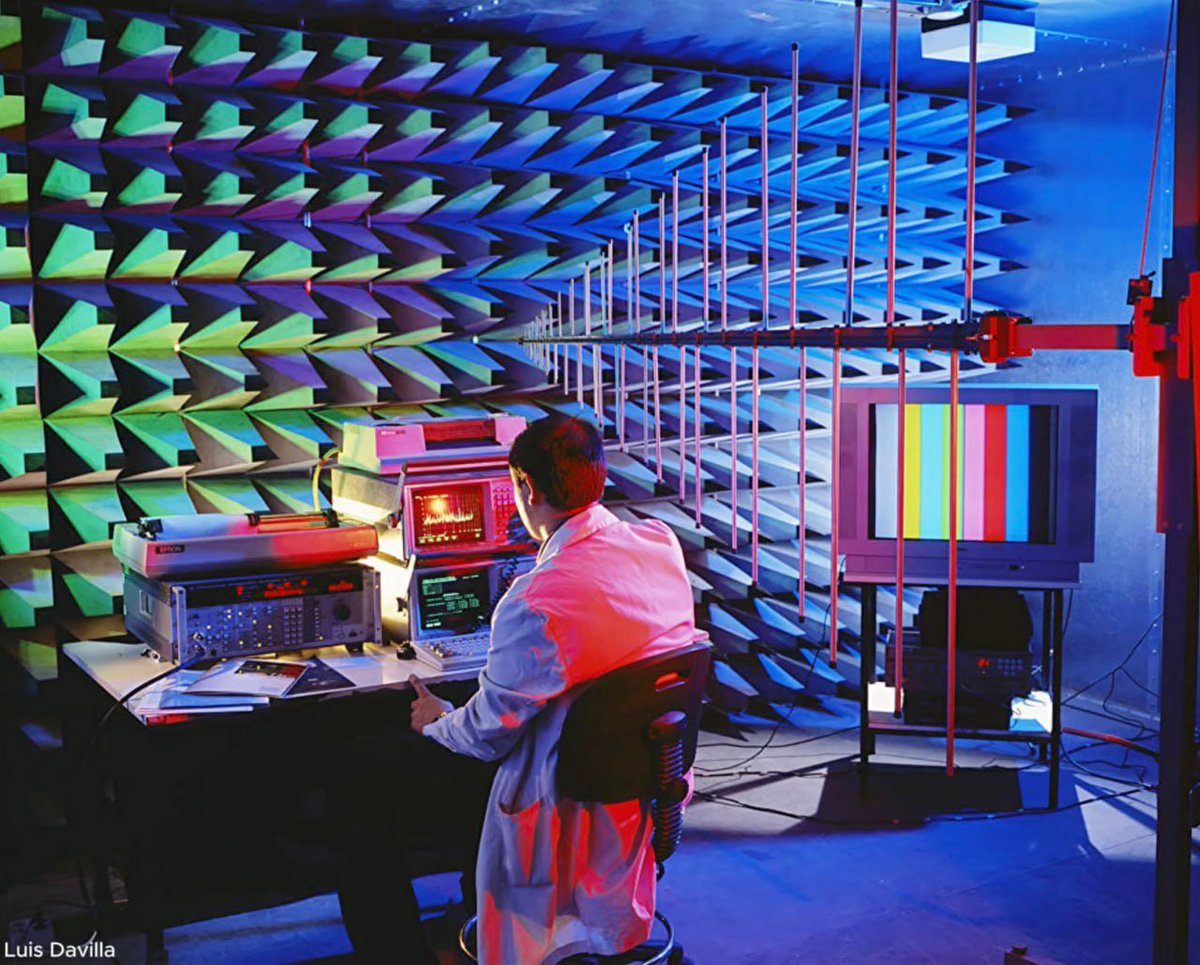
What is a Faraday cage? ⚡️🛡
A Faraday cage is a device that protects equipment from strong electromagnetic interference. It works by distributing electric charges or radiation around the exterior, preventing them from reaching the inside. 🧲🔒
In the photo, you can see it being used to isolate a television antenna, shielding it from external electromagnetic signals. 📡📺
Something went wrong during a routine test of a humanoid robot.
It was being remote-controlled with motion tracking, mirroring its operator's movements in real time.
Then the robot did something it wasn't supposed to.
Watch till the end 👀
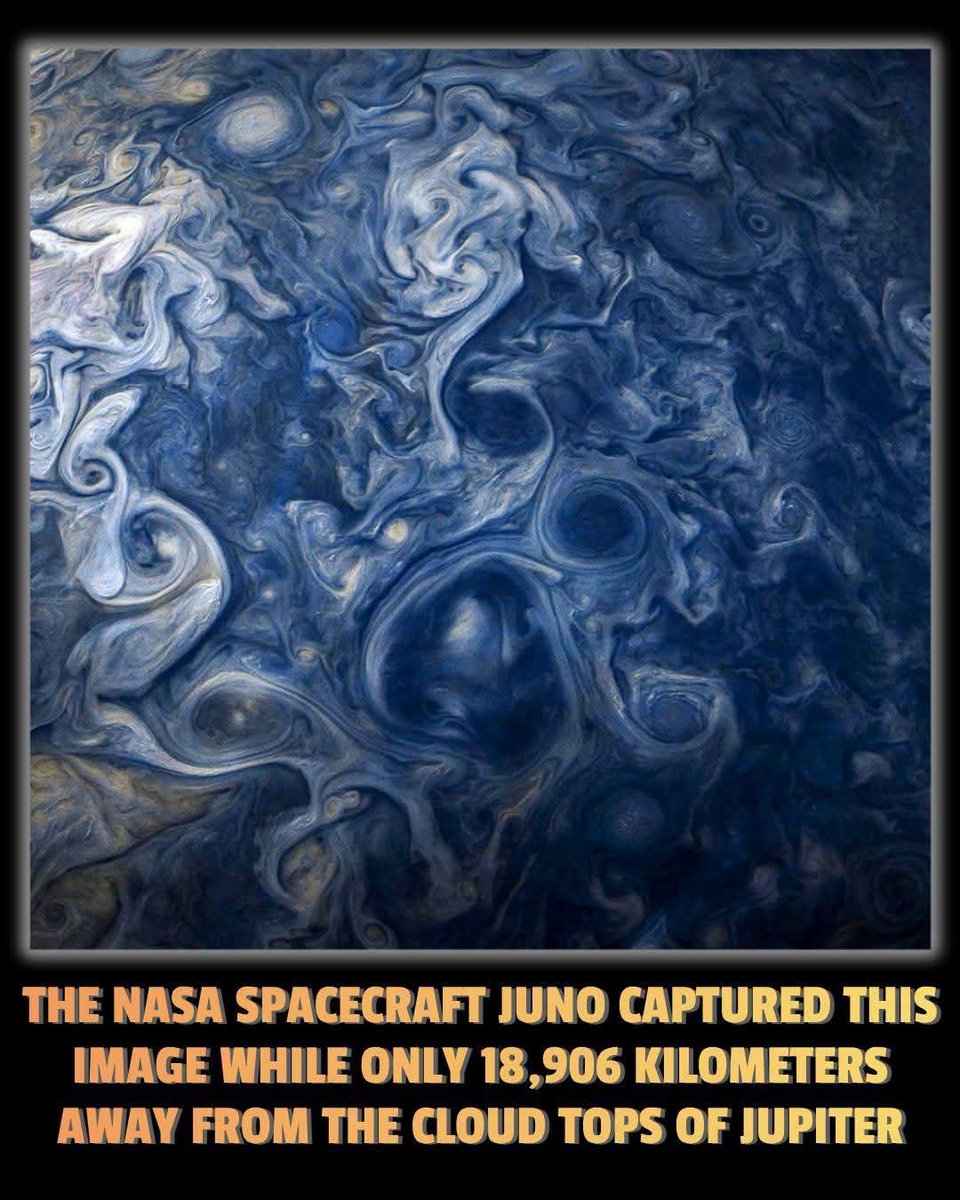
🌀 Jupiter's Clouds Look Like Swirling Paint, But This Is A Real Photograph
At first glance, this looks like an abstract painting, deep blues bleeding into pale swirls, curling and folding into one another like ink dropped into water. But this is not art, it is an actual photograph of Jupiter's atmosphere, captured by NASA's Juno spacecraft from just 18,906 kilometers above the planet's cloud tops, close enough to reveal detail no telescope from Earth could ever capture.
What looks like brushstrokes are massive storm systems and turbulent cloud bands, some stretching for thousands of kilometers, twisting around each other in patterns shaped by Jupiter's extreme wind speeds and constant atmospheric turbulence. The pale, almost white regions are ammonia ice clouds rising from deeper within the atmosphere, while the darker blue tones reveal areas where those clouds thin out, letting slightly deeper, warmer layers show through.
Jupiter's atmosphere is in a constant state of violent motion, driven by wind speeds that can exceed 600 kilometers per hour in certain jet streams circling the planet. Unlike Earth's weather, which is shaped largely by oceans, landmasses, and a relatively thin atmosphere, Jupiter has no solid surface at all. Its storms churn endlessly within a massive gaseous envelope, swirling and colliding on a scale that dwarfs anything experienced on Earth.
Juno was specifically designed to capture imagery like this, orbiting Jupiter in tight, elliptical passes that bring it remarkably close to the planet's cloud layer during each flyby. These close approaches allow cameras to reveal intricate atmospheric detail that would otherwise remain completely invisible from farther away, turning raw scientific data into images that look more like fine art than planetary science.
It is easy to forget this is a real place, an actual, physical storm system captured in a single frame rather than something imagined or painted. Jupiter's chaos, frozen for a moment in stunning, swirling detail.
Some of the most beautiful art in the universe was never painted, it was photographed 🌀
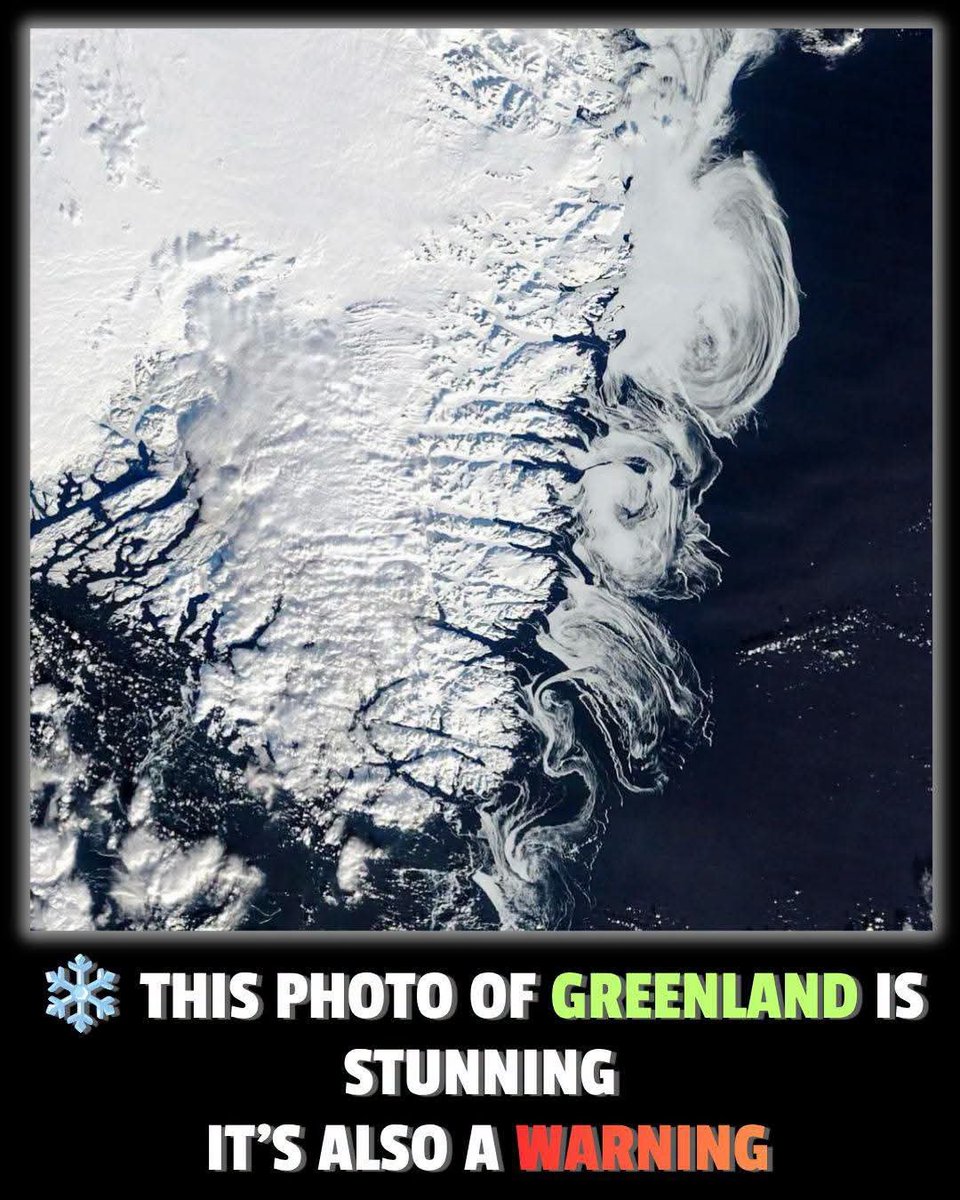
❄️ Greenland's Ice Sheet Looks Otherworldly From Space — And It's Disappearing Fast
From orbit, Greenland looks like a planet wrapped in white silk. This satellite view captures one of the largest ice sheets on Earth, a frozen mass so vast it holds roughly 10% of the world's fresh water. If it ever melted completely, global sea levels would rise by about 7 meters.
What makes this image striking isn't just the scale, it's the texture. Those subtle blue-grey streaks aren't shadows, they're meltwater channels carving their way across the surface, a sign of just how much the ice sheet shifts even in its "frozen" state. Satellites like this one let scientists track that movement in real time, watching Greenland lose an average of over 270 billion tons of ice every year.
Seen from hundreds of kilometers up, it's easy to forget this quiet white expanse is one of the most closely watched indicators of our planet's changing climate. Beauty and warning, wrapped in the same photograph.
One planet, endlessly changing. 🌍❄️
🏔️ A cliff on Mars just collapsed, and a spacecraft happened to catch the dust cloud mid-fall
This image, captured by NASA's Mars Reconnaissance Orbiter, shows an active landslide cascading down a cliff roughly 500 meters high near Mars' north pole, with a visible plume of reddish dust still hanging in the thin Martian atmosphere from the collapse. Catching a moment like this is rare, most geological activity on Mars happens so gradually that spacecraft rarely photograph an event actually in progress.
Mars' north polar region is layered with alternating bands of ice and dust, built up over countless seasonal cycles, and cliffs like this one form as those layered deposits gradually erode and destabilize over time. When enough material finally gives way, it collapses suddenly, sending debris and fine dust particles cascading down the slope and briefly lifting into the atmosphere, exactly what's frozen in this photograph.
Because Mars' atmosphere is roughly 100 times thinner than Earth's, dust clouds like this one behave differently than similar landslides would on our planet, settling more slowly and spreading further before finally resettling onto the surface. Studying active landslides like this one gives scientists valuable insight into how Mars' polar ice caps are shaped and reshaped, layer by layer, over long stretches of time.
Events like this remind us that despite looking like a frozen, unchanging world, Mars' surface is still quietly reshaping itself, sometimes suddenly and violently enough for an orbiting spacecraft to capture it happening in real time 🏔️