@ThomasDHowes At it's height Occupy organized hundreds of thousands to demonstrate all over America.
Are you thinking more like a million or more like millions?
For what it’s worth (and, it’s worth a great deal to me), I wrote TOLKIEN AND THE INKLINGS very much under the patronage of St. Cecilia. Happy feast day!
https://t.co/4IKPY4uHFH
With the Freeman, I am starting a series of five essays (published over 2026-27) regarding myths about inequality and growth. The first one is below https://t.co/pCTZ3PM67C
Still waiting for Cass's economic model showing how tariffs increase growth.
He harshly criticizes models that show they reduce growth, but doesn't offer an alternative.
Other chief economists can produce such research.
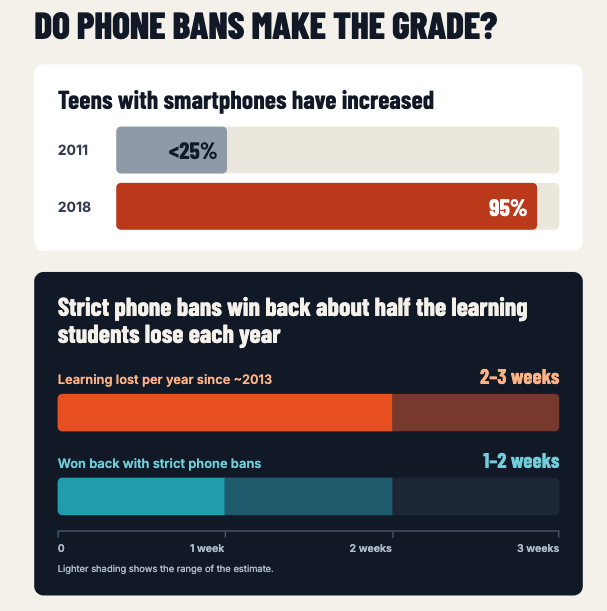
Do phone bans actually help with learning? Since 2013, U.S. students have been losing about 2–3 weeks of learning every year, when smartphones went from a minority of teens to nearly all of them.
Yesterday, a new Harvard-led study tracking 3.3 million students across 4,600 schools found that strict, bell-to-bell phone bans (phones locked in pouches all day) win back about 1–2 weeks of learning a year.
Some important takeaways from the study:
- The gains may seem small but they didn't fade, holding up to three years after a ban started.
- The strictness of the band matters, the bans in the study were all-day lockups, not "phones away during class."
- This intervention is pretty cheap, about $25 per student, far less than paying for extra weeks of instruction.
This lines up with Jonathan Haidt's Tech & Society Lab at NYU, which reviewed 7 natural experiments across 6 countries. Every study that tracked phone use found it fell. Of those that measured test scores, 3 found gains and 3 found no overall effect.
To be fair, the evidence isn't yet settled, an April NBER study found "close to zero" effects on scores, though it did find well-being improved over time. The new Harvard study has yet to be peer-reviewed.
My take: phone-free schools aren't a silver bullet, but a policy that's this cheap and that students can't work around, and that may recover half of a decade-long slide, deserves a serious look.
What's your school or district doing on this policy?
https://t.co/zUchjnVZ1t
#Education #EdTech #PhoneFreeSchools #K12 #TheAnxiousGeneration #StudentWellbeing
New @ActonInstitute podcast!
Thrilled to share this conversation with my mentor and friend @bradleybirzer on his great new book *Tolkien and the Inklings: Men of the West* coming soon from @EncounterBooks .
An excellent Christmas gift!
https://t.co/pzrpGfIYFo
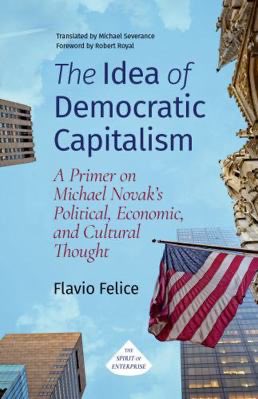
More on this in my review at @CivitasOutlook of Flavio Felice's new book from @CatholicUniv Press, The Idea of Democratic Capitalism.
https://t.co/4IHPgblhYF
Orson Welles: Houdin was *the* greatest magician who ever lived. Do you know what he said? "A magician," he said, "is just an actor."
The Girl: Well, good luck to you,
Orson Welles: "Just an actor playing the part of a magician."
- F is for Fake
There are several individuals far more qualified than Wesley Huff has purported to be, with followings both large and small, who routinely cite the sources from which they are drawing when presenting their arguments and analysis. This serves not only to establish the parameters of their research, and signal its quality, but also benefits their audience by making them aware of books and scholarly articles by other authors in the respective fields.
This segment in particular, from @paulogia0’s latest YouTube video, is especially damning in illustrating Huff’s unscrupulous and plagiaristic utilisation of the material of others.
His mannerisms and ad libs here, are plainly an intentional ruse to leave his audience with the impression that the thoughts he’s articulating are the products of his own scholarship. In reality, he’s simply reading massive swathes of text from a book by Brent Nongbri.
Of course college admissions essays will be replaced by AI.
They were slop the whole time, and AI can make slop much better than people can.
Clear improvement in efficiency here with no loss in truth value.
Of the now-41 equity stake deals inked by the Trump administration (so far), 27 were spearheaded by Lutnick's Commerce Department - the most of any US agency by a wide margin. https://t.co/QWipRZDFZI