63.
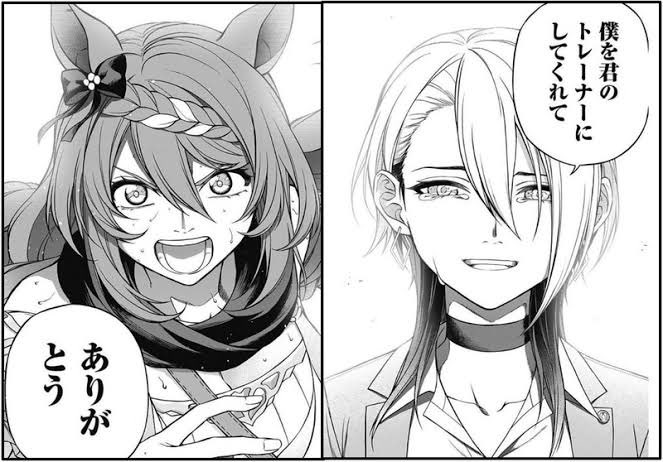
"If that horse has never met that man..."
- Take Yutaka & Super Creek -
1.
(For just story, to 3)
While Umamusume rightfully omits jockeys — after all, the girls race on their own. It’s worth taking a closer look at the real-life riders behind the sport. Different regions have very different pathways to becoming a licensed jockey, and those differences shape not only how jockeys are trained, but also how deeply they interact with horses from day to day.
In countries like Britain, the U.S., or Australia, racing stables are scattered across individual tracks or private facilities, so apprenticeship remains a key part of the system. They start young at the stable. Many jockeys begin their careers as grooms or hot walkers, eventually graduating to exercise riders, and only the most promising among them are given the chance to race professionally. There are now dedicated riding schools in these regions, but hands-on stable work and long-term mentorship still play a huge role in a rider’s development.
In contrast, places like Hong Kong or Japan operate with highly centralized systems. Most horses are stabled and trained at large-scale facilities like Sha-tin(now also Conghua) or Miho/Ritto, and ordinary horse lovers don’t often get close to Thoroughbreds(or any horses, really) in daily life. As a result, becoming a jockey requires attending a dedicated jockey school, usually from the early teenage years. These programs offer rigorous training, but because of the system’s structure, students may not accumulate as much real-world horse experience as their Western counterparts. In my opinion, the gap in early exposure may contribute to why, on average, local riders often find it harder to match the top-tier international jockeys, especially in big races abroad.
While the systems may differ, jockeys around the world face the same harsh realities — and the job is far from simply “sitting” on a horse as some common belief.
2.
The first challenge is weight. Take Japan as an example, race conditions can require jockeys to weigh in at as little as 48 kilograms (106 pounds), including their gear. That’s why most jockeys are notably small in stature — but that doesn’t mean they’re frail. On the contrary, jockeys are among the most incredible athletes in any sport. Maintaining that low weight while developing the core strength, balance, and coordination to control a 500-kilogram Thoroughbred at high speed demands constant physical conditioning.
Despite the light frame, jockeys don’t “sit” on a horse in a traditional sense. Using ultralight saddles built for aerodynamic efficiency, they ride in a crouched squat, hovering above the horse’s back in what’s essentially a high-speed, high-stakes isometric hold. This position minimizes drag but requires extreme lower-body and core strength and precise balance to stay secure while the horse moves beneath them at over 60 km/h (37 mph).
And then there’s the risk. Accidents happen. A jockey who falls risks not just hitting the ground hard, but risks being trampled by a herd of 500kg racehorses thundering right behind them. Every race demands not only physical readiness, but immense mental steel.
Beyond the physical and mental demands, jockeys also act as tacticians. A good jockey reads pace, position, and rival moves in real-time, sometimes adjusting their strategy within split seconds.
They must find the right moment to advance, avoid traffic, rate their horse's energy, and push for the finish without burning out too soon.
That’s why riders like Take Yutaka, who, well into his 50s, has dominated for decades, yet continues to compete at the highest level, are regarded as legends (he probably kept being disciplined all those years).
But every legend still has an origin.
Given the very nature of the job, jockeys must learn to understand and communicate with their 4-legged partners. It’s not just about riding technique; it’s about intuition, mutual trust, and reading each other’s rhythm. Naturally, some bonds grow deeper than others.
Good jockeys often have the privilege of choosing between several mounts. But this case was different.
They call it a reverse pick — when, in a way, it’s the horse, Super Creek, who chooses the rider. And this one felt like destiny from the start.
3.
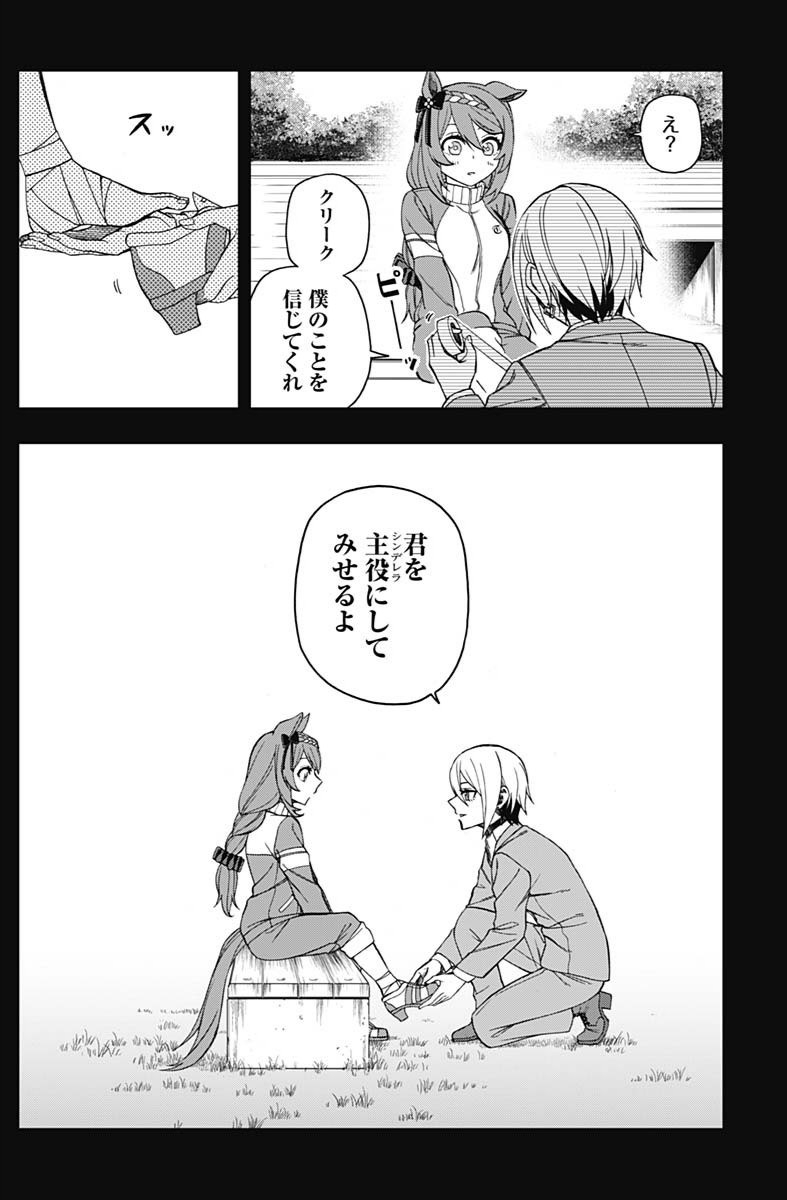
Take Yutaka is known today as a living legend, but back in 1988, he was just a teenage rookie, tall for a jockey at 170 cm. Because of his height, he had to develop a unique riding style, balancing and control in a way few others had to consider. That’s why it’s a bit amusing that Umamusume chose to portray him as the tiny prodigy girl Nase Fumino, Super Creek’s trainer in Cinderella Gray.
In many ways, though, Fumino’s quiet determination mirrors the real-life Take.
At the time, Take had only debuted a year prior. Though he’d already shattered the rookie win record, pressure still loomed — not least because he was the son of Take Kunihiko, the legendary “Magician” of the saddle (later turned to trainer). Carrying the weight of expectations, being hailed as a prodigy, and still chasing that first G1 win, Take was under intense scrutiny.
On the other hand, Super Creek’s journey to this pivotal moment was anything but smooth. Though he was bred to be a stayer, he was born with severely crooked legs — so severe, in fact, that he was overlooked at the sales. Trainer Ito was heartbroken over the colt’s prospects and turned to Kikura Makoto, an old friend of the breeding farm owner. That autumn, Kikura purchased the horse and named him Super Creek, with the hope that “even if he's just a small stream now, one day he’ll grow into a mighty river.”「今は小川 (Creek) でも、いつか大河になって欲しい」
Creek’s early career was a rough start. He missed his debut at Hakodate due to severe diarrhea and only finished second in his actual debut. Despite that jockey who rode him in his second start and saw him win, believed he had great potential. True to his breeding, Creek was entered exclusively in races over 2000 meters from the beginning, aiming toward Japan’s classic staying races.
In early 1988, Take rode Creek for the first time in the Sumire Stakes, taking the win. The team set sights on the Derby — but while prepping for the Aoba Sho, Creek fractured his left foreleg and was ruled out for months. (Uma Musume even pays homage to this injury with a lingering 16-turn debuff after the Sumire Sho in the game.)
After a long layoff, Creek returned in the Kobe Shimbun Hai, placing third. But disaster struck in his next race, the Kyoto Shimbun Hai. Creek was hit in the face by another jockey’s whip multiple times and finished a disappointing sixth. (The always cool Take even got so mad)
That result cost him a guaranteed spot in the Kikuka Sho (Japanese St. Leger).
Out of the 36 horses aiming for the race, only 18 would be allowed in — and Creek’s earnings placed him 19th.
Meanwhile, Take had five potential Kikuka Sho mounts and couldn’t decide. So he went to see each one in the stable, hoping to find a sign.
4.
As if sensing everything that was at stake, Super Creek reportedly tugged at Take’s sleeve repeatedly when the young jockey came to inspect the stables. Out of the mounts he was considering, something about Creek just felt different. Take later said it was like standing at a fork in fate — and declared, “If Super Creek can’t race, I won’t ride in the Kikuka Sho at all.”
That story became known as Creek’s “reverse nomination.” It touched many, including influential owner Shigeyuki Okada (head of Thoroughbred Club Ruffian Ltd, yes, inspired by the legendary US filly Ruffian) , who believed, “A horse with real talent deserves to run.” Okada voluntarily withdrew his own contender, Meiner Flisse, from the race, clearing the way for Creek to make the final cut.
The rest, became history.
Take would later reflect on his bond with Super Creek many times throughout his career. “He was the first horse I truly fell for — the one who met my expectations and gave everything back. I never wanted to hand him to anyone else,” he once said.
Looking back, he added, “Meeting Super Creek was a turning point for me. Without him, I wouldn’t have ridden in so many G1s. He was strong, truly strong. In a way, he was my origin — the horse who helped me get to the top level.”
It’s no surprise that Umamusume chose to portray Super Creek with a maternal, nurturing personality. The character profile that says she “feels more joy in helping others grow than in growing herself” (自分が成長するより、相手を一人前にすることに喜びを感じるタイプ) fits almost poetically.
Because in real life, Creek was that kind of presence — not just powerful, but generous, anchoring the young Take with a kind of silent support.
------
本当の出会いなど、一生に何度あるだろう?
“How many true encounters do we really have in a lifetime?”
PS: In fact, his emotional bond with Super Creek ran so deep that it even influenced how he felt about other top horses of the time — including Oguri Cap. While today, the image of Take Yutaka guiding Oguri to his fairytale Arima Kinen victory is iconic, the truth is that their relationship didn’t start off so warm.
At the time, both Super Creek and Oguri had passionate followings and just as many detractors. After defeating Oguri Cap in the 1989 Tenno Sho (Autumn), Take revealed that “a mountain of hate mail (about Super Creek) came in.”
The backlash was intense, and it left a bitter aftertaste that made it difficult for him to feel warmly toward Oguri at first.
(Dropping a bit more in the thread)
How Seeking The Pearl met the Uenaka family is something I never get tired of writing about.
She was born in Virginia and later walked the Keeneland July Sale ring, but went unsold. After learning this, Masako Uenaka went to inspect the filly herself.
When she arrived, the young Page Proof's 1994 was looking out from the stall window. Masako later recalled that, unlike most young horses, she seemed calm, intelligent, almost as if she was thinking about something.
She felt it was a fateful encounter, and decided to buy her. ($185,000 back in 1995)
The name came partly from her sire, Seeking the Gold, but also from Masako’s birthstone: pearl.
Daughter Tomoko named her with the feeling that the horse had “found” her mother.
(the video caption says “Akiko Uenaka,” unsure if it was a spelling error or simply another one from the family, plz let me know if anybody has a clue..🤔)
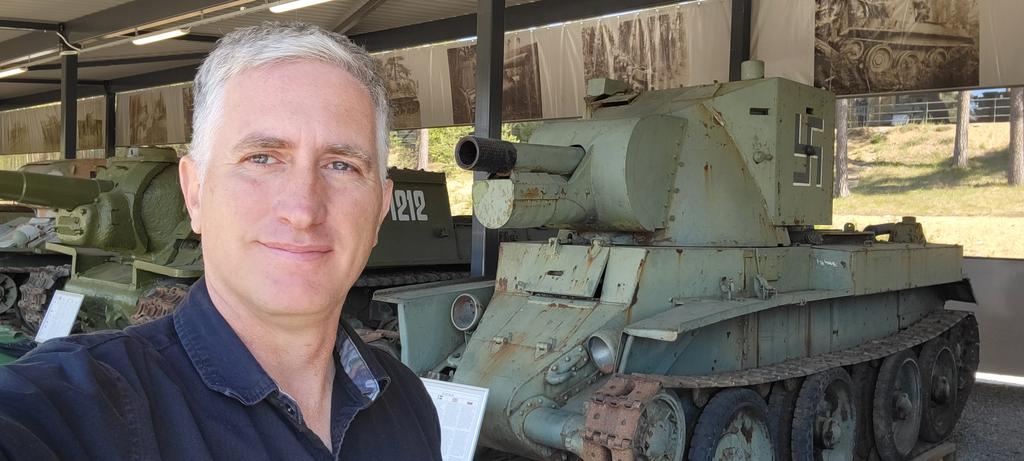
I am at the spiritual home of Girls und Panzer. @panssarimuseo , the Finnish armor collection at Parola. The BT42 has sortof turned into the collection's TOG equivalent. Previously unloved, but now a real star.
Kalo lo seneng mobil & hobi nyetir sbg aktivitas, bukan cm terpaksa buat alat pindah posisi, lo harusnya dukung aktivis urban pro public transit bukan dinyinyirin.
Bnyk org bawa mobil krn terpaksa, makin bnyk mereka ganti pake public transpo, makin lega jalanan buat elo.
LRT a kmoo saying out of all my con concerts that they've been, the one in indonesia was the best because of the crowd's manners and loud cheers for mamamoo
👏👏👏👏