The question everyone is asking about AI: will the spend pay off?
For most of the stack, that is still a bet on a few years out. For the location layer, it pays now, in numbers the business already tracks. No model to train first.
A foundation layer should pay its own way while everything above it matures.
https://t.co/pvUu1m2q0o
The strongest signal is the wrong one.
Indoors, most location systems trust the loudest signal, but that's usually a reflection, not the direct path. A device 5 ft away can read as 45.
We read timing and phase instead. New piece: https://t.co/ouKYMaKr5r
Cameras answer "what is this?" Positioning answers "where is everything?"
What changes for Physical AI and robots when shared location lives in the network- The power of Environmental Memory
https://t.co/nkITQ9fRs5
On the How I Invest podcast with David Weisburd.
What Physical AI actually requires, why the data layer for it does not exist at scale yet, and what nine years of stealth went into solving.
📷 Apple Podcasts: https://t.co/JmtE7kZrVl
📷 Spotify: https://t.co/OqvZqxZ9Q0
Youtube: https://t.co/GKz0N5LruG
Continuing the series. Every 5G device transmits SRS hundreds of times per second as a structural feature of how the network works. The network already receives it.
Listen to it at sub-nanosecond precision, and the network becomes a sensing platform - on infrastructure carriers have already deployed.
https://t.co/UDJbktDm67
First in a short series. Spend time with teams scaling robot fleets and the same issue surfaces. Cameras tell a robot what it can see. They do not tell the fleet where everything else is. Physical AI needs a nervous system, not better eyes.
https://t.co/KPhsdh7Scq
News today: ZaiNar is opening a Tokyo office, and we were selected for the Tokyo Metropolitan Government's GX Program out of applicants from 22 countries.
Tokyo's density breaks GPS. Its 5G deployment is one of the densest on earth. It is the city where this technology matters most.
https://t.co/Es37JcaiOr
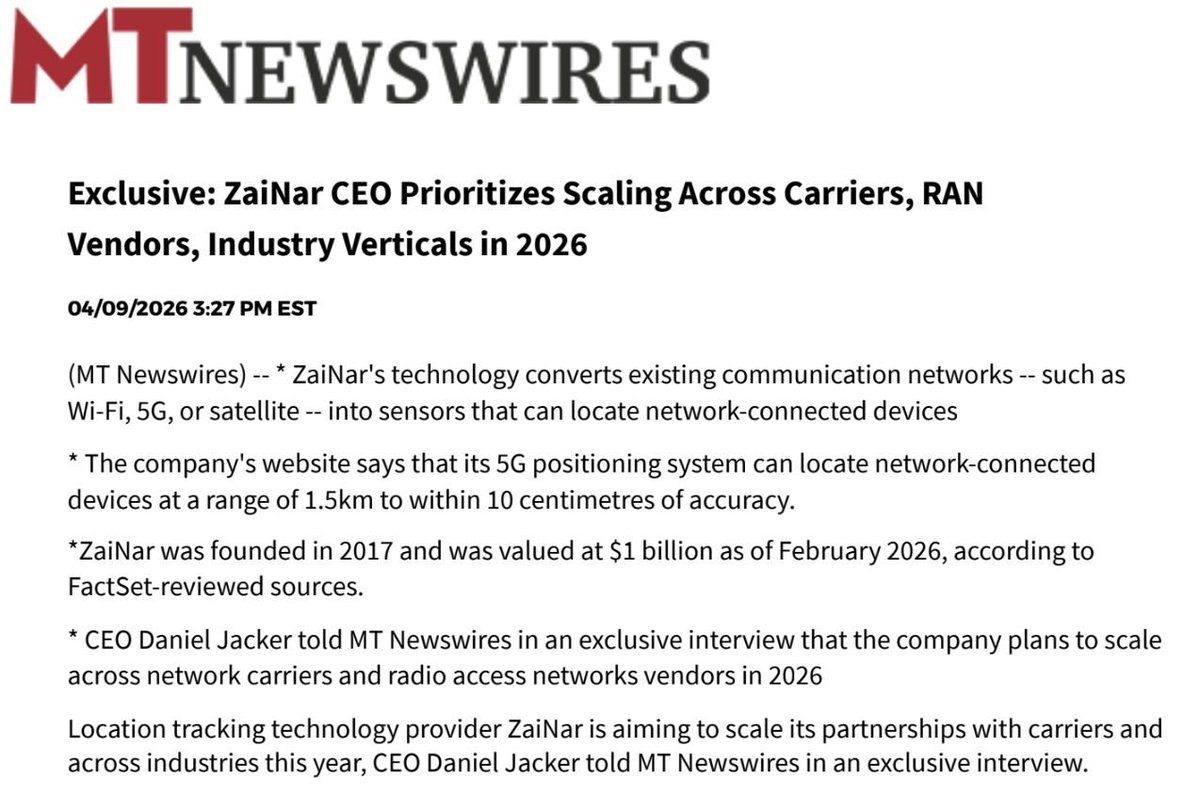
Spoke with MT Newswires about ZaiNar's 2026 agenda.
The focus: carriers globally, RAN vendors globally, and scaling across verticals where Physical AI is already deployed.
$500M+ in contracts and MOUs. The infrastructure layer is real.
Every industrial company will soon become a robotics company.
Jensen Huang said it last week. And he’s right.
But robots still don’t know where they are.
So how does this actually happen?
LLMs worked because they had data from the internet.
Physical AI had nothing close...
...until ZaiNar built it.
👉 https://t.co/PZiKI3211p
I just wrapped MWC and The Montgomery Summit now. Eighty meetings across MWC and The Montgomery Summit. Two very different rooms. The same question in every one: when does 5G start paying for itself?
What I'm hearing - and why 'GPS alternative' is the wrong frame for what ZaiNar actually is.
https://t.co/zjPL5eOCk4
Today: ZaiNar announces the first 5G positioning system delivering sub-10cm accuracy using only existing connectivity signals. Zero battery drain. Carriers can now offer precise location across their networks - a new utility for 5G and a foundation for Physical AI.
Much more at MWC.
https://t.co/WKGUfTKH1p
We spent nine years solving one problem: measuring time at the sub-nanosecond level across existing wireless networks.
Everything else - the sub-meter accuracy, the zero new hardware, the Physical AI applications - follows from that.
Time is the insight. Location is the consequence.
https://t.co/CaIE10lDEi
9 years of stealth. 100+ patents filed, zero rejected. $100M+ invested, $1B+ valuation. Today @ZaiNar emerges as the foundation layer for Physical AI. We solved sub-nanosecond time sync on existing wireless networks. Deployed today. Much more coming. https://t.co/m9wFreQHdB