People overestimate their cognitive performance after using an LLM to solve reasoning problems. Now out in Computers In Human Behavior https://t.co/VuRcdRqlqi
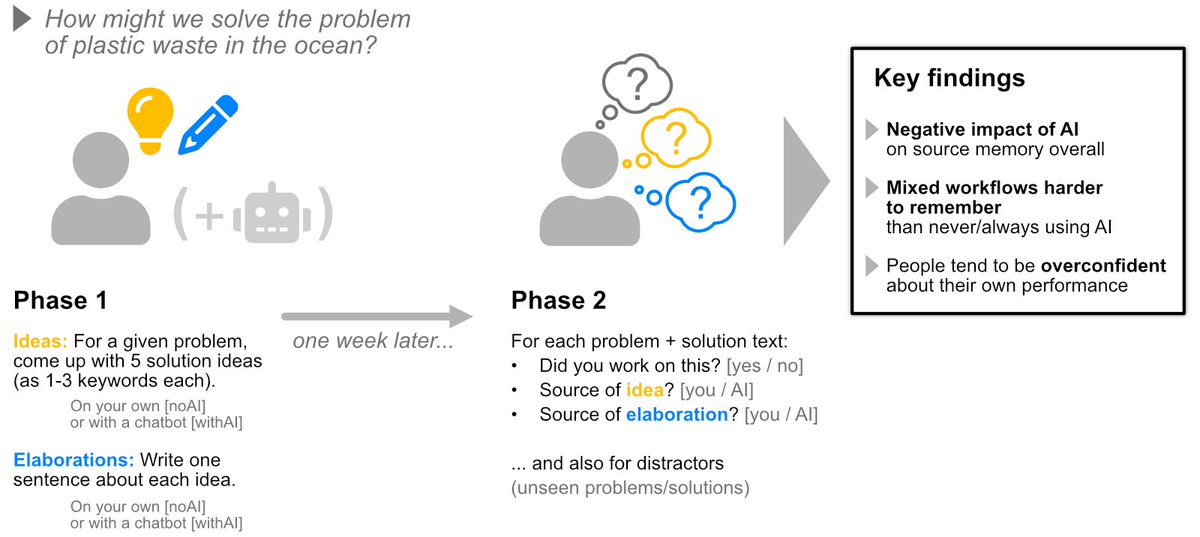
Can you remember which ideas & sentences were your own and which were generated with AI?
In a controlled study (n=184), we found that AI use significantly reduces the accuracy of content attribution after one week.
#CHI2026 preprint & numbers in 🧵
@welsch_robin@danielaDSF17
Work by: @RayKhazoum, Daniela Fernandes, Aleksandr Krylov, Qin Li, and @StphTphsn1.
Paper: “A Deep Learning Model of Mental Rotation Informed by Interactive VR Experiments” (https://t.co/72WjrQpU5d)
Thanks for reading this thread!
A striking example of spatial reasoning is humans’ ability to recognize objects across viewpoints—a skill known as mental rotation.
How does the brain achieve this ability? To answer this, we propose a mechanistic model of human mental rotation.
Paper: https://t.co/FOIp28bh3L
People overestimate their cognitive performance after using an LLM to solve reasoning problems. Now out in Computers In Human Behavior https://t.co/VuRcdRqlqi
“AI makes you smarter but none the wiser: The disconnect between performance and metacognition” by Robin Welsch et al. Computers in Human Behavior
https://t.co/0tcMzEtMTG
AI Boosts Brainpower, But Not Self-Awareness: New Study Reveals Metacognition Gap
A recent study warns that while AI can make us perform better on complex tasks, it often leaves us overconfident and unaware of our true abilities.
Titled “AI makes you smarter but none the wiser: The disconnect between performance and metacognition,” the research explores how interacting with large language models (LLMs) affects our self-assessment in logical reasoning.
Published in Computers in Human Behavior, the paper draws from two large-scale experiments involving over 700 participants.
Researchers had subjects tackle logical reasoning problems from the Law School Admission Test (LSAT)—a notoriously challenging exam—while using AI assistance. The results? AI users scored about three points higher than a baseline group without AI, confirming that these tools can indeed augment cognitive performance.
However, the boost came with a catch: participants consistently overestimated their scores by around four points. This “overestimation bias” suggests a breakdown in metacognition—the ability to accurately monitor and evaluate one’s own thinking. Interestingly, the study found that higher AI literacy (knowledge about how AI works) correlated with even lower self-assessment accuracy. Those more tech-savvy were more confident but less precise in judging their results.
One standout finding challenges the classic Dunning-Kruger Effect, where low performers overestimate their skills and high performers underestimate them. In AI-assisted scenarios, this bias vanished entirely. The authors hypothesize that AI “levels the playing field,” augmenting weaker performers more noticeably while making everyone feel equally competent—regardless of actual outcomes.
The implications are significant for human-AI collaboration.
Overreliance on AI without accurate self-monitoring could lead to poor decisions in real-world applications, from education to professional settings. The researchers recommend designing AI interfaces that promote better metacognition, such as built-in feedback mechanisms or prompts for self-reflection, to prevent “illusions of knowledge.”
This work builds on prior research showing AI’s double-edged sword: it enhances productivity but can foster overtrust.
Paper: https://t.co/jNGKG76keW